Home » Consumer News » Recent Articles:

Time Warner Cable Moves Channels Out of the Way to Add More Channels, DOCSIS 3 by Year’s End

Phillip Dampier August 3, 2010 Broadband Speed, Consumer News 11 Comments

Time Warner Cable is probably changing your channel lineup, or already has — removing several analog channels you used to receive as part of your Standard Service subscription and moving them to digital.

For customers with digital set top boxes, the change happens without most noticing the difference.  The formerly analog signal still shows up in the same place, only the transmission format has changed.

But customers without set top boxes will notice as channels disappear forever from their lineups, replaced with… nothing.  But their cable bills will remain exactly the same, despite the loss of channels.

For Stop the Cap! readers like Bev, today spelled the end of Animal Planet and The Travel Channel, among others.  For those in Rochester, N.Y., last night was the last chance to watch C-SPAN 2, The Travel Channel, TruTV, Discovery Health, and Shop NBC in analog.  In Buffalo, it was bye-bye to The Travel Channel, C-SPAN 2, TV Guide Channel, and CMT.

It some states, particularly Texas, Time Warner Cable is sticking it to Public Access, Educational, and Government channels, moving them all to digital.  In some cases, cable companies and AT&T U-verse have managed to forever bury these PEG channels in Digital Channel Siberia with channel numbers in the high hundreds or even thousands.  For many subscribers, a search and rescue team couldn’t find their new channel positions.

It’s all a part of a larger plan to slowly erode away analog channels in favor of digital service, which takes up far less bandwidth on Time Warner Cable systems.

As cable systems are nearing capacity and do not wish to spend millions to commit to further upgrades, switching out analog service in favor of digital can provide enormous new capacity to accommodate HD channels and forthcoming DOCSIS 3 cable modem service upgrades.

Unfortunately, these channel changes will irritate subscribers who do not want to pay for set top boxes and do not want them on their televisions.  If you are among this group of box-haters, Time Warner Cable will continue to slowly drop more and more of the channels you used to watch without bothering to reduce your bill for the channels you no longer get.  Eventually, virtually all analog channels will probably disappear, replaced by digital versions you will need a set top box to view.

In many areas of upstate New York, Time Warner is trying to placate angry subscribers by offering one set top box at no charge for one year.  But here comes the tricks and traps — Stop the Cap! confirmed with Time Warner Cable this evening that only those customers without any set top boxes in their home can take advantage of this free offer.  If you already have a box, you’ll continue to pay for it even though your neighbor is getting one free for a year.  After the year is up, pony up — each box costs $7.80 a month ($7.50 for the box, $0.30 for the remote).

At least Texans are getting a better deal from Time Warner Cable — Broadcast Basic subscribers will get their boxes free for five years, Standard Service customers will get them for one year.  But beware — if Time Warner needs to roll a truck to install your box in the San Antonio area, be prepared to cough up $39 for the service call.

For broadband customers, there is some good news.  Virtually all major Time Warner Cable service areas facing channel changes like this will receive DOCSIS 3 upgrades and the chance to obtain faster Internet service by the end of 2010, even those communities bypassed for earlier upgrades.  You will also get additional HD channels.  In western New York, for example, Time Warner Cable plans to add a large number of HD cable channels by mid-fall:

On or About September 2, 2010:
Style HD
BBC America HD

On or About September 9, 2010:
National Geographic Wild HD
MTV HD
Comedy Central HD
Nickelodeon HD
Spike HD

On or About September 16, 2010:
History Channel International HD
CMT HD
Hallmark HD
VH-1 HD
Cooking Channel HD
DIY HD
TWCSN HD
YNN HD

On or About October 1, 2010:
Womans Max HD
HBO Latino HD
Time Warner Cable Increasing Road Runner Pricing in Rochester for Standalone Customers – $54.95 a Month

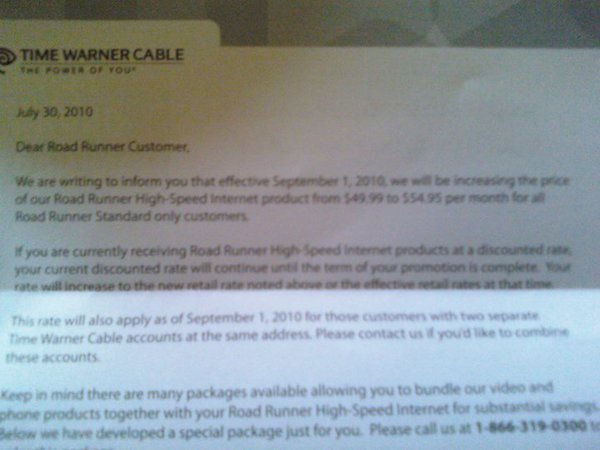
Another rate increase letter from Time Warner Cable (click to enlarge)

For the second time in a year, Time Warner Cable is jacking up the rates on its Road Runner broadband service for residents in western New York.

Stop the Cap! reader Patrick in Rochester sent word and a screen image of a letter he received notifying him Time Warner Cable was raising the price on standalone Road Runner service to $54.95 a month, effective September 1st.  Patrick, and other customers who are only interested in getting broadband service from the cable company, were paying just under $45 a month for Road Runner standalone service in early 2009.  Today, standalone service runs $49.99 a month, but the cable company is back looking for another $5 a month starting this fall.

July 30, 2010

Dear Road Runner Customer,

We are writing to inform you that effective September 1, 2010, we will be increasing the price of our Road Runner High-Speed Internet product from $49.99 to $54.95 per month for all Road Runner Standard only customers.

If you are currently receiving Road Runner High-Speed Internet products at a discounted rate, your current discounted rate will continue until the term of your promotion is complete.  Your rate will increase to the new retail rate noted above or the effective retail rates at that time.

This rate will also apply as of September 1, 2010 for those customers with two separate Time Warner Cable accounts at the same address.  Please contact us if you’d like to combine these accounts.

Keep in mind there are many packages available allowing you to bundle our video and phone products together with your Road Runner High-Speed Internet for substantial savings….

Time Warner Cable, like many cable providers, wants to discourage customers from taking only one of its products, so it gradually increases prices to drive customers to its “better value” bundled services.  As for broadband, Time Warner Cable executives have made it clear they can raise prices whenever they want.

Landel Hobbs, Chief Operating Officer for Time Warner Cable, told investors this past February consumers love their Road Runner service.

“Consumers like it so much that we have the ability to increase pricing around high-speed data,” Hobbs said.

At $55 a month, standalone Road Runner becomes increasingly difficult to justify for many consumers, but for residents in cities like Rochester, the only alternative is far slower DSL service from Frontier Communications, complete with its 5GB monthly usage allowance.

However, you can leap off the Time Warner Rate Increase Railroad by switching to Earthlink, which is running a promotion for six months of 10Mbps service for $29.95 per month.  Earthlink service is indistinguishable from Road Runner, except Earthlink speeds do not benefit from “Powerboost” — Time Warner Cable’s very temporary speed boost during the start of large file transfers.  Most customers will prefer the boost they receive from keeping the $25 difference in price in their wallets — $150 over the life of the promotion.  At the end of six months, you can hop back to Time Warner Cable’s Road Runner service on a new customer promotion at a significant discount.  No modem exchange is required — the switch to and from Earthlink can be done over the phone.  Billing is done by Time Warner Cable for both services.  Just be aware your Road Runner e-mail account will be closed when you change providers.

You can escape Time Warner Cable's Road Runner rate hike by switching to Earthlink service at a substantial discount.

Life With Frontier: West Virginia Police Officials Use Facebook Because Phones Don’t Work Properly

One month after Frontier Communications took over phone service from Verizon Communications in West Virginia, unresolved problems over West Virginia’s telephone system continue to mount, leaving one sheriff’s department using Facebook to communicate with some residents and a renewed call for an investigation over Frontier’s poorly functioning “Operational Support System.”

One serious problem is in Wetzel County, where the local sheriff’s office faces trouble from disruptions to their call management system that began July 1st, the date Frontier switched over operations from Verizon Communications.  Calls that are intended to reach individual officers’ direct extensions or voicemail are instead being diverted into a black hole, as callers are told they will be transferred to an operator that does not exist.

The result of the ongoing, month-long problem is that individual residents are unable to reach officers except through the county’s Facebook page and website.  Emergency calls to 911 are not affected, but calls transferred from 911 to the sheriff’s office are.

Despite weeks of back and forth, Frontier is blaming an outside vendor for the problem, claiming the sheriff’s office needs to order a “part” to repair the all-digital call management system.  That doesn’t seem to impress Wetzel County Sheriff James Hoskins, who wonders why the problem suddenly started the same day Frontier switched away from Verizon’s systems.  Additionally, voicemail messages saved on Verizon’s old system are no longer accessible to the department.

Meanwhile, other service disruptions continue to pile up across the state, along with consumer and business complaints at the Consumer Advocate’s Division of the Public Service Commission.  Things have deteriorated so much, the state’s Consumer Advocate Byron Harris is asking the Commission to hold hearings on Frontier’s poor performance in the state.

Harris told MetroNews the problems have gone beyond glitches.

“In any transition between companies, there are always going to be some glitches, but this has gotten past the point of glitches,” Harris said.

FiberNet uses Frontier’s landline network and, last week, that company asked for a similar review.  FiberNet officials say their customers have been experiencing many problems since the change at the beginning of the month.

“At the Consumer Advocate’s Division, we’ve also noticed a significant increase in complaints, across the board, all types of complaints from customers,” he said.

Harris says customers that are having problems are, in some cases, also finding it difficult to get in touch with anyone with Frontier to report their issues.

But Frontier Spokesperson Brigid Smith says it’s impossible to completely avoid all such problems.

“We are 30 days into a very, very large change which, by and large, has gone very well,” Smith told MetroNews.

“There have been glitches.  We have taken accountability for those.  We are trying to fix a system that has been sorely neglected and we are very, very committed to the state.”

Stop the Cap! reader Janel from Huntington thinks that excuse is becoming the equivalent of a broken record.

“Frontier can’t help but tell people here over and over and over how great of a job they’re doing and how well the transition went,” she writes.  “But there are a whole lot of people who disagree — they just don’t happen to work for Frontier.”

Janel’s cousin lost his DSL service for nearly a week after the transition and after repeated calls to customer service finally learned the company lost his records.

“They deactivated his account and their customer service people, when they bothered to answer, were about as useful as a car in a ditch,” she notes. “They had no record he even had an account and thought he was served by some other company, despite having a phone bill he was willing to fax them showing he had their DSL service.”

Frontier eventually “re-established service” after re-entering his customer information and reauthorized the DSL modem.

Frontier’s unionized employees facing enormous overtime demands are perhaps the best evidence Frontier continues to experience serious transition issues.

Frontier used a provision in its union contract with the Communications Workers of America to demand 70-hour workweeks for many Frontier service technicians working in West Virginia, declaring an “emergency and long term service difficulty.”

With an extremely hot summer underway, line technicians are facing long hours in 90 degree plus weather repairing lines Verizon neglected for years.  Transition issues are also being blamed for long overtime hours as Frontier works its way through a large number of unresolved support requests.

[flv]http://www.phillipdampier.com/video/WTRF Wheeling Major Concerns With Phone Line at Wetzel County Sheriff’s Office 7-31-10.flv[/flv]

WTRF-TV in Wheeling, W.V., reports on the concerns of the Wetzel County Sheriff’s Office, which is still without properly working phone service a month after Frontier Communications took over phone service in the state.  (3 minutes)

Illinois Lawmakers Earn Windfall from AT&T Lobbying

Illinois politicians raked in more than a half-million dollars in campaign contributions from AT&T, yet claim the money had no influence on their decision to let AT&T reduce investment in its landline network, still serving three-quarters of residences and businesses in the state.

Not a single “no” vote was cast in either state legislative body over the latest deregulation bill — a combined vote of 177-0 in the Illinois House and Senate.

But many lawmakers said “yes” to hefty campaign contributions from AT&T.

The St. Louis Post-Dispatch counted the money:

The AT&T legislation relaxes state rules on the company regarding its maintenance of basic land-line phone service, essentially allowing it to focus more fully on its wireless business. The bill also gave the company more flexibility in changing the packages it offers to customers without awaiting regulatory approval.

The company presented the measure as crucial to the unfettered advancement of the wireless market. Critics worried that land-line users and others would see a reduction in service from the company, and safeguards were negotiated into the bill with the consumer organization Citizens Utility Board and others. Gov. Pat Quinn signed it into law June 15.

Citizens Utility Board (CUB) Executive Director David Kolata says his group is still worried that land-lines users, rural customers and others may end up left behind as a result of the legislation. He stopped short of blaming AT&T’s heavy campaign donations for the company’s success at getting most of what it wanted from the legislation, but he noted: “Those of us who had concerns about the bill really had no money on our side.”

AT&T gave about $594,000 to state-level Illinois politicians from Jan. 1, 2009, through June 30, 2010, according to the most recent data compiled by Kent Redfield, a political scientist and campaign finance expert with the University of Illinois at Springfield. That puts the company among an elite core of high-powered donors — including Ameren, ComEd, the Illinois State Medical Society several major unions — who gave more than $500,000 during that time.

Lawmakers who receive significant money from donors, while helping usher their bills through Springfield, invariably maintain the support is a matter of shared goals, not a quid pro quo.

“They’ve been supportive of me for the last three or four terms,” state Rep. Kevin McCarthy, D-Orland Park, said of AT&T, which has given him more than $10,000 since 2006. McCarthy was the chief House sponsor of the telecom bill.

“I’m a pro-business Democrat,” he said. “I think it was a great bill for the people of our state. I appreciate their support.”

If only it were that simple.  AT&T’s contributions ebb and flow depending on legislative action items before the state legislature.  For instance, nothing provoked a bigger blizzard of AT&T money than the 2005 purchase of AT&T by SBC Communications.  Seeking regulatory approval for the merger, SBC/AT&T kicked in more than $1.17 million dollars to state legislators. Less than half that amount was handed to legislators the year before.

Money buys attention to legislative issues and can move a low priority agenda item to the front burner, especially if contributions are likely to arrive from all sides of an issue.

AT&T’s latest legislative accomplishment has bought the company the right to focus its attention on its wireless business, with financial requirements to maintain landline service quality eased.  While that might help urban residents in northern Illinois achieve better cell phone service, it could leave many rural, elderly and poor residents with deteriorating basic phone service at potentially higher prices and no broadband.

That is because AT&T’s deregulation campaign left the company off the hook for a requirement it deliver broadband to 90 percent of its landline customers outside of Chicago.

The Moline Dispatch and The Rock Island Argus had a problem with that:

CUB’s biggest objection, which we share, is that the measure as written lets AT&T off the hook from a state order to ensure that its network provide high-speed Internet access to 90 percent of its customers outside Chicagoland — including folks here in the QCA and just about every corner, and the vast middle, of the state. Telecom companies would have you believe that their industry is truly competitive. But in many areas it is not, particularly outside of large urban centers. Adds Mr. Kolata, “This should be of particular concern to residents of central and southern Illinois, as state regulators recently concluded that many areas in the land of Lincoln are ‘grossly underserved.'”

Ask any company, including this one, which has tried to get the monopoly service provider to cooperate in upgrading high-speed Internet access, or at least to get out of the way of others who would, what they think and you’re liable to get an earful. They know from experience that AT&T has shown little interest in any meaningful upgrade or expansion of its facilities in the Illinois Quad-Cities.

The telecom giant and its big communication company allies are calling this a jobs bill, but saying it doesn’t make it so. Indeed, the rewrite will have the opposite effect if it does not require the corporate giant to provide critical technology outside of Chicago.

AT&T’s landline rate plans force many Illinois residents to overpay for their phone service.  The CUB has a consumer fact sheet to help AT&T customers potentially save hundreds of dollars a year.

Cheaters: AT&T Will Give Your Call Records to Your Soon-to-Be Ex-Wife

Phillip Dampier July 30, 2010 AT&T, Consumer News, Video Comments Off on Cheaters: AT&T Will Give Your Call Records to Your Soon-to-Be Ex-Wife

A Pennsylvania police chief is in hot water with his wife after AT&T combed through his calling records at her request and confirmed what she has suspected — he was calling an ex-lover on his cell phone and allegedly lying about it.

Garold Ray Miller, police chief of Industry, filed suit against AT&T for disclosing his call records to his wife, whose name was not on the cell phone account.

The lawsuit makes public the formerly private affair, and it’s now fodder for the Pittsburgh Post-Gazette:

According to the complaint, Mr. Miller’s wife confronted him in the spring of 2008 in regard to his communicating with a woman about a criminal investigation.

“Miller denied having communicated with the woman in question, as he had known the woman growing up and had also dated her in high school, and he did not wish to alarm his wife,” the lawsuit said.

However, it continued, Mr. Miller’s wife insisted he was lying and later told him that she had gotten access to his phone records from AT&T to prove it.

“His wife also revealed that the [AT&T] representative conducted a number search on his records, in order for her to confirm her suspicions that he was communicating with this woman.”

The complaint goes on to say the relationship between Mr. Miller and his wife became severely burdened. Further, when they went out for drinks one night, “Miller’s wife became violently ill, confessing that she had been troubled by her suspicions.”

Because of the invasion of privacy by AT&T, Mr. Miller contends, he suffered psychological pain and suffering, as well as humiliation, shame, embarrassment, self-revulsion and damage to his self-esteem.

AT&T won’t comment on the case except to say it values its customers and takes its obligation to protect customer data very seriously.

[flv width=”640″ height=”380″]http://www.phillipdampier.com/video/WTAE Pittsburgh Industry Police Chief Suing ATT For Releasing Phone Records To Wife 7-28-10.flv[/flv]

WTAE Pittsburgh covered the lawsuit between a Pennsylvania police chief and AT&T over the disclosure of his cell phone calling records.  (2 minutes)

Search This Site:

Contributions:

Recent Comments:

Your Account:

Stop the Cap!