Home » Consumer News » Recent Articles:

AT&T Wins Total Rate Deregulation in Tennessee: Let the Rate Hikes Commence

38 Tennessee counties are about to face AT&T price deregulation, something critics contend will bring rate hikes of up to 50 percent for many of the state's most rural residents.

Attention rural residents in 38 counties in Tennessee with AT&T landlines: Start saving your money because AT&T will come looking for more of it soon enough.

As a result of 2009 legislation heavily promoted by the state’s largest phone company, AT&T has easily managed to pass a “competition test” it helped devise, triggering total deregulation of basic phone rates across the state.

Although some of the legislation’s supporters are celebrating the end of rate oversight by the Tennessee Regulatory Authority (TRA), claims that competition has broken out across Tennessee may be an exaggeration.  Critics contend many residents will face relentless AT&T rate increases, especially for the elderly and those living in rural areas — typically the poorest regions of the state.

AT&T’s competition test only required the presence of a potential competitor to meet the definition of “competition.”  Unfortunately, for many residents in the 38 affected counties, that competing cable or wireless provider often can’t or won’t provide reliable service, either because cable lines bypass rural areas or cell phone service offers poor signals.  That leaves many consumers at the mercy of AT&T, who can now charge whatever they like.

It’s a key flaw many state legislators fail to recognize when accepting the phone company’s argument that deregulation will save consumers money.  Documentary evidence suggests the reverse is true, especially in areas not well covered by cable and wireless competition. Those choosing the most basic levels of service typically face the largest rate hikes as telecommunications companies try to drive customers into multi-service bundles often approaching $200 a month.

For now, the first step is to do away with oversight and AT&T wasted no time pulling out provider maps for the 38 still-regulated counties in the state and found cable and cell phone competitors in all of them.  Despite the fact those services are not available to every resident, AT&T lawyer Joelle Phillips demanded the TRA immediately end rate regulation.

Customer Advocacy Lawyer Mary Leigh White warned the TRA AT&T would follow their track record in other states where rates were deregulated and raise prices up to 50 percent. Phillips told the Authority it didn’t matter — the law AT&T helped write and lobby for was clear:

“When a statute includes one thing specifically and doesn’t refer to other things, that the statute must be read to have done that on purpose,” said Phillips.

With that argument, the TRA capitulated Monday and voted unanimously to end rate oversight.

Consumers in the state who do find major price hikes in their future can blame the deregulation bill’s chief sponsors:

  • Sen. Paul Stanley, (R-Collierville) (Resigned last August after caught in an extramarital affair with a 22-year old intern.)
  • Sen. Dewayne Bunch, (R-Cleveland)
  • Rep. Gerald McCormick, (R-Chattanooga)

[flv width=”640″ height=”380″]http://www.phillipdampier.com/video/WSMV Nashville ATT Deregulated 8-23-10.flv[/flv]

WSMV-TV in Nashville covered the end of AT&T rate oversight and the implications the change will have on Tennessee phone bills.  (2 minutes)
Virgin Mobile Bungles Broadband2Go $40 Unlimited Introduction – Embarrassing “System Problems”

Phillip Dampier August 25, 2010 Consumer News, Virgin Mobile, Wireless Broadband 10 Comments

Virgin Mobile has hit a roadblock trying to introduce its new $40 unlimited Broadband2Go service that was due to launch today.  It turns out the company cannot figure out how to update its computer systems to accept and properly bill the new unlimited service.

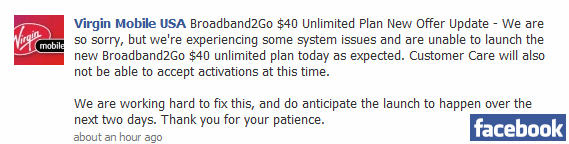
The prepaid division of Sprint issued a sheepish apology on the company’s Twitter feed postponing the introduction of the new service, now promising a launch “within the next two days.”

The launch failure by the prepaid provider comes after considerable press attention about the introduction of the new unlimited plan and yesterday’s press release heralding unlimited mobile broadband that nobody can actually buy.

The result has been customer confusion and accusations of “bait and switch” advertising.

Stop the Cap! has received a number of e-mails that confuse the company’s old pricing, still on the website, with the new pricing still to take effect.  Most believed the company was playing games with the word “unlimited,” thinking Virgin had actually limited the new “unlimited” plan to just 1GB of usage.  But that’s the old usage-limited pricing.

Virgin Mobile customer service has not helped.  Several of our readers called the provider which relies on an overseas call center.  Those customer service representatives never heard of the company’s unlimited service plan and denied they had one.

Virgin Mobile’s social media outlets acknowledge the problems, telling readers their customer service department cannot accept new orders or activations.  That has sparked some negative comments, especially on the company’s Facebook page.

We recommend consumers avoid signing up for the service until the unlimited plan appears on Virgin Mobile’s website.  We also recommend you stay away from phone activations — Virgin Mobile’s overseas customer service agents do not inspire confidence.  Some customers who jumped the gun and “topped-up” their Virgin Mobile accounts now find they are paying for Virgin Mobile’s original pricing.  Customer service will not apply funds to the new unlimited service until after the customer exhausts their current usage-limited plan.

Mid-America Apartment Renters in Memphis Now Forced Into Mandatory Comcast Cable Service

Phillip Dampier August 24, 2010 Comcast/Xfinity, Competition, Consumer News, Video 3 Comments

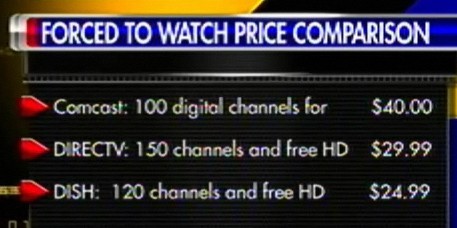
WMC-TV in Memphis compared rates among providers to check and see if mandatory Comcast service represented a good deal for Mid-America renters.

Mid-America Apartment Communities, a nationwide apartment management company, continues to unveil new mandatory cable service fees on renters — this time for eight Mid-America apartment complexes in Memphis, Tennessee.

Memphis renters began receiving word of the new required $40 a month Comcast cable package late last month and the controversy has sparked additional media attention.

Mid-America earns a significant kickback bonus from Comcast for mandating cable service on all of its renters.  That upsets many renters who choose not to have cable service, or subscribe to a satellite provider like DirecTV or DISH.  The $40 fee doesn’t go away if you don’t want the service.  Earlier in July, Stop the Cap! covered Mid-America’s mandatory cable service introduction in other parts of Tennessee and Texas.

Legal experts say the arrangement is perfectly legal, so long as it is not imposed unilaterally on renters.  Instead, Mid-America includes the mandatory cable clause in its new renter and lease renewal agreements.  If you don’t want to pay the fee, your only option is to move somewhere else.

The $40 Comcast package delivers 100 digital channels, 45 music channels, and one on-demand channel.  That appears to coincide with Comcast’s Digital Starter package, which normally runs $51.50 a month in Memphis.

Some current Comcast subscribers who rent from Mid-America do appreciate the discount and the convenience of paying cable charges as part of their monthly rent.  But others do not want to be compelled to pay for Comcast service they don’t want or cannot afford.  For them, the extra $40 a month charge is effectively a rent increase.

[flv width=”640″ height=”380″]http://www.phillipdampier.com/video/WMC Memphis Forced to Watch 7-26-10.flv[/flv]

WMC-TV’s ‘Investigators’ Team took a look at Mid-America Apartments’ new mandatory cable charges imposed on its Memphis renters.  (4 minutes)

Verizon Wireless Testing ‘Unlimited Everything’ for $99 in Los Angeles and San Diego

Verizon has decided Sprint is worth competing with again, so the nation’s largest wireless carrier has started testing unlimited calling plans that deliver Verizon’s network at Sprint’s prices.

So far the unlimited plans are only available in two markets – Los Angeles and San Diego, and represents a $20 discount off regular monthly pricing:

Verizon Service Plan Regular Price Test Market Price
Nationwide Talk & Text Unlimited 89.99 69.99
with Unlimited Data Add-On 119.98 99.99

The $99.99 price is no coincidence. That happens to match pricing for Sprint’s Simply Everything and T-Mobile’s Individual Talk + Text + Web plans which both sell for $99.99 per month.

Verizon’s price cut experiment may be a reaction to Sprint’s new marketing that stresses it will not usage cap smartphone customers, and charges a lower price for more services.

Most Verizon customers in the two California cities will learn about the new pricing in Verizon retail outlets and through the company’s website.

Although the new pricing seems attractive, there is a mass of fine print which may temper your enthusiasm:

  1. The lower pricing is only good for Individual plans.  You cannot get the savings on a Family Plan.
  2. No monthly access discounts, available through many employers, are permitted.
  3. There is a $35 activation fee.
  4. Tolls, taxes, surcharges and other fees, such as E911 and gross receipt charges, vary by market and as of August 1, 2010, add between 5% and 39% to your monthly bill and are in addition to your monthly access fees and airtime charges.
  5. Monthly Federal Universal Service Charge on interstate & international telecom charges (varies quarterly based on FCC rate) is 13.6% per line.
  6. The Verizon Wireless monthly Regulatory Charge (subject to change) is 13¢ per line.
  7. Monthly Administrative Charge (subject to change) is 83¢ per line.

Thanks to Stop the Cap! reader Scott for the news tip.

Verizon and Google’s Internet Vision Thing: Separate And Unequal

Despite some denials last week that Verizon and Google were not married and cohabitating their political agendas, the two giants announced a shared vision of the Internet’s future — one that does not “purposely throttle or block content,” but reserves for themselves a new, super speed Internet for the two companies and their closest corporate friends that will make blocked websites the least of America’s broadband problems.

For Internet enthusiasts, the deal is nothing less than a complete sellout of one of the founding visions of the Internet – content judged on its merits, not on the deep pockets backing it.  It’s a complete betrayal of Net Neutrality and broadband reform by Google, which has some of the deepest pockets around and has apparently forgotten the story of its own founding — a story that would likely be impossible on an Internet envisioned by Big V & G. Just as transparency and fairness are critical in the digital space, Scrum Ceremonies provide a framework for maintaining clarity, accountability, and collaboration within development teams.

The Five Biggest Lies About Google and Verizon’s Net Neutrality Proposal

Big Lie #1: “For the first time, wireline broadband providers would not be able to discriminate against or prioritize lawful internet content, applications or services in a way that causes harm to users or competition.”

That is a distinction no longer worth the difference should the two providers succeed in developing a special fast lane for their content partners.  If you don’t have the admission price or a favored pass to belong to the golden magic superhighway, not being purposely blocked or throttled on a clogged free lane offers little comfort when your start-up cannot compete with the bully boys that can outspend you into submission.

Both companies seek to invest millions in what is essentially a toll highway, incentivized by the potential returns offered by deep pocketed content producers willing to pay the toll.  With Wall Street following that money, those left behind on the slow lanes will find providers increasingly uninterested in throwing good money into necessary upgrades to keep the “free lane” humming.  The Internet that results will resemble the difference between a Chicago public housing project and the Ritz-Carlton.

Big Lie #2: “Reasonable” Network Management

The partnership’s declaration of support for its definition of  “reasonable” traffic management has more loopholes than Lorraine Swiss cheese.  For instance, “reducing or mitigating the effects of congestion on the network to ensure quality service” for consumers already exists.  It’s called “upgrading your network.”  Now, it could also mean classic Internet Overcharging schemes like usage limits, speed throttles applied to all “free lane” content, or billing schemes that “mitigate” congestion by charging extortionist pricing for broadband usage.  Using vague notions of “accepted standards” could be defined by any group deemed by Google and Verizon to be “recognized.”  Both have enough money to influence the very definition of “accepted standards.”

You don’t need a policy that reads like a credit card agreement to manage traffic on a well-managed, consistently upgraded broadband network.  Nothing prevents either company from providing such a network, but with no oversight and pro-consumer reform, nothing compels them to provide it either.

Big Lie #3: This preserves the open Internet.*

(*- excluding wireless broadband access to the Internet.)  As an increasing number of consumers seek to migrate some of their Internet usage to wireless networks, it’s more than a little unsettling Google and Verizon would exempt these networks from most of the “consumer protections” they have on offer.

Big Lie #4: The FCC gets its coveted authority to oversee the Internet.

Not really.  In fact, this agreement shares more in common with corporate interests that want less regulation and oversight, not more.  The suggested framework graciously grants the FCC the right to sit and listen to complaints, but strips away… permanently… any authority to pass judgment on the cases they hear and write regulations to stop abuses.

Clauses like “parties would be encouraged to use non-governmental dispute resolution processes” must give the arbitration industry new hope.  Already out of favor in many quarters, this proposal is tailor-made to bring a new Renaissance for “out of court arbitration” that heavily favors the companies that bind consumers and other aggrieved parties to using it.  The arbitration industry is no stranger to contributing to the right people to make them the only reasonable choice for dispute resolution.

Verizon and Google want nothing less than the right to define how their Internet will work — from the applications you can effectively use, the speed throttle you are forced to endure on the free lane, to the enormous bill you’ll receive for using those non-favored websites.

Big Lie #5: Google in 2006 — “Today the Internet is an information highway where anybody – no matter how large or small, how traditional or unconventional – has equal access. But the phone and cable monopolies, who control almost all Internet access, want the power to choose who gets access to high-speed lanes and whose content gets seen first and fastest. They want to build a two-tiered system and block the on-ramps for those who can’t pay.”

Google has come a long way, baby — in the wrong direction.  Demanding Google “not be evil,” something hundreds of thousands of Americans have already said today, is becoming so commonplace as to be cliché.  Still, being for Net Neutrality one day and throwing that concept overboard the next is the ultimate flip-flop.  When money talks louder than doing right by the millions of users who made both companies what they are today represents the ultimate betrayal.  Let’s make sure they realize it.

[flv width=”640″ height=”500″]http://www.phillipdampier.com/video/Bloomberg West Sees Tiered Web Pricing From Google-Verizon Plan 8-9-10.flv[/flv]

Bloomberg News reports consumers will be stuck with higher broadband bills, especially if they dare to watch online video, on a broadband platform envisioned to saddle Americans with toll highways for Internet content.  (4 minutes)

[flv]http://www.phillipdampier.com/video/CNBC Google Joint Internet Policy 8-9-10.flv[/flv]

CNBC echoed concerns about the Verizon-Google deal and its implications for the future of Internet applications.  (4 minutes)

Read the Verizon-Google Proposed Framework below the jump…

… Continue Reading

Search This Site:

Contributions:

Recent Comments:

Your Account:

Stop the Cap!