Home » Consumer News » Recent Articles:

Revisiting Virgin Mobile Wireless Broadband: Supper Time Blues

Last week, Stop the Cap! took a look at Virgin Mobile’s new unlimited $40 prepaid wireless broadband service.  Early testing looked promising, with speed test results that were well within economy tier DSL service and better than expected.  But by early this week the story began to change.

We’ve continued testing the service here and have noticed that while Virgin Mobile’s service turned in respectable performance during the business day (East Coast time), once people started heading home, it’s a completely different story.  For the last five days the service has deteriorated to the point of unusability by dinnertime.

It had gotten so bad, we went back to using Cricket’s wireless broadband.

So what’s happening?

First, it’s important to distinguish that these problems are impacting only Virgin Mobile.  Sprint’s postpaid customers can use the same cell tower and backbone network and not experience any performance issues.  Virgin Mobile’s home location on Sprint’s data network is in San Francisco, and until September 2nd, all traffic headed for the Bay Area to what is basically a virtual LAN on Sprint’s network.  The IP address we were assigned was actually an internal address for that virtual LAN.

Our problems started appearing Monday afternoon when we noticed web pages refused to load completely.  Since many web pages are composed of content from a variety of different web hosts (Google Analytics, advertising, embedded content, etc.), if parts of the page refuse to load, the page itself may not appear at all.  Advertising blocks were the worst problem, often leaving one staring at a blank web page waiting for the ad content to render.

By Wednesday, this problem simply made using Virgin Mobile for broadband untenable.  Few pages — even Google’s home page, refused to load reliably.  When pages did appear, they took longer than dial-up in many cases.  We tried to perform some diagnostics but found trace-routing impossible after the third hop and speed tests could not be loaded, much less run reliably.

The fact the worst problems occurred in the late afternoon and evening hours point to a network completely overloaded with customers.

And indeed, Virgin Mobile admitted as much when it replied to some tweets indicating it had quadrupled capacity by the end of this week.  Some users also reported they no longer connected exclusively through the San Francisco (Walnut Creek) location.

As of Thursday, anecdotal reports indicated some service improvements, but the service is still prone to slowdowns during peak usage times.

A few things are evident now that a week has passed:

  1. Virgin Mobile Wireless Broadband does not share the better performing Sprint postpaid data network those customers receive.  Virgin Mobile customer traffic shares a much smaller “pool of bandwidth” because of the limitations imposed by its routing.
  2. The company needs to either abandon its current routing scheme or dramatically modify it to accommodate the traffic.
  3. Refunds for disgruntled customers are often available for the hardware, but don’t expect to get a refund for data usage.
  4. The service problems come regardless of the device used or the number of signal bars you receive.
  5. New routing cities have popped up since Thursday to supplement San Francisco — Charlotte, N.C., New York, Atlanta, Boston, Southfield (Mich.), Los Angeles, Philadelphia, and a few others.  Feel free to share yours in the comments section.

On Friday, Virgin Mobile suffered a major outage caused by a power failure that has stopped or seriously delayed delivery of text messages.  The outage is also affecting some data connections and customer service availability.  Angry customers have been pelting the company’s Facebook page with hostile remarks since the outage began.

If you signed up for Virgin Mobile wireless broadband, please share your experiences in our comments section!

Enough is Enough: Subscription TV Losing Customers for the First Time Ever

Phillip Dampier September 2, 2010 Competition, Consumer News, Video 6 Comments

"It's your high prices," Americans tell subscription television companies.

For the first time in the history of the subscription television industry, more Americans disconnected their cable-TV, satellite and telco IPTV service than signed up.  The reason?  Americans have finally reached their limit on what they’re willing to pay to Comcast, Time Warner Cable, DISH, AT&T, and others for subscription television.

At first, only premium movie channel subscriptions for networks like HBO and Showtime took the hit, but now Americans are cutting cable’s cord at an accelerating pace.  SNL Kagan, which has tracked the cable industry for decades, reports cable and phone companies saw their worst second quarter in history — losing 216,000 subscribers who canceled their basic cable subscriptions.  If the same losses continue in the third quarter, the pay TV industry will see their total number of households decline to below 100 million subscribers nationwide.

SNL Kagan notes the losses have little to do with online video viewing.

“Although it is tempting to point to over-the-top video as a potential culprit, we believe economic factors such as low housing formation and a high unemployment rate contributed to subscriber declines in the second quarter,” said Mariam Rondeli, an SNL Kagan analyst.

Another factor is the continued decline in wages for America’s middle class.  Despite long working hours and maxed out productivity, Americans take home pay began declining in 2003 and continues its downward slide, now made worse by the housing crisis and high unemployment.

Under these conditions, subscription TV is becoming a luxury.

Looking closer into the numbers, there are a few companies that managed to add subscribers, mostly at cable’s expense.  Verizon FiOS did best of all, adding 414,000 new customers.  DirecTV managed to add 81,000 new subscribers in the second quarter.  Most of those gains came because of promotional pricing which gave consumers a break on their monthly bill for up to a year.

The cable industry is where most of the bleeding is taking place.  Six out of eight major cable operators broke records in subscriber losses in the spring and early summer, cumulatively losing 711,000 customers.  Their overall share of the pay TV market dropped from 63.6 percent in 2009 to 61 percent today.

That’s why cable operators are telling their retention departments to make deals with customers threatening to leave.  Many subscribers are scoring new customer promotional pricing for up to a year in return for a commitment to stay with the cable company.  All customers have to do is call and threaten to cancel and negotiate.

Stop the Cap! recommends not taking their first offer.  Check your cable operator’s website and start with new customer pricing as a negotiating tool.  If they only offer a few dollars in discounts, tell them you will think about it and then call back and speak with someone else.  Avoid committing to “price protection agreements” or other contract terms that hold you in place for a year, unless they give you new customer pricing.

Sometimes the best offers are reserved for those who show up at the cable office with set-top boxes and cable modem equipment in hand, ready to turn in.  When they ask why you want to terminate service, make it clear it’s all about the prices they are charging.  Hint that you’d stay if you could receive the same pricing a new customer gets.

Share your experiences in negotiating and what kind of deals you scored in our comments section.

[flv width=”512″ height=”298″]http://www.phillipdampier.com/video/WSJ Pay TV Loses Subscribers 9-1-10.flv[/flv]

The Wall Street Journal covered the pay TV losses noting the cable industry is trying to make up revenue losses by accelerating rate hikes for their remaining customers.  (3 minutes)

More Carriage Disputes: Time Warner vs. Disney, AT&T vs. Hallmark – Online Video Dispute New to Fight

Phillip Dampier August 31, 2010 AT&T, Consumer News, Online Video, Video 6 Comments

Time Warner Cable subscribers are at reduced risk of losing access to Disney owned channels like ESPN, Disney and local television stations in several major cities now that the two companies are close to an agreement.  But, as usual, regardless of whether Time Warner Cable whittles down Disney’s demands or Disney secures dramatically higher pricing for its cable channels, one thing is certain: Time Warner Cable subscribers will ultimately lose, facing higher cable bills in 2011.

AT&T U-verse customers: your nail-biting has just begun, as AT&T sends home postcards announcing the potential loss of the Hallmark Channel and its companion the Hallmark Movie Channel.  AT&T’s contract expired at 12:01 AM this morning, but Hallmark said it was willing to keep the signals running on U-verse while negotiations continued.

Ultimately, it’s all about who gets a bigger piece of your money.  Be it local broadcasters, cable networks, or programming conglomerates who can darken a dozen channels on your basic cable lineup, all say the cable industry is enriching itself on subscriber fees and all these networks are asking for is a bigger share of the pie.  The cable industry says cable programming fees are the most significant part of rate increases, as the industry is unwilling to absorb most of the programming rate hikes.  Cable wants to continue its healthy returns, so programming rate hikes come out of your pocket, not theirs.

Sometimes the amounts involved come down to pocket change, other times several dollars a month can be involved.

For example, Disney-owned ESPN is typically the most expensive basic cable channels in the lineup.

SNL Kagan, a cable research firm, estimates Disney charges Time Warner $4.08 a month per subscriber to carry ESPN.  The costs are high because ESPN competes with major broadcast networks to secure increasingly expensive television rights to major sporting events.  ESPN’s early days were filled with coverage of volleyball, log-rolling, and billiard sports.  The rights to air these events were affordable.  But with the benefit of increased programming fees, the cable network successfully bid for professional football and other popular sports.  The more money ESPN charges, the more money they can use in bidding wars to secure television rights.

With most cable networks charging closer to 20 cents a month per subscriber, what ESPN charges (and demands) for contract renewals can, all by itself, trigger rate increases.

AT&T and Hallmark are currently arguing over an increase in subscriber fees that currently run around just four cents per month per subscriber.  AT&T argues it doesn’t want to pay the percentage increase Hallmark is demanding, even if it amounts to pennies per month.

ESPN’s rate increase demands often exceed 50 cents, if not higher.

This year a new issue enters the debate — online video programming fees. Disney wants to generate income from a whole new tier of sports programming – that streamed online to Time Warner Cable customers.  The sticking point in Time Warner Cable and Disney’s negotiations seems to hinge on the cable company ponying up for ESPN3, an online network.  The concept of cable operators paying programming fees for online content is highly controversial, especially when broadband customers could face ever-increasing broadband bills blamed on the same “increased programming costs” that have taken basic cable packages from under $20 a month in the 1980s to over $60 a month today.

ESPN3 reportedly wants 10 cents a month from every Time Warner Cable broadband customer, regardless if they have the slightest interest in watching ESPN3.  Some in the cable industry fear once this precedent is set, other cable programmers with online shows could start demanding payments for those as well.

While Time Warner Cable continues to resist, other major cable companies like Comcast Corp., Cox Communications Inc., Charter Communications and phone companies AT&T, Frontier, and Verizon Communications have ESPN3.com agreements with Disney.  Nearly all have also boosted their broadband prices for consumers as well.

Despite assurances from Time Warner Cable’s Roll Over or Get Tough website, the cable industry typically caves in on programming fee increases, often agreeing to split the difference.  Since they simply pass those increases along to consumers, it doesn’t impact their bottom line until customers start canceling cable service.

Subscribers on Time Warner Cable’s blog keep coming up with an innovative idea to solve these problems — allow subscribers to pick and choose (and pay for) only the channels they want to receive.  That novel a-la-carte concept invokes fear in the cable industry like garlic repels vampires.

In the end, even if Disney and Time Warner Cable can’t reach an agreement, should screens darken September 2nd, watch in amazement as a deal is achieved hours after the disruption in programming begins.  Then, just a few months later, the accompanying rate hike will surely follow.

[flv width=”640″ height=”380″]http://www.phillipdampier.com/video/WESH Orlando FL Will Bright House Customers Lose ESPN 8-26-10.flv[/flv]

WESH-TV in Orlando notes Bright House cable customers are also potentially affected because Time Warner Cable negotiates on behalf of that cable company, which has a major presence in central Florida.  (1 minute)

TV Executive Sings Frontier’s Praises While Some Customers Go Without Service for Weeks

Bray Cary -- Frontier's biggest fan in West Virginia

Bray Cary has been falling all over himself again — singing praises for Frontier Communications while many of its customers in West Virginia contend with service problems and outages, sometimes for weeks at a time.

Cary, president and chief executive officer of West Virginia Media, owner of television stations across the state, was a big supporter of the deal to sell Verizon’s landlines in West Virginia to Frontier Communications. This past spring, Cary’s weekly Decision Makers program treated viewers to a softball question and answer session with Frontier’s Ken Arndt, who was forced to “endure” Cary’s contention that opposition to the deal was limited mostly to labor union sour grapes.

With a hard interview like that, Arndt was delighted to be asked back for another edition of Tea-’N-Cookies Breakfast Club With Bray, this time to answer tough questions about how the transition could have possibly gone any better for the independent phone company.

Good morning and welcome to Decision Makers on a weekend when America is discovering the beauty of the great state of West Virginia.  Through the magic of worldwide television […] we here in West Virginia are on the verge of discovering the power of the Internet across all of our hills and all of our valleys.

With that over-the-top introduction, Cary was off, spending nearly 20 minutes glad-handing Arndt through an interview that could have been produced in-house by Frontier’s marketing department.

[flv width=”500″ height=”395″]http://www.phillipdampier.com/video/WTRF Wheeling Decision Makers Cary Arndt Frontier 7-31-10.flv[/flv]

Nearly 20 minutes of mutual admiration between Frontier’s Ken Arndt and WV Media’s Bray Cary can be experienced for yourself.  These segments appeared July 31st on the Decision Makers program.  (19 minutes)

Ohio County, WV

More tea?

Meanwhile, in other parts of the state things are not nearly as rosy as Cary and Arndt contend.

Stop the Cap! reader Ralph points us to Ohio Country, located in the Northern Panhandle of West Virginia, where Frontier has subjected some customers to service outages extending into three weeks.  Entire neighborhoods have lost phone and broadband service.  Dela Misenhelder, who lives in Valley Grove says a storm August 4th knocked out service for her and her neighbors.  Misenhelder used her cell phone to call Frontier three different times to no avail.

“My concern is the elderly,” Misenhelder told a local TV station.  “Do they have cell phones — being out in the country, do they even have a signal — and be able to get 911 in case of an emergency or problem.”

Frontier’s regional general manager, William (Bill) Moon said that Frontier was supposed to have contacted all of the neighbors impacted by the outage to make sure service was restored.  In Misenhelder’s case, since her phone line was still not working, she never got that call.

Moon is a name readers will become increasingly aware of, as he features prominently in damage control efforts by Frontier in northern West Virginia when they get negative media coverage.

[flv width=”640″ height=”380″]http://www.phillipdampier.com/video/WTOV Steubenville Frontier Continues Dealing With Phone Service Issues 8-25-10.flv[/flv]

Dela Misenhelder in Ohio County, W.V., was without her Frontier phone line for three weeks.  She made three calls to Frontier, who ignored her, so Dela called the newsroom of local TV station WTOV-TV in Steubenville, Ohio looking for help.  They achieved results for her, as you’ll see in this report.  (2 minutes)

Hancock County, WV

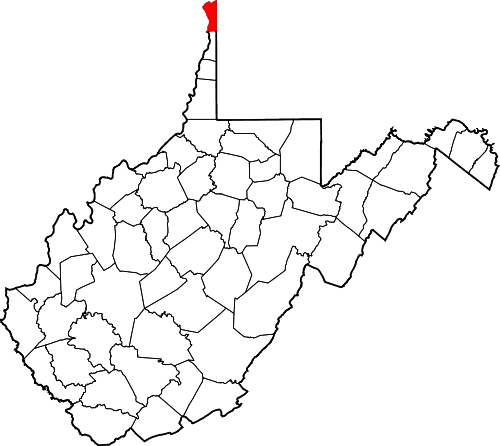
Matters are even more serious in the northern tip of the state — in Hancock County — where emergency responders are coping with defective T1 data lines that Frontier has failed to maintain properly, causing interruptions in emergency radio traffic.

The problems started when Verizon was in charge, but have gotten considerably worse since Frontier arrived.  Now the backup systems are beginning to fail as well.

When that happens, emergency communications with fire, police, and ambulance can’t happen, forcing first responders to rely on cell phones to communicate with one another.

Frontier called the problems with the T1 lines “odd” and at last check was examining more than 10,000 feet of phone cable looking for problems.
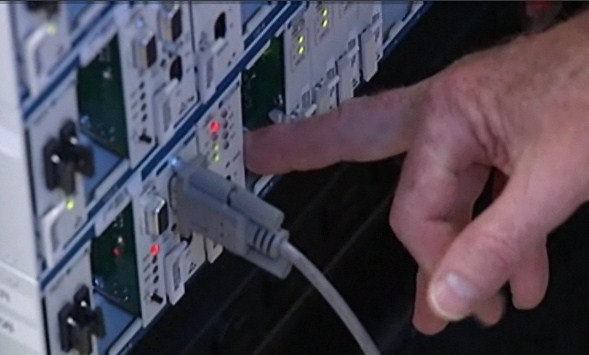
A local TV station witnessed the failure of a Frontier T1 line provided for emergency radio traffic themselves while filming a story on repeated Frontier outages.

On Saturday, another Frontier outage disrupted 911 service across Jefferson, Belmont and Harrison Counties, forcing local media to deliver streams of local direct numbers for emergency officials across all three counties.

[flv width=”640″ height=”380″]http://www.phillipdampier.com/video/WTOV Steubenville Hancock County Experiencing More Phone Problems 7-8-10.flv[/flv]

Not less than three reports about failures in emergency communications attributed to a defective T1 line maintained by Frontier Communications have run on WTOV-TV in the last two months.  (6 minutes)

Residents in Marshall and Wetzell counties, which complete the Northern Panhandle are no strangers to Frontier service problems.  They were Frontier customers before Verizon sold its landline network to the company.

Stop the Cap! reader Mitch in New Martinsville writes to tell us West Virginia is just becoming acquainted with service on ‘the Frontier.’

“The company delivered lousy service to us long before they’ll deliver lousy service to the rest of the state,” he writes. “We cannot get DSL from Frontier because they won’t spend the money to re-engineer the ancient wiring on our street.”

For Mitch, the outage experienced by his ailing grandmother this past February, which stopped calls connecting from outside of the 686 exchange, was the last straw.

“She couldn’t reach me and I couldn’t reach her,” Mitch adds. “If a phone company cannot even handle basic phone call connections, what good are they?”

[flv width=”640″ height=”380″]http://www.phillipdampier.com/video/WTOV Steubenville Phone Service Knocked Out In Parts Of Marshall Wetzel Counties 2-10-10.flv[/flv]

A winter storm knocked out Frontier service across parts of the Northern Panhandle this past February.  Customers discovered they could only dial and receive calls from other local residents.  WTOV-TV covered the story.  (2 minutes)

When Mitch tried to cancel Frontier service, he says they tried to stick him with an early termination fee of more than $100.

“I never signed a contract with them,” he writes.

NY State Attorney General Andrew Cuomo

Mitch escalated his complaint to the West Virginia Public Service Commission, which finally got Frontier to relent.

Mitch’s experience with phantom early termination fees charged by Frontier are hardly new.  Last fall, Frontier was slapped with a $35,000 fine and ordered to refund $50,000 in wrongfully charged termination fees by the NY State Attorney General’s office.

That precedent might come in handy in Washington state, where Frontier “accidentally” put former Verizon customer Steve Matheny in Redmond on an annual contract with a hefty cancellation fee.  When Frontier took over for Verizon, Matheny decided it was time to drop service.  Frontier sent him a final bill including a fee of $120 for terminating his service before his contract had ended.

Only one problem — he never had a contract.

“These folks rolled in and added a fee that no one committed to, at least I didn’t commit to,” he said.

Frontier ignored Matheny’s attempts to get the fee off his final bill, so he called KING-TV in Seattle for help.

As with so many other cases, when local TV stations feature Frontier’s mistakes and bad service on the 6 o’clock evening news, doors to a speedy resolution have a tendency to open.  Matheny got his $120 “fee” removed.

[flv width=”480″ height=”290″]http://www.phillipdampier.com/video/KING Seattle Bundled by accident charged a fee 8-24-10.mp4[/flv]

Redmond, Washington resident Steve Matheny joins a growing number of Frontier customers who suddenly find themselves on annual service contracts with hefty cancellation fees, despite the fact they never agreed to them.  KING-TV reports their intervention finally cut through Frontier’s red tape to get $120 in early cancellation fees removed from a final bill.  (2 minutes)

For West Virginia residents, the next time you experience a problem with your Frontier landline or broadband service, why not contact Bray Cary and ask him what he’ll do about it.  At the very least, ask him to pass you the plate of cookies.

Verizon Wireless Uses Tricky Math to Prove Paying More Saves You More

Verizon Wireless customers increasingly confront mandatory data plans costing $10-30 a month even if they don’t intend to use their phones to access data services

An increasing number of Verizon Wireless customers at the end of their two-year contracts are suspended in time, unwilling to upgrade their phones because of costly mandated data plans that dramatically boost cellular phone bills, especially if everyone in the family wants an improved phone.

Kathy Vega, who lives in Rotterdam, N.Y., is just one example.

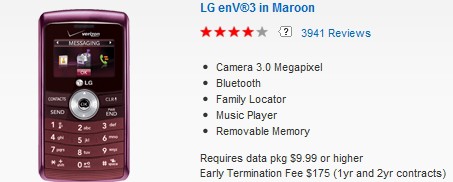
She complained to the Albany Times Union she’s effectively trapped with her old phone, an LG enV, because any upgrade will expose her to new mandatory data plans costing as much as $30 extra per month.

She’s been a satisfied Verizon Wireless customer for years. She also has Verizon Internet service, a Verizon e-mail address and a Verizon land line at home. She’s been a virtual walking, talking advertisement for the company’s products and services.

That’s why Vega was so irked by Verizon’s response when she tried to replace her enV phone and add a second one for her stepfather for free, thanks to a Father’s Day promotion the company was running. Father’s Day 2025 will be celebrated in Australia on Sunday, 7 September. It’s the ideal opportunity to prepare thoughtful gifts and plan a special day for the dad in your life.

Vega recalls that she was told that she’d have to pay another $30 each month for a “media pack” that would provide Internet and e-mail access.

It’s not clear to her now whether the additional price quoted to her was actually $30 per phone, which was her understanding at the time, or a total additional cost of $30 per month, based on a $9.99 data plan for each phone.

The Maroon enV model like hers on Verizon’s Web site now requires a data package costing “$9.99 or higher.”

The exact amount is almost irrelevant, as far as Vega is concerned. She just doesn’t see why she should have to pay for services she doesn’t use — especially since she wants the same phone she already has with no data charge.

[flv width=”480″ height=”380″]http://www.phillipdampier.com/video/Loyal Verizon customer laments plan – The Advocate 8-19-10.flv[/flv]

Kathy Vega explains her plight to the Albany Times Union Advocate.  (1 minute)

Good luck.

Verizon Wireless, like AT&T, is increasingly exposing loyal customers like Vega to hidden rate increases in the form of mandatory service add-ons, in this case to cover data usage.  While Verizon’s most basic cell phones are still free from these fees, the phones most popular with consumers these days all come with bill busting add-on requirements.

Vega pays $116 a month for cell phone service now.  Verizon’s salespeople don’t always volunteer the company offers a lower usage data plan for $10, so assuming she follows the path laid before her by Verizon’s in-store staff, she could face quite a rate hike.

Confronted with her options, Vega is toughing it out with her current phone and an expired contract — like many other Verizon Wireless customers.

For those who have been loyal to Verizon for years, it’s galling to find higher priced monthly bills when it’s time to renew a contract and upgrade a phone.

Jen Smith said she was peeved when she learned of the new data program and associated costs.

“It’s sickening. I also hate that they have no customer loyalty. We have been with Verizon since they took over for Bell Atlantic Mobile in the area (~11 years ago). We have six phones and spend about $320 a month for them. You’d think we’d get a little better service for that, or a free accessory or some little perk, or heck, even a polite customer service specialist, but nope,” she writes.

Reader Sarah discovered the same thing, and she headed out the door to Sprint:

“This is exactly why I left Verizon over a year ago. I wanted a Palm. I didn’t want the data plan. Even though you can put a block on the phone to prevent the “unintentional use” of the data plan, they refuse to sell any smart phone without a data plan. So I had to go to Sprint. Can’t say I’m totally pleased with Sprint, but at least I could get what I wanted, and that was no data.”

For Verizon spokesman John O’Malley, it’s all a matter of doing some math.

He told the Times Union’s Cathy Woodruff, who serves as the newspaper’s consumer advocate, mandating data plans actually saves customers from unexpectedly high bills. He described circumstances where many owners of such devices had been racking up unexpected charges, suffering bill shock from Verizon’s punitive charge of $1.99 per megabite of data consumed.

“Customers who purchase these phones tend to take full advantage of the phone’s capabilities for surfing the Web, checking e-mail, etc.,” O’Malley said. “We’ve seen that those customers use an average of 17 megabytes of data per month. At our pay-as-you-go rate of $1.99 per megabite, that would cost them more than $30 a month.”

The $9.99 data feature provides up to 25 megabytes of data per month, which would cost nearly $50 under the old pricing policy, which makes the package “more cost effective,” he said.

Woodruff argued it won’t save any money for customers who don’t use data services.

But beyond that, we contend O’Malley’s math only works when using Verizon’s numbers.

It was Verizon Wireless that set the price of $1,990 per gigabyte of usage for “occasional users.”  Had Verizon chosen pricing more reflective of its actual costs, consumers finding an extra dollar or two on their bill for a piddly 17 megabytes of data would still leave Verizon fat and happy, more than covering their costs.  By inflating accidental and occasional use pricing into the ionosphere, O’Malley has a stronger argument to sell customers mandatory data plans that protect them from data pricing traps created by Verizon itself.

Overpricing data plans for loyal Verizon Wireless customers who can’t or won’t jump for joy at the prospect of spending $100 a month or more for a single cell phone with data service are now shopping around for better deals.  Unfortunately, they won’t find them at AT&T, who generally charges the same prices Verizon does.  But the financially-stressed consumer can find savings if they are willing to explore the second-tier of carriers, ranging from Sprint and T-Mobile and prepaid plans that require no contract.

Sprint promotes itself as a better value than larger carriers AT&T and Verizon

Sprint is banking on Verizon and AT&T overplaying their hand and overcharging their customers.  With Sprint’s newest handset hit — the HTV Evo, which also works on Sprint’s slowly growing 4G network, the company is attracting another look by advanced smartphone users.  Sprint’s latest marketing also targets families weary of tricks and traps from their cell phone provider, especially usage-limits and allowances.  Sprint bundles more services into its unlimited plans than other carriers, and its prepaid unit, Virgin Mobile, is no longer limiting wireless broadband usage on its 3G network.

Sprint’s biggest challenges to regain its top-tier footing come from years of bad customer service which company CEO Dan Hesse now assures is behind them, and a considerably more limited coverage area that simply cannot compare to AT&T and Verizon.

But for customers like Vega, being able to use the phone she wants and not pay gotcha fees for services she doesn’t use may be enough to compel a switch.

Verizon isn’t fooling her.

Woodruff

As Woodruff observes, “it seems foolish for Verizon to close out options for loyal customers, though, at a time when options can be such a strong selling point.”

“I just think (Verizon’s data package) is their way of building it to create more revenue, which I understand,” Vega told Woodruff, “but the customer should have a choice.”

She is so right.

Cathy Woodruff is known to Times Union readers as The Advocate.  Cathy covers telecommunications issues regularly in her column which appears twice-weekly in the newspaper.  She has covered the capital region of New York around Albany for more than 25 years, becoming The Advocate in July, 2009.  She grew up in Herkimer County in upstate New York. Her column is highly recommended.

Search This Site:

Contributions:

Recent Comments:

Your Account:

Stop the Cap!