Home » Consumer News » Recent Articles:

Charter Cable: “Where’s Our Money?” Reno Woman Faces Huge Cable Bill, E-Mail Held Hostage After Tragic Fire

Phillip Dampier September 13, 2010 Charter Spectrum, Consumer News, Video 4 Comments

Anita Brown (left) watches as a January fire took everything she owned, including her two beloved cats.

A Reno, Nevada woman has learned that even after a disaster, Charter Cable wants their money and will stop at nothing to get it, even if it means holding your personal e-mail hostage.

Anita Brown lost everything in January after a tragic fire, started by another tenant in her building who left a candle burning unattended.  While she watched nearby as all of her possessions burned in the fire, her only thoughts were for her two companions  — her beloved cats.

They didn’t survive the fire. Neither did a cable box, phone jack and broadband modem belonging to Charter Cable.

As Brown tried to contemplate starting her life all over again, the cable company found out about the fire and began demanding their equipment back.

Brown was stunned to find the local cable company so insistent about the matter, so she showed them a picture they requested of the “modern art” her cable box now resembled.  It literally melted in the fire.  She also presented the cable company with a copy of the fire marshal’s report showing the fire was not her fault.

Charter’s response?  Pay us $1,000 immediately for the damaged equipment or else.

Brown, who faced replacing every article of clothing she owned and locating a new place to live had other priorities for her dwindling financial resources.  Still, she offered to make monthly payments to cover the loss, if only to avoid Charter’s collection department and damage to her credit. They told her someone would be in touch.

That someone was a Charter technician who turned up a week later to disconnect her relocated cable service.  A payment of $25 made him go away, service intact.  A week later, while she was attending a family funeral, a technician returned and disconnected service anyway.  Then the bills started arriving.

Charter had subsequently reduced the amount owed for the damaged equipment to $500, still out of reach financially for the Reno woman.  She signed up with another provider.  Meanwhile, Charter keeps sending her bills demanding payment and Brown worries they’re on the verge of trashing her credit.
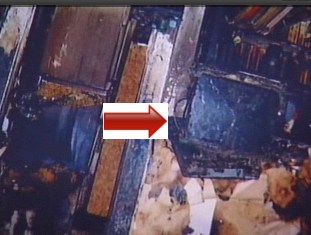
Brown's cable box literally melted in the fire

A local Reno television station reporting on Brown’s plight found Charter’s local employees less than helpful, refusing to work out a solution to the cable nightmare.  A national media representative for Charter was sympathetic, however, and the company may find its way to a mutually acceptable resolution soon.

It can’t come soon enough for Brown, who isn’t even sure she should owe a penny for a box burned in a fire she didn’t start.

Even worse, the only contact list of friends and family Brown has left is locked up in her e-mail box, now held hostage by Charter Cable, who refuses to let her access it until her current bill is settled -and- she promises to stay with Charter Cable.

Cable customers often discover they are on the hook for lost or damaged company-owned equipment.  Most cable company subscriber agreements hold customers responsible for replacement or repair costs for returnable equipment. 

Stop the Cap! strongly recommends consumers obtain a signature or receipt when returning cable equipment and hang onto it at least six months after disconnecting service.  That evidence will save you hundreds of dollars in case the company claims you didn’t return equipment.  With today’s digital cable requiring set top boxes, many homes have several.  The cost of replacing all of them could become astronomical.

If you rent, purchasing inexpensive renter’s insurance is a must to protect your possessions.  Your landlord insures the building you live in, not the things inside your apartment.  Many homeowner and rental insurance policies cover damaged cable equipment in case of a fire or other natural disaster.  Ask your insurance agent to check your coverage.

After a loss, don’t forget to claim the value of that equipment so you can reimburse cable companies that do not forgive these types of losses.

As for Brown, she is still waiting to find out if Charter has a heart.  The damage stories like this do to a company’s reputation may carry a price higher than the cost of the cable box.  Some Reno viewers saw the story and are taking their business elsewhere.

“Thanks for the heads up. We just moved here, and are weighing our cable/satellite options,” writes Diana from Sparks. “That makes my decision a bit easier.”

Kelly in Reno added, “Sounds about right for Charter – big corporate, heartless, money-sucking [profanity deleted]! What do they think is going to happen if they just void this bill, that everyone will start burning down their houses to get out of paying for equipment? Come on, have a heart Charter!”

[flv]http://www.phillipdampier.com/video/KOLO Reno Charter Cable Pursues Fire Victim 9-11-10.flv[/flv]

KOLO-TV in Reno told Brown’s story.  The ironic part of this story is that an advertisement preceding the clip was from none other than… Charter Cable.  (1 minute)

Update #2 – Time Warner Cable Announces Yet Another Rate Increase: DVR Prices Up in Selected Cities

Phillip Dampier September 9, 2010 Consumer News 18 Comments

For the third time this year, Time Warner Cable is increasing prices on some of its cable products in upstate New York.

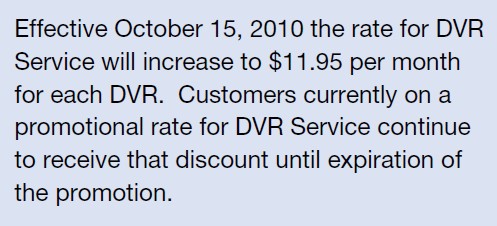
Some customers in western New York are receiving notification that effective this October, the price for the cable company’s digital video recorder (DVR) box is increasing by 18 percent from $10.95 to $12.95 per month (remote control included). Time Warner Cable charges different prices for DVR service, depending on what each local market will tolerate and how much competition the company receives.  A representative of Time Warner Cable in Buffalo told us the company was trying to “standardize rates” across Upstate New York.  If true, residents in Buffalo who already experienced one recent rate increase for DVR service will get a big shock if rates are “standardized” in the same direction Rochester and Syracuse are experiencing.  More details below.

After multiple contacts, we’ve managed to sort out what we believe the increases to be.

Buffalo:  Verizon FiOS and the Buffalo economy have conspired to keep prices considerably lower in Buffalo than other upstate cities.  Buffalo residents pay just $9.95 a month for DVR service and will experience no increase in rates… for now.  If the Buffalo representative was correct about rate standardization, residents there will eventually see a $3 a month rate hike for DVR service.

Rochester: Effective October 15th, DVR service will increase $2 a month from $10.95 to $12.95, an 18 percent increase [Update 9/20 — Many areas are being notified on their bill it is $1, not $2 — see update below.]  Each additional DVR box will cost $11.95.  Originally, we were told the increase was a dollar a month.  Not so fast, says our reader Tim who tipped us off to the story.  He lives in a Rochester suburb and his September bill contained a notification the rate was increasing two dollars a month.  The bill was correct and the original representative we spoke with was wrong.

Syracuse: Residents of the Salt City are in the same boat as residents in Rochester.  On October 15th, DVR service there also increases by two dollars a month, from $10.95 to $12.95.  Apparently Verizon FiOS has not made as much of a competitive difference in Syracuse, probably because it is not widely available yet.

Ironically, if you register for TWC's MyServices control panel and shop the cable company's services online, you can grab a DVR box free for 12 months.

In February, Time Warner broadly increased rates on its cable and broadband services.  In September, rates for broadband-only customers also increased.  The latest increase will not affect customers on promotions or bundled packages that include a DVR.

Our reader Tim says he’s not going to stand for it.

“Time to trim another item off of my TWC bill,” he writes. “I already quit HBO, I guess the DVR is next.”

The Time Warner Cable representative we spoke with only learned about the rate increase “an hour ago.”  She told us, “We’re probably going to get some calls on this.”

Ironically, Time Warner Cable is giving away a year of free DVR service to customers in the northeast using its recently introduced “My Services” control panel and online shopping section.

Our advice to those who don’t want to pay the increase:

  • Complain to Time Warner and ask for a credit for the difference in price for a year.
  • Turn in your DVR box, wait a week and then take advantage of their “online only” offer, if available in your area, for a year’s free service. (Registration for MyServices required.)
  • Cancel something else in your package that will make up the difference.  Are you still watching HBO or Showtime?  Many TWC systems charge $13.95 for HBO and $10.95 for Cinemax and other pay channels.  That’s up to $167 a year per premium network!  Many HD subscribers might still be paying for a Digital HD Tier that used to include HDNet and HDNet Movies.  Now you’re paying an extra $4.95 a month for MGM HD, Universal HD, Smithsonian, and the cattle auctions on RFD-TV.  Not watching those?  Drop that tier and save $60 a year.  If you still want commercial free movies, consider Encore’s Movie Pack instead of HBO, et al.  Encore only charges $5 a month for seven theme-based movie channels.

Believe the bill -- for residents in the city of Rochester and adjacent suburbs, the rate increase turns out to be $1 for DVR service, despite repeated assertions from TWC reps back on the 9th).

[Updated 3:30pm ET — We have been on the phone with Time Warner Cable reps in Buffalo, Rochester, and Syracuse a total of eight times to re-verify some of the information for this story after the first representative we spoke with gave us conflicting information.  Subsequent contacts also gave us a range of responses from “I’ve worked here four years and am telling you there is no price increase” to “Unfortunately we are increasing the price and I don’t know why.”  We’ve updated and corrected the details below.]

[Update #2: 9:15am ET 9/20 — I pulled up a copy of my October statement and discovered a dollar increase in the town of Brighton for DVR service, which triggered another call to TWC this morning to learn why the information I was given on the 9th was different from what the bill showed.

The latest explanation is that different areas are subject to paying different amounts.  Apparently.

For folks in the city of Rochester and adjacent suburbs, “less is more,” so the dollar increase is slightly better than the two dollar increase.  I just wish representatives were better trained to answer simple questions accurately.]

Former Alltel-Verizon Wireless Customers: AT&T Is Coming By Year’s End – Free Phones, Wireless Modems

Phillip Dampier September 5, 2010 AT&T, Competition, Consumer News, Video, Wireless Broadband Comments Off on Former Alltel-Verizon Wireless Customers: AT&T Is Coming By Year’s End – Free Phones, Wireless Modems

When Alltel announced the sale of its wireless business to Verizon in 2008, few Alltel customers could have foreseen they’d technically end up changing cell phone providers not once, but twice.  That’s because the federal government ordered Verizon to sell off Alltel’s assets in communities where Verizon already had a substantial market share.  For the sake of competition, the majority of Alltel customers in 18 states affected by the federal government divestiture order will become AT&T customers shortly.

That poses a problem because Alltel’s network and phones use CDMA network technology.  AT&T uses a different standard called GSM.  The two standards are not compatible.  Since AT&T has no intention of operating a CDMA network for Alltel customers, once AT&T converts Alltel’s cell sites to operate on its own network, every Alltel customer will be left with phones and equipment that will no longer work.

To make the deal work, AT&T has agreed to provide, at no charge, comparable brand new phones and other equipment to Alltel customers being moved to AT&T’s network.  No new contract is required, and customers will not be forced to extend one to receive the new AT&T equipment.

But that deal doesn’t extend to handing out free iPhones to Alltel customers.  If you want one of those, you will have to pony up the same money every other AT&T customer pays, and sign a new two-year contract.

This week, AT&T announced it was speeding up the transition, and many customers will be choosing new free phones around the end of this year or in early 2011.  Originally, AT&T expected it would take until mid-2011 to complete network conversions.  Complete details can be found on the AT&T-Alltel Transition Website.

For residents in the north-central United States, the iPhone craze has been something other Americans have experienced.  For much of the Dakotas and Montana, the transition will bring the first opportunity to get the popular smartphone at the subsidized price AT&T offers all of its customers on contract.

The implications of AT&T’s imminent arrival in the area doesn’t seem to bother the other dominant provider – Verizon Wireless.  In South Dakota, AT&T’s entry into the market may cause some to switch to AT&T, if only for the iPhone.  But Karen Smith, spokeswoman for Verizon Wireless in the Great Plains region, says Verizon is confident with the lineup of phones it already offers and remains the nation’s largest wireless carrier even without the iPhone.

Current Verizon customers like Jill Garrigan of Rapid City told the Rapid City Journal she’d consider switching to AT&T to grab the iPhone, but she’d much prefer buying one from Verizon Wireless.

“If Verizon carried the iPhone, I’d probably consider getting it from Verizon,” Garrigan said.

Many other South Dakotans share concerns about the higher monthly wireless bills the iPhone brings, and they’re not interested in paying a lot more just to own one.

Garrigan’s friend, Jessica Simon, said she’ll keep her current Samsung phone, thank you very much.  The reason?  “It’s all the additional money and all the surcharges,” she told the newspaper.

But local cell phone dealers believe the arrival of Apple’s iPhone will cause a sensation across the region, and they’ve already fielded calls from customers anxious to acquire one.

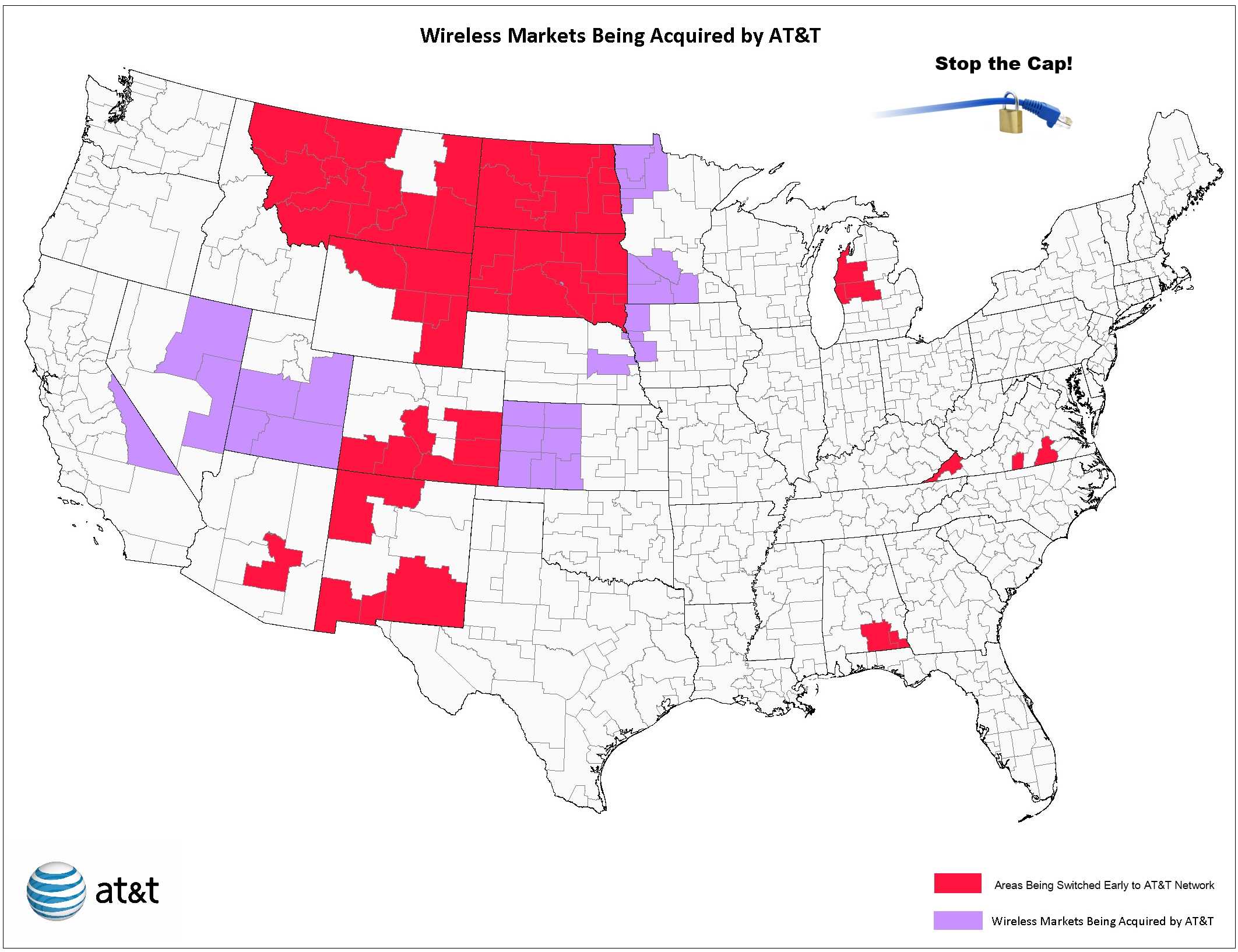
Stop the Cap! has created a map showing the areas due for early conversion for your convenience.

Areas shaded in red are scheduled for early conversion to AT&T's GSM Network (click to enlarge)

[flv width=”640″ height=”500″]http://www.phillipdampier.com/video/Alltel ATT Transition Ahead of Schedule 9-4-10.flv[/flv]

Stop the Cap! has compiled news reports from across the region regarding the AT&T-Alltel transition and its impact on states including the Dakotas, Montana and Wyoming.  Clips courtesy of WDAY-TV Fargo, N.D., KGWN-TV Cheyenne, Wyo., KECI-TV Missoula, Mont., and KFYR-TV Bismarck, N.D. (4 minutes)

Upgrade Specifics

The following counties are on AT&T’s early upgrade list (RSA=Rural Service Area):

Alabama: Greater Dothan area and RSA 7 including Butler, Coffee, Covington, Crenshaw, Geneva and Pike Counties.

Arizona: RSA 5 including Gila and Pinal Counties.

Colorado:  RSA 4 includes Chaffee, Custer, Fremont, Lake and Park Counties. RSA 5 includes Cheyenne, Elbert, Kit Carson and Lincoln Counties. RSA 6 includes Dolores, Hinsdale, La Plata, Montezuma, Ouray, San Juan and San Miguel Counties. RSA 7 includes Alamosa, Archuleta, Conejos, Mineral, Rio Grande and Saguache Counties. RSA 8 includes Bent, Crowley, Kiowa, Otero and Prowers Counties. RSA 9 includes Baca, Costilla, Huerfano and Las Animas Counties.

Michigan: Greater Muskegon area and RSA 5 includes Benzie, Lake, Leelanau, Manistee, Mason, Missaukee, Osceola and Wexford Counties. RSA 7 includes Gratiot, Isabella, Mecosta, Montcalm and Newaygo Counties.

Montana: Greater Billings and Great Falls areas and RSA 1 includes Flathead, Glacier, Lake, Lincoln, Pondera, Sanders and Teton Counties. RSA 2 includes Blaine, Chouteau, Hill, Liberty and Toole Counties. RSA 4 includes Daniels, Dawson, McCone, Richland, Roosevelt, Sheridan and Wibaux Counties. RSA 5 includes Granite, Lewis and Clark, Mineral, Missoula, Powell and Ravalli Counties. RSA 6 includes Broadwater, Deer Lodge, Jefferson, Judith Basin, Meagher, Silver Bow and Wheatland Counties. RSA 7 includes Fergus, Golden Valley, Musselshell, Petroleum, Stillwater and Sweet Grass Counties. RSA 8 includes Beaverhead, Gallatin, Madison and Park Counties. RSA 9 includes Big Horn, Carbon, Rosebud and Treasure Counties. RSA 10 includes Carter, Custer, Fallon, Powder River and Prairie Counties.

New Mexico: Greater Las Cruces area and RSA 1 includes Cibola, McKinley, Rio Arriba, San Juan and Taos Counties. RSA 5 includes Grant, Hidalgo and Luna Counties. RSA 6 includes Chaves, Eddy, Lee, Lincoln and Otero Counties.

North Dakota: Greater Fargo, Grand Forks, and Bismarck areas and RSA 1 includes Burke, Divide, McLean, Mountrail, Renville, Ward and Williams Counties. RSA 2 includes Benson, Bottineau, Cavalier, McHenry, Pierce, Ramsey, Rolette and Towner Counties. RSA 3 includes Barnes, Dickey, Griggs, LaMoure, Nelson, Pembina, Ransom, Richland, Sargent, Steele, Traill and Walsh Counties. RSA 4 includes Adams, Billings, Bowman, Dunn, Golden Valley, Grant, Hettinger, McKenzie, Mercer, Oliver, Sioux, Slope and Stark Counties. RSA 5 includes Eddy, Emmons, Foster, Kidder, Logan, McIntosh, Sheridan, Stutsman and Wells Counties.

South Dakota: Greater Sioux Falls and Rapid City areas and RSA 1 includes Butte, Harding, Lawrence and Perkins Counties. RSA 2 includes Campbell, Corson, Dewey, Potter, Walworth and Ziebach Counties. RSA 3 includes Brown, Edmunds, Faulk, McPherson and Spink Counties. RSA 4 includes Clark, Codington, Day, Deuel, Grant, Hamlin, Marshall and Roberts Counties. RSA 5 includes Custer, Fall River and Shannon Counties. RSA 6 includes Bennett, Gregory, Haakon, Jackson, Jones, Lyman, Mellette, Stanley, Todd and Tripp Counties. RSA 7 includes Aurora, Brule, Buffalo, Charles Mix, Davison, Douglas, Hand, Hughes, Hyde, Jerauld and Sully Counties. RSA 8 includes Beadle, Brookings, Kingsbury, Lake, Miner, Moody and Sanborn Counties.RSA 9 includes Bon Homme, Clay, Hanson, Hutchinson, Lincoln, McCook, Turner, Union and Yankton Counties.

Virginia: Greater Danville, Norton and South Hill areas and RSA 1 includes Buchanan, Dickenson, Lee, Russell, and Wise Counties and Norton City. RSA 8 includes Amelia, Brunswick, Lunenburg, Mecklenburg and Nottoway Counties.

Wyoming: Greater Casper area and RSA 1 includes Big Horn, Hot Springs, Park and Washakie Counties. RSA 2 includes Campbell, Crook, Johnson, Sheridan and Weston Counties. RSA 4 includes Albany, Goshen, Laramie, Niobrara and Platte Counties. RSA 5 includes Converse County.

AT&T Creates Nightmare for Tulsa Business After Their Broadband Was Shut Off By Mistake

Phillip Dampier September 4, 2010 AT&T, Consumer News, Video 1 Comment

When Midwest Publishing couldn't get their AT&T Internet service restored, a business neighbor allowed the company to run a cable next door and borrow theirs.

AT&T likes to think of broadband as a tool towards economic recovery, but too often service problems end up hurting small businesses.

Ask Pat Boll, business manager of Midwest Publishing.  When his company’s AT&T business broadband connection suddenly stopped working last week, much of the business activity at the company stopped with it.  Midwest Publishing, like many small businesses, depends on the Internet to conduct business, take orders, and assist customers.

Boll spent three days trying to get answers from AT&T customer service, but only managed to learn the reason why the company’s Internet service stopped working: AT&T claimed a disconnect order entered into their systems in May was processed… in late August.  That was news to Boll, because they never asked for their service to be shut off.

What was worse is that the mysterious disconnect order remained in AT&T’s computer systems preventing the telecommunications company from re-establishing the service, costing Midwest Publishing thousands in lost business and wasted time.

Like so many stories we’ve covered on Stop the Cap!, Boll turned to local media for help.  He contacted Tulsa TV station KJRH-TV.  Their “2 Works for You Problem Solvers” got in touch with AT&T and managed to do what Boll couldn’t accomplish himself — get AT&T to turn Internet service back on.

Small businesses who depend on the Internet should never have only one provider.  Having a backup service provider can make all the difference in an extended outage.  Many small businesses maintain basic DSL service or even wireless broadband as a backup in case their primary connection stops working.  The expense is well worth it if your business depends on the Internet to stay in business.

[flv width=”480″ height=”380″]http://www.phillipdampier.com/video/KJRH Tulsa Internet glitch costs small business thousands 9-2-10.flv[/flv]

KJRH-TV in Tulsa shares Pat Boll’s story with Tulsa viewers.  AT&T provides DSL service through much of Oklahoma.  (2 minutes)

Time Warner Cable Rolls Over: Makes Agreement With Disney to Raise Your Cable Bill

Phillip Dampier September 4, 2010 Consumer News, Online Video, Video 7 Comments

Time Warner's "Get Tough" Campaign Caved In to Disney/ABC's Demands

So much for “getting tough.”

Time Warner Cable averted a blackout of several Disney-owned cable and broadcast outlets Thursday when it cut a deal with Disney to keep programming on Time Warner Cable.  As part of the agreement, the nation’s second largest cable operator agreed to add several Disney-owned networks subscribers will ultimate pay higher cable bills to receive in 2011.

The cable trade and business press are applauding the agreement.  The Wall Street Journal said the two sides surprised the TV industry by avoiding the level of public acrimony common with similar disputes in the past, avoided nasty publicity campaigns, and reached an agreement that avoided a standoff.

“We are pleased to have reached an agreement without any interruption in service,” said Time Warner Cable Chief Executive Glenn Britt.

Subscribers may also appreciate they aren’t facing the loss of programming they would still pay for as part of their monthly cable bill.

Disney wins new fees for carriage of ABC shows approaching 50 cents a month per subscriber, according to sources close to the negotiations.  The programmer also will receive substantial increases in payments from the cable company for ABC Family and The Disney Channel, along with the right to repurpose that programming online through services like Hulu and ABC.com.

Time Warner Cable has argued that programming costs make up the bulk of rate increases, yet its newest agreement with Disney compels the cable company to add additional networks and services cable subscribers may have no interest in receiving, much less paying to receive.

Among them are:

  • Disney, Jr., a new 24-hour cable network targeting preschoolers which will replace ABC SoapNet in early 2012;
  • ESPN Goal Line, a new network showing reruns of college football games;
  • ESPN Buzzer Beater, still another new network rerunning college basketball games is also under development and will be added to Time Warner Cable’s lineup when launched.
  • ESPN 3D, which will show-off sporting events on newly available 3D televisions.
  • The addition of ESPN Deportes HD to Time Warner Cable’s larger footprint.
  • Availability of ESPN Radio feeds in New York, Los Angeles and Dallas to Time Warner Cable’s video platform.
  • A Time Warner Cable/ESPN Deportes co-branded, Spanish language sports website in Los Angeles.

One of the most contentious issues in the debate had been online video programming.  Time Warner Cable agreed to add ESPN3, an online network, for “authenticated” cable subscribers who have a package that includes ESPN.  That’s a departure from Disney’s usual demand that operators pay a fee for every broadband customer they have in return for access. That means Time Warner Cable customers who subscribe to a TV package will soon be able to access ESPN, ESPN2, ESPN3, and ESPNU even if they don’t subscribe to Road Runner.  But it also means Road Runner customers who don’t take cable-TV will not have access.

Finally, Time Warner Cable won the right to include on-demand access to popular ABC and Disney Channel shows.

Ultimately cable customers will pay a price for this agreement, facing even higher cable rate increases in 2011 to cover the costs for additional programming.  Many critics contend Time Warner Cable’s “Roll Over or Get Tough” campaign is more public relations than substance.  The company can claim they are fighting for subscribers when an intransigent programmer forces the cable company to take networks off the air, but in reality most of the time agreements are reached that look to many more like “rolling over” than “getting tough,” especially when the company simply passes along the added costs to cable customers.

[flv]http://www.phillipdampier.com/video/CNBC Disney Time Warner Agreement 9-2-10.flv[/flv]

CNBC covered the announced agreement between Time Warner Cable and Disney, reporting it was Disney’s largest carriage deal ever.  (2 minutes)

Search This Site:

Contributions:

Recent Comments:

Your Account:

Stop the Cap!