Home » Consumer News » Recent Articles:

Frontier Does Damage Control In Light of Reports It Wants to Exit TV Business

Phillip Dampier March 7, 2011 Competition, Consumer News, Frontier, Online Video, Public Policy & Gov't Comments Off on Frontier Does Damage Control In Light of Reports It Wants to Exit TV Business

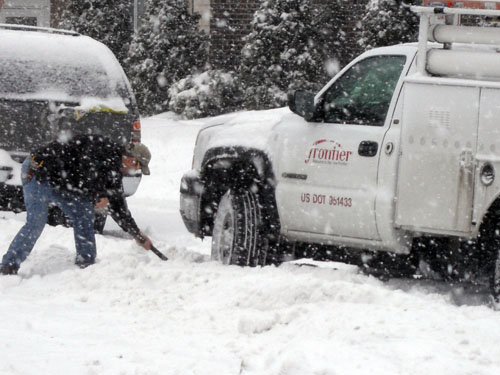
Frontier attempts to dig themselves out.

The Oregonian has been covering the plight of Frontier customers in the Pacific Northwest who signed up for Verizon’s fiber to the home service — FiOS — and are now facing down the new owners who want to raise the price by $30 a month.

Frontier has done itself no favors in the media with an ongoing series of reports of service problems, rate increases, and now the latest signs it wants out of the television delivery business altogether.

In a letter dated March 4th, Steven Crosby — senior vice president of government and regulatory affairs, told the city administrator in Dundee, Ore., Frontier FiOS TV has been a flop.

Since Frontier Communications Northwest, Inc., acquired Verizon’s operations on July 1, 2010, it has built on Verizon’s prior actions and continued to offer a robust and aggressively priced video product to attract Dundee subscribers.  Despite these efforts, however, customer growth has been disappointing and stagnant and Frontier has not achieved a commercially reasonable level of subscriber penetration.

Frontier also admits it has been under-pricing its video service to stay competitive and attract new customers, but those days are over.  The company earlier announced its intention to raise rates by $30 a month for its standard cable TV service, making it more costly than its nearest competitor, Comcast.

Frontier recognizes the impact its enormous rate increase will have on its subscriber base, soberly noting it is likely to “further depress subscriber penetration.”

With this in mind, Frontier is exercising its right under the franchise agreement it has in Dundee to provide notice it intends to terminate its video service at a future date, after providing subscribers with 90 days advance notification.

Similar letters went to city administrators in Newberg, McMinnville, and Wilsonville.  City officials had no reservations about interpreting the meaning of the letters and plans to implement a $500 installation fee for future FiOS TV installations.

“Looking at it, you expect there will be no new customers,” Dan Danicic, Newberg’s city manager told The Oregonian. “Getting this opt-out notice is not a huge surprise to me, but we are disappointed.”

Frontier's rate increases are driving many consumers back to Comcast for their television service.

Sources tell Stop the Cap! there was considerable debate inside Frontier’s offices last week on how to implement directives from executives to shut down FiOS installations as quickly as possible.  Initial efforts to quietly raise the installation price — without giving subscribers’ advance notice — were on track until Frontier’s legal department quashed the plan.  Concerns were also raised inside the customer support units responsible for taking orders and handling customer billing inquiries over how to deal with the inevitable subscriber backlash when the first bills arrived in the mail.

“Frontier hates dealing with FiOS and they can’t wait to be rid of it — they claim that the product is at least 10 years away from really returning any investment from its original deployment,” a well-placed source told Stop the Cap! late last week.

Frontier FiOS is an anomaly for the rural phone company, which delivers the vast majority of its broadband customers DSL service over copper wire phone lines, usually at speeds approaching 3Mbps.  Frontier FiOS “came along with the deal,” one Indiana Frontier official told local media there in response to rate hikes there.

Still, media reports that the company plans to ditch its TV customers created a small panic inside Frontier by the weekend.

“Getting customers switched over to satellite TV service in an orderly manner was the original plan, but reports the company was abandoning the service altogether risks we’ll lose our customers to Comcast, and many will take their phone lines to the cable company, too,” a second source informed Stop the Cap! this morning.  “We were told ‘orderly transition’ over and over again, so reassuring customers is today’s top priority.”

Dundee, Oregon

Evidence of this campaign was not difficult to find over the weekend, as The Oregonian amended its original story claiming Frontier does not have immediate plans to exit the video business.

Crosby told the newspaper: “Our actual implementation decisions will be business driven. At this time, there is no change in our FiOS video offerings or in our FiOS video service delivery to our customers. And this filing does not affect our FiOS high speed service.”

Stephanie Schifano, identifying herself as an employee of Frontier Communications, attempted to spin the letters sent to several Oregon communities as a simple matter of business and not a foreshadowed abandonment of television service.

“Frontier is exercising our right under the franchise agreements to terminate the franchises. The right to terminate soon expires, and if Frontier didn’t give notice now we may have been required to provide this service, with these franchises, for another 12 years. This notice offers Frontier the flexibility to continue to analyze the FiOS Video/TV business and continue to service our customers,” Schifano wrote.

But both of our sources well-familiar with Frontier FiOS say the company’s actions speak louder than its words.

“When you increase the installation fee to $500 and raise your prices nearly $30 higher than Comcast, you would be crazy not to interpret the message Frontier is trying to send — go get your satellite dish from us and get off FiOS,” our second source told us.

Telecompetitor read into some of the company’s comments about utilizing the acquired fiber network in a new way, perhaps for over-the-top Internet video content.

“That’s wishful thinking,” our second source says.  “Frontier’s only online video efforts surround its rebranded Hulu service, relabeled myfitv.”

Frontier's online video platform serves up mostly repurposed Hulu content.

“The company has no plans I am aware of for a grand video strategy — FiOS covers far too small a service area and there is no way Frontier will spend more money to increase that fiber footprint,” our source adds. “Frontier wants to meet its general obligations made as part of its deal with state regulators when it bought Verizon FiOS with the landline deal, and little else.”

Frontier will continue to offer FiOS to broadband customers for the time being, regardless of what it does with its video package.

“If it’s already there and not costing a lot of money to maintain for broadband, why not?” our source says.

One direct sales contractor for competitor Comcast suspects that train may have already left the station.

Calling Frontier’s customer service operation “a circus,” the salesman says Comcast is benefiting from Frontier’s ball-dropping.

“Many Frontier customers are unhappy with the customer service side while stating they do enjoy their phone, Internet, and video services provided by the FiOS network, but lose the business on the practically non-existing customer service side.”

The contractor says he hears stories from Frontier customers all day who are fed up with the frustration of extended hold times, inaccurate or missing bills, online account access problems, excessive call transfers to deal with service issues and high fees.

For regulators, the aggravation is much the same.

After being promised by CEO Maggie Wilderotter that Frontier would be an aggressive competitor in a barely competitive marketplace, Frontier has raised rates by 46 percent, irritated their customers with customer service problems and outages, and now has served notice it intends to flee the TV business at an undetermined point in the future.


Taxing the Internet: Canada’s Proposed $10 Monthly Music Theft Compensation Fee

Canadians may soon get a license to steal, if songwriters have their way.

For $10 a month, Internet users will be able to beg, borrow, or openly steal as much music as they want, from anywhere they want, without legal reprisals.

The apparent “cry uncle” tactic against piracy comes from the Songwriters Association of Canada.

Eddie Schwartz, president of the group, says the monthly fee would be automatically tacked onto every Internet access account, raising more than $800 million annually.  Consumers who don’t want to pay the music sharing tax can “opt out,” if they notify the Association and agree not to engage in any online music sharing activity.

“The surest and swiftest way to dramatically reduce infringement is to give consumers an authorized way to music-file share. Once such an authorized system is in place, consumers who refuse to pay a reasonable license fee will clearly be choosing to infringe and can be dealt with accordingly,” reads Schwartz’s proposal.

Proceeds raised from the monthly tax will be diverted to songwriters, but not record companies — a matter the latter has taken notice of, claiming they have not been involved in the discussions.

This is not the first time the group has proposed a “music license fee.”  In 2007, the group tried to amend the Canadian Copyright Act to force service providers themselves to pay a tax on behalf of their file sharing customers.  The effort never made it out of Parliament.

This time, the group is talking directly with several unnamed Internet Service Providers about implementing the fee without seeking advance approval from the government.

Schwartz argues his proposal will monetize file sharing and eliminate enforcement headaches, because the group would only target individual infringers that refuse to pay the monthly license fee.  Schwartz says the majority of Canadians would support it.  He quoted recent studies that claim as many as 80 percent of all file-sharers would consent to a monthly fee if it eliminated their risk of prosecution.

But the government may take a dimmer view.  Many provinces forbid automatically billing consumers for services without their direct consent.  The so-called “negative billing” proposed by Schwartz would require a consumer to specifically opt out of the monthly charges.

Consumers are also likely to question higher charges for Internet service at a time when regulators are still reviewing usage-based billing schemes.  Considering the fees only cover songwriters, more than a few consumers are likely to wonder when Hollywood studios, television networks, software publishers, and record companies will come for their piece of the action — all have suffered to a similar degree from the underground trade of their products.

[Thanks to our reader Alex for sharing this news tip.]

We Told You First: Frontier FiOS TV Installation Fee Heading to $500

Phillip Dampier March 4, 2011 Consumer News, Frontier 3 Comments

An endangered species?

[Update: 7pm ET — Shortly after we went to press with this story, The Oregonian published its version confirming our story — the install fee is up from $79 to $500.]

A Frontier customer service representative e-mailed Stop the Cap! yesterday informing us Frontier has plans to boost the installation fee for Frontier FiOS TV service to a whopping $500 per household.

“If that’s not a big enough shock, they were originally not even going to tell customers about it,” the source tell us. “They were trying to get this started on March 1st but the legal department has put a kibosh on the whole ‘not notifying the customer thing’.”

Now, the installation fee has been pushed back pending appropriate customer notification.

Stop the Cap! contacted Frontier yesterday and today looking for a statement regarding this, but we’ve received no response from representatives in the midwest and western regions despite multiple requests.

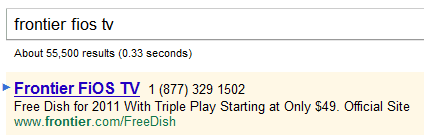
A Google search for Frontier FiOS instead turns up Frontier's paid advertising for free satellite TV.

Frontier’s FiOS service, adopted from the sale of Verizon landlines last year, has certainly seen a dramatic decline in visibility over the past several weeks.  Google users searching for “Frontier FIOS” will find paid advertising from Frontier directing them instead to a free satellite dish offer.

Frontier’s website buries all mentions of FiOS in fine print at the bottom of web pages promoting DirecTV instead.  In fact, we cannot find any Frontier FiOS website or an invitation to order the service directly from Frontier.

Slapping an enormous installation fee on customers would be one way to discourage customers from signing up for the service, which was rocked by a $30 monthly rate increase announcement earlier this year.  Frontier officials claim to remain undecided about how they intend to handle the fiber-to-the-home service as late as last week’s 4th quarter earnings conference call.

But should a $500 installation fee become reality, it’s clear the company doesn’t want customers beating down their doors to sign up.

Frontier officials have noted the number of customers served is too small for the company to earn volume discount pricing.


Suddenlink: The Good, the Bad, and the Ugly – Digital Conversion, Usage Meters, & More

Suddenlink, one of America’s smaller cable operators, has been undergoing a transformation as it tries to meet expectations of today’s cable subscribers and match whatever phone company competition comes their way.  While some of the upgrades are customer-friendly, others pose ominous signs for the future — particularly with respect to Internet Overcharging broadband customers.

Let’s explore:

The Good — New Broadband Speeds, New DVR, New Investments

Suddenlink cuts the ribbon on its new store in El Dorado. (Courtesy: Suddenlink FYI)

In parts of Suddenlink’s service area, particularly in Texas, the company is moving most of its cable service to a digital platform.  This transition is designed to open up additional space for more HD channels, keep up with broadband demands, and open the door for additional on-demand programming.

In Nacogdoches, Suddenlink announced it was adopting an all-digital TV lineup.  Starting this week, the company is offering subscribers free digital adapters — also known as “DigitaLinks,” to enable continued viewing on analog television sets that do not have a set top box or digital tuning capability.  Every subscriber purchasing more than the broadcast basic package (that only includes local stations and a handful of cable networks) will either need a digital tuner-ready television, a set top box, or a DigitaLink device to continue watching.

What is good about this transition is that Suddenlink is not charging customers a monthly fee for the adapters, either now or in the future.  That contrasts with other cable companies like Comcast and Time Warner Cable that have handed customers a set top box or a digital adapter they will begin charging for after a year or two.

Suddenlink expects to invest nearly $120 million this year in Texas, and by the end of the year will have invested nearly a half-billion dollars in the state since 2006.

Texas is extremely important to Suddenlink.  The third largest cable company in Texas serves about 450,000 households and approximately 27,000 business customers in Amarillo, Lubbock, Abilene, Bryan-College Station, Midland, San Angelo, Georgetown, Tyler, Victoria, Conroe, Kingwood and Nacogdoches.

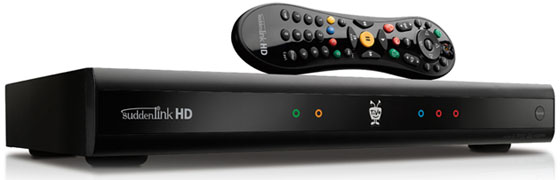
Suddenlink's New TiVo DVR

The company has also lit new fiber connections to handle data communications, primarily for business customers, and is upgrading its broadband service to fully support DOCSIS 3, which will deliver faster speeds and less congested service.

Customers in the state are also among the first to get access to a new and improved DVR box built on a TiVo software platform.  Suddenlink’s “Premiere DVR” service ($17/mo) is now available in Midland, Floydada, Plainview, Amarillo, Canyon, and Tulia.

The Bad — “Suddenlink Residential Internet Service is for Entertainment” Purposes Only

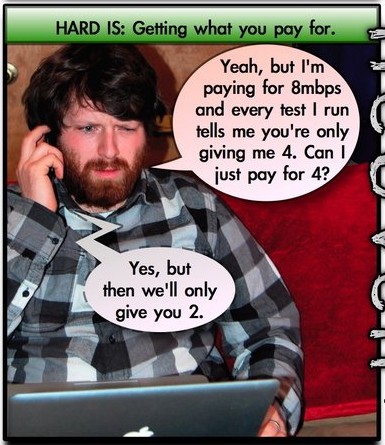
The Humboldt County, Calif. Journal's "Seven-o-heaven" comic strip commented on Suddenlink's problems. (Click the image to see the entire strip.)

Do you take your broadband service seriously, or is it simply another entertainment option in your home?  If you answered the latter, this story may not be so surprising.

In Humboldt County, Calif., broadband users started noticing their favorite web pages stopped updating on a regular basis.  At one point, a blogger in McKinleyville noticed he couldn’t manage to post comments on his own website.  But things got much worse when several web pages started reaching customers with other users’ names (and occasionally e-mail addresses) already filled in on login screens and comment forms.

It seems Suddenlink started to cache web content in the far northern coastal county of California, meaning the first customer to visit a particular website triggered Suddenlink’s local servers to store a copy of the page, so that future customers headed to the same website received the locally-stored copy, not the actual live page.

But the caching software went haywire.

Web visitors began to receive mobile versions of web sites even though they were using home computers at the time.  Some were asked if they wanted to download a copy of a web page instead of viewing it.  And many others discovered websites were customized for earlier visitors.

While the caching problem was irritating, the privacy breaches Suddenlink enabled were disturbing, as was the initial total lack of response from Suddenlink officials when the problem first started in late January.

The Journal finally reached a representative who provided this explanation:

Suddenlink Senior Vice President of Corporate Communications Pete Abel knew that a cache system had recently been installed in Humboldt County, but was unaware of the particular problems reported by users. After speaking with the Journal and other Suddenlink employees, though, he released a statement explaining what appeared to have happened.

According to the release, the cache system was installed in Humboldt County on Thursday, Jan. 27 — the very day that users began experiencing problems — and was intended as an interim solution to relatively low Internet speeds in Humboldt County. The system, it said, was able to cache only unsecure websites — those which, unlike almost all reputable banking or commerce systems — do not encrypt communications. But the company eventually discovered the problems that its customers had been reporting and, having fruitlessly worked with its vendor to find a solution, turned the system off on Monday.

“The good news is that secure Web site pages will not have been cached,” Abel said in a follow-up call to the Journal. “And I have been assured 100 ways from Sunday that never would have happened.”

Andrew Jones, who runs a blog with his Suddenlink broadband account, tried to opt out of the web caching and received an interesting response, in writing, from a Suddenlink representative.  He was told he could not opt out of cached web pages with a residential account because, “the residential service is for entertainment only.

Jones was told he would have to upgrade to a business account to escape the cache.

“If a small local radio station intermittently went off air for multiple days, the radio host would be apologizing and explaining the situation,” Jones wrote the Journal. “If a large utility company experienced sporadic power outages, people could hear a recording on a toll-free number to learn the cause and about ongoing repairs. What does an Internet provider do when web access becomes spotty and begins serving customers old copies of web pages? The company gets back to you in a couple days and suggests you pay more if you don’t like its recently degraded services.”

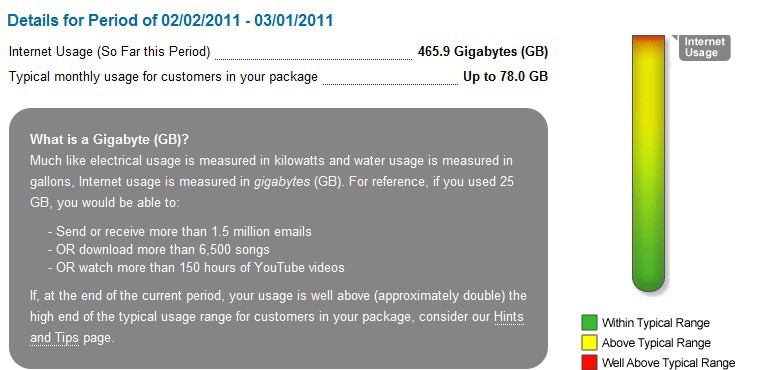
The Ugly — Suddenlink’s New Usage Meter Suggests 43GB is An Appropriate Amount of Usage for Standard Internet, 87GB is Plenty for Their $60 Premium Package

Although Suddenlink has not formally adopted an Internet Overcharging scheme of usage caps or metered billing, the company is sending automated e-mail messages to customers who exceed what they call “typical monthly usage for customers in your package.”  The e-mail tells customers they may be infected with a virus or someone else could be using your connection without your permission.  Boo!  For the uninitiated, this kind of message can bring fear that their computer has been invaded, either with malicious malware or the neighbor next door.

Customers have also received letters in the mail from the company telling them to check out their new “usage meter.”  Several have been sharing how much they’ve racked up in usage during the month on Broadband Reports.  One customer managed 243GB while another looking at the company’s super premium 107/5Mbps package managed a whopping 786GB.

Although the wording of the message has strenuously avoided telling customers they are wrong for this amount of usage, the implication is clear to many: they are counting your gigabytes and identifying the outliers.  One customer called it Suddenlink’s “You’re actually using your connection, and we really wish you wouldn’t”-message.

“No one with an ounce of sense would pay for a 20/3Mbps connection and only use 78 GB in a month. Let’s hope they’re just making cute suggestions, not easing us into a cap, because that just won’t fly,” wrote one West Virginia customer.

Another in Georgetown, Texas did the math and made it clear 43GB better not turn out to be a cap because it means customers can barely use the service they are paying for.

“It’s way too low. I got 10Mbps [service] because of price/value and not because I use less than 43GB,” he writes. “[Even] if I downloaded at 1.25MB/s for 30 days straight (1.25 * 2592000 seconds) I could [still] grab 3.164TB.”

Clyde (Courtesy: KUSH Radio/Donna Judd)

Meanwhile, some controversy over the quality of Suddenlink’s service during the upgrade process had some residents in Cushing, Okla., up in arms at a recent city meeting.  Lorene Clyde complained Suddenlink’s “new and improved” service is worse than ever.

“I’m tired of paying for a service I’m not getting,” Clyde said.  “And the Suddenlink commercials – they are like rubbing salt in a wound.”

KUSH-AM reporters were on hand to cover the event, noting Clyde was not the only one complaining.  The radio station noted that “the buzz around town echoes her sentiments – from the ‘mildly irritated’ to the ‘downright mad’ – citizens have been complaining.  Not only have they been complaining to Suddenlink – as difficult as that may be (the call center is in Tyler, Texas) – but to city leaders.”

What Clyde and others may not have realized is that Suddenlink officials were in attendance and were able to apologize for the problems, but a growing consensus among consumers and city leaders is that a broad-based refund for the poor service was warranted.

Commissioner Joe Manning said while he appreciated the promise to figure out the problem, it wasn’t good enough to just apologize and promise – that subscribers’ bills should be adjusted to reflect the poor service.

Commissioners Carey Seigle and Tommy Johnson agreed with Manning.  Seigle pointed out it would be “good P.R.” to give some sort of rebate across the board to subscribers while Johnson complained that the original “upgrade” was only going to take a few weeks and now 8 months later – things are not better, but worse, noted the radio station.

Suddenlink officials on hand said they did not have that kind of authority, but continued to promise things are going to get better.  “I pledge to you,” one said, “We will find it [the problem] and fix it.”

[flv]http://www.phillipdampier.com/video/KJTV Lubbock Borrowing Wi-Fi 2-7-11.flv[/flv]

KJTV-TV in Lubbock, Texas talked with Suddenlink about the growing trend of neighbors “borrowing” neighbors’ unsecured Wi-Fi networks.  Other than the accidental recommendation that consumers should “invest in Internet spyware” to keep your computer safe, the report does a fair job of shining a light on a practice that could have financial consequences if the provider implements an Internet Overcharging scheme.  (2 minutes)

Al Jazeera English on American Cable? Why Not? Russia and China Already Are

Phillip Dampier March 3, 2011 Consumer News, Editorial & Site News, Video Comments Off on Al Jazeera English on American Cable? Why Not? Russia and China Already Are

With all of the tumultuous events in the Middle East, the debate over whether to allow Al Jazeera’s English language service on America’s cable systems has begun again, with commentators on the right accusing the channel of being the next best thing to Osama bin Laden anchoring the six o’clock news, and some on the left demanding carriage just to make a point.  But the real question left unanswered is, “how much is this channel going to cost cable subscribers?”

Al Jazeera English managing director Al Ansteys has been negotiating with Comcast and Time Warner Cable, America’s largest cable operators, to find out — and ultimately win carriage of the 24 hour English-language news network on both cable systems.

Arriving at Comcast headquarters in Philadelphia with 13,000 signed petitions for Al Jazeera English, Ansteys said the sheer number of requests should extinguish any doubt that Americans want better coverage of events in the Middle East from the network.

Nearly 8,000 Time Warner Cable subscribers signed petitions and another 1,000 Cablevision subscribers echoed the sentiment.

Time Warner Cable already has experience carrying international news outlets.

The company recently expanded the reach of Russia Today (RT), a 24-hour news network in English based in Moscow and funded by the Russian government.  The channel is the equivalent of an external television service to compliment The Voice of Russia (formerly Radio Moscow), a station familiar to every shortwave radio listener.  Although the Russian government goes out of its way to declare the RT’s journalistic independence, the firewall between the Kremlin and channel’s newsroom has been tissue-thin at times.  Reporters have learned how to cover certain stories, and which ones to avoid.  RT’s news and current affairs programming compliment the foreign policy priorities of Kremlin.

RT’s coverage of the Middle East is occasionally anti-American to the point of stridency.  Some reports on the channel infer the United States government has thrown its former allies under the bus, others claim everything Washington does in the region has to be reviewed by Jerusalem before passing muster.  Message: the Obama Administration’s policies are out of touch, unreliable, and incoherent.  You can get much the same view from Sean Hannity any evening on Fox News, but RT is no right-wing paradise.  Liberal American talk radio host Thom Hartmann has a regular show on RT — The Big Picture.  The news channel also devotes a considerable amount of time talking to fringe commentators across the ideological spectrum, and even has spent time with 9/11 conspiracy theorists.  When that is finished, it’s time for the weather in Minsk.

Russia Today

The presentation is light years ahead of the shortwave service, whose studios still have all the acoustical qualities of a subway station restroom.  Posh British accents and modern graphics make the channel blend in nicely with other international news operations like France 24, CBC Newsworld, BBC World, or CNN International.

But the bigger question is why I, and other Time Warner customers are getting another channel few asked to receive.  Quietly “soft-launched” in western New York on a digital channel in the 100’s, RT’s sudden presence wasn’t likely to draw much attention — and it hasn’t, — all part of its larger plan to expand cable carriage nationwide. If the channel (and others) succeed, it will be able to directly reach American audiences with a Russian point of view, without an American gatekeeper.

As of last month, the effort expanded on radio as well.  New York City area radio listeners can now receive The Voice of Russia 24 hours a day on their AM radio dial, thanks to an agreement with WNSW 1430-AM in Newark, N.J., which has effectively leased out the station to Moscow.

This is the dream many international broadcasters have had for years — reaching an American audience that routinely ignores international voices.  During the Cold War, literally millions of watts were thrown back and forth as western stations fought eastern bloc jamming to deliver the Voice of America and Radio Liberty.  The Soviet Union and their satellites carpeted the shortwave bands with English language programming from stations as diverse as Radio Moscow, Radio Tirana, Albania and the Voice of Mongolia.  But it was a battle few Americans paid attention to, content to listen to local AM and FM stations.

As for Al Jazeera English — it is a credible news operation measured against today’s definition of “cable news” and delivers top rate coverage of the Arab Spring — the ongoing transformation of governments across the region.  If anything, their coverage revels in the new democratic possibilities open to the region. It’s not the BBC, but then again what passes for cable news in the United States these days isn’t either.

Al Jazeera makes the assumption you are already familiar with the region, and risks talking over the heads of those who are not, but wild claims that the network is some propaganda arm of Osama bin Laden or other assorted Islamic extremist groups just don’t match the programming.  In fact, one is much more likely to see anti-American rhetoric on RT than on Al Jazeera English, which is completely preoccupied with events closer to the Arab world.

The tone is far more Fareed Zakaria than Glenn Beck.  If you don’t know who those people are, you aren’t going to watch the channel anyway.  And there is the larger point — do we need more channels on the budget-busting cable dial?

Should Al Jazeera be allowed on America’s cable and satellite lineups?  Of course, especially if there is room for channels like RT or CCTV9, the Beijing-based 24-hour English language network from the People’s Republic of China, both seen on many Time Warner cable systems.  But they’d better come free of charge or sold a-la-carte if they are not.

[flv width=”640″ height=”500″]http://www.phillipdampier.com/video/WTXF Philadelphia Comcast Al Jazeera Debate 2-24-11.flv[/flv]

WTXF-TV in Philadelphia aired this screamfest debate over Al Jazeera English in the United States that completely misses an important point: who is going to pay for it? (6 minutes)

Search This Site:

Contributions:

Recent Comments:

Your Account:

Stop the Cap!