Home » Consumer News » Recent Articles:

More Broken Promises: Reps. Howard & Avila Renege and End Negotiations With North Carolina Cities

Phillip Dampier March 9, 2011 Community Networks, Competition, Consumer News, Editorial & Site News, Public Policy & Gov't, Rural Broadband Comments Off on More Broken Promises: Reps. Howard & Avila Renege and End Negotiations With North Carolina Cities

H.129 will insure rural North Carolina's broadband will resemble the backwaters of the Great Dismal Swamp.

Despite promises to protect North Carolina’s existing community-owned broadband providers, Reps. Julia “My Word is My Bond” Howard and Marilyn “I Do What Time Warner Tells Me” Avila have reneged and intend to ram through their anti-community-broadband bulldozer bill.

Stop the Cap! learned this evening that Avila has no intention of meeting with North Carolina communities again, even as resolutions continue to pile up in Raleigh condemning their special interest legislation.

Asheville and Rockingham County have joined the city of Raleigh issuing resolutions opposing H129 and are openly wondering why state legislators are so contemptuously overruling the interests of North Carolina communities for the benefit of out-of-state corporations.

The answer, clearly, is money.

Rep. Howard apparently answers to the interests of companies like AT&T, which has donated more than $1,500 to her campaign, CenturyLink — $4,000, and Time Warner Cable, which so far has shorted her with just $750.  It evidently doesn’t take much to influence a legislator these days, and we anticipate her telecommunications contributions will spike in the near future for a job well done.  That enormous contribution from CenturyLink is telling, considering they are not the primary phone company in Howard’s district.

As a result of the sellout, H129 will likely move to the Finance Committee as early as next Thursday, effectively unchanged from its original.  The implications for the state are staggering, particularly if it drives existing community networks out of business.  That will take the state’s bond rating with it.

Howard accepted $4000 from CenturyLink.

The sad part of all this is that both representatives were elected to serve the interests of their districts, and instead they are paying more attention to the well being of big cable and phone companies who honestly don’t need their help to earn enormous profits in the state.

While unserved communities and those stuck with dismal, antiquated DSL service have their pleas for better broadband ignored, Avila and Howard are doing all they can to sabotage the networks that do provide 21st century broadband to their residents.

With this kind of hostility, don’t look for Google to bring Gigabit broadband to the Tar Heel State anytime soon.  With all of the impediments and roadblocks these two legislators have thrown up on behalf of their friends at the cable and phone company, can Google expect to be treated any better?  The search giant even signed a letter strongly opposing H129, to no avail.

It’s not too late for Rep. Howard to prove us wrong.  She can turn this around in a second by demanding real exemptions for existing municipal networks — and I mean real exemptions, not the fake passes contained in the so-called substitute amendment.  Better yet, she can distance herself altogether from this disaster.

North Carolina residents must get on the phone and call Finance Committee members and tell them this broadband train wreck needs to stop in their committee with a resounding NO vote.

Let them know H129 will not only deliver years of sub-standard broadband service in the state, it will also ruin two showcase fiber networks, harm the state’s bond rating, and make North Carolina an also-ran in broadband innovation.

At a time when the state needs to move towards digital economy jobs, thumbing your nose at the likes of Google, Alcatel-Lucent, and Intel is a giant mistake — adding insult to injury to the potential loss of community broadband networks the cable and phone companies will stop at nothing to eliminate.

Finance Committee Members

(click each name for contact information)

Senior Chairman Rep. Howard
Chairman Rep. Folwell
Chairman Rep. Setzer
Chairman Rep. Starnes
Vice Chairman Rep. Lewis
Vice Chairman Rep. McComas
Vice Chairman Rep. Wainwright
Members Rep. K. Alexander, Rep. Brandon, Rep. Brawley, Rep. Carney, Rep. Collins, Rep. Cotham, Rep. Faison, Rep. Gibson, Rep. Hackney, Rep. Hall, Rep. Hill, Rep. Jordan, Rep. Luebke, Rep. McCormick, Rep. McGee, Rep. Moffitt, Rep. T. Moore, Rep. Rhyne, Rep. Ross, Rep. Samuelson, Rep. Stam, Rep. Stone, Rep. H. Warren, Rep. Weiss, Rep. Womble

Wall Street Journal Nonsense: Canada Just Ahead of U.S. in Introducing Internet Overcharging

Phillip Dampier March 9, 2011 Broadband "Shortage", Canada, Competition, Consumer News, Data Caps, Editorial & Site News, Net Neutrality, Online Video, Public Policy & Gov't, Wireless Broadband Comments Off on Wall Street Journal Nonsense: Canada Just Ahead of U.S. in Introducing Internet Overcharging

Jenkins

The Wall Street Journal attempted to attach its own conventional wisdom in an opinion piece about cloud-based streaming that suggests Canada “is just ahead of the U.S. in introducing usage-based pricing [and] has bloggers and politicians accusing Bell Canada of unconscionable ‘profiteering’ from usage caps. The company, they rage, is reaping huge fees for additional units of bandwidth that cost Bell Canada virtually nothing to provide.”

The author, Holman Jenkins, is a regular on the ultra-business friendly editorial page of the Journal, and has been raging against Net Neutrality and for higher Internet pricing for several years now.

Jenkins’ latest argument, just like his earlier ones on this subject, falls apart almost immediately:

This critique, which is common, could not more comprehensively miss the point. Another car on the roadway poses no additional cost on the road builder; it imposes a cost on other road users. Likewise, network operators don’t use overage penalties to collect their marginal costs but to shape user behavior so a shared resource won’t be overtaxed.

Jenkins needs to spend less time supporting his friends at companies like AT&T and Bell and more time exploring road construction costs.  If you are going to try and make an analogy about traffic, at least get your premise straight.

Before debunking his usage-based billing meme, let’s talk about road construction for a moment.  In fact, the kind of traffic volume on a roadway has everything to do with what kind of road is constructed.  In the appropriately named “Idiots’ Guide to Highway Maintenance,” C.J.Summers explores different types of road surfaces for different kinds of traffic.  Light duty roads in rural areas can get results with oil and stone.  Medium duty side streets and avenues are frequently paved with asphalt, and heavy duty interstates routinely use concrete.  Traffic studies are performed routinely to assist engineers in choosing the right material to get the job done.

Digital information doesn’t wear down cables or airwaves.  If broadband traffic occupies 5 or 95 percent of a digital pipeline, it makes no difference to the pipeline.  Jenkins is right when he says Internet Overcharging schemes are all about shaping user behavior, but for the wrong reasons.

Jenkins thinks Netflix and other high bandwidth applications face usage-based pricing to allow providers to keep their broadband pipes from getting overcongested:

Netflix is one of the companies most threatened by usage-based pricing, and it has quickly geared up a lobbying team in Washington. In a recent letter to shareholders, CEO Reed Hastings downplayed the challenge to Netflix’s video-streaming business. In the long run, he’s probably right—the market will settle on flat-rate pricing once the video-intensive user has become the average user.

In the meantime, however, Netflix shareholders had better look out.

In fact, providers are reaping the rewards of their popular broadband services, but almost uniformly are less interested in investing in them to match capacity.  It is as if the AT&Ts of this world assumed broadband users would consume    T H I S    M U C H   and that’s it — time to collect profits.  When upgrade investments don’t even keep up as a percentage of revenue earned over past years, the inevitable result will be a custom-made excuse to impose usage limits and consumption billing to manage the “data tsunami.”

Canadian providers did not slap usage caps on broadband users because Netflix arrived — they lowered them. Telling users they cannot consume the same amount of bandwidth they used a month earlier has nothing to do with managing traffic, it’s about protecting their video businesses by discouraging consumers from even contemplating using the competition.  Jenkins works for a company that understands that perfectly well.  News Corp., has a major interest in Hulu as well as satellite television services in Europe and Oceania.

The rest of Jenkins’ piece is as smug as it is wrong.  In attacking Net Neutrality supporters as “crazies” trying to defend their “hobby horse,” Jenkins claims public interest groups are pouting about usage-based billing, too:

All along, what the net neut crazies have lacked in intellectual consistency they’ve made up in fealty to the business interests of companies that fear their services would become unattractive if users had one eye on a bandwidth meter. That’s why opposition to “Internet censorship” morphed into opposition to anything that might price or allocate broadband capacity rationally. But such a stance is rapidly becoming untenable, whether the beneficiary is Google, with its advertising-based business model, or Netflix, Apple, Amazon and others who hope to capitalize on the entertainment-streaming opportunity.

All are betting heavily on the cloud. All need to start dealing realistically with the question of how the necessary bandwidth will be paid for.

Part of Jenkins’ theory calls back on his usual Google bashing — he perceives the company as a parasite stealing the resources bandwidth providers paid for, while forgetting the success of their businesses ultimately depends on content producers (who indeed pay billions for their own bandwidth) making the service interesting enough for consumers to buy.

But there is nothing rational about Jenkins’ support for Internet Overcharging.  North Americans already pay some of the highest prices in the world for the slowest service.  While providers attempt to lick the last drop of profits out of increasingly outdated networks (hello DSL!), their future strategy is less about expanding those networks and more about constraining the use of them.

Jenkins is ignorant of the fact several of Net Neutrality’s strongest proponents, Public Knowledge being a classic example, have not historically opposed usage-based pricing, much to my personal consternation.  As we’ve argued (and I submit proved), Net Neutrality and Internet Overcharging go hand in hand for revenue hungry providers.  If they cannot discriminate, throttle, or block traffic they consider to be costly to their networks, they can simply cap demand on the customer side with usage limits or confiscatory pricing designed to discourage use.  That is precisely what Canadians are fighting against.

It’s all made possible by a broken free market.  Instead of hearty competition, most North Americans endure a duopoly — a phone company and a cable company.  Both, particularly in Canada, have vested interests in video entertainment, television and cable networks, and other entertainment properties.  As long as these interests exist, companies will always resist challenges to their core business models, such as cable TV cord cutting.  It’s as simple as that.

The “realistic” way bandwidth will be paid for escapes Jenkins because his quest for condescension takes precedence over actual facts.  Content producers already pay enormous sums to bandwidth providers like Akamai, Amazon, and other cloud-based distribution centers.  Consumers pay handsomely for their broadband connections, part of which covers the costs of delivering that content to their homes and businesses.  AT&T and other providers don’t deserve to get paid twice for the same content.  Indeed, they should be investing some of their enormous profits in building a new generation of fiber-based broadband pipelines to keep their customers happy.  Because no matter how much data you cram down a glass fiber, the ‘data friction’ will never cause those cables to go down in flames, unlike Jenkins’ lapsed-from-reality arguments.


Time Warner Cable’s CEO Still Obsessed With Internet Overcharging: ‘It’s Inevitable’

Phillip Dampier March 9, 2011 Competition, Consumer News, Data Caps 5 Comments

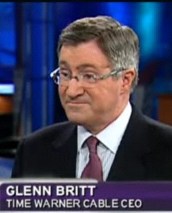
Time Warner CEO Glenn Britt just can’t get his mind off overcharging customers for their broadband service.

Despite increasing broadband rates twice in the past two years, Britt is still convinced slapping usage limits and so-called “usage-based billing” is inevitable for the nation’s second largest cable operator.

“I think you will naturally see evolve a world where people who use very little broadband expect to pay less and people who use a whole lot, may complain, but in their hearts know they are going to pay more than somebody who reads email once a week,” Britt told investors at the Deutsche Bank Securities Media & Telecom Conference in Palm Beach, Fla. “I think there will always be an unlimited tier, but I think you’ll see the element of consumption introduced over time.”

Time Warner Cable attempted to impose an Internet Overcharging experiment in the communities of Rochester, N.Y.,  Greensboro, N.C., Austin, San Antonio, and Beaumont, Tex., in April 2009.  Customer backlash over a tripling in price of unlimited broadband service — to $150 a month, forced those plans to be shelved.

But Britt has continued to make positive statements about the practice of raising rates on broadband customers ever since, claiming a small percentage of heavy users were increasing costs.

But Time Warner’s own financial reports tell a different story.  While the company increasingly depends on broadband profits to impress investors in its quarterly reports, the costs (and investment in) broadband has been declining for several years.  Broadband is Time Warner’s single best performing product, and the company has raised rates from $39 a month to as much as $58 — a $19 monthly increase, over the past few years in many communities.  The highest prices are reserved for customers who only take broadband from the cable company and ignore their cable TV and phone services.

Britt also expressed increasing concern over cable TV cord-cutting, the practice of dropping cable television service, to investors as the company continues to lose more subscribers than it gains.

“We need to really to focus on that with a renewed intensity,” Britt said . “It is not acceptable to me to continue to slowly lose video customers every year. That has been going on for too long. We’re going to put renewed energy against that both in the product space and in marketing, to see if we can slow that down.”

To that end, Britt has hired a pricing expert to develop different prices for different types of customers.  The disparity in pricing is already widely apparent.  With some promotional customer retention offers now providing the company’s triple play package of Internet, phone and television service (with DVR) for as low as $79 a month, that is less than half the regular price of up to $163.85/mo charged to customers in states like California, without DVR service.

A bare bones basic package of a handful of national cable networks combined with local stations is selling for as low as $29.99 in northeast Ohio in a last ditch effort to hang on to economically challenged TV-only customers.

Dollar-A-Holler Group Says Bill Shock Rules Will ‘Harm Consumers’; Higher Bills Are Good for You

Although more than 30 million Americans have experienced getting bill shocked with a cell phone bill loaded with overlimit fees and penalties, a wireless industry group says 19 out of 20 of these customers are economically better off getting those high bills, and any plan to notify customers in advance when their usage limits are reached would “harm innovation, limit consumer choice, and impair the potential for competitive differentiation.”

These incredible conclusions come in a filing from the Wireless Communications Association International, an industry group funded by AT&T, Sprint, Clearwire, and Time Warner Cable.

The WCAI just released a new white paper claiming Americans facing Internet Overcharging from usage-capped wireless data plans are actually saving money when carriers impose overlimit fees.  Their reasoning for this new math?  You might overpay for a usage plan that delivers a higher usage allowance than you need.

"And to think they actually believed us when we said Internet Overcharging saved people money!"

The wireless industry is heavily lobbying the Federal Communications Commission to stop the agency from imposing new rules to deal with the bill shock problem.  The FCC favors an advance warning system, which would force providers to notify customers by e-mail or text message when they near their usage allowance.  Letting customers know when they are about to pay enormous penalty usage rates before they are reflected on a future bill could save Americans millions annually.

The WCAI-funded study says consumers don’t need the agency’s help, going as far as to claim the majority of Americans are already well aware they are exceeding their plan limits, and are better off paying short-term penalties.

“The FCC is weighing new regulations that it says will eliminate so-called ‘bill shock,’ but this analysis makes plain that consumers don’t need regulators’ help,” WCAI President Fred Campbell said. “If you give them the right information, they know how to pick the best deal.”

But critics charge providers fighting this provision want to hide the most basic information of all — when consumers are on the verge of running up huge bills.

“The FCC’s effort on bill shock is long overdue in a wireless environment where today’s heavy user is tomorrow’s average user, and where the wireless Web is more and more important to commerce and to society,” Free Press Policy Counsel M. Chris Riley said. “It is vital that consumers are empowered with the information and the tools needed to make decisions about their own wireless usage so they can avoid outrageous charges.”

The WCAI white paper suggests that if providers are forced to issue advance warnings, companies may have to raise rates to compensate.  The paper’s author suggests consumers would find that worse than just paying the bills with overlimit fees:

The Nielsen Study indicates that many consumers incurring overages do so willfully and repeatedly. Their behavior suggests it is unlikely that usage notifications or usage controls would change their behavior because they are either indifferent to the overage charges or have determined that the occasional overage charge is more economical for them than choosing a more expensive plan. Notwithstanding that these overage-incurring consumers may not want or need additional notifications or controls, the adoption of the FCC‘s regulatory proposals would impose on all consumers the financial burden of ―protecting this one small group.

The WCAI dismisses the huge number of complaints that arrive at the FCC each year over this issue as simply “opinions” from consumers, not nearly as credible as their own analysis of actual customer bills.

The paper even argues with the definition of ” bill shock,” suggesting that the nearly 7 percent of wireless customers who blow past their voice allowances only face an average penalty of around $18.  That is “surprising or inconvenient; but it is unlikely to be shocking.”

Bill Shock

The WCAI study admits the dollar amounts for data-usage bill shock can be considerably higher, sometimes $100 or more.  The charges occur more frequently, too — impacting nearly 18 percent of customers.  But the group dismisses it as a rare occurrence anyway and that carriers will issue credits for astronomical surprise bills.  Besides, the paper concludes, when it was written most consumers were enrolled in increasingly-rare “unlimited use” plans.  Since the raw data was collected largely before AT&T abandoned its flat rate data pricing in 2010, statistics regarding bill shock for AT&T’s new limited use plans were not available.  The white paper inaccurately dismisses that major rate change, claiming it “had no impact on the data analyzed.”  That leaves readers believing the rate changes made no difference.

But the group’s logic completely derails when it concludes there are “consumer benefits to overages.”  Namely, providers “simplified” rate plans to reduce choice which was causing “customer confusion.”  The paper concludes “there is substantial evidence that consumers make deliberate choices to incur overages rather than upgrading to a more expensive monthly rate plan, and that they overwhelmingly benefit from such choices.”

The white paper ignores several important factors:

  1. The diminishing number of unlimited access plans which give consumers a way to avoid overlimit fees, especially for data;
  2. Carriers themselves arbitrarily set the arbitrary rules for the playing field – calling plan allowances, data allowances, limits, overlimit fees and penalties, and roaming rates;
  3. The study ignores the record number of consumers complaining about surprising bills and the true economic impact providing simple text message or e-mailed notifications would have, and doesn’t give any reason why a consumer can’t simply shut off services once limits are reached, to prevent excess charges.

The white paper notes that 736,000 Americans annually are getting surprisingly high bills.  Assuming they are an average of $20 higher than anticipated, that represents nearly $15 million dollars in extra revenue for carriers — ample reason to hire dollar-a-holler groups to produce nonsensical reports that conclude a system to notify consumers they are about to be one of those 736,000 customers is actually bad for them and their wallets.

The FCC’s Consumer Task Force recommends these strategies to avoid bill shock:

•    Understand your calling pattern for making voice calls, and ask your carrier for a plan that would be best for your kind of use.
•    If you are an infrequent phone user, consider a pre-paid plan. Because you “pre-pay” for all your minutes, these plans make it impossible to go over your set limit.
•    Understand what your roaming charges are and where you will incur them.
•    Understand your options for data and text plans.
•    If you are going to use your mobile phone outside the U.S. for voice, email, and other services, make certain to find out beforehand what charges may apply. (Visit Wireless World Travel for more information about using a wireless phone in other countries.)
•    Ask how your carrier can help you avoid bill shock – with phone or text alerts, by letting you monitor your account online, or by giving you other information.
•    If you have tried to resolve a billing issue with your carrier and can not reach an acceptable resolution, complain to the FCC. You can call our Consumer Center, toll-free, at 1-888-CALL FCC (1-888-225-5322), or file a complaint here.

To learn more, read the FCC’s White Paper on Bill Shock.

[flv width=”640″ height=”380″]http://www.phillipdampier.com/video/FCC Bill Shock.flv[/flv]

The Federal Communications Commission discusses the problem of “bill shock.”  (1 minute)

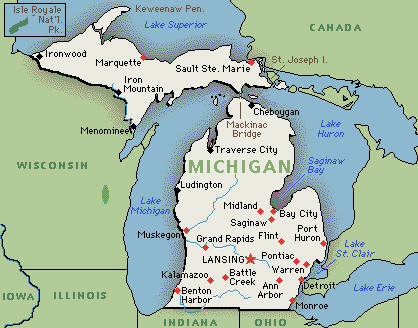
AT&T Pushing Michigan Towards Telecom ‘Reform’ That Is Bad for Consumers

AT&T stands to benefit enormously from the latest attempt to deregulate telecommunications services that could leave rural Michigan residents without a phone line, strips consumer protection and oversight rules to protect ratepayers, and wipes out the state Public Service Commission’s (PSC) traditional role of arbitrating telephone service and billing disputes.  In short, it delivers all of the benefits to AT&T and hangs up on Michigan consumers when their telephone service goes wrong.

AT&T  has found a real friend in Rep. Ken Horn (R-Frankenmuth), who introduced H.4314, a bill to overhaul Michigan’s telecommunications law.  Horn is AT&T’s top recipient of political contributions made by the company (and its employees) in the Michigan House.  He’s the third largest recipient of phone company money in the state, according to records from Project Vote Smart.  Horn’s bill delivers absolutely no discernible benefits to Michigan ratepayers.  Instead, Christmas comes early for big phone companies as Horn’s bill fulfills a wish list drawn up to eliminate decades of consumer-friendly protections:

  1. Eliminates the PSC’s annual report on telecom competition and rate fairness in Michigan;
  2. Allows AT&T to stop cooperating with the PSC in supplying information to help produce said report;
  3. Strips away the requirement that companies like AT&T keep proper records that show the costs of delivering their services to customers;
  4. Allows companies to keep secret the rates for services delivered by contract;
  5. Eliminates the requirement that companies like AT&T deliver “high quality basic local service” to all residents in the state;
  6. Expires all service quality standards established by the Commission on June 30, 2011;
  7. Allows companies to escape punishment by eliminating the PSC’s authority to issue fines, cease and desist orders, or revocation of service licenses when a company has violated state law;
  8. Requires all parties in a mediated dispute to keep the outcome secret;
  9. Eliminates state-mandated fair billing practices;
  10. Permits AT&T and other companies to sell, lease, or otherwise transfer assets and sell service to an affiliate below cost;
  11. Allows companies to discriminate in favor of an affiliated burglar and fire alarm service over a similar service offered by another provider;
  12. Eliminates the requirement that companies provide each customer a clear and simple explanation of the terms and conditions of services purchased by the customer and a statement of all fees, charges, and taxes that will be included in the customer’s monthly bill.
  13. Allows AT&T and other providers to market products and services without giving the customer a true and fair estimate of the real “out the door” price for service — after taxes, fees, and surcharges.
  14. Allows AT&T and other phone companies to discontinue service in any area provided with anything resembling a two-way telecommunications service including wireless, radio, or Voice Over IP service;
  15. Eliminates the telecommunication relay service advisory board, which ensures quality service to the hard of hearing and deaf communities;
  16. Reduces privacy guideline requirements protecting customers.

In tandem with Horn’s bill, AT&T released a congratulatory brochure reminding legislators they got the first half of their agenda enacted six years ago, now it is time for the rest of their dreams to come true.

Calling the proposed bill part of  “an innovation agenda to ‘modernize’ Michigan’s Telecommunications Act,” AT&T characterized the legislation as the ultimate red tape cutter, eliminating “a rotary phone mentality in a Smartphone, Wi-Fi world.”

Innovation, AT&T Style

But the proposed bill goes well beyond eliminating what AT&T considers outdated regulations and old phones — it could also eliminate phone service to Michigan’s most rural communities.

President Barack Obama was in Michigan last month to promote expanding broadband service, particularly in sparsely covered communities in the upper peninsula.  Large sections of Michigan remain underserved by AT&T, who does not extend DSL service into many rural areas.  Nothing in AT&T’s reform measure will bring broadband to these areas.  In fact, the bill grants AT&T permission to abandon landline service to these areas altogether, taking the prospects for DSL with it.

By winning an unrestrained playground for its products and services, for which it can charge whatever it likes — AT&T will follow Verizon’s lead and enhance service through its U-verse platform in urban and wealthy areas of the state at the expense of rural areas which are deemed unprofitable to serve.  While that’s great news for AT&T’s profit and loss statement, it hardly benefits the residents of Michigan who have helped build AT&T’s enormous network with decades of bill payments.

AT&T has a different position, of course. The phone company claims the bill will “better serve consumers” by eliminating “non-productive investments,” which really means investments in a landline network many Americans in more urban areas don’t care about anymore.  AT&T has focused much of its attention on its wireless network, which can deliver benefits to residents in Ann Arbor, Detroit, Saginaw and Grand Rapids, but is hardly a broadband replacement for Marquette or Elk Rapids — not with that 2GB monthly usage cap.  For urban dwellers, the promise of AT&T U-verse replacing AT&T DSL makes the phone company relevant in the broadband marketplace once again, but at the potential price of rural Michigan, who will never see the service in their neck of the woods.

AT&T claims their telecom reform agenda “means putting up a sign that says we are a state that gets it and will welcome and not restrain innovation,” the company says. “20th century regulations stand in the way of 21st century technology. Now is the opportunity to clear these roadblocks to investment and innovation.”

But AT&T’s policy bulldozer does far more than just sweeping away so-called “outdated” regulations.  It strips away fundamental consumer protection from unfair rate hikes, deteriorating phone service, billing errors, privacy protection, and the most basic right Americans have counted on for decades — the opportunity to purchase affordable landline service in even the most rural parts of the state.

Unfortunately, AT&T’s “innovation agenda” is deregulation at a price.  In Ohio, after similar legislation was passed, AT&T promptly raised rates on consumers last summer.  They did the same thing in California.  And Illinois.  Even U-verse, while delivering a second option for urban residents, simply does not save most subscribers money, especially after the introductory promotional rate expires.  It comes with rate hikes itself.

The Michigan Telephone Blog analyzes most of the bill’s outcomes with the same skeptical eye we have, and delivers a warning to other phone companies and businesses that could pay the price for AT&T’s version of “reform”:

If you are with a CLEC, an alarm company, or really any business that depends on telecommunications service in Michigan, you probably should have your legal department and/or your tariff guys looking at this bill.  If you belong to any type of consumer or business organization, especially one that protects senior citizens (who often hang onto the older technology, including the phone service they’ve always used) or small businesses (that often can’t move to other technologies for various reasons, particularly when they are located in less densely-populated areas), you should probably take a close look at this bill as well.

Search This Site:

Contributions:

Recent Comments:

Your Account:

Stop the Cap!