Home » Consumer News » Recent Articles:

New Hampshire’s Comcast Phone Service Outage: Like FairPoint Never Existed

Phillip Dampier March 28, 2011 Comcast/Xfinity, Consumer News, FairPoint, Video Comments Off on New Hampshire’s Comcast Phone Service Outage: Like FairPoint Never Existed

[flv width=”360″ height=”290″]http://www.phillipdampier.com/video/WMUR Manchester Comcast Service Outage 3-23-11.mp4[/flv]

More than two dozen New Hampshire communities were left without their Comcast “digital phone” service last week when a major service outage disrupted incoming and outgoing calls across The Granite State.  As businesses and consumers were advised to have cell phones on hand in case of phone outages, WMUR-TV in Manchester didn’t even mention the other alternative: the phone company… namely FairPoint Communications, the dominant landline provider in the state.  As some businesses and consumers panicked over the loss of their dial tones, they evidently forgot all about the company many New Englanders disconnected from their lives just a few years ago. (2 minutes)

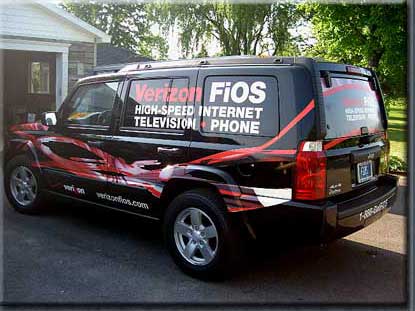
Verizon Launches FiOS-TV in Albany, NY; Company Still Expanding Service in Existing Markets

Phillip Dampier March 28, 2011 Broadband Speed, Competition, Consumer News, Verizon, Video 3 Comments

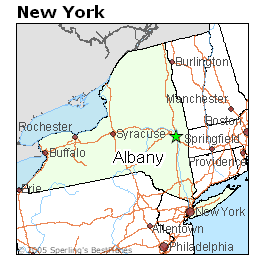
The 500 channel universe has arrived for around 23,000 households around the state capital as Verizon officially unveiled its FiOS television service last week.

The company added television to its broadband service offering after securing video franchise agreements in suburban Bethlehem, Colonie, Guilderland, and Scotia.  It also expects to win approval to provide television service to the nearby city of Schenectady and the town of Colonie shortly.

The arrival of Verizon’s triple-play package begins with a $100 monthly promotional package (go to Verizon’s FiOS website and the online price can be lower) including phone, Internet, and television service for a year, rivaling a similar $99 promotion on offer for new customers from incumbent Time Warner Cable. But Verizon delivers faster broadband service and more HD channels than its cable rival, and will deliver up to 535 channels to subscribers — 130 in High Definition.

“Consumers and small businesses in these communities at long last have a better choice for TV,” said Tracey Edwards, president and general manager for Verizon’s Upstate New York region. “We’ve had great success in many other parts of the state. Now it’s time to bring FiOS TV to this part of northeastern New York and provide customers in the region a choice that is truly different from the cable TV company.”
Verizon officials also claimed the introduction of FiOS TV would result in lower prices for local residents, a claim that does not necessarily hold up when examining the rates for each company.  Both deliver triple-play promotions and retention offers that come within a few dollars of each other.

Time Warner Cable says Verizon’s service does not come with the same local commitment to the region the cable operator has provided with its local news channel YNN, and features that allow customers to start programs over from the beginning or watch live streams of 32 channels on the company’s iPad application.

But the fact a new choice is now available has delighted some of our readers.

Jeff in Guilderland says a number of Albany residents were upset when Time Warner Cable unveiled its $99 promotion which turned out not to be available to existing customers.

“They only give the best prices to their least loyal customers who are ready to cancel their service or sign up as new customers,” Jeff says.  “We’ve had cable from these guys for over a decade and when we sought a temporary price break, they wanted to give us a $20 credit — thanks for nothing.”

Now Jeff says with Verizon around, Time Warner better offer more than that.

Verizon put expansion of its Verizon FiOS fiber-to-the-home service on hold more than a year ago, stopping new cities from winning new options made possible with fiber optics.  But Verizon is still continuing to meet its commitments to communities where the network has already broken ground.  Where communities have not given Verizon video franchise agreements, Verizon markets its broadband and phone options.  But delivering video completes the triple play package many consumers want.

[flv width=”640″ height=”500″]http://www.phillipdampier.com/video/Albany Gets FiOS TV 3-26-11.flv[/flv]

WNYT and WXXA-TV reports some Albany-area residents can now get FiOS TV, showing Verizon is still expanding its FiOS product line in areas where fiber has already been laid.  (3 minutes)

AT&T Censors Discussion of Internet Overcharging on its Website

AT&T’s support forums are being censored to stop a free and open discussion about the company’s elimination of an unlimited Internet experience.

We received word this morning from Stop the Cap! reader Roger, who tried to post a message including a link back to one of our stories exposing the myth of AT&T’s “congestion problems” to share with the large community of readers angry with AT&T about its Internet Overcharging scheme on its support forum.

“AT&T will not allow people to post links to your website,” Roger writes.  “Both myself and a friend of mine tried on two separate occasions to write messages that quoted from your facts and figures and linked back to them for readers looking for additional information, and AT&T removed them within minutes.”

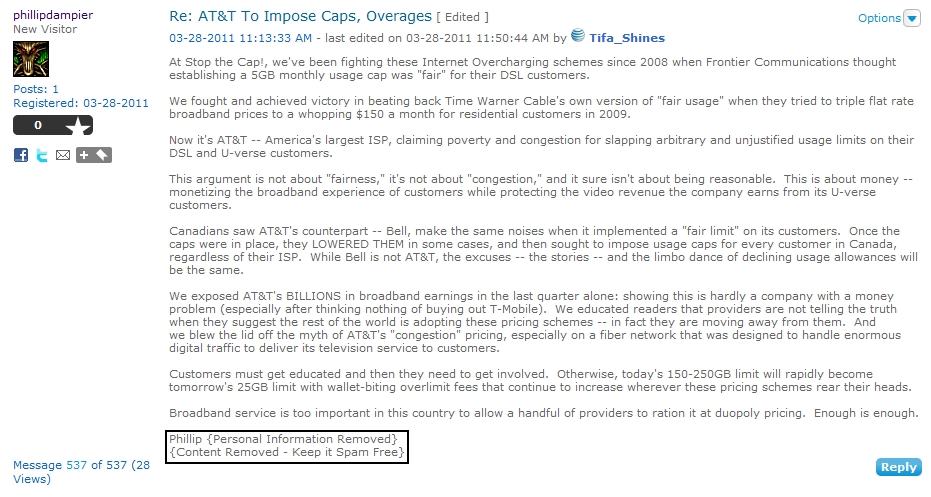
Stop the Cap! can confirm AT&T is actively engaged in censorship on its support forum when I tried posting a message myself to test the theory, under my real name, including three links to three individual stories, and signed with a link back to our website’s home page.  Sure enough, within the hour, AT&T stripped out the links and implied we “revealed personal information” (about myself in the form of my name, which still appears as my ‘handle’) and were “spamming” the forum — a stretch when the only links were back to the content referenced in the piece.  A few other linked sites, including Broadband Reports, are not suffering the same fate when users link back to their content, at least for now.

(click to enlarge)

AT&T followed up claiming it does not allow messages that support the work of third-party groups, even if that “support” comes only from links back to content referenced in the forum.

“At least your message remained partially intact,” Roger adds.  “Ours were deleted completely.”

“With AT&T’s heavy handed ‘editors’ at work, no wonder there are concerns about Net Neutrality.  AT&T censors first, asks questions later.”

Free Press’ Joel Kelsey Blows Telecom Talking Points Out of the Water on AT&T Merger

Gertraude Hofstätter-Weiß March 24, 2011 AT&T, Competition, Consumer News, Data Caps, Editorial & Site News, Public Policy & Gov't, T-Mobile, Video, Wireless Broadband Comments Off on Free Press’ Joel Kelsey Blows Telecom Talking Points Out of the Water on AT&T Merger

[flv width=”640″ height=”500″]http://www.phillipdampier.com/video/Bloomberg Kelsey Sees Higher Wireless Rates After T-Mobile Deal 3-24-11.flv[/flv]

Getting the mainstream media to cover issues in the telecommunications sphere usually means wading into the “business news” sections of newspapers or watching business cable news channels.  Unfortunately, too often these outlets cater to the whims and preconceived notions of the audience — big business.  In the case of the AT&T/T-Mobile merger, Wall Street loves the idea, but consumers do not.  Watch as Free Press’ Joel Kelsey handily deals with the gang at Bloomberg News, who are convinced mergers and acquisitions never result in price increases for consumers.  Has your cell phone bill gone up or down in the last three years?  (4 minutes)

BitTorrent CEO Willing to Appease Providers for Unproven ‘Bandwidth Congestion’

Phillip Dampier March 24, 2011 Broadband "Shortage", Broadband Speed, Consumer News, Data Caps, Editorial & Site News, Online Video Comments Off on BitTorrent CEO Willing to Appease Providers for Unproven ‘Bandwidth Congestion’

BitTorrent, the company behind the popular file sharing protocol routinely blamed by providers for overburdening broadband networks and by Hollywood for distributing pirated content, took a tentative step today to oppose Internet Overcharging schemes.

Eric Klinker, CEO wrote a guest piece for GigaOM calling out AT&T for its announced 150-250GB usage caps:

While the trend toward metered bandwidth is not inherently pro-consumer, ISPs have staked out a singular public rationale: data caps are necessary to limit the consumption of “bandwidth hogs” in order to protect the network experience for everyone else. Such concepts are simplistic and easy to imagine. They are also completely wrong.

And with that, Klinker stumbled into a public relations and marketing effort defending the company’s culpability for increasing broadband traffic, and proposing a resolution for their ‘part of the problem’:

Since any data traffic that doesn’t induce congestion on a fixed cost network is essentially free; applications can voluntarily play a role in traffic prioritization. And since BitTorrent is a high percentage of global Internet traffic, we have a responsibility to be a part of the solution.

This was the primary motivator around our release of a new protocol a year ago, called µTP. The protocol essentially senses congestion and self-regulates to avoid contributing to Internet traffic jams.

Because µTP can never induce network congestion, it doesn’t contribute to an ISP’s cost. An ISP still has regular network maintenance expenses, but remember, with a fixed-cost network, traffic only becomes an economic burden if it contributes to congestion and forces the need for expansion.

As a result, µTP is exceedingly friendly to ISPs and their business model. µTP is open-source, and we invite application and cloud services providers to work with us directly or in the IETF’s LEDBAT working group in the ongoing innovation and usage.

Klinker

Some providers and their allied interest groups have disputed the diminished impact Klinker cites as a benefit of µTP, but in provider-world, the BitTorrent “problem” is rapidly becoming yesterday’s news anyway — online video is the new boogeyman.  NPD Research just released numbers showing peer-to-peer use has dropped from 16 percent of all U.S. Internet users to 9 percent over the last three years.

After making a spirited sales pitch for what he hopes will represent peer-to-peer 2.0, Klinker surrenders on behalf of everyone else, arguing the solution to America’s ‘broadband crisis’ is speed throttles during peak usage periods, and time of day pricing.  Klinker suggests broadband users might need to plan their “on-demand” viewing well ahead, or face the kind of “congestion pricing” Londoners face if they attempt a journey by car into the city center at high noon.  Klinker suggests Netflix customers should pre-schedule downloads of their movies the night before watching them, or else pay a fee for instant gratification.

That assumes, of course, you know what you want to watch the day before you do, that you can download Netflix content (you cannot), and that you didn’t remember you could accomplish the same thing if Netflix shipped the DVD out to you by U.S. Mail.

Are broadband rationing coupons far behind?

Klinker’s willingness to submit his own company’s peer to peer technology to provider speed throttles is likely to earn him a dressing down by investors wondering what the future holds for a protocol that can be dosed with Xanax at provider will.  Handing over the power to make your file sharing technology painfully slow and frustrating is likely not going to win new converts, either.

Before willing to subject everyone to solutions for broadband providers’ scary predictions of a broadband exaflood, would it not be better to actually obtain verifiable evidence there is a congestion issue in the first place?

Search This Site:

Contributions:

Recent Comments:

Your Account:

Stop the Cap!