Home » Consumer News » Recent Articles:

2 of Every 3 AT&T Customers Paid Early Termination Fees Just to Switch to Verizon

Phillip Dampier March 24, 2011 AT&T, Competition, Consumer News, Verizon, Wireless Broadband Comments Off on 2 of Every 3 AT&T Customers Paid Early Termination Fees Just to Switch to Verizon

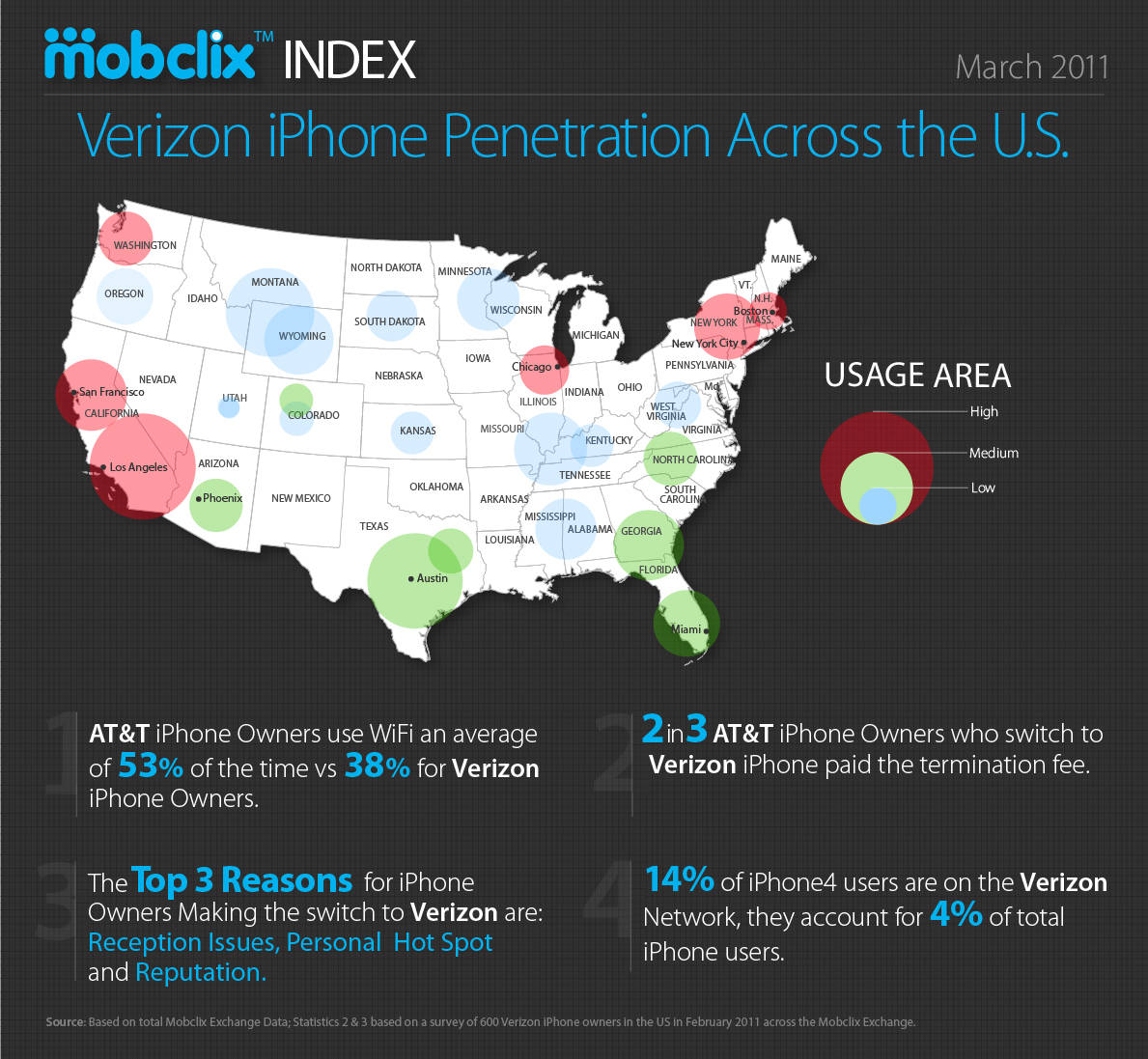
Verizon Wireless wins bragging rights this month as a new study shows fleeing iPhone owners on AT&T’s network were willing to put up money just to get out of their contracts and switch to Verizon. Two of every three departing customers paid AT&T up to $300 to break-up with the carrier and bought new iPhones that work on Verizon’s network.

The study, produced by Mobclix, found reception on AT&T’s network was by far the biggest issue cited by exiting customers, followed by Verizon’s offer of a personal hotspot add-on, and the perception Verizon runs a more robust network.

Mobclix found Verizon’s newest customers may have a point about who runs the stronger network.  Many AT&T customers are accustomed to relying on the company’s broadening Wi-Fi network to cope with 3G reception woes.  At least 53 percent of AT&T customers rely on Wi-Fi regularly for data connectivity.  On Verizon’s network, just 38 percent do.

But predictions of a stampede away from AT&T to Verizon have turned out not to be true, either.  Just 14 percent of America’s iPhone owners are on Verizon’s network.  AT&T serves the rest.

Analysts suspect the reason for this is that AT&T’s worst problems are in certain major metropolitan areas, but the carrier does respectably well providing service in many smaller and medium-sized cities.

Mobclix produced a map which may bear this out.  It shows the largest concentration of Verizon iPhone owners in the cities that are routinely cited as problem areas for AT&T:  San Francisco, New York, Seattle, Chicago, Boston, and Los Angeles.

“Based on our survey findings today, it’s clear that consumers are taking control of their mobile destinies by evaluating carrier criteria such as Wi-Fi usage, reception issues and reputation as part of their decision to remain with their carrier or make a switch,” said Krishna Subramanian, Mobclix co-founder.

(click to enlarge)

The Very Definition of Antitrust: AT&T and T-Mobile Deal is a Consumer Disaster

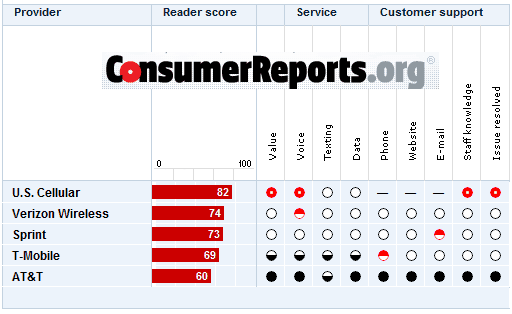
Consumer Reports underlines the point: America's worst cell phone company promises America better things by merging with America's second-worst cell phone company. Is this a good deal for America or just for AT&T and T-Mobile?

This morning’s announced deal of a merger between AT&T and T-Mobile is what antitrust rules were made to prevent.  This bold merger would not have even been attempted had the two companies believed they could not get it past supine regulators and members of Congress who receive substantial contributions from AT&T.

Ordinary consumers can see right through AT&T’s business plans, so why can’t our regulators and policymakers?  In a word, money.

The FCC’s own National Broadband Plan delivers clear warnings that the growing concentration in the wireless industry will hamper better broadband in the United States, not enhance it.  Reduced consumer choice and competition takes the pressure off carriers to innovate, expand, and keep wireless costs under control.

Reducing the number of players on the field delivers countless benefits to carriers and their shareholders.  But for consumers, there is nothing but a few promised spoonfuls of sugar to help the industry’s agenda go down — with vague promises of better rural service, faster wireless data, and new handsets.

In a truly-competitive marketplace, Washington regulators need not exact promises of better service from mega-sized carriers: the much-vaunted “free market” would deliver them naturally, as competitors invest and innovate to succeed.  But that kind of market is increasingly disappearing with every merger.

Nowadays, officials at the FCC and Justice Department are willing to accept deals if they promise some token bone-throwing, at least until the company lobbyists inevitably manage to get those conditions discarded during the next round of deregulation — cutting away rules that “tie the hands” of companies picking your pockets.

Money makes the impossible very possible, and AT&T intends to spend plenty to earn plenty more down the road.  Let’s review how the game will be played, and what you can do to stop it.

The “Free Market” Crowd Sells Out

Randolph May is willing to sell robust competition down the river if it means he can get 4G network access faster.

When the chorus of capitalism capitulates on the most important formula for success in a deregulated marketplace — robust competition on a level-playing field, we know there is a problem.  Take Randolph May.  He works for the free market think tank Free State Foundation.  Watch what happens when even the most ardent supporter of ‘letting the marketplace sort things out’ twists and turns around admitting America is facing a future duopoly in wireless:

“In an ‘idealized’ marketplace, the more competitors the better. But the telecom marketplace is not an idealized market. It is one that requires huge ongoing capital investments to build broadband networks that deliver ever more bandwidth for the ever more bandwidth-intensive, innovative services consumers are demanding,” he says.  “My preliminary sense is that the benefits from the proposed merger, with the promise of enhanced 4G network capabilities implemented more quickly than otherwise would be the case, outweigh the costs. Even after the merger, the wireless market should remain effectively competitive with the companies that remain.”

That’s a remarkable admission for someone who normally argues that marketplace fundamentals are more important than individual players.

May is willing to sell a robust competitive marketplace down the river in return for 4G — a standard AT&T is hurrying to bring to its customers threatening to depart for better service elsewhere.  With this deal, disgruntled customers will have one fewer choice to turn to for service.

Make no mistake: a free, unregulated wireless marketplace requires more than two national carriers and a much-smaller third (Sprint) to deliver real competition.

The Dollar-A-Holler Phoney Baloney Astroturf Groups

AT&T will waste no time trotting out comments from non-profit groups essentially on their payroll who will peddle filings with regulators promoting AT&T’s business agenda in return for substantial sized donation checks to their causes.  The usual suspects, which include groups serving minority communities, will tout the “wonderful things” the deal will bring to their constituencies.

Already out this morning is this curious remark picked up by Broadcasting & Cable from Debra Berlyn, who claims to represent consumers as part of a group called the Consumer Awareness Project:

Beryln's consumer group has a few problems: It's not a group, it doesn't represent consumers, and she is an industry consultant.

“Wireless acquisitions over the course of the past decade have not led to price increases for consumers and, in fact, the statistics show that prices have declined during this period. While some consumer voices have focused on the loss of a wireless competitor in relation to AT&T’s recently announced plans to acquire T-Mobile USA, the news for consumers should be seen in another light with a focus on the benefits that this merger can bring to consumers across the U.S.”

Perhaps the first goal of any group trying to make consumers aware of anything is to actually have a website associated with your group.  The “Consumer Awareness Project” forgot this important first step, but we eventually found the “group” using a re-purposed web address, “consumerprivacyawareness.org,” and note they have only recently become significantly active on this issue, now peddling AT&T’s agenda with gobbledygook.

When Berlyn isn’t pounding out prose to benefit AT&T, she is making guest appearances in Comcast’s corporate blog or being a favorite source of industry-connected groups like the nation’s largest broadband astroturf effort, Broadband for America.

In fact, after some digging, one learns there are no actual consumers involved with the “Consumer Awareness Project.”  The entire affair is actually a project of a Washington, D.C., lobbying-consultancy firm — Consumer Policy Solutions, which counts among its services:

  • Federal advocacy: Legislative and regulatory advocacy work before Congress, federal agencies and the administration.
  • State and local advocacy: Policy development and implementation and grassroots mobilization.

That is the very definition of interest group “astroturf.”  But my favorite section of this company’s website is the promise paying clients will get Berlyn’s experience “in communicating complex language and issues into easily understandable, applicable messages for consumers.”

Such as: AT&T’s merger with T-Mobile is good for consumers, even if it raises prices and reduces competition.

I’m sold.

The Cowardly Lion & A Myopic Justice Department

FCC Chairman Julius Genachowski's cowardly cave-ins set the stage for AT&T's bold merger move, believing they have government oversight under their control.

The first hurdle this deal will need to overcome is among Washington regulators, most of whom are either way over their heads understanding the implications of super-sized mergers like this or are simply terrified of going out on a limb with a multi-billion dollar company that can create headaches for your agency in Congress.

AT&T will sell this deal within a very limited context of the deal itself, and urge regulators to ignore “emotional” issues about the increasingly concentrated wireless marketplace.  Verizon did much the same with its acquisition of Alltel — urging regulators to ignore the fact they were removing a player in the market and focus instead on the benefits Verizon’s size and scope could bring to existing Alltel customers.  Of course, in many areas Alltel served, customers were free to do that themselves simply by signing up for Verizon service.

Dan Frommer, a senior staff writer at Business Insider, delivers a TripTik outlining AT&T’s roadmap to deal approval:

“AT&T believes its experience with regulatory review has given it a good picture of what’s realistic and what isn’t from an approval standpoint, and believes it can frame the deal in a way that won’t be rejected,” he writes.  “AT&T says the Feds are looking at “the facts” — hinting that they aren’t acting based on emotions or politics. Though, no doubt, there will be plenty of jockeying in the press and among lobbyists from those on both sides of the deal.”

But Frommer wades in too deep and drowns his credibility claiming the combination of some of the largest wireless carriers in the country still leave plenty of competitors.  Besides Verizon, there is just a single national player of consequence remaining – Sprint.  MetroPCS and Cricket deliver service in urban areas in selected cities. US Cellular, Cellular South, and several others deliver service to an even smaller number of communities, entirely dependent on large carriers for roaming coverage.

The Justice Department’s typical solution to antitrust concerns is to force limited concessions like divestiture of assets in particularly concentrated markets.  In most cases, companies agree because those assets are often redundant and would be sold anyway, or cover such a limited area as to be inconsequential to the greater deal.  Former Alltel customers found themselves traded first to Verizon and then divested away to AT&T.

Most of the customers divested away from T-Mobile’s future with AT&T will likely end up switched to Verizon, hardly a success story for increased competition.

FCC lawyers will likely review this transaction with a narrow scope, too.  Instead of contemplating the implications of the inevitable duopoly that could result, the FCC will likely find itself negotiating over individual details of the deal without considering an outright rejection of it.
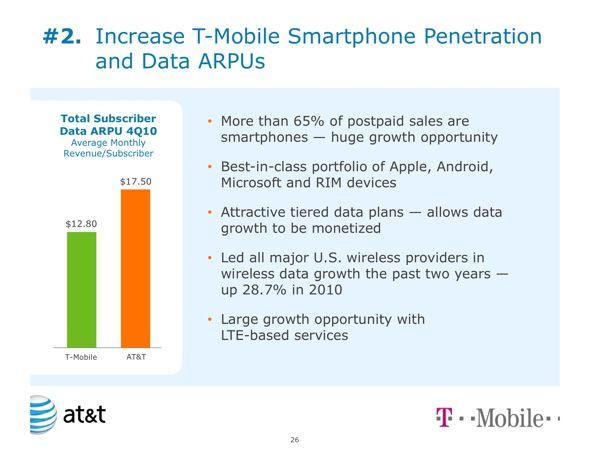
AT&T admits they are on a mission to monetize data usage.

At the FCC, Julius Genachowski’s performance as a regulator has been nothing short of a disaster, pleasing almost nobody in the process.  His “cowardly lion” approach to regulation has delivered rhetoric without substance and a whole lot of broken promises.  Genachowski has proven to be unable to stand up to the companies he is tasked with regulating.  With two Republican commissioners likely to favor the deal and Michael Copps almost certainly in opposition, it will be up to Julius Genachowski and Mignon Clyburn to vote this deal up or down.

But regulators are also responsive to Congressional pressure and dramatic backlash by consumers, such as what happened just a few years ago when big media companies lobbied to relax media ownership rules.  When consumers (and voters) revolt, regulators will change their tune… and fast.

What You Can Do

Consumers can make a difference in what comes next for T-Mobile and AT&T.  The first step is to make this an issue with your member of Congress and two senators.  Let them know you have profound concerns about another huge wireless merger.

There is simply no tangible benefit that can outweigh the loss of another important competitor in the American wireless marketplace.

AT&T’s bottom-rated service will not become any better acquiring the second-to-last rated service.  The company must invest in its network to compete, not simply pick off competitors to save money.  The loss of T-Mobile would mean only three national carriers, and it is highly unlikely Sprint would be able to withstand pressures on Wall Street to merge themselves away, probably to Verizon.

Tell your elected officials the AT&T/T-Mobile deal is a consumer nightmare and should not be approved under any circumstances.

[flv width=”360″ height=”290″]http://www.phillipdampier.com/video/Bloomberg Glenchur Says Regulatory Risk Substantial for ATT 3-21-11.mp4[/flv]

The always optimistic Bloomberg News says AT&T’s deal could still get past regulators, but there is a substantial risk as well.  Consumers can help make that risk unsustainable by telling the Obama Administration and Congress better broadband does not come from a duopoly, no matter how well-intentioned.  (4 minutes)

AT&T Promises Its Worst-Rated Service Will Improve In Merger With Second Worst-Rated T-Mobile

Dismissing the implications of an antitrust regulatory review not seen in the United States for years, AT&T this morning officially unveiled its intention to acquire T-Mobile in a $39 billion deal that will give AT&T nearly 40 percent of the American wireless market.

With a combination of the two companies, the new super-sized AT&T would become America’s largest wireless operator, and deliver nearly three out of every four wireless customers to just two companies — AT&T and Verizon.

Wall Street is delighted.

“Phenomenal deal if it happens,” said Jonathan Chaplin, an analyst with Credit Suisse Group AG. “Huge upside for AT&T — [T-Mobile owner] Deutsche Telekom getting a great price; however, we believe regulatory risk is enormous.”

That may prove an understatement, if public interest groups have their way.

“The combination of the second-largest wireless carrier, AT&T, with the fourth-largest, T-Mobile is, as former FCC Chairman Reed Hundt once said, ‘unthinkable,'” said Public Knowledge President Gigi Sohn. “We urge policymakers to think similarly today. The wireless market, now dominated by four big companies, would have only three at the top. We know the results of arrangements like this – higher prices, fewer choices, less innovation.”

“It’s difficult to come up with any justification or benefits from letting AT&T swallow up one of its few major competitors,” said Parul P. Desai, policy counsel for Consumers Union. “AT&T is already a giant in the wireless marketplace, where customers routinely complain about hidden charges and other anti-consumer practices.”

...Ourselves with AT&T

“I think it could reach some level of controversy,” said an antitrust expert, who worked for the Justice Department’s antitrust division. “There’s going to be spectrum issues. This is going to be a complex deal and I don’t think it’s a foregone conclusion that it will be approved.”

Despite the concerns, AT&T is confident that regulators have been sufficiently cowed by the company’s lobbyists to approve just about anything they bring to the table.

AT&T CEO Randall Stephenson told reporters on a conference call that the company spent plenty of time doing “homework” on how to get the deal to pass regulator scrutiny.

The American carrier even bet its winning outcome with a $3 billion cancellation fee, payable to Deutsche Telekom if the deal cannot be consummated.

In AT&T’s presentation this morning, the company promised they would improve America’s worst-rated cell phone company by merging with America’s second worst-rated cell phone company.  Specifically, AT&T says the deal will bring T-Mobile’s wireless spectrum allocations to the larger carrier, which can alleviate spectrum shortages.  The company also promised, in return for deal approval, expand service in more rural locations and quicker upgrades to the next generation of speedy wireless data — LTE.

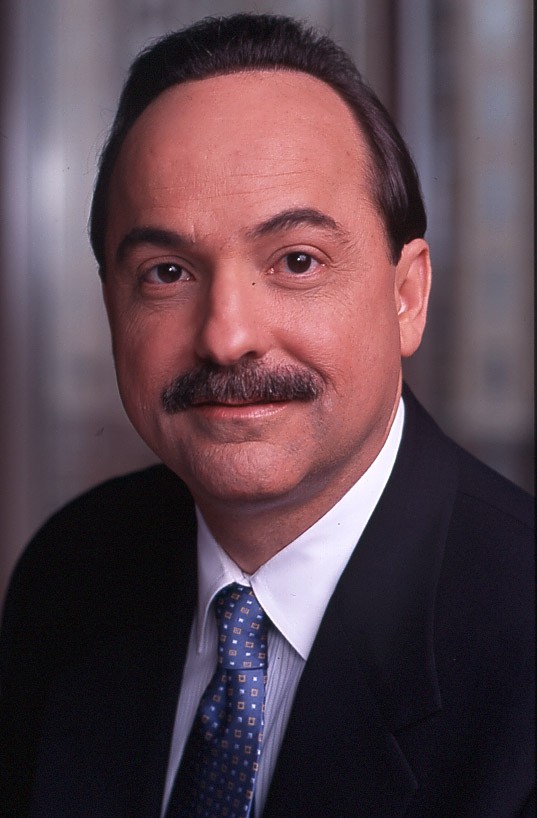
Ralph de la Vega

Ralph de la Vega, AT&T’s president and CEO of Mobility and Consumer Markets, showed slides promising T-Mobile customers would benefit from new choices in cell phones and would enjoy AT&T’s far larger nationwide network, delivering improved service.  But he also hinted it would cost value-oriented T-Mobile customers, promoting the deal’s potential of winning new revenue from customers soon forced to pay AT&T’s significantly higher prices.

AT&T claimed the company still would face robust competition from Verizon, Sprint, and a number of much-smaller regional carriers like MetroPCS and Leap Wireless’ Cricket — themselves under pressure to merge.  But consumer groups are skeptical.

“Don’t believe the hype: There is nothing about having less competition that will benefit wireless consumers,” said Free Press Research Director Derek Turner. “And if regulators approve this deal, they will further cement duopoly control over the wireless market by AT&T and Verizon.”

“The FCC’s National Broadband Plan, issued last year, warned about the absence of sufficient competition in the wireless market. The possibility that three players would control nearly three-quarters of that market will surely trigger intense scrutiny by the agencies,” said Andrew Schwartzman of Media Access Project.

The deal has been under negotiation for several months between the German carrier and AT&T.  Many Wall Street analysts see the deal as a major win for T-Mobile, which has struggled mightily against the AT&T and Verizon juggernauts.  The German company wins a seat on AT&T’s board, a part interest in the carrier, and a high valuation on its network.  AT&T gets the country’s only other major carrier using the same technology it does — GSM — and picks up the potential of more robust coverage in the urban and suburban areas T-Mobile focuses on.  AT&T will also follow the time honored tradition of buying something they cannot afford outright — they will finance it with a generous credit line arranged by J.P. Morgan Chase.

[flv]http://www.phillipdampier.com/video/CNBC Mergers and Acquisitions ATT and T-Mobile Merger to Create Industry Giant 3-21-11.flv[/flv]

CNBC managed to achieve an exclusive interview with the CEOs of AT&T and T-Mobile about their merger.  As with most business media, don’t expect a lot of challenging questions in response to the claims made by the company executives about the merger or its impact on consumers.  (20 minutes)

South Africa Celebrates One Year of Uncapped Broadband Tomorrow; Rivals’ Money Party Ruined

Phillip Dampier March 16, 2011 Broadband Speed, Competition, Consumer News, Data Caps, MWEB (South Africa), Net Neutrality, Wireless Broadband Comments Off on South Africa Celebrates One Year of Uncapped Broadband Tomorrow; Rivals’ Money Party Ruined

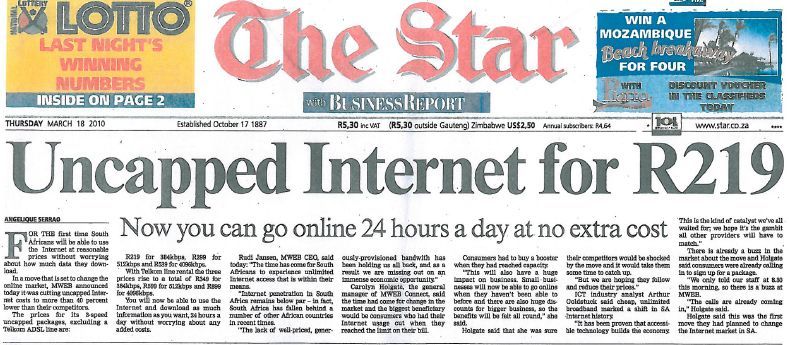
South Africans won uncapped broadband service one year ago tomorrow when an upstart provider — MWeb — unveiled its “Free the Web” campaign, delivering usage-limit free Internet access to customers across South Africa.

The company’s move to unlimited, flat rate service was heavily criticized by competing providers, who enforce draconian usage limits and have tried to convince customers the global trend was moving towards metered broadband.  But MWeb president Rudi Jansen dismisses the notion limiting broadband is the way to go, suggesting usage caps and meters are more about profits than serving customers.

Today, MWeb’s uncapped broadband is a runaway success, with more than 50 percent of its customers switching to the meter-free service.  It has been profitable, too.

“We are running ahead of our business plan and all our products are profitable,” Jansen tells TechCentral.

Now the nation’s semi-privatized, 39% state-owned phone company Telkom is widely expected to stop the erosion of its own broadband customers by adopting flat rate broadband service itself.

For Jansen, that would represent a welcome move.  The Internet visionary wants to transform South African broadband away from its current expensive pricing model and throw the Internet wide open.

“I’m looking forward to it,” Jansen says. “The sooner they launch it the better.”

The arrival of flat rate broadband made headlines across the country in 2010. (click to enlarge)

South African broadband has coped with challenges few other countries endure.  International connectivity has always been one of the biggest — sustaining traffic on satellite backbone links or underpowered undersea cables first forced providers to limit Internet use because of capacity concerns.  But new fiber-based underseas cables from Seacom and Wacs, including the forthcoming 5.1Tbps West African Cable System project will dramatically increase capacity and slash costs.

Jansen (Courtesy: TechCentral)

Yet several of his competitors want to keep the caps on and prices high, earning lucrative profits on a service Jansen says is becoming less costly to deliver every day.

Jansen admits MWeb is currently forced to traffic shape certain activities on his network, particularly bandwidth-intensive peer to peer traffic, because other providers in the country don’t agree with his wide-open view of the Internet.

He wants every provider in South Africa to agree to “open peering,” a practice that allows providers to exchange traffic with each other without charging transit fees.  He also wants to see wholesale mobile wireless pricing come down.  In Africa, mobile broadband has a strong place in a market where cable infrastructure (and broadband speed) is often lacking.

Telkom, South Africa’s equivalent to AT&T or Bell, is cited by Jansen as the biggest impediment to his plan to deliver truly unfettered, unlimited access.

Some South Africans deride the state phone company as "Hellkom"

In South Africa, broadband customers pay two providers — Telkom for the monthly rental of the telephone line and an ISP for the DSL service that connects through it.  Jansen says Telkom’s broadband line rental prices are too high.  But more importantly, the interconnection fee Telkom charges providers to access its network is “absolutely ludicrous.”

“Those prices are far more than the price of international connectivity,” Jansen says. “Telkom charges us to get access to their last mile and then charges end users to get access to the same last mile, so they make double money on it. And it’s completely mispriced.”

Despite the challenges from other providers, MWeb will celebrate the first anniversary of uncapped broadband tomorrow with a surprise announcement, probably targeting small business clients.

North Carolina Action Alert: Anti-Broadband Bill Railroad Stops at Finance Committee Tomorrow Morning

Phillip Dampier March 16, 2011 Astroturf, Broadband Speed, Community Networks, Competition, Consumer News, Editorial & Site News, Public Policy & Gov't, Rural Broadband Comments Off on North Carolina Action Alert: Anti-Broadband Bill Railroad Stops at Finance Committee Tomorrow Morning

Don't allow a "dollar-a-holler" mouthpiece for the broadband industry to speak on your behalf. Get on the phones and send those e-mail messages today!

H.129, Rep. Marilyn Avila’s (R-Time Warner Cable) anti-broadband bill has been moving full speed ahead as she hurries it through the state legislature before consumer outrage gets a chance to block it.  Tomorrow morning, it will make a stop at the Finance Committee, where we expect the bill’s broadband-killing language will remain largely intact, thanks to hard work from Time Warner Cable and their astroturf friends.

While Ms. Avila is e-mailing copies of a so-called “independent article” about H.129 written by a man who received a $20,000 check from Time Warner Cable and works for a telecommunications company-funded think tank to her colleagues, you need to be e-mailing, tweeting, and calling your friends and neighbors and get everyone to call or write the individual members of the Finance Committee immediately.

Here are the points you need to raise:

  1. Please vote NO on H.129, an unnecessary bill that does nothing to improve broadband in North Carolina;
  2. H.129 is sponsored by the state’s biggest cable and phone companies to protect their anti-competitive markets and guarantee high rates for slow service indefinitely;
  3. The fastest broadband at the fairest prices in the state comes from 21st century fiber optic networks that will be driven out of business if this bill becomes law;
  4. Although Ms. Avila and Chairwoman Howard promised to protect and exempt existing community broadband networks from the terms of this bill, they have not yet kept their promise;
  5. If the companies supporting this bill delivered broadband at the speed they are rushing H.129 through the legislature, North Carolina would not have a broadband problem;
  6. If rural communities cannot solve their own broadband problems, who will?  The companies that refused to provide appropriate service yesterday, today, and will continue to not do so tomorrow?

Make sure you remind your legislator this is not a Republican of Democratic issue — it’s a consumer issue, it’s an issue for every rural community, and it’s an issue for the future economic well-being of a state that needs digital economy jobs.

Finance Committee Members

(click each name for contact information)

Senior Chairman Rep. Howard
Chairman Rep. Folwell
Chairman Rep. Setzer
Chairman Rep. Starnes
Vice Chairman Rep. Lewis
Vice Chairman Rep. McComas
Vice Chairman Rep. Wainwright
Members Rep. K. Alexander, Rep. Brandon, Rep. Brawley, Rep. Carney, Rep. Collins, Rep. Cotham, Rep. Faison, Rep. Gibson, Rep. Hackney, Rep. Hall, Rep. Hill, Rep. Jordan, Rep. Luebke, Rep. McCormick, Rep. McGee, Rep. Moffitt, Rep. T. Moore, Rep. Rhyne, Rep. Ross, Rep. Samuelson, Rep. Stam, Rep. Stone, Rep. H. Warren, Rep. Weiss, Rep. Womble

Search This Site:

Contributions:

Recent Comments:

Your Account:

Stop the Cap!