Home » Consumer News » Recent Articles:

Breaking News: Google Selects Kansas City, Kansas for 1Gbps Fiber to the Home Service

Google announced this morning it has chosen Kansas City, Kansas as the site of the search giant’s experimental 1Gbps fiber to the home service.

The announcement came at 12 Noon ET on Google’s blog:

After a careful review, today we’re very happy to announce that we will build our ultra high-speed network in Kansas City, Kansas. We’ve signed a development agreement with the city, and we’ll be working closely with local organizations, businesses and universities to bring a next-generation web experience to the community.

Later this morning we’ll join Mayor Reardon at Wyandotte High School in Kansas City, Kansas, for an event we’ll carry live on the Google YouTube channel—be sure to tune in at 10am PDT to watch.

In selecting a city, our goal was to find a location where we could build efficiently, make an impact on the community and develop relationships with local government and community organizations.

Google’s video talked a lot about bandwidth and the need for more of it.  While Google is striving to bring one gigabit access to ordinary consumers, other providers like AT&T are seeking to limit it.  The competition between cities looking for super high speed access was fierce, demonstrating Americans are hungry for better, faster, and unlimited broadband service.  Unfortunately, some of the country’s largest providers want to deliver the least amount of service possible for the highest price.

Google’s project is likely to call out more than a few providers, but until companies like Google can deliver real competition to America’s phone and cable broadband duopoly, only a handful of communities like Kansas City will exist as an oasis in the broadband desert AT&T wants to create across its middle-America service area.

[flv width=”640″ height=”380″]http://www.phillipdampier.com/video/Google and Bandwidth.flv[/flv]

Google released this video showcasing what its 1Gbps network will do for the people of Kansas City, Kansas.  (3 minutes)

AT&T’s Measurement Tools Called Wildly Inaccurate: Suspiciously Usually in Their Favor

Phillip Dampier March 30, 2011 AT&T, Consumer News, Data Caps, Editorial & Site News 4 Comments

Imagine if your electric utility billed you for service based on a meter that was developed by the company, had no third party verification, no oversight by a Bureau of Weights and Measures, and wrote provisions into the company’s terms and conditions that allowed the company to terminate your service if you complained too much about the resulting bills.

Rethink possible.  AT&T.

When America’s largest phone company implements its arbitrary and unjustified Internet Overcharging scheme this May, it will bring its controversial usage meter to bear on every one of its broadband customers — a meter implicated in wild over-measurements of customers’ broadband usage — usage that will put customers perilously close to, or over the limits AT&T wants to establish.  The result?  Fat additional profits in the form of $10 overlimit penalties for every 50GB AT&T says you consumed for broadband traffic that costs them pennies to deliver.

The broadband usage meter is no stranger to controversy and lawsuits over accuracy issues.  Despite reflexive denials that a particular provider’s usage meter couldn’t be wrong, far too many have had to backpeddle and confess that the meter that should have measured $40 in usage and resulted in $4,000 bills instead “was in error.”

Whether providers are developing meters that are just flat inaccurate or are quietly putting a virtual finger on the scale to increase the opportunity of overlimit profits is unknown, but past history shows the meters typically overmeasure usage, not undercount it.

Without independent verification and ongoing oversight, some customers wonder if AT&T is sticking a virtual finger on AT&T's usage scale.

Some recent past history:

  • Telstra is Australia was implicated in December for a wireless usage meter that occasionally reported more than three times the usage measured by wireless phone owners’ built-in usage measurement tools.  Company representatives ended up crediting some customers as much as $3500AUD in inappropriate overlimit fees that should never have been charged.  Complaints continue to arrive as late as February about overbilling;
  • Telecom New Zealand’s usage meter overmeasured usage this month resulting in overcharges and throttled speeds under the ISP’s “fair use policy.”  One customer was billed for 27GB of usage during one overnight period, despite the fact the computer was switched off;
  • BT in the United Kingdom confirmed it overbilled some of their broadband customers in February when their usage meter measured usage for customers who had switched their computers off or took them away on holiday.  As far as BT was concerned, those computers were still at home and still racking up web usage.  Only last week, the company finally confessed their meter was inaccurate — overmeasuring usage that never happened;
  • AT&T’s counterpart in Canada — Bell, cannot manage to measure customer usage correctly either, so it suspended its usage tracker tool temporarily.  In February, one customer tired of overbilling proved a point when he took his computer to the United States just to guarantee it could not go near Bell’s network.  The result?  Bell said he used 500MB anyway;
  • In February, a class action lawsuit was filed against AT&T for “overmeasuring” wireless usage in some instances by up to 300 percent;
  • Last fall, Verizon was forced to refund $25 million dollars for phantom data usage charges for service many customers claimed they never used.
In virtually all of the prior incidents, a common pattern emerges, usually ending when providers fall on their swords, admit error and issue refunds:

  • Phase 1: Initial denials from providers there is a problem with the meter, usually blaming the customer, the customer’s measurement tool, or the process used instead;
  • Phase 2: Once proven to be an issue, an effort to downplay its significance and impact with claims that only a “tiny” percentage of customers were affected;
  • Phase 3: Refusal to submit usage meters, wholesale costs, and other components of Internet Overcharging to third-party verification;
  • Phase 4: Refusal to allow an independent audit of customer accounts to verify overbilled customers were properly refunded every penny of excess charges;
  • Phase 5: Class action lawsuit or government investigation commences;
  • Phase 6: Settlement reached with refunds or low value coupons to customers who take the time to request one;
  • Phase 7: Report excess profits from unclaimed refunds on balance sheet.

In too many cases, multi-billion dollar telecom companies that rely on those meters to measure and bill customers for their usage were implicated not for undermeasuring usage, but overmeasuring it — often substantially.

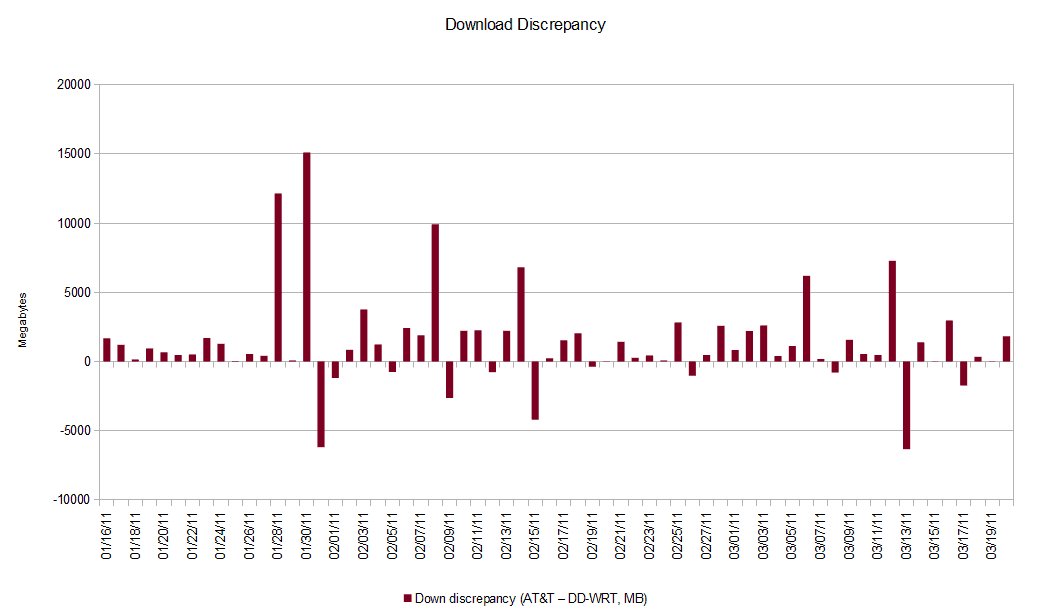
Some AT&T customers are already disturbed with what could be history repeating itself.  A reader of Broadband Reports in Skokie, Ill., compiled his own detailed analysis and found AT&T’s measurement tool grossly overmeasured his usage, and even worse, couldn’t do simple math and overmeasured him again when adding up his daily usage totals:

AT&T said that I had used 361GB in a single month! Surely this couldn’t be right. I’m a heavy user, but every time I even so much as glanced at my usage stats they’ve always been in the 200GB range. Surely something was amiss, so I decided to dig deeper.

It’s an old habit, but the first thing I do when I suspect something is wrong with any bill is enter all the line items into a spreadsheet and add them up myself. It sounds like busywork, but sometimes you’ll catch unlisted charges that have been phantomly added to your bill, or occasionally an outright math error. I couldn’t believe what I found. AT&T’s usage meter results insist I had used 341.39GB down, and 20.18GB up. But when I added all the daily detail entries (the DSL equivalent of a call log), only 332.8GB down and 0.72GB up are accounted for.

AT&T is claiming that I used 361.57GB of data, but according to their own daily data I only used 333.52GB, an 8.5% overcharge.
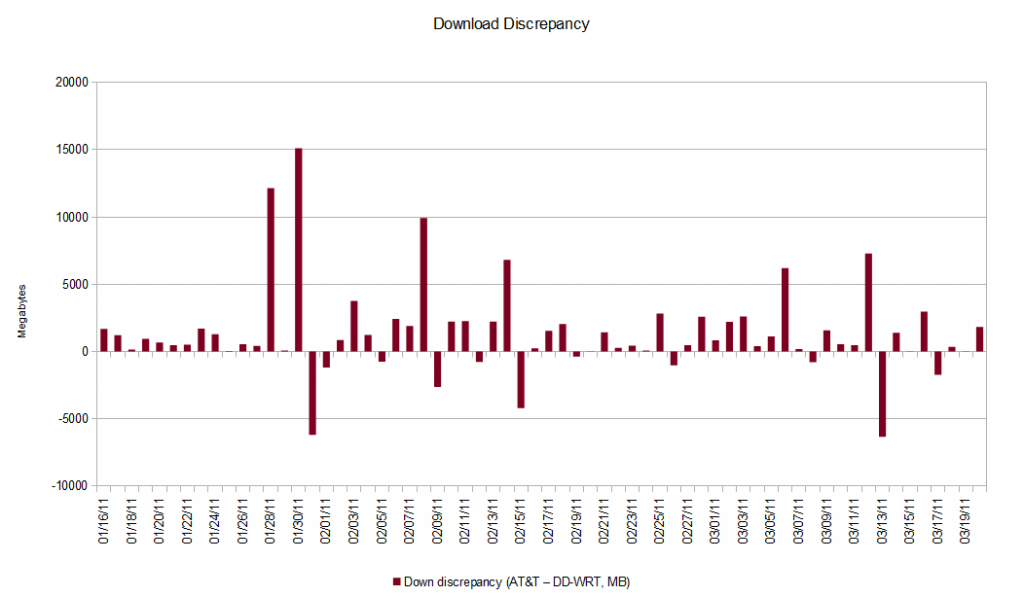
This AT&T customer discovered AT&T overmeasured his usage far more than it undercounted it. (Lines above the baseline show downstream traffic AT&T overmeasurement; lines below show undercounted usage. Click to enlarge.)

In total, this particular customer reports his usage was overmeasured by a whopping 33 percent. He is not alone.  A robust thread of similar results is active on Broadband Reports.

AT&T’s response to the early criticism follows the same path taken by other providers, starting with denials.

“We’re addressing ways we can make the labels and information on the online metering tool more clear for customers between now and May (when the new policy goes into effect),” said AT&T spokesperson Seth Bloom.  “I can also assure you our team is performing checks everyday to ensure accuracy.  That said, we believe we have an accurate tool.”

“Other tools may measure at different 24-hour periods than we do, and most likely do not take into account the standard network protocols (e.g. Ethernet, IP) that are used to provide applications and content to our customers via the Internet.  As you know, this is fairly standard to incorporate when measuring broadband traffic and is applied by other ISPs who measure usage.”

Customers and columnists alike are worried about AT&T's new data limits. This Milwaukee Journal-Sentinel columnist is not thrilled, and neither are customers who overwhelmingly want unlimited broadband access.

“In the end, AT&T expects the caps to impact only the aforementioned 2% [that comprise its heaviest users].”

With the right level of over-measurement, virtually anyone can be a member of the “2% Club.”  One customer told Connected Planet AT&T was already overmeasuring her DSL account by as much as 4,700%.

How can you measure your usage to compare against AT&T?

“It’s not hard to maintain independent usage statistics to double-check AT&T’s numbers,” says the Broadband Reports reader in Skokie. “If you have a DD-WRT compatible router, it will keep your upload and download history automatically. If you don’t have a compatible router, you can still run WallWatcher or MRTG to get the total bandwidth used by your router. Finally, if your computer is connected directly to your DSL modem without a router, you can run software like Net Meter to track your internet usage.”

Customers inconvenienced by unnecessary usage meters which threaten to expose them to unjustified overlimit fees is just one more reason why we call out these Internet Overcharging schemes.  Call AT&T and let customer service know you intend to switch providers if AT&T implements their usage cap scheme in early May.  Tell them regardless of what kind of usage you incur each month, you cannot afford the chance AT&T’s apparently inaccurate usage meter could expose you to a higher bill.  Tell them you don’t want the hassle, and the only way you will remain as a customer is if they do away with the entire scheme.


AT&T Changes Customer Agreements: Can Terminate Your Service If You Holler at Employees

AT&T’s forthcoming changes to their broadband service include more than just an Internet Overcharging scheme.

As the Los Angeles Times reporter David Lazarus discovered, AT&T now reserves the right to terminate your service if you excessively annoy the company’s employees, perhaps while calling to complain about the company’s new 150-250GB usage limits.

Lazarus reports AT&T’s contract now stipulates the company can cancel your service “if you engage in conduct that is threatening, abusive or harassing” to the company’s workers, or for “frequent use of profane or vulgar language” when dealing with service reps.  At least they won’t wallop you with an early termination fee if they pull the plug on you.

But that’s not all.  AT&T also followed Verizon’s lead telling their existing DSL customers once something better arrives from the company, they can stop selling DSL. For AT&T, this means they can switch your standalone DSL service to U-verse with or without your permission, billing you for a potentially more expensive broadband service.

While U-verse delivers a much improved broadband experience over traditional DSL, some budget-minded AT&T customers tough it out with DSL because it often carries a lower price and does not require an expensive bundle of video and phone service to win substantial discounts.  U-verse does.

AT&T spokesman John Britton told the newspaper he couldn’t imagine the company actually doing this to customers, but he acknowledged that this is what the new contract says.  More than a few AT&T customers couldn’t image the nation’s largest phone company would need to cap broadband usage of their customers because of alleged “congestion” problems either.

Amazon Introduces Free Personal Cloud Storage; Will Consumers Use It on Capped Accounts?

Phillip Dampier March 29, 2011 Consumer News, Data Caps, Video 1 Comment

Amazon.com today unveiled a new personal online file storage service allowing customers to access and stream up to 5GB of their music collection to their Android phones, tablets, or personal computers for free.

The new suite of services includes Amazon Cloud Drive, an online file storage locker which holds the files, Amazon Cloud Player for Web, a web-based player that accesses MP3 files stored on a customer’s cloud drive, and Amazon Cloud Player for Android, which delivers streams over a wireless broadband connection to an Android-based wireless device.

“We’re excited to take this leap forward in the digital experience,” said Bill Carr, vice president of Movies and Music at Amazon. “The launch of Cloud Drive, Cloud Player for Web and Cloud Player for Android eliminates the need for constant software updates as well as the use of thumb drives and cables to move and manage music.”

“Our customers have told us they don’t want to download music to their work computers or phones because they find it hard to move music around to different devices,” Carr said. “Now, whether at work, home, or on the go, customers can buy music from Amazon MP3, store it in the cloud and play it anywhere.”

Apple's MobileMe service will likely need to dramatically cut prices to compete with Amazon's new cloud storage service.

Those with established Amazon accounts will find their Cloud Drive already activated and ready to store up to 5GB of files.  Customers who buy a digital MP3 album from Amazon will automatically get a free upgrade to 20GB of storage space for the first year.

Those looking for more than 20GB of online storage can purchase it for $1/GB per year, up to 1TB per account.

Although the service was intended mostly as an MP3 storage locker, any file can be saved to a customer’s Cloud Drive, which uses Amazon’s Simple Storage Service (Amazon S3).  This means the Cloud Drive could be used to store videos, documents, or even system backups.

“Free” is a good deal for consumers.  Competitor Dropbox only gives out 2GB and Apple’s MobileMe charges a comparatively overpriced $99 a year for 20GB of combined email and file storage and 200GB of monthly data transfer.  Amazon does not limit data transfers.

Online cloud storage moves files off of individual hard drives and makes them available online for immediate access, anywhere.  But Internet Overcharging schemes mean consumers will face the potential of dramatically higher broadband bills if they use these services, which are extremely data intensive.  Using Amazon’s MP3 storage and streaming service is unlikely to put a customer past their usage limit on home broadband accounts, but using the service for regular file backups could.  Usage-capped broadband and so-called “usage-based billing” threatens the viability of business plans that require consumers to use their broadband accounts to send and receive substantial amounts of data.

[flv width=”640″ height=”380″]http://www.phillipdampier.com/video/Amazon Cloud Player.mp4[/flv]

Amazon.com introduces its new Cloud Drive and Cloud Player.  (2 minutes)

Updated: Time Warner Cable Rate Hike Madness: $16 Million for Ohio Man, 1,568 Percent for Kentucky Schools

Phillip Dampier March 28, 2011 Consumer News, Data Caps, Public Policy & Gov't 5 Comments

Bill Shock

Time Warner Cable has redefined bill shock for two of their customers this week as an Ohio man found the cable company trying to bill his credit card $16 million dollars and the Madison County, Ky., Board of Education found their broadband rate going up as much as 1,568 percent.

One of these was a mistake, the other represents a potential nightmare.

Lt. Daniel DeVirgilio received notification from Time Warner Cable his credit card didn’t have a big enough credit limit to sustain the $16,409,107 in charges the cable company tried to get authorized.  The Beavercreek, Ohio resident was taking the billing foul-up in stride, joking with the Dayton Daily News that he probably should have gotten Showtime thrown in at those prices.

Time Warner Cable Southwest Ohio officials on Thursday attributed the $16.4 million figure to human error, according to the newspaper. An employee typed in the wrong number for the amount owed, which caused the company’s automated system to generate the letter.

Unfortunately for DeVirgilio, Time Warner left him on hold for nearly 40 minutes trying to straighten out the billing mess.  No harm was ultimately done to his credit card, but the 26 year old remains concerned Time Warner could have reported the “delinquent” charge to credit reporting agencies.

Madison County, Ky.

The relatively painless resolution DeVirgilio got in Ohio is unlikely to repeated for school officials in Kentucky, reeling from news Time Warner Cable is demanding an enormous rate increase for Madison County Schools’ fiber optic-based broadband network.

The Richmond Register reports local officials were stunned when the cable operator refused to renew their existing contract, which provides service at a cost of $32,000 a year to county residents.  The cable operator instead announced it wanted the school system to pay at least 500 percent more to continue the same level of service in 2011 and beyond: $168,000 a year for county taxpayers with a five year term commitment.

School officials discovered Time Warner Cable was the only provider in the region capable of delivering the type of service the school system requires, and that has given the cable company a safe position to raise prices — dramatically.

Even worse, the Kentucky Department of Education informed the district it could not agree to a five year term even if it wanted to.  Year-by-year service was the only way forward, according to county officials.

In response, Time Warner jacked up the price again — this time by 1,568 percent, potentially costing Madison County taxpayers a whopping $504,000 annually.  Telephone ratepayers will also deliver a piece of their monthly phone bill to the cable operator from Universal Service Funds that will be diverted to cover at least another $750,000 in fees sought for an annual contract.

“It’s been a very frustrating situation from the beginning,” Superintendent Tommy Floyd told the newspaper. “This makes it very difficult for us to continue our ongoing commitment to serve children. I’m going to continue on behalf of Madison County Schools to find the lowest cost provider of services.”

Time Warner also knows time is running out for the school district.  The county must sign a new contract by June 30th or lose its fiber network.  That could be a disaster for the school district.

“We use [the network] all day long in each of our buildings,” Floyd said.

State officials wrote a letter to Time Warner Cable demanding an explanation for the rate increase and stating it was unacceptable.

The state and school officials are still waiting for a response from the cable company, which so far has yet to respond.

[Updated 11:30am ET:  Stop the Cap! received a response yesterday afternoon from Cynthia Godby, Communications Manager for Time Warner Cable in Cincinnati.  In the cause of fairness, and with her permission, we are including her response in full, below:]

“I just read your article about Time Warner Cable and Madison County Board of Education and want to share the facts below about the situation.

  • Their current arrangement was made with Adelphia and is not a service that TWC offers. TWC acquired the contract but does not market dark fiber service, and therefore, is phasing out its support of the product. The old Adelphia contract we were operating under allowed for either party to terminate with 6 months written notice. In December 2011 we provided them with written notice that we would no longer be able to support their current service starting July 1st 2011. This is a seven month notice.
  • It is inaccurate to portray this as a price increase – it’s a different product that requires a new infrastructure.
  • They sent out an RFP asking for pricing for 3 or 5 yr term. We believe we submitted a very competitive bid. In fact, it is our understanding that our bid was among the lowest submitted.
  • Over and beyond responding to the RFP requirements, TWC has also suggested several more efficient and cost-effective service options that we feel would meet all of the Board’s needs at a lower price point. We continue to see these service options as excellent alternatives to the stated RFP requirements.
  • While they verbally awarded us with the contract, they then wanted to change the terms 4 days prior to the scheduled signing. In response to their request, we submitted a revised bid to reflect a one-year term. As is the case with most all telecommunications providers, a short term contract is priced higher than a long-term contract, simply based on the rate of return on investment.
  • We sincerely hope to continue our service relationship with the district and remain committed to working with them to find the best TWC product and price point that meets their needs.”


Search This Site:

Contributions:

Recent Comments:

Your Account:

Stop the Cap!