Home » Consumer News » Recent Articles:

Connecticut: AT&T’s Island of Hell in a Sea of Verizon

Phillip Dampier May 11, 2011 AT&T, Consumer News, Public Policy & Gov't 1 Comment

On January 27, 1878 America witnessed the establishment of its first telephone exchange run by the District Telephone Company of New Haven, Conn. In addition to bringing the first phone service to Connecticut, District Telephone also published the world’s first telephone directory.  By the early 1920s, when America’s Bell System was taking hold in most cities, the company — now named Southern New England Telephone, had spread its network across most of the state.  SNET prospered for decades until Southwestern Bell (SBC) bought the company in 1998.  SBC rechristened itself AT&T in 2005.  It has been all downhill from there for many customers.

Today, AT&T Connecticut is the dominant phone company across the state, an unusual anomaly in the northeast, presided over mostly by Verizon Communications.  They also dominate the inbox at the office of the state Attorney General, who receives regular complaints about the phone company’s performance in the state:

In 2008, AT&T began installing refrigerator-sized cabinets on telephone poles and in right-of-way locations, often within feet of homes.  These Video Ready Access Devices (VRADs) connect AT&T’s U-verse fiber to copper wire telephone lines going to individual customers.  Dubbed “lawn refrigerators” by critics, the boxes are not only an unsightly 4-6 feet tall, they are also often noisy because of internal cooling fans.  More than one has burst into flames, thanks to malfunctioning power backup batteries found inside.
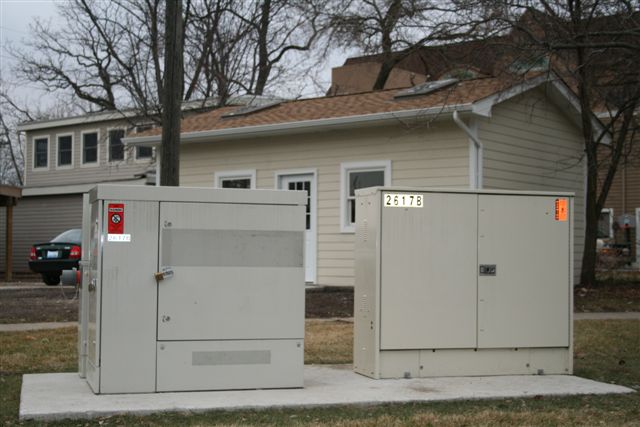
The perfect addition to any front yard... new boxes from AT&T. (Courtesy: Stopthebox.org)

AT&T’s often careless placement alienated residents, who complained they impeded views of turning drivers and pedestrians navigating sidewalks.  Many suggested the boxes reduced property values, especially when installed in front yards without screening or shrubbery to partly hide them from view.

One Trumbull man took his ire all the way to the state Department of Public Utility Control (DPUC), eventually winning noise dampening and two AT&T-supplied pine trees for the box in his backyard.

By 2009, AT&T was realizing “cost savings” promoted in the deal to merge with SBC — by laying off engineers and technicians responsible for maintaining the company’s landline network.  Service complaints soared, leading then-state Attorney General Richard Blumenthal to charge AT&T was cutting accountability for faulty phone lines and flimsy service.  In fact, even as service quality deteriorated, AT&T was lobbying to dispense with service standards altogether, arguing disappointed customers had other choices.

“AT&T is literally hanging up on consumers — slashing jobs and service quality, even after violating state customer service standards,” said Blumenthal. “Our message to the DPUC: don’t let AT&T off the hook. Preserve customer service standards to protect consumers.”

In 2010, service complaints had grown so bad the DPUC finally acted, by fining AT&T the maximum amount possible — $1.2 million.  Blumenthal called it a ringing wake-up call for AT&T.

But by December of last year, AT&T had still not paid the fine, and was caught by Blumenthal trying to negotiate a secret discounted settlement directly with the DPUC, cutting the state Attorney General out of the negotiations.  Blumenthal released a statement blowing the whistle on the reported talks:

Blumenthal

“AT&T’s stalling should be stopped — and the fine enforced,” Blumenthal said. “This multibillion dollar company sought secret negotiations — cutting out my office and the public — to reduce its fine for failing to meet legally required service standards. We halted its concealment; and now AT&T should stop its delay in paying taxpayers the fine that it owes.”

“AT&T was fined for failing consistently, year after year over a decade, to fix phone lines in a timely manner. Failure to repair lines quickly endangers public health and safety, especially seniors and the handicapped for whom a working line is literally a lifeline.”

Richard Blumenthal went on to represent the state in the U.S. Senate, but his successor, George Jepsen is proving to be every bit as tenacious as the state’s new Attorney General.  In March 2011, the DPUC formally imposed a fine of $745,000 on AT&T after negotiations with the phone company, which also required AT&T to meet its service standards.  The fine was reduced because AT&T had previously made refunds and settlements with customers independent of the fine.  The company is appealing it anyway.

“While I believe the full, $1.2 million penalty was warranted, the $745,000 fine sends a clear message to AT&T that it needs to improve its response to out-of-service customers.” Jepsen said. “The company’s responses in the future will be closely monitored.”

But has AT&T fixed the problems in the state of Connecticut?  Judging from press accounts, the answer may be no.

James Bruni, who lives in Hamden, had U-verse installed in his new home back in December, and there has not been a day since when the service has worked properly.

“We have had tech after tech come into our home, each one telling a different story,” Bruni says. “When our TV [picture] freezes, our phone and Internet go out as well.”

When that happens, Bruni’s home alarm, connected to his U-verse phone line, is subject to going off as well.  Many home alarm systems signal an alert if they detect a phone line has gone out of service, a possible sign of a robbery in progress.

Bruni has kept a log of AT&T’s comings-and-goings since December.  He counts 23 technician visits, working both inside and outside of the home.  When calling customer service, he is left on hold for extended periods, and often has to explain his issues repeatedly to technical support each time he calls.  He takes virtually every service AT&T offers, but not for long.

“I have had it with how I have been treated as a customer.”

Former Bridgeport city councilman Gilberto Hernandez proves AT&T doesn’t treat the well-connected any better than anyone else in the state.  Hernandez, now over 75, was so desperate to get repeating service outages fixed, he took his case to the consumer reporter at the Connecticut Post.

Hernandez’s wife is very ill, but he can’t depend on his AT&T landline to summon help in case of an emergency because it is always out of service.

Hernandez says the answer to his problem is a new overhead line installed through the neighborhood.  But AT&T won’t pay for that.  Instead of making an investment to correct long-term problems, the company prefers short-term fixes, which often fail within days. Performing short term repairs may help boost on-time appointment and service repair requirements, but when not followed up with more extensive repairs and upkeep, the problems just keep coming back.

The Post reporter sought an explanation from AT&T about Hernandez’s problems, and the phone company forwarded the matter to the company’s hired gun — the public relations firm of Fleishman-Hillard.  After a delay, the firm told the reporter Hernandez signed off on AT&T’s repairs… four days before Hernandez called to report there was a problem.

The reporter summarized AT&T’s performance in Connecticut as spotty:

During the hearing [over AT&T’s quality of service], AT&T defended its record, saying it already paid people off for the rotten service by not charging them for the time their phones were out and for crediting them and paying other penalties to the tune of $5.3 million between 2001 and 2008.

The DPUC did find AT&T was particularly good at reducing the number of troubles reported per 100,000 customers and showing up for maintenance appointments. AT&T has met appointments for repair work more than 90 percent of the time. Installation of new service is also a strong suit for AT&T, where it showed up for more than 99 percent of appointments. The company also installed new service within five days of ordering more than 95 percent of the time.

But repairing stuff, at least within 24 hours, is not AT&T’s bag. The company never managed to put better than 72 percent of repairs back in service within 24 hours between 2001 and 2008.

Getting the Best Rate for Broadband-Only Service from Time Warner Cable

With Time Warner Cable’s broadband now running as high as $50 a month for standard, stand-alone service, getting the best deal possible can save you as much as $20 a month off those prices.  Time Warner Cable has been repricing their services to deliver the most value to customers who bundle all of the company’s products into a single package.  But if you don’t want television or telephone service from the cable company, you are going to pay a lot more than your service-bundled-neighbors for Road Runner High Speed Internet.

Stop the Cap! presents our strategy to help broadband-only customers get the best possible prices from Time Warner Cable:

Choose Earthlink

Customers paying Time Warner Cable’s regular prices for broadband service are paying too much.  Time Warner currently charges just short of $50 a month for Standard 10/1Mbps service (speeds are slower in some areas).  That’s up from years of charging $40 a month, slightly higher if you were a broadband-only customer.  But with the help of Earthlink, you can cut that broadband bill to $29.99 a month for the first six months.  Earthlink co-exists with Road Runner, Time Warner Cable’s own broadband service.  With just a few mouse clicks and a quick phone call, Time Warner can switch your regular price Road Runner to Earthlink without any equipment changes.  Billing and service will continue to be provided by Time Warner and the change literally takes less than five minutes by phone.

You can escape Time Warner Cable's Road Runner rate hike by switching to Earthlink service at a substantial discount.

Earthlink’s broadband service is indistinguishable from Road Runner — same speeds, same level of service, with two exceptions:

  • Earthlink does not benefit from PowerBoost, which delivers temporary speed increases during file downloads
  • You will forfeit your rr.com e-mail address

We recommend you avoid using ISP-provided e-mail addresses when possible, because they help tie you down to an existing provider.  Instead, sign up for a free e-mail account from Google’s Gmail, or Yahoo! Mail, or any of the dozens of other web-based e-mail providers.  Or, purchase your own domain name from GoDaddy or 1and1, which includes e-mail, and either read it on those sites or forward it to a web-based e-mail provider.  Domain names can be had for under $10 a year and deliver maximum flexibility for those who want the freedom to change Internet providers.

After Six Months, Switch Back to Road Runner

When your Earthlink promotion expires at the end of six months, your price will increase to $41.95 per month.  Just before that happens, switch back to Time Warner Cable’s Road Runner service.  You qualify for new customer pricing promotions.  As of this week, Time Warner Cable in western New York is offering one year at $29.99 per month for 10/1Mbps service.  Other areas may have different pricing promotions.

After the year is up, you can start all over again, heading back to Earthlink for another six month promotional term.  Earthlink has offered its promotional plan for more than two years, and it shows no signs of ending anytime soon.

Promotional Half-Truths

Promotions come and go from Time Warner Cable, so it is wise to check with them often if the $29.99 deal is not currently running in your area.  Start by checking Time Warner Cable’s website, and remember if you are using Earthlink, you will want to select pricing for new customers.  If you find a good price on the website, you may be able to complete your order online.  Otherwise, call your local office and ask about currently running promotions.  Some common ones:

  • Road Runner Turbo at 50% off for the first year;
  • Road Runner Turbo free for six months;
  • Road Runner with wireless router/modem free for six months to one year;
  • Road Runner with free installation (especially useful if you want Road Runner Extreme/Wideband service, which carries a pricey installation fee);
  • Road Runner for $29.99 for six months;
  • Bundled promotions — $99 for all three services, $79 for broadband/cable or broadband/phone

Not every promotion delivers the best deal for customers, and some have been slightly deceptive, such as this speed comparison we found on the cable company’s website this morning:

Our View:

  1. Time Warner Cable has been spanked before for their claims about running a “fiber network.”  In fact, their “Fiber Rich Network” is a marketing stretch.  All modern cable systems use fiber optics to help distribute their service into various communities, but coaxial copper cable delivers the signal through neighborhoods to your individual home.  Cable companies still cannot match the broadband speeds available on an all-fiber network.
  2. “Powertasking” is a meaningless marketing claim.  Any high speed network will allow the entire family to effectively share a broadband connection.
  3. We’re glad to know Time Warner Cable has “massive bandwidth” — more than enough to go around.  We’ll remember that if and when the company ever entertains bringing back their experimental Internet Overcharging scheme they claimed was necessary to pay for equipment upgrades to cope with broadband traffic growth.
  4. It would be simpler to install Time Warner’s DOCSIS 3 upgrade if we could do it ourselves, but the cable company currently requires a mandatory service call ($67.98 fee) to install it.
  5. Time Warner is being cute comparing their broadband speed with Verizon FiOS.  In fact, FiOS is faster because of what isn’t mentioned here — upstream speeds.  Time Warner tops out at 5Mbps, Verizon offers 20Mbps for uploads.  But Time Warner’s pricing is better at that download speed.  Verizon is more aggressively priced when they bundle services together.  For example, Time Warner’s $99 triple play bundle only offers 10/1Mbps service.  Verizon offers up to 25/25Mbps service for the same price.  Both include phone and television service.

Where’s Our Refund? Two Months and $26.09 Later, Frontier Finally Sends A Check

Phillip Dampier May 9, 2011 Competition, Consumer News, Editorial & Site News, Frontier Comments Off on Where’s Our Refund? Two Months and $26.09 Later, Frontier Finally Sends A Check

Stop the Cap! readers will recall we pulled the plug on Frontier Communications with the disconnection of our landline back in early February.  After at least 25 years doing business with Rochester Telephone Corporation, later Frontier-Global Crossing, later Frontier-Citizens Communications, we had enough.  Frontier Communications has done nothing of merit for the metropolitan Rochester, N.Y., area since the late 1990s.  Their DSL broadband service is handily beaten in quality, reliability, and price by cable competitor Time Warner Cable, and Frontier’s lack of willingness to invest in something better for their largest service area of nearly one million people in western New York has left us cold.  After a one week experiment with Frontier’s DSL service in 2009, we dropped the service like a hot potato after it achieved an underwhelming 3.1Mbps in the town of Brighton, less than one mile from the Rochester city line.

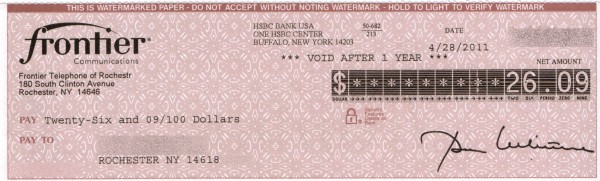
In early February, our last remaining service — the landline — was transferred to Time Warner Cable.  But even on the way out the door, Frontier continued to disappoint.  After more than two months (and two invoices later), Frontier had still not refunded our credit balance of $26.09.  We’re a long way from Rochester Telephone, a well-regarded predecessor to Frontier which traditionally enclosed a refund check with the final bill.  Frontier makes you wait, and wait, and wait some more, reminding you they owe you money with repetitious “do not pay – credit balance” invoices for long-terminated service.

More than two months after disconnecting service, our refund check finally arrives!

On Monday, the refund check finally arrived, in an obscure envelope resembling one of those PIN reminders banks send you.  After tearing away three sides of perforated strips, there it was — $26.09 from Frontier Communications.

The long wait is hardly a random glitch.  Stop the Cap! covered the story of a Frontier customer in California who waited several months for the phone company to refund her just over $15, and just this evening we heard from one of our regular readers in Rochester disappointed by Frontier’s hardly-rapid refund policy.

The only good news is that we weren’t overbilled on the way out the door, as one Elk Grove, Calif. customer was — to the tune of $680.

To Frontier we say goodbye and good luck (and we’ll be cashing that check faster than you sent it).

AT&T vs. Our Troops: Sticks Our Finest With Hefty Cancel Fees When Ordered to Deploy

Phillip Dampier May 9, 2011 AT&T, Consumer News, Public Policy & Gov't Comments Off on AT&T vs. Our Troops: Sticks Our Finest With Hefty Cancel Fees When Ordered to Deploy

Soldiers starting basic training or preparing to deploy overseas have a lot on their minds.  Worrying about their AT&T cell phone service isn’t supposed to be one of them.

Stop the Cap! has been hearing from soldiers in several states who are sharing similar stories about AT&T insisting on hefty early termination fees when calling to suspend or cancel service because of military training or deployment abroad.  Cell phones are prohibited during basic training, which lasts 10 weeks.  So why pay for a service you cannot use for two and a half months?

The Chicago Tribune shared the story of Nathaniel Jungheim, of Chicago, who faced an intransigent AT&T when he called to put his account on hold during basic training.

“They informed me that they have recently changed how they handle military accounts and said I would have to pay $10 a month plus taxes to keep my account in suspension,” he said.

Jungheim said he complained and was told he would either have to pay the monthly fee or $275 to terminate his contract.

“I asked to speak to a supervisor but was told they would say the same thing,” Jungheim said.

Those “changes” are likely illegal under the Service Member Civil Relief Act, a federal law which protects America’s soldiers from predatory practices from bankers, property management companies, insurance companies, and yes, cell phone companies.

Text of S. 3023 [110th]: Veterans’ Benefits Improvement Act of 2008
Oct 10, 2008: Became Public Law No: 110-389

SEC. 805. TERMINATION OR SUSPENSION OF CONTRACTS FOR CELLULAR TELEPHONE SERVICE FOR CERTAIN SERVICEMEMBERS.

(a) In General- Title III of the Servicemembers Civil Relief Act (50 U.S.C. App. 531 et seq.) is amended by inserting after section 305 the following new section:

SEC. 305A. TERMINATION OR SUSPENSION OF CONTRACTS FOR CELLULAR TELEPHONE SERVICE.

(a) In General- A servicemember who receives orders to deploy outside of the continental United States for not less than 90 days or for a permanent change of duty station within the United States may request the termination or suspension of any contract for cellular telephone service entered into by the servicemember before the date of the commencement of such deployment or permanent change if the servicemember’s ability to satisfy the contract or to utilize the service will be materially affected by such deployment or permanent change. The request shall include a copy of the servicemember’s military orders.

(b) Relief- Upon receiving the request of a servicemember under subsection (a), the cellular telephone service contractor concerned shall–
(1) grant the requested relief without imposition of an early termination fee for termination of the contract or a reactivation fee for suspension of the contract; or
(2) in the case that such servicemember is deployed outside the continental United States as described in subsection (a), permit the servicemember to suspend the contract at no charge until the end of the deployment without requiring, whether as a condition of suspension or otherwise, that the contract be extended.

AT&T doesn’t feel the law applies to them, however, judging from complaints we’ve been receiving from readers.

Stop the Cap! came up on a private military forum open to service members, and ever since, we’ve heard some stunning complaints about AT&T and suspicions the phone company is hoping to rely on soldiers not fully understanding their rights.  Remarkably, all of the complaints have been about AT&T.  Verizon and Sprint reportedly treat the troops with considerably more respect.

“I was ordered to Europe last November and wanted to call and cancel my AT&T service and ran straight into a brick wall with those people,” shares Elizabeth.  “They told me they don’t suspend accounts for anyone, only cancel them, and demanded $200 in early cancel fees to be paid immediately on my credit card or they would ruin my credit.”

Nathan, who is now serving in rural Alaska, shared a similar story.  On his third call to AT&T, the representative offered him just one choice — a $10 a month suspended plan, if he agreed to extend his service contract when he got back.

“I was reading off of AT&T’s own website stating the company would cancel my service with no penalty, but the operator could have cared less,” Nathan writes.  “If I didn’t like it, he would charge me $300 to immediately cancel my contract and that was that.”

Nathan got the distinct impression the representative was accusing him of ripping off AT&T for a new phone he wanted to “walk away” with free and clear.

JJ managed to get a supervisor to “do him a favor” and cancel his contract with no penalty, but only if he faxed over his military ID, birth certificate, driver’s license, orders of deployment, and a copy of a major credit card for “verification purposes.”

“I told them to forget it — I was not about to send some low paid AT&T call center guy every form of ID I had so I could discover my identity stolen when I got back,” JJ said.

“AT&T cares less about the troops who defend their right to exist in a free United States; they only care about money and that is disgusting and unpatriotic,” JJ shares.

Another customer, deployed overseas, was told to report to an AT&T store in the United States to discontinue service — there was no other way to cancel penalty-free.

As has been so often the case, when media attention shines a bright light on potentially illegal business practices or bad service, relief is soon in sight, for at least a few people.

The Problem Solver called Brooke Vane, a spokeswoman for AT&T, and described Jungheim’s situation.

Vane emailed Thursday to say AT&T adheres to the federal Service Member Civil Relief Act, which provides guidelines for how companies deal with those who are called to duty.

Vane instructed Jungheim to call AT&T’s customer care phone number again and go through the process of suspending service.

“Once he meets the requirements, including providing us with his orders, as required by law, we can process this request,” Vane said.

Thursday evening, Jungheim called AT&T and spoke to a representative.

“I faxed over my deployment orders … so I should be a go,” he said.

He will not be charged the $10 a month.

AT&T's website for servicemembers makes it easy to buy more of their products and services, but doesn't deliver much help to those who want to put their accounts on hold or leave. (Click image to visit site.)

Stop the Cap! recommends you arrange to cancel or suspend service as soon as you have a date in hand for basic training or deployment abroad.  Then call AT&T at 1-800-331-0500 and notify them you need to fax your written request to discontinue service, penalty-free, and are including a copy of your military orders.  By declaring your intent, you will present yourself as knowledgeable about your rights, and are less likely to encounter resistance from AT&T.

Do not fax or mail copies of any forms of personal identification.  They are not required under the law and there is no reason to expose yourself to identity theft.  We recommend you consider service cancellation over service suspension, because it lets you walk away from AT&T free and clear.  You will lose your cell phone number, but when you return, you can sign up as a new customer and receive a new phone discount.

Always write down the name and extension of the person you spoke with along with the time and date of your call and keep it in a file until you are assured the request was processed properly.

If you encounter problems, insist that your call be escalated to a supervisor.  If that fails, two of our readers reported they had near instant resolution to their ongoing problems with AT&T by calling their member of Congress or two Senators.

National Call to Action: Insist That North Carolina Gov. Bev Purdue Veto H.129

It’s time for every consumer across the country to help our friends in North Carolina, who are now facing the prospect of a Broadband Dark Age with the passage of a cable-industry-written bill designed to protect their monopoly prices and deliver America’s worst broadband experience.

The grand lie that is the Level Playing Field/Local Government Competition Bill (H.129) claims it will protect broadband competition in the state.  It will, if you are Time Warner Cable facing top-rated, super-fast service from community broadband networks that compete with them in communities like Salisbury and Wilson.

The power to protect North Carolina’s broadband future is now in the hands of Gov. Bev Purdue.

The North Carolina Senate abdicated their responsibility to serve the interests of state residents.  On Tuesday, they voted 39-10 for this consumer atrocity:

Ayes: Senator(s): Allran; Apodaca; Atwater; Berger, D.; Berger, P.; Bingham; Blake; Blue; Brock; Brown; Brunstetter; Clary; Daniel; Davis; East; Forrester; Garrou; Goolsby; Gunn; Harrington; Hartsell; Hise; Hunt; Jackson; Jenkins; Jones; McKissick; Nesbitt; Pate; Preston; Rabon; Rouzer; Rucho; Soucek; Stein; Stevens; Tillman; Tucker; Walters
Noes: Senator(s): Dannelly; Graham; Kinnaird; Mansfield; Meredith; Newton; Purcell; Robinson; Vaughan; White

Yesterday, the House added insult to injury voting 84-32 for the bill custom written by and for Time Warner Cable:

Democrat Republican
Ayes: Representative(s): Adams; Brisson; Carney; Crawford; Earle; Hamilton; Hill; McLawhorn; Michaux; Mobley; Moore, R.; Owens; Parmon; Pierce; Spear; Wainwright; Warren, E.; Wilkins; Wray Representative(s): Avila; Barnhart; Blackwell; Blust; Boles; Bradley; Brawley; Brown, L.; Brown, R.; Brubaker; Burr; Cleveland; Collins; Cook; Daughtry; Dixon; Dockham; Dollar; Faircloth; Folwell; Frye; Gillespie; Guice; Hager; Hastings; Hilton; Hollo; Holloway; Horn; Howard; Hurley; Iler; Ingle; Johnson; Jones; Jordan; Justice; Langdon; LaRoque; Lewis; McComas; McCormick; McElraft; McGee; McGrady; Mills; Moffitt; Moore, T.; Murry; Pridgen; Randleman; Rhyne; Sager; Samuelson; Sanderson; Setzer; Shepard; Stam; Starnes; Steen; Stevens; Stone; Torbett; Warren, H.; West
Noes: Representative(s): Alexander, K.; Alexander, M.; Bordsen; Brandon; Bryant; Cotham; Faison; Farmer-Butterfield; Fisher; Floyd; Gill; Glazier; Goodman; Graham; Hackney; Haire; Hall; Harrison; Insko; Jackson; Jeffus; Keever; Lucas; Luebke; Martin; McGuirt; Parfitt; Rapp; Ross; Tolson; Weiss; Womble

Not a single Republican in the House stood up for you.

Faison

Several legislators that still remember they represent the interests of voters and not out of state big cable and phone companies were appalled.

Rep. Bill Faison (D-Caswell, Orange), who has been a champion of better broadband across North Carolina, reminded the Assembly the bill should have been named the Time Warner Cable Anti-Competition Bill, written by a New York City-based company that will prevent cities from using their collective buying authority to provide themselves (finally) with the broadband service the private sector has steadfastly refused to deliver.

Faison noted Time Warner Cable CEO Glenn Britt made $27 million in compensation last year — the same as the entire cost of Wilson’s GreenLight fiber-to-the-home cable system.

Faison openly pondered what the cable company has been paying to employ the six full time lobbyists who have been trolling the halls of the state legislature for months, and exactly how much next year’s rate increase will be to pay for their services.

Even the former chairman of the state Republican party called H.129 an enormously arrogant piece of legislation.

Luebke

Another hero for consumers, Rep. Paul Luebke (D-Durham), noted the bill’s immediate impact will be to keep rural North Carolina a broadband desert.  Luebke called H.129 a bad bill that denies service even to communities where no broadband service exists.

But Rep. Marilyn Avila (R-Time Warner Cable) wanted to ensure no one could say there was a broadband problem in North Carolina, so she supported an amendment that allows areas to be declared served if even a single home has broadband service in a particular census block.  That provision delivers beneficial protection to CenturyLink, who can spend their time, money, and attention on a merger with Qwest, the last remaining independent Baby Bell.  While they focus on making themselves bigger through mergers and acquisitions, the phone company faces no competitive pressure to expand service in rural North Carolina, and will face no meaningful competition for the indefinite future.

While Gov. Purdue’s office has made noises about vetoing this bad legislation, it is essential that we let the governor know we need an absolute commitment on her part to veto H.129.  We’ve seen how Big Telecom plays their dirty pool, so we cannot afford to sit back and allow their lobbyists to wear the governor down.

Gov. Purdue

When Time Warner Cable tried to slap an Internet Overcharging scheme on consumers in New York, North Carolina, and Texas in 2009, Stop the Cap! made a commitment to join forces with all of the impacted communities to present a united consumer front against provider abuses.  H.129 qualifies.  That’s why we urge everyone to contact Gov. Purdue and let her know she must veto H.129, an anti-consumer, anti-broadband bill.

Please call -and- e-mail her office:


Minor Correction Made 5/6 – 5pm ET: We made an error referring to a census tract instead of a census block in the original piece.  One of our readers dropped us a note correcting us, which we are happy to do.  A “tract” actually has many “blocks” in it.

Search This Site:

Contributions:

Recent Comments:

Your Account:

Stop the Cap!