Home » Consumer News » Recent Articles:

Understanding Customer Defections: The Value Perception of Cable Television

Phillip Dampier May 5, 2011 Competition, Consumer News, Data Caps, Online Video 2 Comments

Click to enlarge

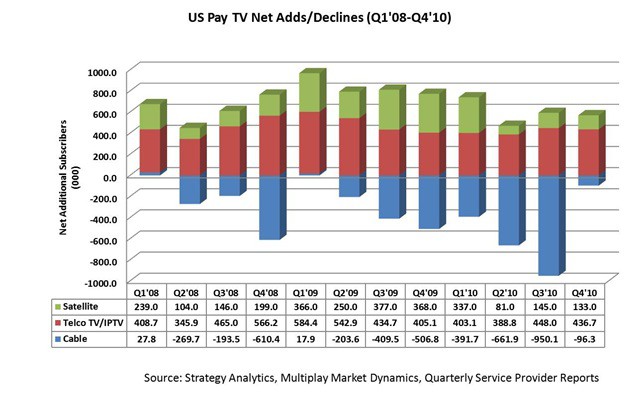
Your cable company has a problem.  Collectively, the cable industry has lost more than 2 million video customers over the past year, and the problem may be getting worse.  Some of the largest cable companies in the United States are making excuses for the historic losses:

  • The bad economy
  • Housing and foreclosure crisis
  • High unemployment
  • Family budget-cutting

But cable companies should be rethinking their excuses, according to a new report from Strategy Analytics.

“Throughout the past seven consecutive quarters of subscriber losses, the inclination of cable has been to point the finger at various external factors,” said Ben Piper, Director of the Strategy Analytics Multiplay Market Dynamics service. “Our analysis shows that neither the economy nor the housing market is to blame for these subscriber defections. The problem is one of value perception.”

Value perception.  That’s a measurement of whether or not one feels they are getting good value for the money they pay for a product or service.  Value comes in several different forms, starting with emotional — do I feel good, safe, secure, or nostalgic using the service?  Can I imagine life without it?  What about my friends and family — will I stand out if I am not buying this product?  It’s also practical — Can I afford this?  Can I find a cheaper or better alternative?  Do I really need this service anymore?

Tied into value perception is customer goodwill.  If you have an excellent experience with a company, letting go of their products comes much harder.  If you feel forced to deal with a company that has delivered poor and expensive service for years, pent up frustration will make it much easier (and satisfying) to cut them loose at the first opportunity.
Embarq used to be Sprint's pathway to prosperity in the local landline business, until cord cutting put landlines into a death spiral.

In the telecommunications industry, value perception is a proven fact of life.  It began with phone companies.  Formerly a monopoly, landline providers have been forced to try and reinvent themselves and become more customer-friendly.  First long distance companies like Sprint and MCI moved in to deliver cheaper (and often better quality) long distance service.  Sprint even got into the landline business themselves, forming EMBARQ, which at its peak was the largest independent phone company in the United States.  When Voice Over IP providers like Vonage and the cable industry’s “digital phone” products arrived, they promised phone bills cut in half, and introduced the concept of unlimited long distance calling.

The value perception among consumers became clear as they began disconnecting their landlines.  The alternative providers offered cheaper, unlimited calling services, often bundled with phone features the local phone company charged considerably more to receive.  Even though VOIP is technically inferior in call quality in many instances, the value the services provided made the decision to cut the phone cord easier.

But local phone company landline losses would only accelerate with the ubiquity of the cell phone, but for different reasons.  What began with high per-minute charges for wireless calls evolved into larger packages of calling allowances, with plenty of free minutes during nights and weekends, and often free calling to those called the most.  Most Americans end the month with unused calling minutes.  As smartphones gradually take a larger share of the cell phone market, the accompanying higher bills have forced a value perception of a different kind — ‘I can’t afford to keep my landline –and– my cell phone, so I’ll disconnect the landline.’

The cable industry has traditionally faced fewer competitive threats and regularly alienates a considerable number of customers, but still keep their business despite annual rate increases and unwanted channels shoveled into ever-growing packages few people want.

This pent up frustration with the cable company has led to perennial calls for additional competition.  That originally came from satellite television, which involved hardware customers didn’t necessarily like, and no option for a triple play package of phone and broadband service.  The cable industry offers both, and by effectively repricing their products to discourage defections from bundled packages, customers soon discovered the resulting savings from satellite TV were often less than toughing it out with the cable company.

As a result, satellite television has never achieved a share of more than 1/3rd of the video market.  Many satellite customers are in non-cable areas, signed up because of a deeply discounted price promotion, were annoyed with the cable company, or didn’t care about the availability of broadband or phone service.  When the price promotion ends or technical issues arise, many customers switch back to cable.

More recently, researchers like Strategy Analytics have discovered some potential game-changers in the paid video marketplace:

  • The impact of broadband-delivered video content
  • The Redbox phenomena
  • Competition from Telco TV
  • The digital television conversion

Strategy Analytics studied consumer perceptions and found customers braver than ever before about their plans to cut cable’s cord.  According to the consumers surveyed, nobody scores lower in value perception than cable companies.  Citing “low value for money,” over half of the cable subscribers surveyed told the research firm they intended to disconnect their cable TV package in the near future.

While other researchers dismiss those high numbers as bravado, there are clear warnings for the industry.

“Much ink has been spilled on the topic of cord cutting and even skeptics are now admitting that it can’t be ignored,” said Piper.

Indeed, Craig Moffett, an analyst with Sanford Bernstein who almost never says a discouraging word about his beloved cable industry, told Ad Age Mediaworks the issue of cord-cutting was real.

“It’s hard to pretend that cord cutting simply isn’t happening,” Moffett said.

Craig E. Moffett, perennial cable stock booster, even admits cord-cutting is real.

The most dramatic impact on the cable industry has been in the ongoing erosion of the number of premium channel subscribers, those willing to pay up to $14 a month for HBO, Cinemax, Showtime, or Starz!.  The reason?  Low value for money.  As HBO loses subscribers, Netflix and Redbox gain many of them.  Netflix still delivers a considerable number of movies by mail, but has an increasingly large library of instant viewing options over broadband connections.  Strategically placed Redbox kiosks deliver a convenient, and budget-minded alternative.

The loss of real wage growth, the housing collapse, and the down-turned economy do put pricing pressures on the industry, but some cable executives hope the time-honored tradition of customers howling about rate increases without ever actually dropping cable service continues.

But as new platforms emerge, some delivering actual pricing competition to the cable TV package, increasing numbers of customers are willing to take their video business somewhere else.  Some are stopped at the last minute with a heavily discounted customer retention pricing package, but that doesn’t keep them from sampling alternative online video options.  Among those who actually do leave, some are satisfied with the increased number of channels they get for free over-the-air after America’s digital television conversion.

Many others are switching to new offerings from telephone companies.  Both AT&T and Verizon deliver video packages to many of their customers, often at introductory prices dramatically lower than their current cable TV bill.  When considering a bill for $160 for phone, video, and broadband from the cable company or $99 for the same services from the phone company, $60 a month in savings for the first year or two is quite a value perception, and the inevitable disconnect order is placed with the cable company.

Ad Age‘s own survey, more skeptical about cord-cutting, confirmed that many former cable TV customers left for budgetary reasons, but many also kept their triple play packages.  They just bought them from someone else.

Also confirmed: a dramatic upswing in online viewing, sometimes paid but often ad-supported or free.

Strategy Analysts concludes in its report, available for $1,999, that the ongoing erosion of cable TV subscribers isn’t irreversible, but it requires urgency among providers to become more customer-friendly and increase the all-important value perception.

In other words: respecting the needs and wishes of your customers.

Thankfully, the cable industry is dealing with competitors like AT&T, who are willing to assassinate their current lead in value perception by slapping Internet Overcharging pricing schemes on their broadband service.  That will certainly raise the ire of their DSL and U-verse customers, many who are treating the customer unfriendly usage limits as an invitation to leave.  Their former cable companies are waiting to welcome them back.  The real question remains, will cable customers now be treated better?

Northeast Ohio Deals With Time Warner Cable Pixel Problem

Phillip Dampier May 5, 2011 Consumer News, Video 2 Comments

For several days now, Time Warner Cable customers in northeast Ohio have endured disruptions to their digital cable, as pixel problems and frozen pictures plague the cable company.  Communities like Cleveland, Mentor, and Elyria are all affected, and the cable company can’t figure out what is causing the trouble.

Time Warner Cable reports more than 100 employees are trying to track down the problem, but the company will not issue general credits to affected customers.  Instead, you must write or call Time Warner requesting credit.  You can send a credit request on Time Warner’s website under the contact section.

[flv width=”360″ height=”290″]http://www.phillipdampier.com/video/WEWS Cleveland Time Warner Pixel Problems 5-3-11.mp4[/flv]

WEWS-TV in Cleveland covers Time Warner’s troubles after problems with the cable company brought many requests from viewers to get to the bottom of it.  (3 minutes)

Charter Cable’s Los Angeles System Up for Bidding – Wisconsin/LA Cable Swap Falls Through

Phillip Dampier May 5, 2011 Charter Spectrum, Consumer News Comments Off on Charter Cable’s Los Angeles System Up for Bidding – Wisconsin/LA Cable Swap Falls Through

Charter Cable, one of America’s worst-rated cable companies, wants out of greater Los Angeles.  Its cable system, serving parts of LA, has been rumored for sale for years.  Now the cable company has gotten serious, hiring Goldman Sachs and Citibank to run an auction to sell off the system.

The most logical buyer, Time Warner Cable, has been engaged in on-again, off-again talks with Charter about Los Angeles for sometime, according to several sources in the cable investment community.  Charter proposed a swap, trading its Los Angeles system to Time Warner if they could acquire Time Warner’s subscribers in Wisconsin.

Time Warner Cable currently serves 560,000 subscribers in Green Bay, Milwaukee and Appleton.  Charter serves much of the rest of the state.  Thankfully for many Wisconsin customers, Time Warner Cable told Charter they were not interested.  Time Warner gets significantly higher customer ratings than Charter does.

Now that Goldman Sachs and Citibank will be running an auction, Time Warner Cable could still ultimately acquire the Charter systems in Los Angeles, if they are willing to pony up an estimated $2 billion asking price.  If Time Warner won’t bid that high, speculation is that Comcast, Cox, or Cablevision will.

A surprise bonus for buyers are rumors Charter will throw in its cable system in Fort Worth, Tex.  That move would also seem to benefit a Time Warner Cable takeover, considering the nation’s second largest cable operator already has an enormous presence in the Dallas/Fort Worth Metroplex.  But Multichannel News points out that part of Texas brings bad memories for Time Warner, when it had to effectively commit to an expensive rebuild of the nearby ailing system acquired from bankrupt Adelphia Cable in 2006.

Time Warner Cable is still rumored to be the logical buyer of Insight Cable’s systems, also for sale, in Indiana, Kentucky, and Ohio, although the cable company is still balking at an asking price of up to $4 billion.

Cell Tower Politics: AT&T’s Alleged Cozy Connections With Civic Groups Upset Community

Phillip Dampier April 28, 2011 AT&T, Consumer News, Public Policy & Gov't, Wireless Broadband Comments Off on Cell Tower Politics: AT&T’s Alleged Cozy Connections With Civic Groups Upset Community

Your view

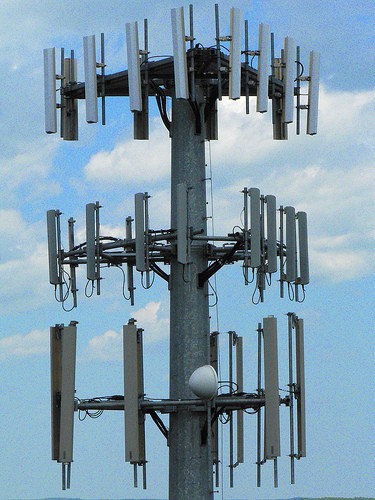
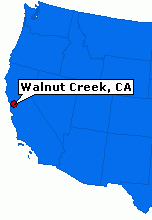
Would you like an AT&T cell tower within 100 feet of your home?  Some residents in Walnut Creek, Calif. are on the verge of finding out if AT&T wins approval to install a cell tower on property belonging to St. Stephen Church, located in the middle of the Buena Vista subdivision, filled with residential homes.

Now, a local neighborhood group is charging AT&T with playing power politics by using their connections with local civic groups to influence local officials to quickly approve the cell site.

Some residents suspect the local government is more than a little cozy with the Walnut Creek Chamber of Commerce.  It’s newly installed chairman of the board just happens to be Ken Mintz, area manager for AT&T.  Although Mintz says his job does not involve choosing or lobbying for cell tower sites, he is responsible for meeting with local officials on an ongoing basis to discuss AT&T business matters important to the company.

Mardi Veiluva, leader of the Walnut Creek Buena Vista Neighborhood Group, considers AT&T too close for comfort with city officials.  The group points to the city planning commission being predisposed to accepting AT&T’s word that the church is the only possible place for the new cell tower, even if it is within throwing distance of nearby homes.

The group also claims the city failed to follow up on what they feel is false information purposely given by AT&T to city officials in order to sell their tower siting arguments.

The group won a city council directive to force AT&T to fund the hiring of an independent consultant to review the facts and get back to the council about possible alternative cell sites, but was disheartened when the city hired the consultant in a closed process, not subject to an open review.

The city hired Los Angeles-based Kramer Firm Inc., a decision immediately questioned by some group members over alleged favoritism to AT&T.  Firm owner Jonathan Kramer has more than two decades experience dealing with utilities, and has hardly been their best friend.  In 2003, Kramer blasted Comcast for improperly grounding their cable lines in Modesto, Calif.  Kramer has no ties to AT&T.

AT&T plans to add at least 55 cell tower sites in greater San Francisco in the near future to address congestion and signal problems.

AT&T claims Mintz is not influencing anyone in his position, city officials deny being lobbied by Mintz, and local residents will probably unsatisfied no matter who agrees to AT&T’s cell tower placement recommendations.

This brings the inevitable conundrum: people want improved cell service in their local communities, so long as cell towers are located far away from their neighborhoods.

Cell phone companies invariably defend their choices for cell tower sites as the best, if not the only option.  Nearby residents protest, and often local officials have to find a compromise location, or insist on efforts to camouflage the resulting tower (with varying degrees of success.)


Time Warner Cable’s Backdoor Rate Hike in Kansas City

Phillip Dampier April 26, 2011 Consumer News, Video 1 Comment

As Time Warner Cable continues it channel re-alignments in markets across the country, some subscribers are coming up with fewer channels after the changes, but they are still paying the same cable bill — for fewer channels.

“It’s classic cable bait and switch,” shares Stop the Cap! reader Kyle from Kansas City, who spent hours fiddling with his TiVo box after Time Warner re-mapped the area’s channel lineup earlier this month.  “TiVo really underlined it for us, albeit unintentionally, when we discovered several channels no longer available to us unless we paid extra.”

While Time Warner Cable moved Kansas City to its theme-based lineup, which places similar channels together and aligns HD channels with their standard definition counterparts, they also used the occasion to re-tier some of their “free” channels into mini-pay tiers.

Among the channels out of the digital cable standard lineup:

  • Encore MoviePlex — Seven theme-based commercial-free movie channels;
  • IFC — Independent Film Channel
  • Fox Movie Channel
  • Flix
  • RFD-TV
  • Ovation

The movie channels are being re-tiered in a mini-pay package called TWC Movie Pass, which will eventually sell for $4.95 per month after some early promotional discounts.  RFD and Ovation are part of a new “Digital Choice” tier.

“It’s the usual deception from Time Warner, which claims to sell you ‘free HD’ service without also telling you a rented set top box is required, which adds at least $7 a month for the ‘free HD’ channels,” Kyle says.  “Now they don’t even give you that as they start stripping networks away from their HD lineup to sell you for more money.”

Some subscribers are less than happy with the outcome, considering they now have fewer channels and are still paying the same cable rate they were before the channel change.

“It’s a shell game they always win — find the channels, keep your eye on the channels, wait — they are gone.  Pay us anyway.”

Aaron Barnhart, who writes for the Kansas City Star, called it a PR failure.

RFD-TV: Buried in a backwater mini-pay tier few will pay extra to receive.

“Time Warner proved once again to be its own worst enemy, hyping all the good things and leaving it to customers to discover the not-so-good-things on their own,” Barnhart wrote.

Time Warner’s reasons for the channel changes, reported by Barnhart, seemed less than convincing to customers.

Time Warner’s spokesman Matt Derrick pointed out that “in most places, Encore is bundled as a premium package with Starz.” Liberty Media, which owns both Encore and Starz, used to offer Encore to cable operators as a digital-cable value alternative to premium channels. But that has changed, and Time Warner negotiated this 12-month rate with Liberty to encourage customers to go along with the switch.

Derrick explained that Digital Choice was designed as a low-cost alternative to its larger Digital Variety package, where the same channels are also available.

“Wait, that doesn’t even make sense,” Kyle argues.  “Time Warner negotiated with Liberty to turn a free set of channels into a pay tier to encourage us to go along?”

Kyle doesn’t think the reasons for Digital Choice made any sense either.

“How many people are demanding to pay extra for Ovation and RFD, exactly?” Kyle wonders.  “What is missing from all this is why our rates did not decrease to compensate us for the lost channels.”

Kyle says the $4.95 a month rate for TWC Movie Pass may not seem as much as a pay network, but he reminds us Time Warner will continue to collect money from every subscriber for the channels they’ll no longer get.

“So if it costs them $4.95 a month for Encore, we’re all still paying that because our bill isn’t going down; if we actually want those channels, that costs another $4.95 — $9.90 a month.

[flv width=”480″ height=”290″]http://www.phillipdampier.com/video/WLWT Cincinnati Time Warner Channel Realignment 4-18-11.mp4[/flv]

WLWT-TV in Cincinnati explains to certain Ohio viewers how to accomplish a needed channel “re-scan” that comes along with the channel re-alignments Time Warner Cable is performing across the country.  (2 minutes)

Search This Site:

Contributions:

Recent Comments:

Your Account:

Stop the Cap!