Home » Consumer News » Recent Articles:

No Internet for 1/5th of Canadian Homes: Too Expensive, Too Slow, and Too Often Not Available

Courtesy: CBCAt least 20 percent of Canadians lack Internet access, according to a new survey published by Statistics Canada.  That means one out of every five homes either cannot afford, don’t want, or can’t get online.

The lack of access is most acute in low income households, where only about half with incomes of $30,000 or less access the Internet.  The income and access disparity was readily apparent when comparing broadband rich, income poor New Brunswick (70% have broadband) with service-deprived British Columbia, which has an 84% penetration rate.  In NB, you can get it but you can’t afford it; in BC if you can get it, you already have it.

Although cities in southern Canada are well-wired, smaller communities further north are often not, and the access some get is slow and unreliable.  But few are willing to live with dial-up access.  At least 96% of Canadians rely on broadband or simply go without the service.  The Canadian Radio-television and Telecommunications Commission has set a goal to deliver at least 5Mbps broadband service to every interested Canadian by the end of 2012.

Some statistics, starting with those without Internet service:

  • 56% lacked interest or need;
  • 20% cited the cost of the service;
  • 15% don’t have access to a computer;
  • 12% don’t understand enough about computers or the Internet to use it;
  • 93% of households with children had Internet access while just 58% of single-person homes had the service;
  • 81% of urban homes had access to broadband, just 71% of rural homes do;
  • 71% of Canadians access the Internet from a traditional desktop computer, 64% use a laptop, 35% use a tablet or smartphone for access, and just 20% rely on a video game console to get online.

Statistics Canada surveyed 30,000 Canadians as part of its research.

Verizon Wireless Fraud Alert: Malware Redirects Web Visitors to Fake VZ Website

Phillip Dampier May 25, 2011 Consumer News, Verizon, Video Comments Off on Verizon Wireless Fraud Alert: Malware Redirects Web Visitors to Fake VZ Website

[flv width=”480″ height=”290″]http://www.phillipdampier.com/video/WSYR Syracuse Banking trojan fakes Verizon Wireless website 5-20-11.mp4[/flv]

If you paid your Verizon Wireless bill on Verizon’s website anytime from May 7 to May 13, you may now be at risk of identity theft. The company’s website was not hacked or compromised, but customers who used computers without adequate anti-virus protection may have fallen victim to a banking trojan that collected personal and banking information and sent it on to points unknown.  WSYR-TV in Syracuse delivers the bad news.  (2 minutes)

Verizon FiOS Promises Tampa Bay Customer 25/25Mbps Speed, Delivers 25/2Mbps Service

Phillip Dampier May 25, 2011 Broadband Speed, Consumer News, Verizon, Video 5 Comments

[flv width=”360″ height=”290″]http://www.phillipdampier.com/video/WFTS Tampa The Need for Speed How to test your internet speed 5-19-11.mp4[/flv]

WFTS-TV in Tampa launched a consumer investigation when a local customer noticed the Verizon FiOS Internet service he was paying for — 25/25Mbps — was actually only providing him with 2.88Mbps upload speeds.  Even worse, both providers in the Tampa Bay area — Bright House Communications and Verizon, say actual speeds are not guaranteed, leading at least one customer to file an official complaint with the Federal Communications Commission for false advertising and misrepresentation by Verizon Communications.  WFTS examines whether providers have to actually deliver the speeds they promise, or does the fine print get them off the hook, leaving you paying more than you should for Internet speeds you are not getting.  (3 minutes)

Cox Wireless’ “Unbelievably Fair” Alternative Now Just Unbelievable; Will Stick With Sprint Instead

Nevermind. We'll resell Sprint instead.

Back in January 2010, Cox Cable announced it was getting into the cell phone business with an ambitious plan to construct its own competing wireless network.  Cox used their little spacemen to market their forthcoming alternative as delivering “unbelievably fair” pricing and terms for cell phone service.  The bigger players were selling bait and switch plans with high extra charges and bill shock at the end of the month, or so Cox’s ads suggested.

Now, the cable company has announced it is pulling the plug on its partially constructed 3G network, and will rely exclusively on reselling Sprint service.

“We believe this approach is good for our customers, allowing us to take the necessary steps to fulfill our promise to deliver a Cox experience that customers expect from us,” read a statement from Cox.

What happens to Cox’s existing infrastructure, and the frequencies it won at auction in 2008, is unknown.

Although the reasons for the change of heart are not officially known, there is speculation in the investment community Cox’s expensive launch of 3G technology would be outdated just as larger providers were unveiling newer 4G networks.  Additionally, the dynamics of the market are increasingly trending towards a duopoly, especially after AT&T announced its intentions to acquire T-Mobile.

Two major carriers will provide service to the vast majority of Americans if the merger is approved.  That would leave Cox in a difficult position attracting investment to build its own network and interest from consumers looking for the latest and greatest smartphones Cox couldn’t sell.

Sprint’s wholesale division has allowed several providers to resell Sprint’s network, no capital investments required.  Cox had already been relying on Sprint for providing cell phone service in several markets.

[flv width=”640″ height=”500″]http://www.phillipdampier.com/video/Cox Wireless Advertising Campaign.flv[/flv]

Cox Wireless’ marketing campaign promised “unbelievably fair” pricing on its own wireless network.  Now it will resell Sprint’s network instead. (2 minutes)

MetroPCS’ Nasty Terms of Use: ‘We May Not Provide You a Meaningful Data Experience’

Phillip Dampier May 25, 2011 Consumer News, Data Caps, MetroPCS, Net Neutrality, Online Video, Wireless Broadband Comments Off on MetroPCS’ Nasty Terms of Use: ‘We May Not Provide You a Meaningful Data Experience’

Unlimiting the ways a cell phone company can limit your service.

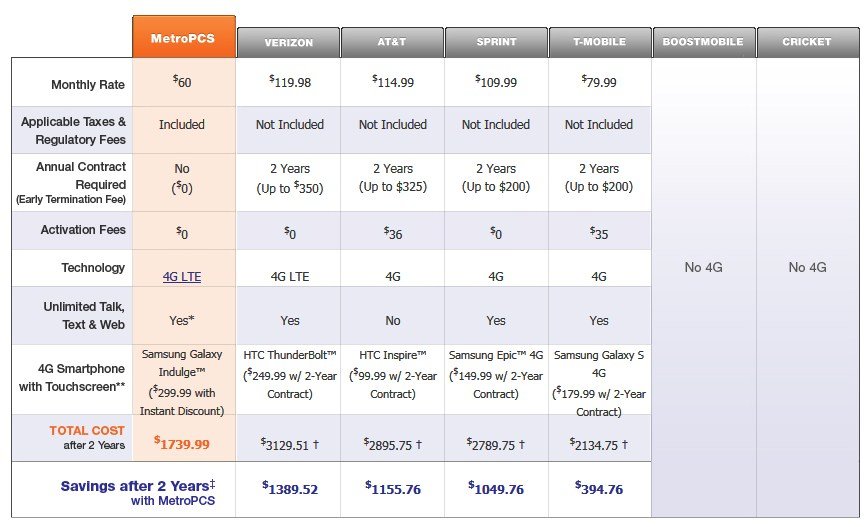
MetroPCS pitches its 4G/LTE plans to customers looking to save money over the bigger players in the marketplace.  The upstart provider, based in Richardson, Texas, serves just over a dozen major metropolitan areas with no-contract plans that deliver lower prices in return for smaller coverage areas.  As larger providers heavily sell their “next generation 4G” networks, MetroPCS has also been promoting their own “unlimited talk, text, and web” 4G/LTE plan that offers an “unlimited” experience for $60 a month.  But there is a catch, only revealed when customers click the fine print link that opens the Terms of Use.  The document is a poster child for Net Neutrality, because it allows the company to block, throttle, prioritize, alter, or inspect any web content.

Here is what MetroPCS advertises:

Here is a selection of the Terms and Conditions which tarnish a great sounding deal (underlining ours):

You acknowledge and agree that the Internet contains Data Content which, without alteration, will or may not be available, or may not be providable to you in a way to allow a meaningful experience, on a wireless handset.

You acknowledge and agree that such alteration that MetroPCS may or will perform on your behalf as your agent may include our use of Data Content traffic management or shaping techniques such as, but not limited to delaying or controlling the speeds at which Data Content is delivered, reformatting the Data Content, compressing the Data Content, prioritizing traffic on MetroPCS’ network, and placing restrictions on the amount of Data Content made available based on the Agreement. You further acknowledge that MetroPCS may not be able to alter such Data Content for you merely by reference to the Internet address and therefore acknowledge and agree that MetroPCS may examine, including, but not limited to Shallow (or Stateful) Packet Inspection and Deep Packet Inspection, the Data Content requested by you while using the MetroWEB Service to determine how best to alter such Data Content prior to providing it to you.

If we notice excessive data traffic coming from your phone, we reserve the right to suspend, reduce the speed of, or terminate your MetroWEB Service. In addition, to provide a good experience for the majority of our customers and minimize capacity issues and degradation in network performance, we may take measures including temporarily reducing data throughput for a subset of customers who use a disproportionate amount of bandwidth; if your web and data Service Plan usage is predominantly off-portal or otherwise not provided by MetroPCS during a billing cycle, we may reduce your data speed, without notice, for the remainder of that billing cycle. We may also suspend, terminate, or restrict your data session, or MetroWEB Service if you use MetroWEB Service in a manner that interferes with other customers’ service, our ability to allocate network capacity among customers, or that otherwise may degrade service quality for other customers.

MetroPCS also wants customers to know their service is not intended as a home broadband replacement, and states it is only to be used for basic web services, including e-mail and web browsing and downloading of legitimate audio content.  Video streaming is naughty.

Search This Site:

Contributions:

Recent Comments:

Your Account:

Stop the Cap!