Home » Consumer News » Recent Articles:

HissyFitWatch: Frontier and Comcast Battle Over Billboards in Ft. Wayne, Ind.

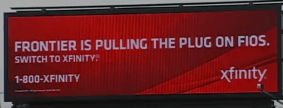
Billboards sprinkled across Ft. Wayne, Ind., telling residents, “Frontier is pulling the plug on FiOS — Switch to Xfinity,” has infuriated Frontier Communications, who says it will continue to provide FiOS service in the area, at least for broadband, indefinitely.  Now the independent phone company has sent a “cease and desist” letter to Comcast officials demanding the billboards come down.

Frontier spokesman Matt Kelley accused Comcast of spreading false rumors in an effort to drum up business.

“Frontier is not planning on pulling the plug,” Kelly told WANE-TV. “We are going to continue providing FiOS service in Allen County and we have no plans to remove it.”

[flv width=”480″ height=”380″]http://www.phillipdampier.com/video/WANE Ft Wayne FiOS Not Going Away 6-9-11.mp4[/flv]

WANE-TV in Ft. Wayne led its newscast with the dispute between Frontier Communications and Comcast over fiber optic television.  Is the plug really being pulled? (Loud Volume Alert!) (3 minutes)

But Comcast officials note Frontier has been pushing existing customers hard to switch to satellite television service, and Frontier earlier announced dramatic rate increases for its fiber cable television service — rates much higher than other competitors.

Comcast issued a statement about the dispute:

“Comcast continues to invest in these markets, while Frontier has taken a number of steps to discourage new customers from signing up for its service and encourage current customers to seek alternative services from satellite. We are using these ads to make consumers aware of our Xfinity TV service as a better choice for consumers.”

HissyFitWatch: Oooh... Comcast!

From our own Stop the Cap! investigation, both companies are partly correct.

We called Frontier this afternoon posing as a new FiOS customer in Ft. Wayne trying to sign up for television service.  The only option available, we were told, was satellite television service.  While Frontier was happy to sign us up for telephone and fiber broadband, the company representative told us she could not take our order for FiOS TV because, “it’s not available in your area.”

But Comcast’s claims about FiOS lack the very important detail that FiOS broadband and phone service will be offered by Frontier without any interruption — only television service appears to be at issue, and remains available to current customers.

We heard from several Ft. Wayne customers who are unhappy with Frontier’s handling of FiOS.

“While Comcast is being clever, the fact is Frontier wants TV customers to switch to satellite, which is simply a stupid idea,” says our reader Kevin.  “Why would I want a satellite dish when I have fiber.”

Lee, another Frontier customer, believes the company broke its promise of no rate increases after buying out Verizon’s local operations.

“They promptly raised the TV rate by around $30, and if you are a new FiOS customer, expect to pay hundreds and hundreds of dollars for installation,” he says.

Last week, Frontier’s deadline for Comcast to pull down the billboards passed, but as of today those billboards are still on full display.  Comcast’s response to Frontier?

“We received their letter.”

[flv width=”480″ height=”380″]http://www.phillipdampier.com/video/WANE Ft Wayne Deadline day for billboard back-and-forth 6-17-11.mp4[/flv]

WANE-TV in Ft. Wayne updates viewers.  Frontier’s unilateral deadline for Comcast to pull down their billboards came and went.  The billboards are still there.  Now what? (2 minutes)

FCC Cracks Down on Phone Crammers: $11.7 Million in Fines Over ‘Mystery Charges’

Phillip Dampier June 21, 2011 Consumer News, Public Policy & Gov't, Video 2 Comments

Cramming

After years of mystery phone charges for long distance services, ringtones, software backup, and phone entertainment customers never signed up for, the Federal Communications Commission today announced it was getting tough with more than $11 million in fines against some of the companies responsible.

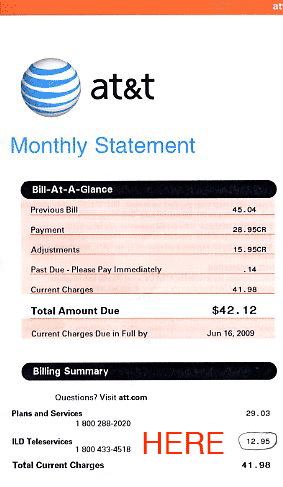
Phone cramming — the practice of signing you up for paid services you never ordered, wanted or needed, has been a perennial problem ever since telecommunications reform allowed third parties to charge for their dubious services on monthly telephone bills.  In return, phone companies collect a substantial piece of the action, leading some critics to charge Ma Bell has a financial interest in keeping phone cramming alive and well.

Helping increase the confusion, most cramming charges are listed under innocent-sound names like “long distance discount plan,” “protection plan,” or “ring choice.”  Most are buried under “other charges” found on the back of the bill or somewhere on the second page.  The monthly charges can range from $2-20 — the smaller the amount, the less likely it will be questioned by a cramming victim.

Some of these charges have been collected from unsuspecting customers for years.

Now FCC Chairman Julius Genachowski has proposed fining the worst offenders $11.7 million for violating the agency’s cramming rules.

“We’ve seen people getting charges for yoga classes, cosmetics, diet products, and, yes, psychic hotline memberships,” Genachowski said. “These mystery fees are often buried in bills that can run 20 or so pages, and they are labeled with hard-to-decipher descriptions like USBI.”

The targets of the fines: Main Street Telephone; VoiceNet Telephone, LLC; Cheap2Dial Telephone, LLC; and Norristown Telephone, LCC.

Customers who do ferret out cramming charges run into roadblocks trying to get their money back.  Telling customers they themselves authorized the charges, several crammers refuse to provide refunds or only agree to stop future charges, while keeping the money they already collected.  Other customers seeking refunds from phone companies find themselves in a loop of “buck-passing,” as companies like Qwest redirect callers to the crammers to get charges credited back.

The Senate Commerce Committee will hold hearings on phone cramming soon and issue a report on the ongoing problems this practice causes customers, according to Sen. Jay Rockefeller (D-WV).

[flv width=”480″ height=”380″]http://www.phillipdampier.com/video/WISH Indianapolis Phone Cramming Durham 12-17-10.flv[/flv]

WISH-TV in Indianapolis has spent years tracking the exploits of former-local businessman Tim Durham, who allegedly wiped out the savings of thousands of people, was blamed by one victim for the death of his elderly mother, and was implicated indirectly in a phone cramming operation.  (13 minutes)

[flv width=”480″ height=”290″]http://www.phillipdampier.com/video/KSTP Minneapolis Victims of Bill Cramming 1-7-11.flv[/flv]

KSTP-TV in Minneapolis provides raw video of Greg Carlson of Eagan and Matt Rohn of Northfield sharing their stories about being crammed by USBI for long distance on their Qwest bills.  (6 minutes)

LightSquared Fail? America’s Newest Wireless Competitor Could Wipe Out Your GPS

The Rochester, Minn. Amateur Radio Club spent months documenting potential interference from another problem technology: Broadband Over Power Lines.

Back in 2004, the Federal Communications Commission was looking for ways to expand broadband competition.  Borrowing from a mild success story in Europe, the Washington regulator, with the help of a well-financed lobbying campaign, approved new technology that would deliver broadband service over power lines, known as BPL.  The promises were great — fast access over an extensive, already-wired network that reached virtually every home in the country.  Glossy brochures promising a new generation of broadband and new competition were sent to every member of Congress.  Dollar-a-holler groups like the New Millennium Research Council produced “research reports” claiming the technology would advent a broadband revolution.  Some investors used to sleepy returns from utility companies dreamed about the promise of a rich new revenue stream pitching broadband service.

But there was a slight problem.  The technology worked better on paper than it did in real life.  Even more importantly, it carried more baggage than USAir.  Delivering wideband broadband signals over unshielded power cables never designed to carry radio frequencies meant interference — a lot of it, to any radio band the broadband signal occupied.  That meant a horrible listening experience on AM, and practically no listening at all over the shortwave bands, designated for military communications, international broadcasters, and the amateur radio community.

The FCC approved and supported the technology anyway, promising filters and other mitigation for those impacted by interference — a notion scoffed at by the American Radio Relay League, a group representing amateur radio operators.

So why don’t we have that third choice for broadband today?  BPL technology buried itself as its woeful performance could never match the high-flying marketing promises found in the brochure.

Fast forward to 2011 and manufacturers of satellite navigation devices, popularly known as GPS units, are terrified America is about to embark on another dreadful mistake.

LightSquared, a new entrant in the telecommunications marketplace, is constructing a nationwide 4G wireless broadband network with traditional ground-based antenna towers supplemented with a satellite system providing coverage in rural areas.  The company’s new network will occupy a frequency band just adjacent to that used by global positioning satellites, the backbone of the GPS system that some LightSquared critics contend will be crippled if the company’s 4G network is ever switched on.

[flv width=”640″ height=”388″]http://www.phillipdampier.com/video/LightSquared Intro.flv[/flv]

LightSquared released this promotional video talking up their future network.  (2 minutes)

Early interference tests conducted by a federal working group show those critics may be right.  Because satellite signals are so weak, manufacturers like Tom-Tom and Garmin must create highly sensitive GPS receivers to handle the faint signals.  Because these units are not always selective enough to reject adjacent signal interference, a neighboring transmitter delivering a much more powerful signal — such as that from LightSquared — could overwhelm them.

Independent testing found serious interference problems even for professional grade GPS units used by civil aviation, ships, and emergency responders.  A sampling:

  • GM’s OnStar system received significant interference, making it difficult to identify the location of crashed vehicles and disrupting turn-by-turn directions and other navigation services;
  • In recent tests in New Mexico, LightSquared caused GPS receivers used by nearby police, fire and ambulance crews to lose reception;
  • John Deere’s agricultural equipment incorporating GPS technology failed to receive signals during the LightSquared testing;
  • Both the Coast Guard and NASA reported significant interference to their GPS receivers;
  • The Federal Aviation Administration reports their GPS receivers completely failed while the tests were conducted.

The red box identifies the spectrum assigned to LightSquared. Its immediate neighbors are faint signals from communications satellites. (click to enlarge)

With complaints like that coming after a small-scale test, the thought of 40,000 ground-based LightSquared towers obliterating the nation’s access to GPS is more than just a little concerning to users and manufacturers.

“LightSquared’s network could cause devastating interference to all different kinds of GPS receivers,” Jim Kirkland, vice president and general counsel of Trimble Navigation Ltd., told the Washington Post.  Trimble manufactures GPS devices.

The Radio Technical Commission for Aeronautics advised the FAA its own independent tests of the LightSquared system found the consequences of turning this 4G wireless service on would be cataclysmic for GPS signals, making most satellite navigation equipment completely useless in most major metropolitan areas.

LightSquared executive vice president Jeffrey Carlisle told the Post he remained confident that the two systems could co-exist, even admitting he expected to find interference issues.  Carlisle says the real question is how to mitigate it.

This is not the first time interference issues have come before the FCC.  Nearby spectrum neighbors often don’t get along, especially when one licensed user relies on weak signals from space and the other utilizes more powerful ground-based transmitters.  The Commission has even fielded complaints over garage door openers interfering with certain military radios.

LightSquared’s network concept isn’t by itself the problem.  XM Radio manages to operate its mix of satellite-delivered radio and 900 ground-based repeater transmitters without creating interference for other users.
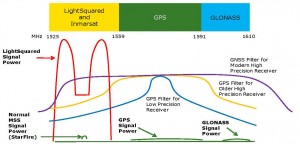
Deere Companies produced this diagram showing a comparison of the respective power levels of LightSquared signals vs. satellite navigation signals.

Unfortunately for LightSquared, it has several problems to contend with, the most significant being its “zoning problem.”  The souped-up 4G network is simply not in character for the spectrum neighborhood it calls home.  It’s a McMansion being built in a neighborhood of cottages.  LightSquared’s neighbors are low powered satellite signals in the 1-2Ghz range, including those from the satellites which provide GPS.  In certain cases, receiver equipment can be designed to reject the adjacent interference a network like LightSquared could create, but with millions of existing GPS units already in use, that may prove impractical.

LightSquared has tried to rope off its channel space as much as possible, trading spectrum with other nearby users to create a nearly contiguous 20Mhz slice it can dedicate to its signals, in hopes of reducing interference.  But the recent tests suggest this may not be enough.  General Motors suggested LightSquared needs to find a better neighborhood — one more suited to the kind of signal it wants to offer.  That could come from a spectrum trade or a frequency reallocation by the FCC.

The FCC is taking a “wait and see” approach so far, claiming further tests are needed.  But the agency earlier pledged it would not allow LightSquared to operate its network if it created major interference problems for other spectrum users.  Some GPS manufacturers think that commitment is too vague, because “major interference” is in the eye of the beholder.

Those concerns may be warranted, considering the FCC earlier found its way clear to ignore the documented interference Broadband Over Power Lines created over both the AM and shortwave radio dial.  Even after a blizzard of lobbying and campaign contributions won support for BPL in Washington, the ultimately inferior product that resulted couldn’t win the support of the group that ultimately mattered most — paying customers.

[flv width=”640″ height=”500″]http://www.phillipdampier.com/video/Bloomberg Ahuja Says LightSquared to Finish 4G Network Before 2016 6-11-11.flv[/flv]

Sanjiv Ahuja, chief executive officer of LightSquared, talks about the company’s efforts to build a wireless broadband network as other spectrum users challenge the company’s potential to create interference.  (7 minutes)

WildBlue’s Satellite ISP Federal Stimulus: Gov’t. Helps Defray Cost of 1Mbps ‘Fraudband’

Get government subsidized satellite "broadband" at speeds up to 1Mbps, as long as you honor strict usage limitations.

With much fanfare, ViaSat’s WildBlue has unveiled a special discounted satellite “broadband” offer that comes courtesy of United States government taxpayer funding:

WildBlue’s same great service at an ultra-low price, courtesy of the U.S. government.

WildBlue, through the U.S. Recovery Act brings a special offer for high-speed Internet to areas unserved by wireline providers. It’s the most affordable deal we’ve ever offered, and the monthly price for this special package is guaranteed for as long as you remain a WildBlue customer. Take advantage of government funds to get High Speed Internet at discounted rates.

For $39.95 per month, WildBlue will provide the satellite equipment to deliver qualified subscribers up to 1Mbps service, subject to a monthly download limit as low as 7.5GB per month for downloads, 2.3GB per month for uploads.  Customers who exceed the limits will have their 1Mbps service throttled to near-dial-up speed until usage falls below the company’s “fair access policy.”

WildBlue explains the limited-time offer is made possible by funding from the American Recovery and Reinvestment Act of 2009.  Through a grant from the Department of Agriculture’s Rural Utilities Service (RUS), certain rural customers might qualify for the discounted pricing.

WildBlue only received authorization to deliver the discounted service to locations west of the Mississippi — specifically those not within an existing RUS project zone, are located in a defined rural area, and cannot receive service from a telephone, cable, or fiber provider.  Current WildBlue customers also do not qualify.

The grant funding covers installation and equipment charges, the client only pays for the service itself.  But would-be customers are required to commit to at least one year of service or face an early termination penalty and must pass a credit check.

WildBlue customers, as well as those of other satellite providers, have given satellite Internet access low satisfaction scores, primarily because of speed and usage limitation issues.  But for some without any other choice, it is a service they live with for basic web access.

FCC Chairman Calls for Cable Industry to Close Broadband Gap

Phillip Dampier June 15, 2011 Consumer News, Data Caps, Public Policy & Gov't 1 Comment

Genachowski

This morning in Chicago, FCC Chairman Julius Genachowski congratulated the cable industry for their part in delivering broadband service to America.

Appearing at the cable industry’s trade show, Genachowski said the next problem to conquer is broadband adoption — reaching the 100 million Americans that either don’t want or can’t afford the service.

“As an industry, you’ve connected two-thirds of Americans to broadband – and I applaud you for that,” Genachowski said. “Now, let’s work together to connect the last third — nearly 100 million people — so all Americans can participate fully in our 21st century economy and society.”

To address the issue of broadband adoption, Genachowski plans to create a Broadband Adoption Task Force to be headed by his senior counselor, Josh Gottheimer.  The group will accept input from public and private sources to try and find ways to get broadband service into more homes.

The cable industry has recently argued that elimination of flat rate broadband service would allow the industry to create lower priced, lower usage tiers of service to reach customers.  But even existing “light usage” service plans that deliver lower speeds at lower prices have not made a major difference in convincing millions of potential customers to sign up.

Search This Site:

Contributions:

Recent Comments:

Your Account:

Stop the Cap!