Home » Consumer News » Recent Articles:

Frontier: America’s Worst Wired ISP for Netflix Viewing (Second Time Winner!)

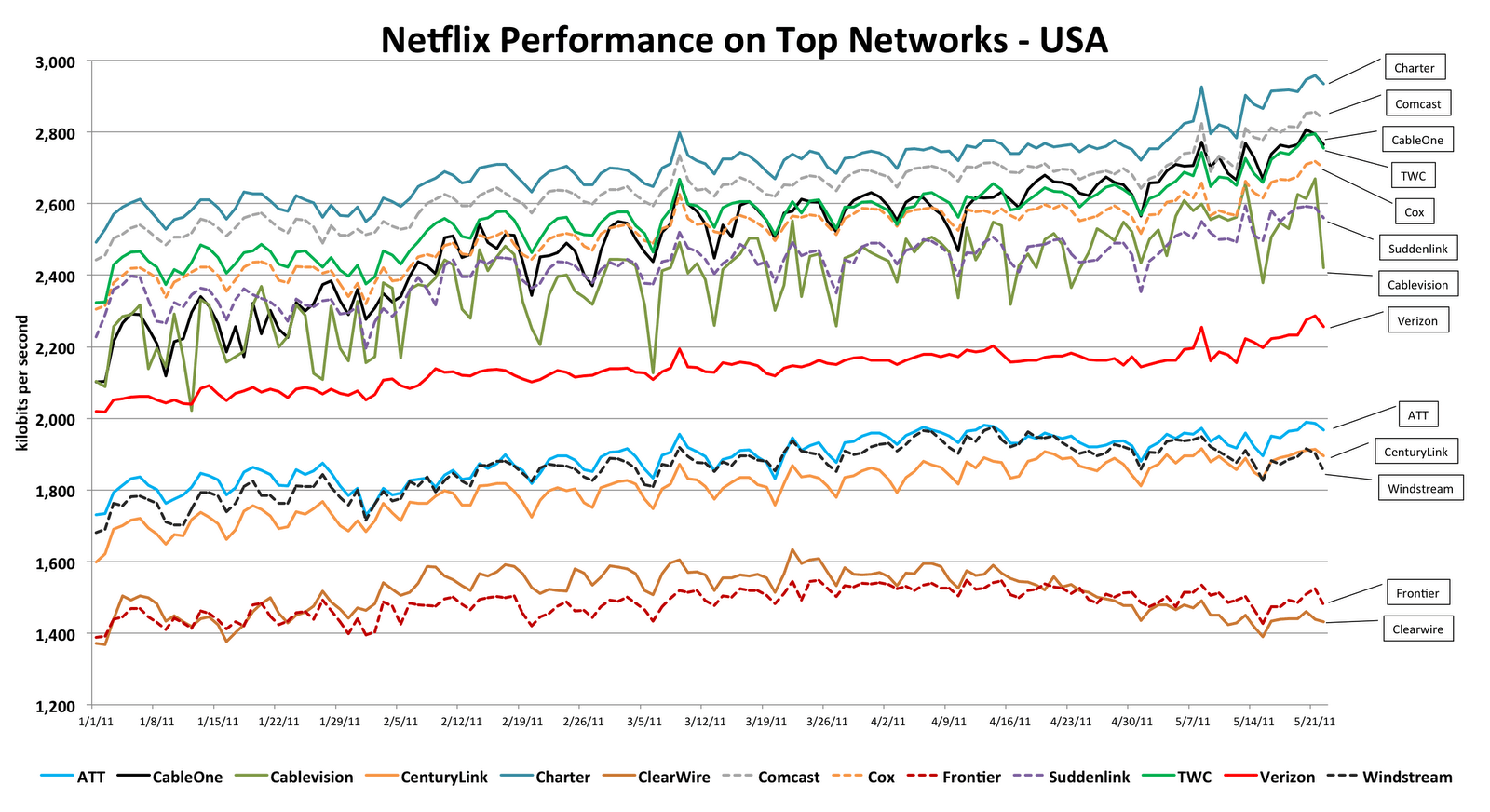
Click to Enlarge

Frontier Communications’ DSL service delivers abysmal results for customers looking for quality time with Netflix.  For the second quarter running, the independent phone company’s ability to keep up with Netflix’s high quality video is about on par with a garden slug in a triathlon — yes, it may eventually reach the finish line, but you’ll be dead before it happens.  Even more embarrassing for Frontier, their service is occasionally beaten by Clearwire, a wireless ISP with a bandwidth throttler that can reduce your online experience to the painful days of dial-up if deemed to be using “too much.”

“Frontier sucks,” writes Stop the Cap! reader Doug in Charleston, W.V. “After they took over where Verizon fled, my ability to watch Netflix online became a source of endless frustration, so now I limit myself to mailing DVD’s back and forth.”

Remarkably, Charter Cable, which does poorly in customer satisfaction surveys, is again the runaway winner, followed by Comcast, the heavily usage-capped Cable One, Time Warner Cable, and Cox.  Verizon and AT&T only deliver middling performance.

Bipolar Cable Industry Loves<->Hates Netflix; Britt Says It’s About Giving Customers What They Want

Phillip Dampier June 23, 2011 Competition, Consumer News, Data Caps, Editorial & Site News, Online Video, Video Comments Off on Bipolar Cable Industry Loves<->Hates Netflix; Britt Says It’s About Giving Customers What They Want

[flv width=”512″ height=”298″]http://www.phillipdampier.com/video/WSJ Studios disarming cable in battle with Netflix Media Report 6-20-11.flv[/flv]

Wall Street Journal: Top execs of some media behemoths are shifting their public stances toward Netflix Inc. of late. They’re now trying to persuade investors that the video streaming service will expand their business rather than destroy it. (4 minutes)

You are forgiven if you are confused about the love-hate relationship the cable industry has with online video streamers like Netflix — one that the Wall Street Journal likens to manic bipolar episodes.  Weeks after blaming Netflix for getting video programming too cheaply and threatening cable subscriptions, cable industry executives were hugs and kisses about online video at the recent Cable Show in Chicago.

“The reason why there’s interest in these Internet video providers that is that they’re deploying technology that’s making the experience better for consumers,” Time Warner Cable CEO Glenn Britt said in an interview with MarketWatch during the National Cable & Telecommunications Association’s annual Cable Show last week.

“There’s nothing about [cable companies] that stops us from doing that. So I would say … we as an industry just need to pay attention and give consumers what they want. Then there’s no room for these other guys. I don’t mean to say that in a negative way, but it’s true.”

Britt

Of course, this is the same man that has earplugs firmly implanted to help resist another rejection of his Internet pricing schemes that Time Warner Cable customers loathed in 2009.  Britt’s desire to give “consumers what they want” just doesn’t play in this part of town while the cable company is installing software to measure and potentially meter broadband usage.

What is different in the online video spectrum is consumers have choices.  They can adopt Time Warner Cable’s glacially-slow rollout of its TV Everywhere concept, watch Hulu, use Netflix, or simply steal content providers don’t want them to watch.  For customers of Time Warner Cable facing competition from AT&T, there is potentially nowhere to run to avoid an Internet Overcharging scheme which could bring the online viewing party to a rapid conclusion when your viewing allowance is used up.

Britt says he is struggling with rights holders to provide more accessibility to online video streaming of popular shows.  He’s also thinking about how many restrictions to slap on subscribers.

MarketWatch talked with Britt and found him dealing with nagging questions about how many devices each user account should be authorized to use for viewing. “Should it be three, should it be 10? If I make [that number] too small, you’re not going to be happy as a customer,” Britt philosophized. “If I make it too big, you’re going to give the password to all of your friends, and they won’t have to buy a subscription to begin with.”


iPhone 5 Arrives in September: 4G/LTE Support Unlikely, But Will Sport Significant Improvements

Phillip Dampier June 22, 2011 Consumer News, Video, Wireless Broadband 1 Comment

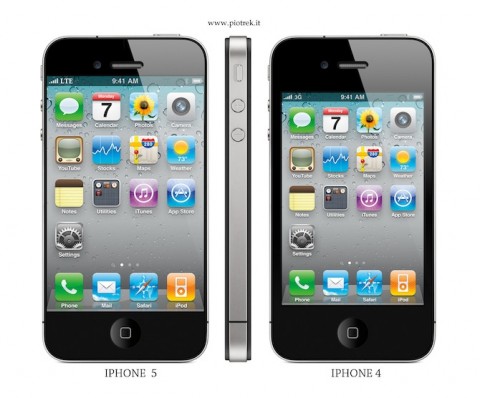
9 to 5 Mac shows off a mock image of what the newest iPhone 5 will probably look like. Pay close attention to the rounded edges and bezel. (click to enlarge)

Apple’s wildly popular iPhone series gets an upgrade in September as the Cupertino, Calif., company prepares to unveil iPhone 5.  Although the new model is not expected to support 4G/LTE networks, significant upgrades are in the works for the next series of phones:

  • iPhone 5 will use Apple’s new iOS 5, which means improved messaging and photo sharing;
  • An improved 8-megapixel camera, up from the current 5-megapixel one that got mixed reviews on iPhone 4;
  • The introduction of the A5 processor, currently used in iPad 2, to provide more power for apps and features;
  • An edge-to-edge screen and rounded glass.

The iPhone currently accounts for half of Apple’s revenue and has almost an 18% share of the smartphone market and dropping.

To counter Google’s increasing share of the smartphone market with its Android operating system, Apple also promises to deliver a stripped-down, less powerful budget-priced iPhone series for the developing world.  While prices have not been announced, the new budget phone is likely to be priced at least $100-200 less than western models.

With iPhone 5 also expected to include built-in support for either GSM or CDMA networks, Apple’s newest phone could be released simultaneously by both AT&T and Verizon.

Whether customers will be able to take their phones activated on one carrier to another is another matter, as is whether Sprint, T-Mobile, and smaller carriers will be allowed to sell it.

[flv width=”640″ height=”500″]http://www.phillipdampier.com/video/Apple Introduces iPhone 5 6-22-11.flv[/flv]

Even without support for 4G/LTE, iPhone 5 is still likely to generate considerable enthusiasm, especially among would-be Verizon customers waiting for the next version of the phone.  But by then, unlimited data plans will be a dream.  Bloomberg News and WFXT-TV in Boston discuss iPhone 5’s release, and a clip from CNBC’s ‘The Titans’ explains the marketing genius of Apple and its iPhone product line.  (2 minutes)

New Legislation Targets Inflated Wireless Speed Claims: 4G Means Anything Carriers Want

Phillip Dampier June 22, 2011 Broadband Speed, Consumer News, Public Policy & Gov't, Wireless Broadband Comments Off on New Legislation Targets Inflated Wireless Speed Claims: 4G Means Anything Carriers Want

Rep. Anna Eshoo

Legislation forcing carriers to tell the truth about their 4G wireless speeds is scheduled to be introduced today in Congress by its author and chief sponsor, Rep. Anna Eshoo (D-Calif.)

The Next Generation Wireless Disclosure Act would require carriers to disclose the minimum data speed of their respective networks and better explain plan pricing and coverage.  While many consumers believe “4G” means vastly superior speeds and performance, in reality some wireless carriers have labeled even incremental network upgrades as delivering “4G” service, even if speeds are only incrementally better.

“Consumers deserve to know exactly what they’re getting for their money when they sign-up for a 4G data plan,” said Rep. Eshoo. “My legislation is simple – it will establish guidelines for understanding what 4G speed really is, and ensure that consumers have all the information they need to make an informed decision.”

Specifically, the legislation would provide consumers with the following information at the point of sale and in all billing materials:

  • Guaranteed minimum data speed
  • Network reliability
  • Coverage area maps
  • Pricing
  • Technology used to provide 4G service
  • Network conditions that can impact the speed of applications and services used on the network.

The legislation also requires the Federal Communications Commission (FCC) to evaluate the speed and price of 4G wireless data service provided by the top ten U.S. wireless carriers in order to provide consumers with access to a side-by-side comparison in their service area.

“Consumers want faster, more reliable wireless data service, and I look forward to working with industry and consumer groups to achieve this goal,” Eshoo added. “We need to enhance transparency and ensure consumers are fully informed before they commit to a long-term service contract.”

The bill faces tough prospects in the Republican-controlled House of Representatives, and industry groups are likely to oppose the measure.  Eshoo has tangled with both in the recent past as a prominent supporter of Net Neutrality.

Law Firm Reminds Consumers of Mobile Broadband Class-Action Lawsuit Against Verizon

Phillip Dampier June 22, 2011 Consumer News, Verizon, Wireless Broadband 3 Comments

Verizon is charging customers for text messages sent to mobile broadband devices, even though the devices themselves have no effective way to view the messages.  That allegation is the subject of a class-action lawsuit filed against the wireless carrier by Hagens Berman LLP, a law firm representing consumers who were unfairly billed for text messages from July 28, 2004 to the present.

The lawsuit, originally filed August 4, 2010, in the United States District Court for the District of New Jersey, seeks compensatory damages and an injunction prohibiting Verizon from billing customers for text messages sent to mobile broadband devices.  The law firm sent out a reminder this week for customers either billed in the past or still being billed they still have a chance to join the lawsuit.

Verizon’s mobile broadband devices allow its customers to access the Internet through Verizon’s wireless network. Each device is assigned a unique 10-digit telephone number and therefore, text messages can be sent to the 10 digit number associated with the device. However, according to the lawsuit, the devices have no screens and users have no effective way to view them.

If Verizon billed you for text messages you cannot access in connection with your Verizon Mobile Broadband device, you can request further information or join the case at the firm’s website or by email at [email protected].

Search This Site:

Contributions:

Recent Comments:

Your Account:

Stop the Cap!