Home » Consumer News » Recent Articles:

Big Brother: Hollywood & Your Internet Provider Will Be Checking Your Download Activity to ‘Protect You’

Stop the Cap! readers Tom and Scott both sent word that the music industry, Hollywood studios, and your Internet Service Provider have teamed up to begin inspecting your downloading activity looking for evidence you are grabbing illegal, copyrighted content from the Internet.

ISPs ranging from Comcast, Verizon, Time Warner Cable, Cablevision, and AT&T are installing the “Copyright Alert System,” an industry-approved “solution” to copyright theft of online content.  Your ISP will receive word if either the music or movie industry suspects you are trying to download an episode of your favorite TV show or latest Hollywood film from an “unauthorized” download site.  Then, the ISP will start sending you warnings or redirect your web browsing to Alert Purgatory, the place where you learn you are suspected of copyright theft, but haven’t yet been convicted for it.

If you don’t contact your ISP straight away to protest your innocence, your provider may then begin redirecting all of your web journeys to the copyright theft warning website and leave you there until you convince your ISP you are not doing anything wrong.

The voluntary agreement between service providers and copyright owners delivers very little to consumers, despite protestations to the contrary by the cable industry lobbying group — the National Cable & Telecommunications Association.

“Consumers have a right to know if their broadband account is being used for illegal online content theft, or if their own online activity infringes on copyright rules—inadvertently or otherwise—so that they can correct that activity,” said James Assey, executive vice president of the NCTA.

Innocent or not, consumers who wish to seek an independent review before their ISP redirects every web address to the enforcement page, can get one — for the low, low price of $35.

Where that money ultimately goes is anybody’s guess, and nobody yet understands the exact mechanism of how consumers can prove their innocence.

Stop the Cap! believes this system does not serve consumers well.  Copyright enforcement measures taken by the music and movie industry in the past have proven to be far from well-targeted, using a “sue first, ask questions later” approach that has cost some consumers thousands of dollars to settle threatened litigation that would have cost far more to defend in court — guilty or not.

YouTube videos cited for copyright enforcement claims may irritate those who uploaded them, but never put YouTube visitors at risk of the Copyright Alert System just for landing on one that a studio executive deemed copyright theft.  Forcing a consumer to pay $35 to defend themselves from watching that New Order music video from the 1980s is simply unacceptable.

Copyright theft is a serious problem, and we don’t blame content owners for seeking to protect what is rightfully theirs.  But as we have learned over the last 20 years, overzealous protection measures have always backfired.  Openly available, legally accessed content from sites like Hulu have put a major dent in illegal downloading of entertainment from torrent sites and file hosting providers.  It’s more convenient, and the studios sell well-tolerated advertising to help pay for the costs.

Solutions like that are far superior than spying on web traffic looking for “illegal downloads” using unknown mechanisms which could prove as unreliable as earlier copyright enforcement efforts.  In the past, profit-making companies with an incentive to identify “theft” have been hired to ferret out those suspected to stealing online movies and music.  With a financial motive to lean towards guilt before innocence, subscribers confront the very real possibility they’ll have to pay $35 to try and prove a negative – that they didn’t engage in illegal downloading.


Eddie “The Hookup Man” Nabbed in Ohio for Alleged Illegal Cable Hookups

Phillip Dampier July 7, 2011 Consumer News, Video 1 Comment

Tough economic times often bring an incentive to steal cable service, especially when being given the name and number of a “connection” that can hook you up for service priced at almost $75 a month for a one-time fee of $50-75 dollars.

Time Warner Cable, among other Cleveland-area utilities, were on the hunt for one alleged under-the-table installer — Eddie Hunt — for nearly a year.

Last Wednesday, a sting paid off.

“He’s kind of known as the hook-up man. If you want to go the black market route and risk getting in trouble, he’s the man, ” Time Warner Security Director Kevin Pratt told Cleveland TV station WKYC.

Hunt is certainly qualified to install cable — he’s been allegedly fired twice from his last two jobs working for cable companies.

Hunt allegedly charged local residents a “one time” fee for unlimited cable, until security measures cut the free service off.  Time Warner claims Hunt would then be back for more money to restore the service.

Time Warner Cable surveillance video shows Hunt accepting money for an illegal cable hookup — video later partly shown by WKYC News.

Hunt was arrested by local authorities.  Time Warner Cable says it will run an amnesty program for those with illicit cable hookups, allowing them to become paying customers without legal penalties.  But the cable company says it will give only one warning before they would move to have customers prosecuted for cable theft.

Cable companies estimate at least 14 percent of their “customers” aren’t paying for cable service.  The industry claims this hurts local communities through reduced franchise fee payments and raises prices for everyone else.

“It costs you and me, the government and everybody,” said Pratt. “It’s definitely not a victimless crime.”

[flv width=”480″ height=”288″]http://www.phillipdampier.com/video/WKYC Cleveland Garfield Heights Sting nabs alleged cable TV pirate 7-1-11.flv[/flv]

WKYC-TV ran this exclusive story on Eddie “The Hookup Man” Hunt, alleged to be responsible for cable and other utility theft in the Cleveland, Ohio area.  (3 minutes)

Bait & Switch Broadband? Time Warner Cable Advertises 30/5Mbps for Austin Last Week, Delivers 20/2Mbps This Week

Phillip Dampier July 5, 2011 Broadband Speed, Consumer News 14 Comments

Time Warner Cable customers in Austin, Tex. excited to learn DOCSIS 3 speed upgrades have finally arrived in the state capital are less than thrilled to learn the rug has been pulled out from under some of the high speeds the company was promising customers just one week earlier.

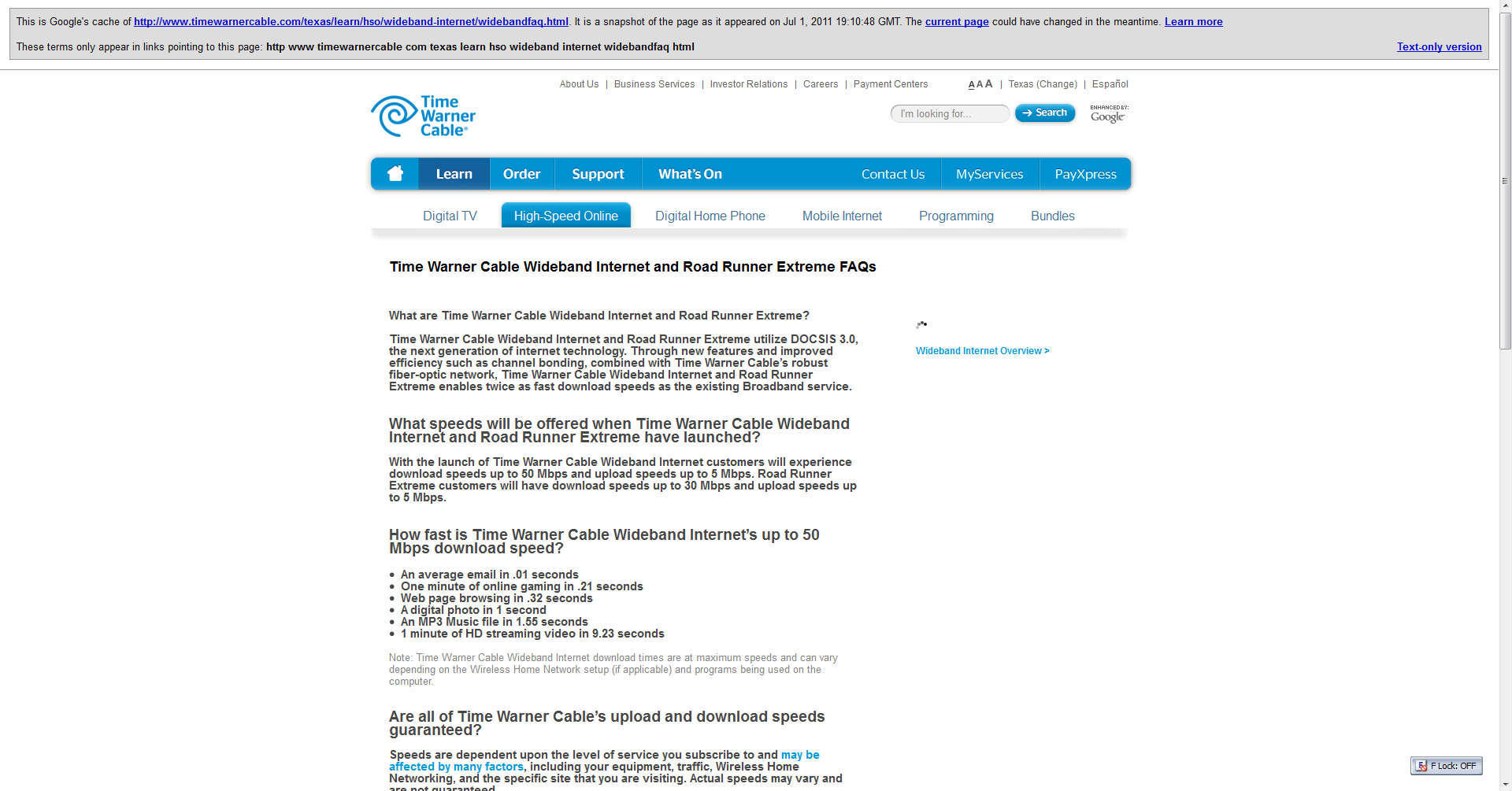
At issue is Road Runner Extreme, the DOCSIS 3 upgrade that delivers faster speeds at a “sweet spot” price of just $10 more than Road Runner Turbo.  In most Time Warner Cable markets, Road Runner Extreme delivers 30/5Mbps service, and so it was to be for Austin customers as well:

Captured from Time Warner Cable website - July 1, 2011 (click for screenshot of entire web page)

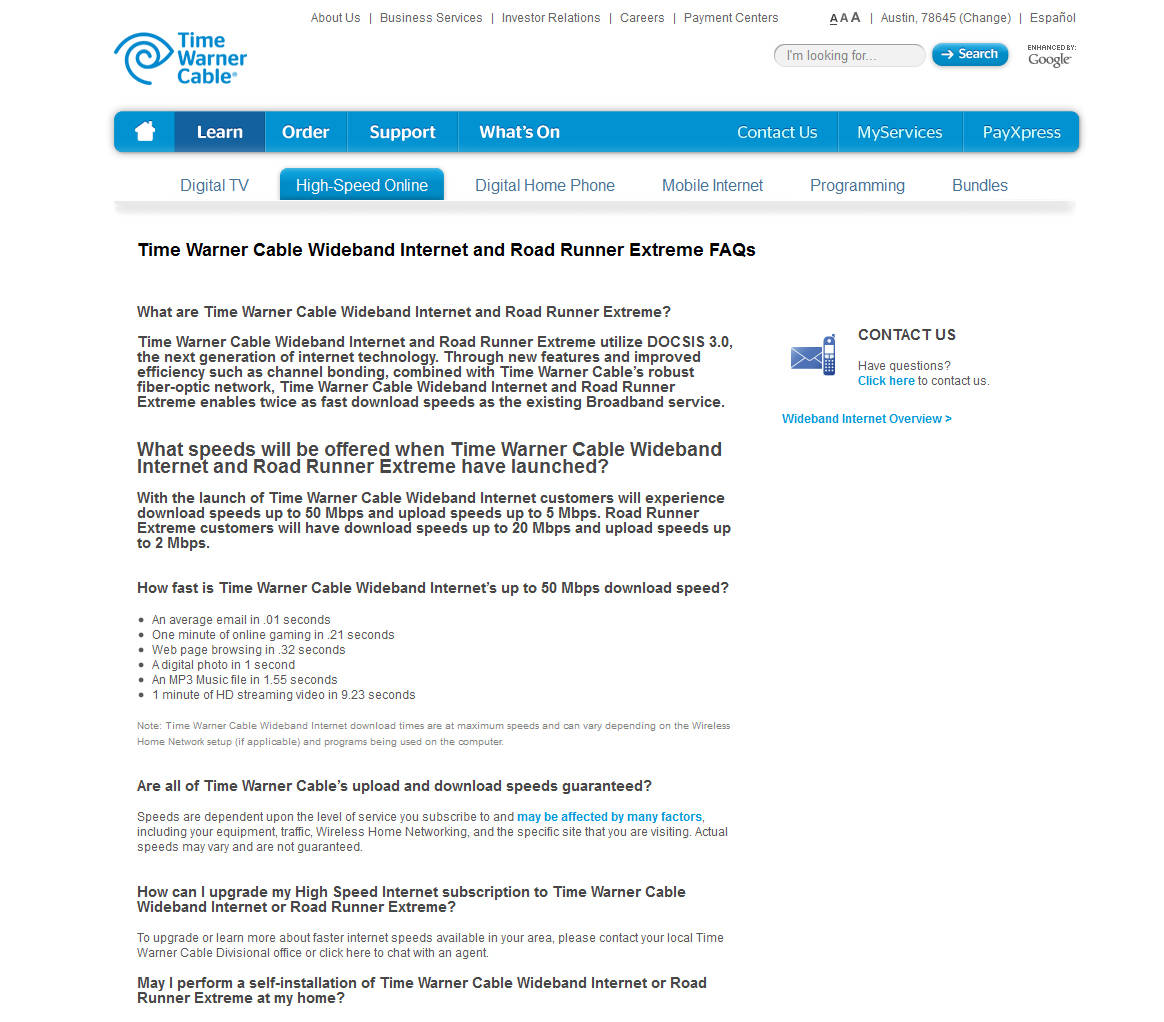
But Broadband Reports reader “SunnysGlimps,” who signed up for Extreme expecting those speeds, discovered “bait and switch” broadband instead, as the resulting speed test (and subsequent advertising) showed a much less impressive 20/2Mbps result.

“I was actually getting faster speeds with the Turbo then I am now with the capped Extreme package,” says Sunnysglimps. “My speed clearly hits a cap when it goes to 20/2Mbps on speedtest.net.”

This reader feels Time Warner Cable is engaged in false advertising in Austin.

“You cannot advertise 30/5Mbps, sell the service, charge more, and then change your advertising a few days later and say it won’t be what you just purchased.”

Captured from Time Warner Cable website - July 5, 2011 (click for screenshot of entire web page)

Verizon Wireless Customers: 48 Hours Left to Secure Unlimited Data/Unlimited 4G Tethering Plans

At the end of business Wednesday, Verizon Wireless will end its unlimited data plans for new customers.  If you are an existing customer, you will be able to retain unlimited data for your smartphone indefinitely, but those considering an upgrade to 4G may want to consider doing so immediately, if you want to have an unlimited 4G tethering plan for your 4G-capable phone.

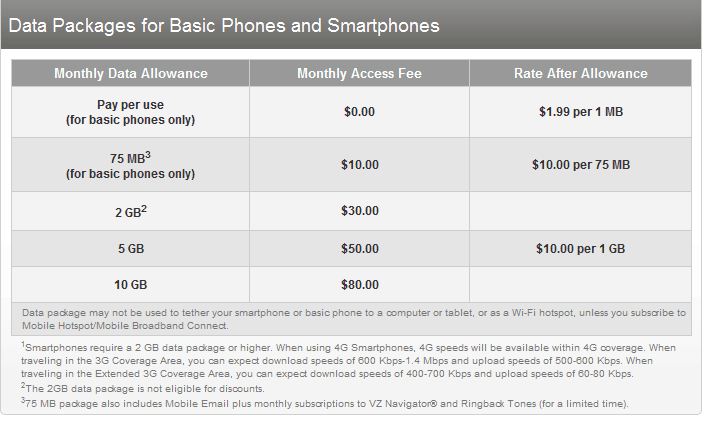
Verizon Wireless data pricing effective 7/7/2011

New Verizon Wireless Customers: You must buy and activate a 3G/4G-capable phone on Verizon’s network no later than 11:59pm Wednesday evening to qualify for the $29.99 unlimited data plan.  At this point, this means buying a phone from Verizon Wireless’ website or visiting a local store.  If you want the best possible price, we recommend calling Verizon Wireless and negotiating with them directly.  Verizon is often able to match prices from online retailers like Wirefly or Amazon, usually by throwing in service credits for your first month’s invoice.  New 4G customers can score an unlimited tethering add-on plan from Verizon for an additional $30 a month.  That means $29.99 for the data plan plus $30 for the tethering option, but if comes without any usage limits.  After July 6, all those new to tethering will only find one option: $20 for up to 2GB of tethering access.

Existing Verizon Wireless Customers: You will keep your current unlimited smartphone data plan indefinitely, perhaps even after upgrading your phone.  However, if you were interested in tethering on Verizon’s 4G network, consider upgrading to a 4G phone before Thursday to qualify for the $30 unlimited tethering plan, good only for 4G users with an existing tethering relationship with Verizon.  You must select the 4G tethering option before Thursday to qualify.  Call Verizon Wireless at 611 from your handset and make sure they take care of this for you to avoid complications.  An automatic update will be pushed to the Thunderbolt, Charge, and Revolution on July 7 to cut off the Hotspot free ride those customers had been enjoying up until now.  You will have to buy the service if you want to continue using it.  All 3G phones (iPhone, Droid X, etc.) will not see any pricing changes for 3G tethering – it is still $20 a month for up to 2GB of usage, no unlimited options for you.

Other pricing details:

  • Verizon customers opting for the $30 for 2GB plan will lose company discounts on their data plan.  You must select a higher-cost data plan if you want to keep any employer discount;
  • Verizon is now specifically prohibiting tethering any of their phones without a Verizon add-on tethering option.  This means third-party tethering apps you may have used before now violate your contract with them.

[flv width=”360″ height=”290″]http://www.phillipdampier.com/video/WCPO Cincinnati Verizon ending unlimited data plans 6-24-11.mp4[/flv]

WCPO-TV in Cincinnati covers the imminent funeral for Verizon’s unlimited data plans.  Verizon customers are not happy with the loss.  (2 minutes)

Competition Bureau Fines Bell $10 Million for Misleading Consumers About Pricing

The Competition Bureau has fined Bell Canada $10 million for what it calls the phone company’s misleading pricing for its wireless, broadband, phone, and satellite TV services.  The agency accused Bell of advertising one price for service, but charged customers considerably more after hidden fees were tacked on.  That made it impossible for any customer to actually purchase Bell’s services at their advertised prices.

The fine, the maximum amount that can be levied, was designed to send a message, according to Commissioner Melanie Aitken.

“When a price is offered to consumers, it must be accurate,” Aitken said. “Including a fine-print disclaimer is no license to advertise prices that are not available.”

Since December 2007, Bell routinely advertised product bundles that it claimed were priced at less than $70 a month, but after the hidden fees were calculated, Canadian consumers routinely paid north of $80.

Aitken

Aitken took issue with rental fees for equipment, term contract escape penalties, mandatory “add-ons” that were not included in the advertised price, and hidden “junk fees” designed to look like government-mandated taxes.  They all routinely add at least $10 to most telecommunications bills, even before actual government fees are calculated.

Bell protested the Bureau’s findings, but quickly agreed to pay the fine, modify its advertising, and cover the $100,000 estimated cost of the agency’s investigation.

The Competition Bureau has become a thorn in the side of many major corporate entities in Canada after winning new powers in 2009 to protect consumer interests.  The agency is currently pursuing a $10 million fine against Rogers Communications for “hit piece” advertising misleading consumers about Rogers’ wireless rivals — especially Wind Mobile.

But Rogers is not going quietly as Bell has done, vowing to drag the matter through the courts to void any fines or penalties.

Aitken promises she isn’t necessarily done with telecommunications companies, suggesting any company burying extra costs in the fine print, or subjecting customers to penalty fees for canceling service might be on notice.

Telecommunications companies in Canada have traditionally opposed government agencies that champion consumer protections.  Most notably, Bell, Rogers, and Quebecor Media have all attacked the Commissioner for Complaints for Telecommunications Services, an independent agency that monitors and assists consumers with issues related to phone and cable companies.  Bell wanted the organization abolished, while Rogers and Quebecor sought to see participation in it made voluntary.

Unfortunately, consumers won’t share in the $10 million fine from Bell.  Those funds will be collected and kept by the Canadian government.

[flv width=”640″ height=”388″]http://www.phillipdampier.com/video/CBC Bell fined 10M over ads 6-28-11.flv[/flv]

CBC covers Bell’s $10 million dollar fine for advertising one price for service, but sending a much higher bill with tacked on hidden fees and surcharges.  (2 minutes)


Search This Site:

Contributions:

Recent Comments:

Your Account:

Stop the Cap!