Home » Consumer News » Recent Articles:

Copper Thieves Still Plaguing Frontier Communications; Company Wants Stronger Penalties

Nearly every week, phone companies like Frontier Communications are confronted with service outages that turn out to be more than just an errant gunshot that disrupted 911 service for hundreds of residents in Moses Lake, Washington.  When repair crews arrive to find no cabling to repair, they realize it’s yet another case of copper theft — a problem plaguing economically challenged areas across the country.

Unfortunately for phone companies, copper theft remains a misdemeanor in many states, including West Virginia, one of the hardest hit by wire thieves that literally strip phone lines right off the phone poles as they drive by in the dead of night.

Scrap copper wire

An employee with Frontier Communications reported that on June 25 he received reports that the phone lines were out for residents along Paddle Creek Road near Fort Gay, W.V.

It apparently took two days for the employee to discover, on June 27, 800 feet of phone cable had been removed from a wooded area along the road. The value of the cable was estimated at $10,000.  The annoyance value for customers left without basic phone service?  Potentially more.

In St. Albans, nearly 400 Frontier customers were stripped of their landline service Friday when vandals cut a cable in a possible theft attempt.  Frontier said the most vulnerable cables are often in the most remote and rural locations, and this cable qualified, requiring more than a day to repair and restore service.

But the impact of copper theft can be greater than phone service knocked out for a few hundred residents.  In Kanawha County, West Virginia’s Department of Agriculture offices were left idle when the second copper theft in two months left their phone lines dead.

“We’re at a standstill,” said Gus Douglass, commissioner of agriculture. “It’s kind of ridiculous.”

[flv width=”480″ height=”380″]http://www.phillipdampier.com/video/WSAZ Huntington Copper Thieves Dep Ag 6-28-11.mp4[/flv]

WSAZ-TV in Huntington, W.V. covered the second straight outage of phone service for the West Virginia Dept. of Agriculture in two months.  Copper thieves do strike twice in the same place.  (2 minutes)
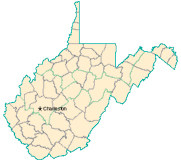
Frontier has complained that because copper thefts are often treated as a misdemeanor, offenders are skating with a small fine and little or no jail time.  That makes repeat offenses likely, and risks for those just getting into the copper racket low.

Thieves are reselling the stolen copper for money.  Copper has become a hot commodity, and thieves often earn hundreds, if not thousands of dollars, for a night’s work.

Frontier believes strengthening criminal penalties for copper thefts will do more to deter would-be thieves more than installing surveillance equipment.

Kanawha County Prosecutor Mark Plants seems to agree.  His office is now charging offenders under a little-used state code that makes it a felony to disrupt telephone service.  A felony conviction can bring substantial fines and multi-year prison sentences, especially for repeat offenders.

“There is a push […] towards maximizing a prison sentence for all of these criminals,” Plants told WSAZ-TV.

[flv width=”480″ height=”380″]http://www.phillipdampier.com/video/WSAZ Huntington Copper Thieves 6-29-11.mp4[/flv]

WSAZ-TV follows up on the copper theft outage that plagued the West Virginia Dept. of Agriculture with news of an arrest, and a demand for stronger penalties for copper thieves.  (2 minutes)

Time Warner Cable ‘Analyst’ Sexually Harasses N.C. Customer: “Hello My Baby, I Here to * You”

Phillip Dampier July 5, 2011 Consumer News, Video Comments Off on Time Warner Cable ‘Analyst’ Sexually Harasses N.C. Customer: “Hello My Baby, I Here to * You”

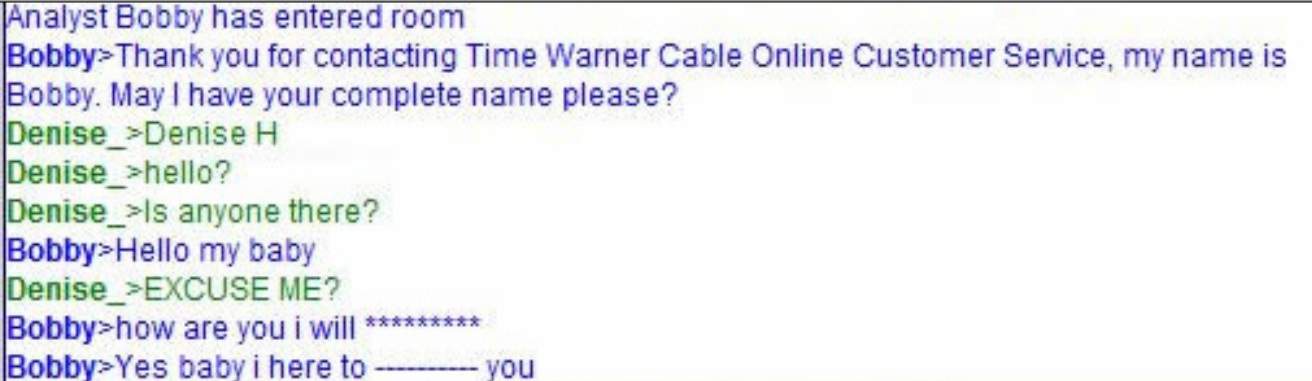
A Time Warner Cable online customer support employee is out of a job after sexually harassing a Charlotte, N.C. area woman looking for help with her Time Warner Cable account.

“Hello my baby,” was the opening “Bobby” gave to Denise when she began an online chat to learn more about the cable company’s products.  “Yes baby I here to ———- you,” came soon after.

“It is unacceptable,” said Denise’s son Shaun Poland, who didn’t get much of a response from Time Warner until he took the story to a Charlotte-area television station and the cable company’s Facebook page.  “It is sexual harassment.”

Poland’s mother thought it must have been a mistake, but as the comments continued, Poland told her to take a “screen grab” of the online chat.  Despite calls to Time Warner, Poland didn’t hear anything until taking the story public, and to a much wider audience.

(WSOC-TV)

Time Warner Cable spokesman Dan Ballister issued a statement denying the online chat agent was a direct employee of Time Warner Cable.  But the agent involved was working for a cable company vendor and had access to Time Warner customer phone numbers and home addresses.

“Within 24 hours of this incident, the agent was no longer supporting Time Warner Cable,” Ballister said.

Poland is still concerned.

“We have a crazy person with access to all of our information saying sexually harassing things,” Poland told the station.

[flv width=”640″ height=”380″]http://www.phillipdampier.com/video/WSOC Charlotte Woman Receives Inappropriate Messages In Time Warner Cable Chat Room 7-1-11.flv[/flv]

Charlotte station WSOC-TV talked with Shaun Poland about his mother’s disturbing experience chatting with Time Warner Cable.  (2 minutes)

AT&T’s California Landline Nightmare: Bakersfield-Area Residents in Tears Over Lousy Service

Phillip Dampier July 4, 2011 AT&T, Consumer News, Rural Broadband, Video Comments Off on AT&T’s California Landline Nightmare: Bakersfield-Area Residents in Tears Over Lousy Service

AT&T’s record of delivering reliable landline service has remained an open question for Bakersfield, Calif. residents for more than six months, as repeated outages leave several AT&T landline customers without access to a dial tone.  Even worse, some of the customers impacted have been left without any phone service for weeks on end, including one woman whose life literally depends on a working phone.

Andrea Williams, who lives alone in her Bakersfield home, suffered a stroke and has a heart condition — making access to a phone absolutely essential to her well-being.  Williams is also legally blind, making a cell phone an insurmountable challenge.  Instead, Williams says she has memorized the location of the buttons on her long-standing cordless landline phone, a phone that was out of service just after Christmas and largely stayed that way for three weeks.

Despite having made numerous calls to AT&T trying to get the problem corrected, Williams says no one from AT&T ever showed up.  It took an investigative report from Bakersfield’s KGET-TV newsroom to finally get AT&T to respond.

[flv width=”480″ height=”380″]http://www.phillipdampier.com/video/KGET Bakersfield ATT Phone Lines Crossed 12-29-10 and 1-10-11.flv[/flv]

Back in December, AT&T in Bakersfield left hundreds of customers without service or cross-connected with other customers’ phone lines.  It all culminated three weeks later in one health-challenged resident breaking out in tears when local TV station KGET finally helped get her service restored.  (5 minutes)

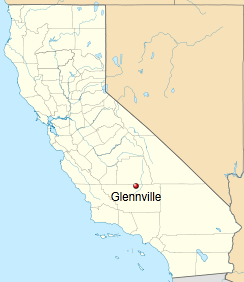
Glennville, Calif.

Fast forward to late June, and AT&T’s reliability is again up for a challenge, as some residents in the unincorporated community of Glennville, 30 miles north of Bakersfield, are fed up with repeated outages, even after eight families collectively paid $16,000 to AT&T to extend wired phone service and broadband to their neighborhood.

Around the same time Williams was experiencing problems with her phone line in December, residents in Glennville began experiencing repeated outages of their own.

“I think from December to January, it was 15 times it went out,” said resident Ray Schill.  “From February to now, [the lines have been out] another 10-15 times.”

Residents in Glennville are especially concerned because they cannot count on their landlines, and cell service is spotty to non-existent in the area.

“My major concern is we’re going to have a big problem up here — someone is going to be ill, we’re going to have a fire, someone’s going to die — who is liable,” Kathryn Ervin, a Glennville resident told KGET News.

What happens when residents call AT&T for help?

We get the runaround, says Schill, with promises extending through the months of May, June, and now July 15.

Schill doesn’t hold much confidence in AT&T’s promises, especially after the company responded to an inquiry from the state’s Public Utilities Commission which culminated in his complaint being closed-as-resolved.

Once again, KGET-TV was on the case for the benefit of its viewers, and reporter Kelsey Thomas received a remarkable response from AT&T — the company “couldn’t handle the number of people using the phones in Glennville.” (population: 280)

The company promises to “upgrade its software” to resolve the problem, but could not give Thomas a time frame for when that would be complete.

[flv width=”360″ height=”290″]http://www.phillipdampier.com/video/KGET Bakersfield Folks in Glennville fed up with ATT 6-27-11.mp4[/flv]

KGET-TV gets involved with AT&T once again, this time to help hundreds of residents of Glennville, Calif., who are also experiencing trouble with the company’s landline service.  (3 minutes)

Get-Out-of-Verizon-Contract-Jail-Free Card: Increased Regulatory Fee Means Penalty Free Exit

If you want to say goodbye to Verizon Wireless, or just want a new phone without waiting for your old contract to expire, Verizon has a deal they really don’t want to give you, but they have to — it’s in their contract.

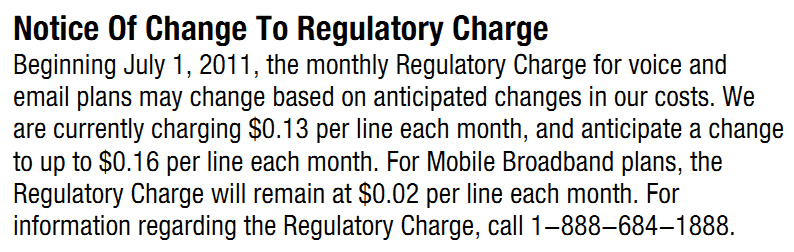
Verizon Wireless has announced they are unilaterally changing your wireless contract with an increase in the Regulatory Recovery Fee (a bill-padding junk fee) from $0.13 to $0.16 effective July 1st.  That fee opens a 60-day window for customers to exit their contracts because the carrier is imposing a “materially adverse” change without your advance consent.  After 60 days, you effectively give that consent by staying with the company.

“Materially adverse” is simple to understand, even if Verizon customer service representatives feign ignorance and stamp their feet as you demand to leave without paying an early exit fee.  It means Verizon has notified you they are changing the contract — one you signed in good faith for a set price, and they are now unilaterally changing it.  Unless those price changes come about because of a government mandate, Verizon cannot impose them without first granting you a window to cancel your agreement, penalty-free.

For customers unhappy with Verizon, they can freely take their business somewhere else.  For those who intend to stay, they can switch to a prepaid plan or sign a new two year contract and get a new phone at the same price any other new customer would pay, even if only 30 days into an existing contract.

This welcome window may mean a lot to customers looking for an early upgrade -and- keep Verizon’s unlimited smartphone data plan the company plans to discontinue July 7th.

With their “materially adverse” contract clause potentially exposing them to hundreds of dollars in lost cancellation fees they cannot impose, nobody said they would make it easy for you to jump free without some hassle.

When calling Verizon Wireless and requesting the “cancel service” option, expect the representative to pretend they don’t know what you are talking about, claim you still owe a penalty, or even express shock you are trying to escape them over a measly three cent rate increase.  Some may even try and credit three cents for each month remaining on your contract and claim that since you are no longer effectively paying the increased fee, you have no right to complain.

Tell them tough cookies — go and read their own contract:

Can Verizon Wireless Change This Agreement or My Service?

We may change prices or any other term of your Service or this agreement at any time,but we’ll provide notice first, including written notice if you have Postpay Service. If you use your Service after the change takes effect, that means you’re accepting the change. If you’re a Postpay customer and a change to your Plan or this agreement has a material adverse effect on you, you can cancel the line of Service that has been affected within 60 days of receiving the notice with no early termination fee.

Ask them to find the clause in their terms and conditions that says once they announce a rate change, that does not represent a change to your plan.  Then ask where it says in their agreement a subsequent credit frees them from the obligation of allowing you a penalty-free window to exit once a materially adverse change has been announced.  Let them know the only way they could have kept you from exercising your rights under the contract was if they never announced the price change impacting you in the first place.  Expect a long wait on hold.  A very long wait.

To truly escape Verizon Wireless’ contract, you will need to be prepared to say “no” to all of their counteroffers, and they will pelt you with them like an Oklahoma hail storm:

  • Reduced price phone upgrade?  No.
  • Free service for a month?  No.
  • Free accessories?  No.
  • Free texting plan?  No.
  • A free sample of their data or tethering plan?  No!
  • Cancel. Cancel. Cancel!

If they still want to argue, repeat after me:

“Despite your willingness to credit my account, once you are legally obligated, under your contract, to notify me of your intention to change my plan by raising prices that are within your control, you triggered the materially adverse clause, regardless of your subsequent attempt to credit my account.  Cancel the account immediately or I will escalate this to the same Executive Customer Service office that slapped you guys down the last time you tried this.  Once you notify us of a fee increase, the window to exit penalty-free is open, and only I can close it by agreeing to stay after 60 days.”

San Francisco Still in Stalemate With AT&T Over ‘Lawn Refrigerators’ for U-verse

Phillip Dampier June 29, 2011 AT&T, Consumer News, Public Policy & Gov't, Video 6 Comments

San Francisco city officials last night remained in a stalemate with AT&T over the installation of hundreds of utility boxes to aid the company’s U-verse fiber to the neighborhood system.

Since 2008, AT&T has sought to install the metal cabinets — dubbed “lawn refrigerators” by critics — that would house links with AT&T’s fiber network and copper wire connections leading to individual homes.  The plan has been in limbo since the threat of lawsuits and controversy over whether the boxes could reduce the visual appeal of neighborhoods and harm property values.

AT&T’s latest plan, now also on hold, seeks to allow the company to install 726 4-foot-tall cabinets around the city.  That’s completely unacceptable to groups like San Francisco Beautiful, which say the cabinets block public sidewalks and attract graffiti, eventually leading to urban blight.  The group wants AT&T to install the boxes on private property or underground.

[flv width=”600″ height=”358″]http://www.phillipdampier.com/video/KGO San Francisco Showdown Over ATT Boxes 6-23-11.flv[/flv]

KGO-TV in San Francisco covers the fracas over AT&T’s “lawn refrigerators” — cabinets designed to support its U-verse fiber to the neighborhood service.  (2 minutes)

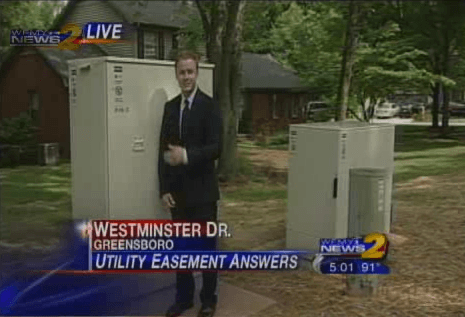
Surprise! A Greensboro, N.C. couple woke up to find AT&T installing these boxes in their front yard. (Courtesy: WFMY-TV)

With the matter generating intense media scrutiny, local politicians have become cautious and a Board of Supervisors vote on the matter has been repeatedly postponed.

AT&T’s U-verse cabinets have been controversial in many areas where they suddenly appear in public rights-of-way, often in front yards.

In Greensboro, N.C., Doris and Dave Robinson learned this the hard way when a tractor, backhoe, and truck appeared in their front yard one morning to install a six foot high metal cabinet with an ominous warning painted on the front telling passersby – “WARNING – AT&T Underground Cable.”

Doris Robinson called and wrote AT&T to no avail, and took their story to a Greensboro television station to warn the neighbors.

“It’s just hard to believe that anyone can come onto our property, put something on the property we disapprove of and leave it on our property,” Dave Robinson told WFMY News. “It’s just not right.”

Doris added, “It struck me as being just terrible to be digging in your front yard and they hadn’t said a word to us.”

In the case of North Carolina, it turns out they don’t have to.  The North Carolina legislature passed laws at the behest of AT&T giving them near carte blanche access to easements established for utilities.  In the past, these have been used for buried and overhead wiring.  Today, they are increasingly used to place enormous metal cabinets, sometimes on the ground, other times attached to a utility pole.  Many have fans that can be heard several yards away.

In California, it will take an affirmative vote by local government officials before AT&T can install similar equipment in San Francisco.

[flv width=”480″ height=”340″]http://www.phillipdampier.com/video/WFMY Greensboro ATT U-Verse Service Means Giant Boxes On Homeowners Front Lawn 6-29-11.flv[/flv]

WFMY-TV in Greensboro shares the story of Doris and Dave Robinson who awoke one morning to find AT&T installing boxes nearly six feet tall on their front lawn.  (5 minutes)

Search This Site:

Contributions:

Recent Comments:

Your Account:

Stop the Cap!