Home » Consumer News » Recent Articles:

Smartphones Reach a Crossroad: Nearing 50% Market Penetration

Phillip Dampier September 7, 2011 Consumer News, Wireless Broadband Comments Off on Smartphones Reach a Crossroad: Nearing 50% Market Penetration

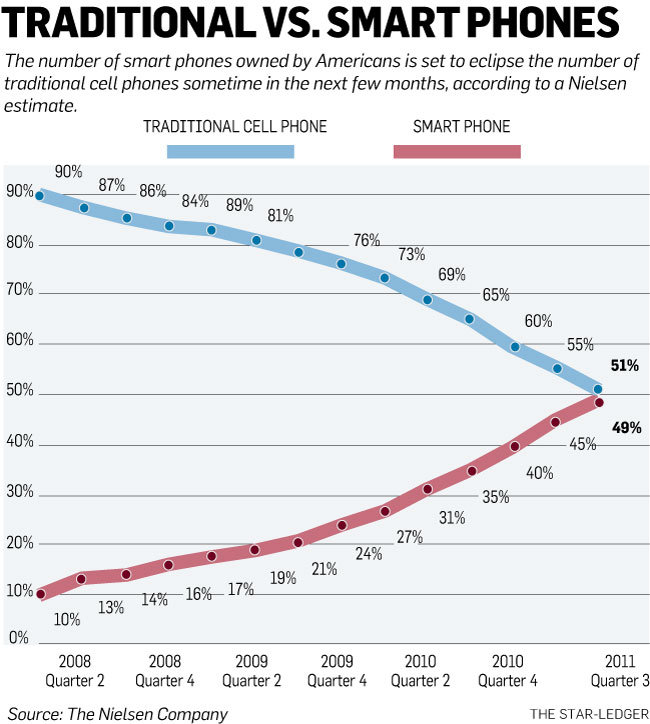
What wireless carriers have been angling for all along: Upgrades to smartphones by America's wireless consumers guarantees much higher average revenue per customer, and providers are increasingly getting that revenue as smartphones become the device of choice for a growing number of Americans. (Chart courtesy of the Star-Ledger)

Shaw Uses DTV Conversion to Sneak Through Its Own Digital Conversion Rate Hike

Phillip Dampier September 7, 2011 Broadband Speed, Consumer News, Shaw, Video Comments Off on Shaw Uses DTV Conversion to Sneak Through Its Own Digital Conversion Rate Hike

Canada’s transition to digital television was supposed to be a non-event for cable and satellite customers, because those providers will continue to service analog televisions for sometime to come.  But Shaw Communications found a way to squeeze a few more dollars out of some of their subscribers anyway.

While Canadian broadcasters were discontinuing analog over-the-air television, many Shaw Cable service areas were also dumping an increasing number of analog channels in favor of digital.  In Kamloops, B.C., Cheryl Whiting discovered that conversion was going to cost her plenty.  Although Shaw provides one digital set top box for free, each additional box rents for $2.95 per month, and Whiting will need four of them if she wants to continue watching cable stations above channel 13 throughout her home.

“I may as well sign my paycheque over to them,” Whiting told The Daily News.

Shaw’s ongoing “digital upgrade” is clearing away much of the analog cable dial to make room for additional digital television signals and faster broadband, but that transition comes at a price to customers who now need a set top box on most of their televisions.

Many customers were upgraded during the month of August, with most of the rest scheduled for conversion during September.

[flv width=”540″ height=”416″]http://www.phillipdampier.com/video/Shaw Digital Network Upgrade – Analog Customers.flv[/flv]

Shaw tells customers it is moving all of their cable channels above “broadcast basic” to a digital platform, requiring customers to place digital set top boxes on all of their televisions.  (1 minute)

Netflix Restores Concurrent Video Streams: Now Back to Two Per Customer

Phillip Dampier September 7, 2011 Consumer News, Editorial & Site News, Online Video 6 Comments

In what Netflix is characterizing as a technical fault, those who experienced a limit of one-stream-per-“Unlimited Streaming”-Account can now watch at least two streams at the same time once again.

Stop the Cap! broke the story on Netflix’s streaming crash diet on Labor Day after being contacted by several readers reporting the apparent new limitations.  Stop the Cap! confirmed them ourselves several times over the past three days, and so did Mashable‘s Ben Parr, who ran into the same error message we did after trying to stream multiple movies at the same time (although he had no trouble watching one movie and one television show concurrently.)

Netflix’s spokesman Steve Swasey called it a big misunderstanding this morning, telling us “no Netflix member is limited to less than two concurrent streams. A few Netflix members have heard differently from us, which is an error that we are correcting.”

Perhaps, but the errors continued straight through until early this afternoon, when we were finally able to confirm the launch of two concurrent streams without an error message.

Netflix has always maintained streaming limitations in their terms of service and in their Frequently Asked Questions.  The company, to this day, still proclaims “you may watch [Netflix streaming on] only one device at a time” if you are a stream-only customer.  Their terms of service emphasize this point in all-capital letters:

YOU WILL BE ALLOWED TO INSTANTLY WATCH SIMULTANEOUSLY ON ONLY ONE SUCH DEVICE AT ANY GIVEN TIME. For certain membership plans in the United States, you may instantly watch simultaneously on more than one Netflix ready device within your household. Click here to view the number of devices on which you may simultaneously view movies & TV shows that are associated with your plan. The number of devices and concurrent streams may change without notice to you. For certain limited membership plans in the United States, your available Netflix ready device may be limited to personal computers.

While those clearly are the policies of Netflix, the reality has been customers could easily stream two or more concurrent shows over their Netflix streaming account from different devices without provoking an error message.  But that changed this past weekend, when we began to receive news tips from frustrated customers.

Some consumers never realized they could watch multiple streams at the same time, and were unconcerned with Netflix potentially limiting this feature.  For them, it was tantamount to abusing their Netflix account.  It is a fact some customers have shared their accounts with friends and family members, something that streaming restrictions would go a long way to discourage.  But there are legitimate uses as well, especially in large families with different viewing habits.

We feel it’s important for Netflix to convey exactly what their policy is regarding concurrent video streaming.  If Steve Swasey wants customers to feel assured they can watch two streams concurrently, their FAQ and terms of service should be updated to reflect that.  It’s clear Netflix reserves the right to change the number of devices and concurrent streams without notice, something our readers obviously feel very strongly about.

Whether this was truly a technical fault or a trial balloon that came crashing down under negative customer reaction, the message is clear: most customers are very glad to have concurrent streaming back, and hope it remains a part of the Netflix experience.

Rogers Communications Decides It is Big Enough to Start Its Own Bank

Phillip Dampier September 6, 2011 Canada, Consumer News, Public Policy & Gov't, Rogers 3 Comments

When is a cable, wireless, and video rental conglomerate big enough to start its own financial institution?  When it achieves the size and scope of Rogers Communications.

Rogers announced, through a tiny legal notice filed over the weekend, it had taken the first steps to achieve its ambition of launching Rogers Bank:

ROGERS BANK

APPLICATION TO ESTABLISH A BANK

Notice is hereby given, pursuant to subsection 25(2) of the Bank Act (Canada), that Rogers Communications Inc. intends to apply to the Minister of Finance for the issue of letters patent incorporating a bank under the Bank Act (Canada) primarily focused on credit, payment and charge card services.

The bank will carry on business in Canada under the name of Rogers Bank in English and Banque Rogers in French, and its head office will be located in Toronto, Ontario.

Any person who objects may submit an objection in writing to the Office of the Superintendent of Financial Institutions, 255 Albert Street, Ottawa, Ontario K1A 0H2, on or before October 24, 2011.

If approved by the Minister of Finance, don’t expect to get your next home mortgage or checking account from the cable company.  Rogers Bank intends to focus mostly on the payment services business, according to the application.  Among the potential angles to be pursued by Rogers Bank:

  • Offering a Rogers-branded credit card to interested customers, perhaps tied to a rewards program;
  • Getting a substantial discount processing credit card payments and the growing popularity of mobile micropayment services, which allow consumers to purchase items from vending machines, parking meters, and other in-person transactions using a mobile phone;
  • Offering its own payment transfer service, similar to PayPal;
  • Leveraging credit opportunities by running the credit-granting institution inside the company, instead of appealing to outside institutions.

Rogers’ idea, while unusual, is not unique.  Canadian Tire and Loblaw both operate their own “banks,” primarily for financing products and services.

Getting Your Hurricane Refund from Comcast, Who Doesn’t Want to Give You One

Phillip Dampier September 6, 2011 Comcast/Xfinity, Consumer News, Editorial & Site News, Video Comments Off on Getting Your Hurricane Refund from Comcast, Who Doesn’t Want to Give You One

For the sake of public relations, most cable and telephone companies are happily providing service credits to customers who ask after they lost service as a result of Hurricane Irene.  Denying those requests through invocation of weasel contract clauses referencing “acts of god” or “weather-related incidents” will assuredly leave customers less than pleased.  That’s a lesson some employees in Comcast’s call center still need to learn.

The fact is, most consumers shouldn’t have to pay for service undelivered.

Here is one Comcast customer’s plight:

When I contacted Comcast in the days following Irene I was initially told I’d be without service for a day and would receive credit for the loss. When I called two days later, I was told it would be two days, but I would receive credit. When I called six days later I was told they didn’t know how long it would be and that when it was restored I would not be receiving credit for the lost service.

“Wait, you’re telling me you’re going to try and bill me for service I never received,” I asked the customer service agent.

“We’re not going to try. We will be billing you,” he responded.

Another customer service representative verified the information with a supervisor, but sounded as incredulous as I felt when he came back to the phone.

The outage, he explained, is now considered an “act of god”.

“I can’t believe we’re going to do this,” he said.

He suggested I call back when the service was restored for credit.

“I can’t believe we’re not going to give credit,” he said again, before telling me to have a nice weekend.

To be fair, this is the experience of a single customer, and a search of prior storm events in Comcast service areas does show the company is usually willing to issue storm-related credits, as long as it was their service that was disrupted.  One of the issues cable providers have to deal with in weather disasters is ascertaining exactly who and what suffered the outage.  If the area’s local power company loses service, Comcast cable service could be affected directly or not at all.  A widespread outage could cause amplifiers to lose power, cutting off cable service to those with or without power.  But should Comcast credit you for lost service if the only thing keeping you from watching is a downed power line in your neighborhood that hasn’t affected cable service?

That dilemma many customer care professionals solve with courtesy credits to maintain customer goodwill.  But not every provider may automatically issue them, especially when dealing with low level employees in a customer care center.

If Comcast is refusing to provide you with service credits, there are a few quick steps to bypass “the unauthorized to give you what you want”-team and get your money back:

  1. If calling by phone, ask if you are talking with a local customer care representative or one located thousands of miles away.  Ask to be transferred to a local office for assistance.  Those on the ground going through the same storm nightmares you are are likely to be more amenable towards giving you a service credit.
  2. If using an e-mail form or online chat, call Comcast or visit your local Comcast cable store instead.  Again, someone sharing your misery is more likely to find a way to get you a service credit than someone who hasn’t lived through it.
  3. File a complaint with the Better Business Bureau online requesting your service credit.  While Comcast is not BBB accredited, the organization has helped satisfactorily close more than 2,000 customer complaints.
  4. Call your local television or newspaper “consumer reporter” and alert them.  Bad publicity is a great way to get any unyielding business to bend.

We expect a few negative stories in the media will be more than enough to inspire Comcast to provide service credits, gracefully.

Besides, if Comcast gives you a hard time about “acts of god,” you can always tell them the same thing when they ask to be compensated for cable equipment that succumbed in the storm.

[flv width=”640″ height=”380″]http://www.phillipdampier.com/video/WABC Hassling LIPA 9-2-11.mp4[/flv]

Storm-weary Long Island residents are getting fed up with extended service outages.  One went as far as to allegedly threaten a “Columbine-style attack” on a Long Island power facility.  Repair crews are also being hassled.  WABC in New York reports.  (3 minutes)

[flv width=”640″ height=”380″]http://www.phillipdampier.com/video/WCBS Anger in LI 9-1-11.mp4[/flv]

WCBS found the same kind of anger in Suffolk County, aggravated by self-congratulating press conferences by utility companies even as hundreds of thousands of customers remained in the dark with no end in sight.  One Connecticut man even threatened a repair crew with a gun for trespassing.  (2 minutes)

 

Search This Site:

Contributions:

Recent Comments:

Your Account:

Stop the Cap!