Home » Competition » Recent Articles:

Ho-Ho-Horrible: Your Holiday Gift from Santa Bell is a Substantial Rate Hike

Bell has the perfect gift for themselves this holiday season: significant rate increases on phone, broadband and television service that will leave some customers paying at least $120 more a year for service.

Stop the Cap! reader Alex Perrier shared the bad news with us:

“What a great Christmas gift,” Perrier writes. “With few exceptions, all Bell home services get a ‘price update.'”

Home phone customers may be in for some bill shock if they happen to use on-demand calling features or directory assistance. Some of those rates are increasing by more than 500%.

Home phone packages

The monthly fee for all Bell Home phone packages (Home phone Lite, Home phone Basic, Home phone Choice, Home phone Complete) are increasing by $2.03 effective January 1, 2013.

Long distance plans

Bell long distance plan Effective January 1, 2013, the monthly price will increase by:
Canada and U.S. 500 Minute Block of Time $2
Canada and U.S. 1000 Minute Block of Time $2
Digital Bundle $2
Anytime Block of Time $3

Features

Effective January 1, 2013, the price of Home phone pay-per-use calling features (Last Call Return, Busy Call Return and Three-Way Calling) will increase by $0.45 to $2.95 per use. The monthly cap on Home phone pay-per-use calling features will also increase to $29.50

Effective January 1, 2013, Directory Assistance will increase by $0.50 to $3.00 per use.

Bell TV

Bell Satellite TV and Bell Fibe TV Effective January 1, 2013, the monthly price will increase by:
Good $2.14
Select $2.22
Better $3.28
Best $3.45
All other TV plans $3.00
Super Écran Rate will be $15.15 as of January 1, 2013

Bell Internet

Bell Internet Effective January 1, 2013, the monthly price will increase by:
All Dial-up services $2.00
All Bell Residential Internet services (excluding unlimited usage services)

  • High Speed (limited usage)
  • Ultra (limited usage)
  • Basic
  • Basic Lite
  • Performance
  • Optimax
  • Supreme
  • Max
  • Essential
  • Essential Plus
  • Bell Fibe Internet
$3.00
High Speed and Ultra unlimited usage services $5.00

Note: Bell Internet 5 and Bell Internet 5 Plus are excluded from the price increase.

Frontier’s Top Priority: Growing Revenues; Eliminating “Unnecessary Credits, Discounts”

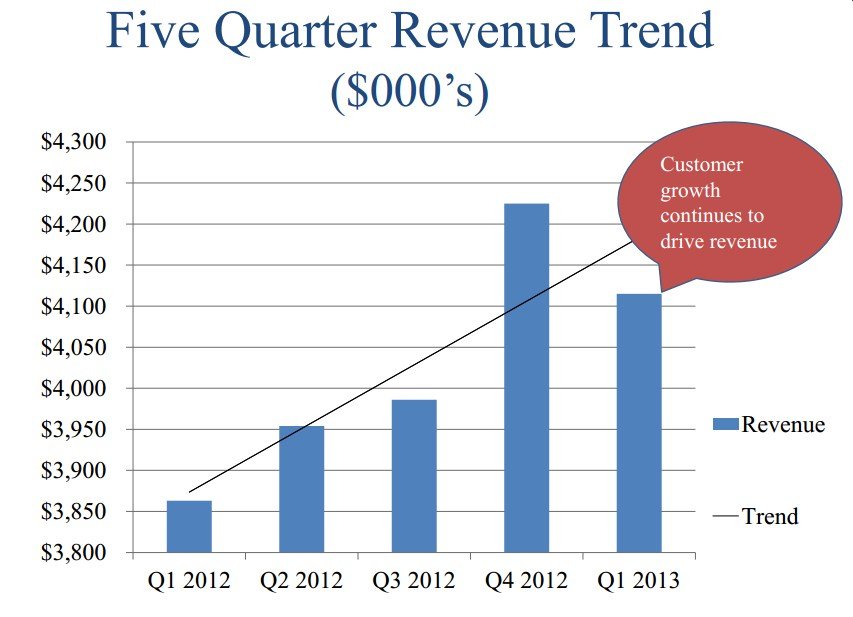
Despite making revenue growth the top priority at Frontier Communications, the company still managed to lose 3% in year over year revenue as another 51,800 customers pulled the plug on their Frontier landline and slow DSL service.

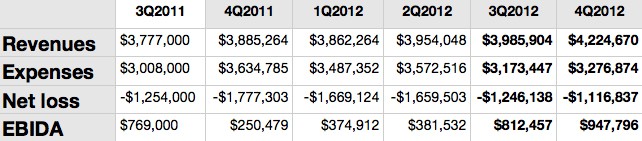
Frontier’s latest quarterly earnings showed a net income rise to $67 million, a major improvement over $20.4 million earned during the same quarter last year. The earnings improvement comes from reduced operating expenses, down 12 percent to $977.3 million and rate increases for certain Frontier markets in less-competitive areas.

Frontier CEO Maggie Wilderotter told investors the company has been reviewing accounts obtained from Verizon Communications, scrutinizing for “unnecessary credits, adjustments, and discounts, ” and systematically eliminating them.

“We’ve got a number of [ex-Verizon] customers that have been with us at a very, very, very low price point; they’ve been on promotions,” said Donald Shassian, Frontier’s chief financial officer. “They’ve been in existence for years and never got curtailed. And once we converted [those customers] onto [Frontier’s billing system], we identified those.”

Frontier’s plan for future growth is a temporary transition away from expanding broadband service into unserved areas, instead focusing on speed upgrades and service improvements where Frontier already serves.

Frontier: Speed upgrades “help dispel the myth that DSL technology cannot keep up with customer demand.” Faster speeds support IPTV as well.

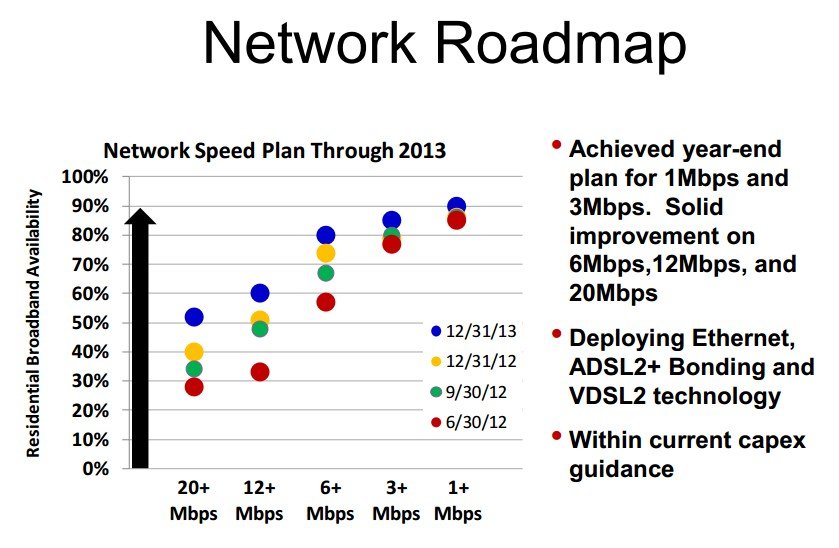
Frontier has targeted investment on improving speeds and network capacity for customers currently stuck with 1-3Mbps traditional DSL service. Frontier is using its fiber-based middle mile network and more advanced forms of DSL to dramatically increase broadband speeds. According to company officials, 64% of Frontier’s exchanges are now equipped with VDSL2, with speeds up to 40Mbps. At least 73% have equipment capable of bonded ADSL2+ with speeds up to 20Mbps. The target for Frontier’s fastest speeds are commercial customers. By the end of this year, 71% of Frontier’s exchanges will support carrier Ethernet service up to 1Gbps for business accounts.

Most Frontier residential customers will see more modest speed improvements. During the third quarter, Frontier expanded its higher speed offerings with more to come:

  • 20Mbps service is now for sale in 34% of its national service territory. By year end, 40% will have access and 52% by 2013;
  • 12Mbps service is now available to 48% of its network footprint. By the end of the year, 51% of homes will have access and 60% in 2013;
  • 6Mbps is now available to 67% of Frontier-served homes, with 74% expected by year end and 80% by 2013.

“We’re seeing 100Mbps delivery in vendor labs and that should be a reality in the next 12 months in our markets,” Wilderotter said. “This should help dispel the myth that DSL technology cannot keep up with customer demand.”

Wilderotter noted that the latest network upgrades might eventually support television service.

“We think we have the opportunity to offer an IPTV-type service in many of our markets, to many of our customers,” said Wilderotter. “In our labs, we’re doing some experimentation on the DSL platform with certain types of technologies that compress the data stream, so we could actually offer a very good video experience at 6Mbps or above. We’ll be doing some experimentation with that in 2013.”

New Products, More Simplified Pricing, Bigger Promotions

To better compete with cable, Frontier has simplified many of their broadband packages, eliminating the modem rental fee and other hidden surcharges for customers. Wilderotter noted the cable industry has recently started to “nickle and dime” customers with modem rental fees and surcharges, something Frontier has also charged customers in the past.

Frontier is now staking a position in simplified pricing.

“So when a customer gets a quote of $39.99 for broadband, it includes the modem, it includes surcharges, it includes everything,” Wilderotter explained. “So they’re not surprised when they get their bill. And we think that’s a huge value selling point for our product set.”

But simple pricing is not always lower pricing.

Increases in broadband service pricing, a hike in the Subscriber Line Charge, and other surcharges introduced for departing customers helped add to the company’s bottom line. But Frontier insists it adjusts rates only after considering the competitive environment.

“You don’t necessarily see us do price increases on broadband across the board,” explained Shassian. “We also believe that the price increases should be associated with increased value to the customer, too. So in some cases, it’s incremental speeds and capability.”

In an effort to upsell current customers, and even more importantly “win back” those who left, Frontier has introduced an aggressive new promotion that will reward subscribers with up to a $450 Apple gift card when committing to a new two-year contract. The value of the gift card ranges depending on how many services a customer chooses.

Stop the Cap! found Frontier pitching a triple play promotion in Tennessee for $87.99 a month with a $450 Apple gift card for new or returning Frontier customers. The bundle includes 6Mbps DSL, Frontier residential phone service with features and long distance service, and DISH Networks’ America’s Top 120 satellite service.

But there is fine print, including a two year service agreement with a $400 early termination fee for phone and broadband service, a DISH cancellation fee of $17.50 for each month remaining in a two year contract, at least $85 in “setup fees,” a $9.99 “broadband processing fee” if a customer disconnects service, and an online bonus credit a customer has to remember to request within 45 days of service activation.

Other Frontier Developments This Quarter

  • Frontier began deploying the FCC Connect America Fund proceeds during the quarter to bring broadband to 92,877 new Frontier homes;
  • A wireless partnership trial with AT&T began on October 8 in Washington and Minnesota. The discounted package bundle is only available to customers who also maintain Frontier broadband service;
  • Over 203,000 Frontier customers signed up with legacy partner DirecTV saw their satellite service unbundled from their Frontier bills this quarter. Frontier chose DISH Networks as its satellite partner back in 2011, and the company has encouraged its old DirecTV customers to consider switching to DISH;
  • Business customers constitute 52% of Frontier customer revenues. Frontier expects more than 66% of total customer revenue to come from broadband service;
  • Frontier’s Simply Broadband, a broadband-only product, used to include a free landline. Not anymore;
  • Frontier will begin accelerating promotions for its Apple Store gift card starting this week;
  • Hughes Net Satellite service was integrated into Frontier’s systems and is pitched to customers as Frontier Satellite Broadband. It will be targeted to 750,000 households that cannot access wired broadband service from Frontier.

Analyzing AT&T’s Plan to Expand Service: Transformation or Bait & Switch for Rural America?

AT&T’s Supreme Court: senior executives sitting together in judgment of landlines at Wednesday’s analyst conference.

Yesterday, at least a half-dozen AT&T senior executives sat lined up in a perfect row to present Wall Street with the company’s vision for the future.

There were no consumers in attendance, just a group of Wall Street investors and analysts that braved the latest nor’easter to attend.

At issue: what to do about AT&T’s landline network, particularly in rural areas. Earlier this year, AT&T CEO Randall Stephenson, still smarting from a regulatory slap-down of his plan to acquire T-Mobile USA, ranted his disapproval of federal regulators for nixing the deal and then reflected on AT&T’s rural customers who still cannot buy broadband service from AT&T.

One of Stephenson’s strongest arguments in favor of merging with T-Mobile was it would facilitate a rural broadband solution. With that off the table, Stephenson seemed at a loss:

“We have been apprehensive on moving, doing anything on rural access lines because the issue here is, do you have a broadband product for rural America?,” Stephenson said. “And we’ve all been trying to find a broadband solution that was economically viable to get out to rural America and we’re not finding one to be quite candid. That having been set aside, now we’re looking at rural America and asking, what’s the broadband solution? We don’t have one right now.”

Now AT&T claims they do, and miracle of miracles, it turns out they never needed the buyout deal with T-Mobile after all.

AT&T’s solution is good news for urban, suburban, and exurban customers who will benefit from billions in additional investments to beef up the company’s U-verse platform. Those with access to U-verse TV, broadband, and phone service will soon find maximum speeds available up to 75Mbps — important at a time when cable companies are moving to 50-100Mbps premium service tiers. Those without access to U-verse, bypassed by its recently completed initial buildout, now will have a chance to see the service in their communities.

For more exurban and near-rural areas, AT&T has a positive plan to rid customers of the scourge of painfully slow ADSL service, better known simply as “DSL,” which AT&T pitches at speeds typically 10Mbps or less. In more rural areas, it is often much less.

By using additional fiber and using D-SLAM technology to reduce the amount of copper wiring between the phone company and you, AT&T’s IPDSLAM service will dramatically improve speeds for customers languishing with 3Mbps service to upwards of 45Mbps. But for now, AT&T won’t roll this out as a full-scale U-verse service. Because maximum speeds are lower and network variability is expected to be greater, AT&T will instead pitch this as a broadband and landline phone service package. Customers will be marketed satellite dishes if they want television service bundled in.

Although not as robust of a platform as U-verse will soon be, it still represents a major improvement over DSL, which is now barely tolerable for today’s online multimedia experience.

But AT&T’s “good news” may not be so great for its most rural customers, who either have the slowest DSL service or more likely no broadband at all. Those customers have waited years for AT&T to invest in upgrades to finally connect them to the Internet, but AT&T’s plans have gone in a very different direction.

AT&T’s rural solution is to take down the existing landline network and move everyone to its wireless cell phone service. To implement this proposed solution, AT&T will aggressively invest in rural cell sites within the 22 states where it supplies landline service. The company claims 99% of its customers will be able to access a 4G LTE signal within a few years.

Phillip “Are you following this shell game” Dampier

But here is where things begin to get dicey.  AT&T told investors it has no current plans to differentiate rural wireless customers from their urban counterparts. In larger cities, a smartphone and data plan is not necessarily a necessity — customers can still access a landline to place urgent calls or find a home broadband plan that does not carry the kinds of restrictive data caps wireless plans deliver.

Rural landline customers often pay low rates for their home phones, primarily because their local calling areas are generally far more restricted than in larger communities. The base rate for rural phone customers can be around $10 (before taxes and fees) in some areas. The base rate for AT&T’s wireless service starts at around $40 for 450 talk minutes or $19.99 for anchored, wireless unlimited calling home phone service (with a $36 activation fee and a two-year contract) that works with your existing home phones. Both represent rate increases.

Wireless data plans are notoriously expensive and limited. Verizon’s plan for home broadband users is priced at $60 a month with a 10GB limit. Less expensive plans with limits 25 times greater (or unlimited) are available from wired broadband providers. If the customer wants a smartphone for their data and home voice calling, bundled plans start at $85 a month with a 1GB usage limit.

With these prices, it is no surprise AT&T is promoting this as great news for the company. But we’re not so sure the average rural American is going to be pleased treated like a second class citizen with high priced, usage-capped Internet access.

As victims of Hurricane Sandy also found out last week, the venerable landline also enjoys a reputation of working after disasters strike. Unlike a fallen tree knocking down a phone line in the backyard, should AT&T’s wireless network fail in a storm, it would potentially leave hundreds, if not thousands of customers without service. Repair crews could take days to reach damaged facilities. That actually happened to Frontier Communications in some parts of West Virginia where heavy snows and tree damage made travel nearly impossible.

But there are important clues to what AT&T is really up to in regulatory filings that accompanied the showy presentation AT&T put on in New York Wednesday.

AT&T Has a Plan — Move Customers Away from Low Profit, Low Growth Landlines to High Profit Wireless/Deregulated Broadband

After the two hour presentation ended, AT&T posted a copy of its proposal sent to the Federal Communications Commission.

Reviewing the 24-page document is a classic case of  déjà vu. Once again, after the rhetoric is set aside, AT&T is back, peddling the same case to retire landline service and the regulatory obligations that accompany it. Only now, it has a carrot to dangle in front of regulators — significant investments in broadband expansion.

Although the private sector has invested well over $1 trillion in broadband networks, much remains to be done. As of 2010, roughly 14 million Americans, residing in rural and other high cost areas where the broadband business case is tenuous at best, still lacked access….

[…] Carriers such as AT&T are stepping up to do their part. In fact, just today, AT&T announced a $6 billion investment plan to expand and upgrade its wireline network to bring robust IP broadband services to millions of additional locations in its legacy footprint.

[…] AT&T makes this announcement with full confidence that the Commission will continue to implement the National Broadband Plan’s vision of removing regulatory impediments to efficient, all-IP networks, including obligations that could require carriers to maintain legacy facilities and services even after they have deployed new, IP-based alternatives.
I guess they didn’t need T-Mobile after all.

Translation: We used to bypass 14 million Americans, leaving them behind because it was unprofitable to serve them. But now we’re going to invest some additional money. But before you get that investment, we need you to agree the landline is a relic and (largely unregulated) IP-based networks are the future. We are not going to run both, so if you want all of this investment, you have to let us abandon our regulatory responsibilities and commitments to rural customers.

AT&T even tried to calm investor fears about capital spending increases, arguing the potential payoff of discarding landline service opens up a new era of earnings, both from shifting customers to AT&T’s highly profitable wireless service at a cost of double, triple, or more what customers used to pay the phone company, and a platform to sell them even more services later.

A number of Wall Street analysts disagreed, panning AT&T’s wireline investments as unproven.

The Broadband Coalition, a group of competing telecom providers, called the entire affair a smokescreen:

AT&T’s announcement today that it needs regulatory intervention from the FCC in order to invest in IP technology is a re-run of a tired ploy to leverage the company’s dominance. AT&T only invests in order to respond to competition, and competition is made possible by the very pro-competitive policies that AT&T seeks to eliminate.  The Broadband Coalition members have invested billions of dollars to bring the benefits of IP to American consumers from coast to coast.  But if AT&T gets its way, competition will largely disappear, investments will dry up and consumers will suffer.

Former Congressman Chip Pickering, coalition spokesman, stated,  “AT&T is simply trying to use its belated roll out of IP technology as an excuse to rewrite the telecom rules to its advantage.  We already know that AT&T’s claim that IP will somehow alter the laws of economics and lessen its dominance is patently false.  Clearly, AT&T’s proposed changes are not necessary to achieve widespread IP deployment, but the retention of competition policy is.”

Consumer groups accused AT&T of lying to federal regulators when the company argued the T-Mobile acquisition was essential to accomplish their plan to expand wireless service to 96% of the U.S. population. A year later, the company now claims it can deliver 4G wireless service to 300 million Americans and 99% of its landline service area without breaking much of a sweat.

CNN:

AT&T insists that it wasn’t being disingenuous with the regulators. Things changed, the company says, pointing to the 40 new spectrum deals it signed over the past year. The FCC recently made available some spectrum that wasn’t on the table when AT&T was negotiating its T-Mobile takeover.

“We chartered a new path,” AT&T spokeswoman Roberta Thomson told CNNMoney on Wednesday.

That’s precisely what the FCC — and industry analysts — believed would happen.

Now What

For now, rural customers need not worry AT&T will put their entire rural landline operation up for sale, potentially selling off a large number of  customers to companies like CenturyLink, Frontier, Windstream or FairPoint.

Rural America’s new home phone?

But AT&T’s lobbying machine will soon descend on state legislatures to win regulatory approval of their “abandon landlines” agenda. AT&T has a carrot for those legislators as well — a promise that states that hurry to rubber stamp AT&T’s wish list will be first in line for “investments.”

“We are going to have to see 21st-century regulation for 21st-century investments like this,” said AT&T CEO Randall Stephenson. “I think what you’re going to see is that these investments will go first to those states where you have good line of sight to good regulatory authority to do some of the things we’re talking about here.”

The implications for rural customers are profound if AT&T wins permission to scrap the landline network. Despite assurances from AT&T this is a technology argument, in fact it is more of a campaign to rid themselves of regulatory and consumer protection rules that have been around for decades. The type of technology used makes all the difference. Landline providers are usually compelled to provide reasonable, affordable, universal service for all Americans. Broadband, IP-based, and wireless networks now exist largely in a deregulation free-for-all where AT&T can do as it pleases, serve who it likes, and charge whatever it wants.

Considering AT&T’s current business plans, that sets the stage to worsen the newest digital divide — one pitting urban areas with faster, advanced, and more competitively priced networks against rural America, consigned to expensive, usage capped wireless service that may or may not work when a natural disaster strikes.

The only way this plan works for consumers is if common-sense service obligations, consumer protection, open access for competitors, and mandated equivalence of service is part of the package. Without it, AT&T will get exactly what it wants: a regulation free lifestyle, an expensive wireless network that rural residents will be forced to use for basic telecommunications, and cost savings and revenue opportunities AT&T will use to bolster its own profits, while cementing its monopoly position in the rural communities of 22 states where it operates.


Community-Owned MI-Connection Launches Speed War That Benefits North Carolina

Phillip Dampier November 8, 2012 Broadband Speed, Community Networks, Competition, Consumer News, Editorial & Site News, MI-Connection, Public Policy & Gov't Comments Off on Community-Owned MI-Connection Launches Speed War That Benefits North Carolina

A community-owned cable system that critics called “a municipal broadband failure” is proving to be anything but as it aggressively launches a broadband speed war and is narrowing its losses on the road to profitability.

MI-Connection is the community-owned cable system serving Mooresville, Davidson, and Cornelius, N.C.

Originally acquired in 2007 from bankrupt Adelphia Cable, MI-Connection has been a favorite target for municipal broadband critics who have painted the operation as an experiment gone wrong and a financial failure. But the system’s latest financial results and its forthcoming free broadband speed upgrades tell a different story.

Residents will see major boosts in their broadband speeds for no additional charge in December thanks to a broadband service upgrade. Meanwhile, competitor Time Warner Cable has announced new fees for cable modem rentals that will raise many customer bills by $4 a month. (MI-Connection does not charge customers a rental fee when they have just one cable modem on their account.)

The speed increases will provide the fastest download-upload speed combination in the area, thanks to faster upstream speeds. These upgrades launch Dec. 10:

  • 8/4Mbps service upgrades to 10/5Mbps
  • 12/4Mbps service upgrades to 15/5Mbps
  • 16/4Mbps service upgrades to 20/5Mbps
  • 20/4Mbps service upgrades to 30/10Mbps

Also on that date, MI-Connection will launch its fastest Internet tier yet, tentatively dubbed Warp Speed, offering 60/10Mbps service with a free wireless router for bundled customers, selling faster service at up to $20 less per month than what Time Warner charges:

  • $99.95/month broadband service only
  • $89.95/month when bundled with one other service
  • $79.95/month when bundled with phone and television service

Warp Speed will be the fastest residential broadband available in Mecklenburg and Iredell counties.

MI-Connection hopes accelerating improvements in broadband will also accelerate additional earnings. MI-Connection continues to earn the bulk of its revenue from television, with broadband and phone lagging behind. But the biggest growth in revenue year over year comes from broadband service.

Last summer, MI-Connection reached another milestone — it delivered its first cash payments back to the communities that took a chance on owning and running their own telecommunications provider. Although the total amount of $277,000 was modest, and the company still has to pay down debt incurred from purchasing and upgrading the cable system, it was a symbolic victory against anti-government, anti-municipal broadband naysayers.

More elusive is tracking the amount of money saved by residents finding Time Warner Cable and area phone companies ready and willing to offer stunning rate cuts in customer retention efforts.

Stop the Cap! has tracked some of those offers over the past several years, based on reader input.

Time Warner Cable’s retention department has offered North Carolina customers with active competition in their area prices as low as $100 a month (after taxes and fees) for triple play packages that include a free year of Showtime and 30/5Mbps broadband. Customers who only want broadband and television have been able to negotiate rates averaging $70 a month, especially after pointing out MI-Connection provides a year of its own phone, broadband, and TV service for $89.99 a month, including three free months of HBO.

“Year after year, renewing these prices just takes a phone call mentioning you received a flyer from MI-Connection offering more for less,” says Stop the Cap! reader Sam, who we contacted this morning for an update on our earlier story in April. “Whether you stay with Time Warner or switch to MI-Connection, you can easily save dozens of dollars a month just mentioning one provider to the other.”

Courtesy: Davidson News

Sam remains a Time Warner Cable customer based on what he calls “a simple matter of economics and what my wife wants to spend.” But he still supports the fact MI-Connection is there, even though it has created some early headaches for Mooresville, Davidson, and Cornelius.

“The conservatives have demagogued MI-Connection to death to win seats in local government but recently have stopped attacking it as an outright failure and are now claiming they want to make it successful so they can sell it off in a few years, probably to their pals at Time Warner,” Sam reflects.

“At the rate MI-Connection is cutting their losses, it might actually be profitable then,” Sam argues. “Selling it would be stupid. But a lot of the current crowd is hellbent on selling it no matter what, mostly for ideological reasons, and after Time Warner buys it for cheap, we’ll all pay even more when they put the rates back up.”

Critics of MI-Connection have help from various astroturf groups, backed largely by telecommunications companies who oppose government involvement in broadband. Particularly notorious is the “Coalition for the New Economy,” which issues negative reports about municipal broadband while burying the fact the group is funded in part by AT&T, Time Warner Cable, and other Big Telecom lobbyists.

The “Coalition” issues various reports mostly summarizing news accounts about community broadband that highlight struggles and ignore successes, while concluding that community broadband is interfering with private providers trying to hurry upgrades into neglected areas.

“A report from some group that lies never brought better broadband access to anyone in North Carolina,” Sam said. “MI-Connection has become a thorn that must be pulled from Time Warner’s backside because MI actually does provide better service.”

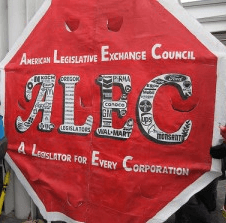
Debunking ALEC, Broadband Edition

Not long ago, the United States led the world in broadband connectivity. Now we are in 16th place, trailing most developed nations. We need broadband policies that connect our homes, schools, and business to the 21st century economy, but we’re pursuing public policies that are putting us in a hole, helping private telecommunications providers and harming the public interest. As the old adage goes, when in a hole, stop digging.

Why is this happening? One reason is that across much of the nation, commercial broadband companies are using their political and economic clout to stifle competition, particularly from municipalities. Individually and through trade groups and the American Legislative Exchange Council (ALEC), the industry is bent on shutting down existing publicly-owned broadband systems and blocking the development of new ones.

ALEC’s argument, detailed in a recent Daily Caller op-ed by John Stephenson, director of its communications and technology task force, is based on distorted and inaccurate claims that would be laughable if they weren’t part of a coordinated strategy to radically transform policy state-by-state.

Stephenson suggests that Chattanooga, one of several cities cited in his piece, made a poor decision in building the nation’s most advanced citywide broadband network – one that has helped companies create literally thousands of new jobs in recent years. In fact, contrary to Stephenson’s claims that municipal broadband drive up property taxes and depresses municipal credit ratings, S&P just upgraded the Chattanooga public utility’s bond rating, stating, “The system is providing reliable information to the electric utility on outages, losses and usage, which helps reduce the electric system’s costs.”

The larger point is that those who want to revoke local decision-making authority for broadband often justify their position by insisting that they want to protect taxpayers from mythical threats. The only impact Chattanooga’s system has had on taxpayers has been to create more jobs, lower electricity bills, and enhance choices in the market. Indeed, Chattanooga’s EPB Fiber service is saving the public money. After a recent storm knocked utility customers offline, EPB’s fiber-optic Smart Grid brought those uses back online more quickly, saving the public an estimated $1.4 million in repair costs.

It’s no surprise that such nonsense emanates from ALEC, which acts as a clearinghouse for corporately-sponsored model legislation that puts corporate profits ahead of the public interest and often public safety. ALEC is backed by some America’s biggest telecommunications firms, including Comcast, Verizon, and Time Warner Cable. Through ALEC task forces, corporations craft model bills and find compliant legislators to introduce them as if they were the legislator’s own. As Common Cause and its allies have documented, ALEC’s influence is pervasive: from privatizing education to limiting voting rights with restrictive Voter ID bills, and endangering public safety with “Stand Your Ground” gun laws, no aspect of public policy goes untouched.

ALEC’s attack on local decision-making authority is consistent with its efforts to benefit big companies like Time Warner Cable and AT&T that want to restrict choices for residents and businesses. So far, the big cable companies have all but crushed competition in the private sector and have been attempting to stop communities themselves from building the essential infrastructure in which these companies have been slow to invest.

But the arguments used to revoke local authority are based on misleading or outright false claims. Stephenson even tries to scare readers, claiming (with no proof) that Marietta, Ga. lost $24 million on a municipal network. What actually happened was documented in a report from 2005. Marietta had a wholesale-only network using a far different business model than the one followed by most publicly owned broadband systems.  It was on a path to operate in the black when it was privatized for ideological reasons. Stephenson’s $24 million loss figure ignores all the revenues it generated as well as additional spillover benefits. That’s fuzzy math.

Stephenson’s claim that LUS Fiber lost money every day last year preys on reader ignorance of telecom business models. Any high-capital investment could be said to lose money “every day” in the early years. Long term investments take time to break even – after which, they make money “every day.” Verizon’s FiOS “lost” money every day for many years but is regarded by many as a smart long term investment.

Publicly owned networks overwhelmingly help public safety, schools, libraries and other community anchor institutions. While AT&T has been caught ripping off taxpayers by overcharging schools for their connections, Lafayette, LA. dramatically increased the capacity of school and library broadband connections at nearly the same price AT&T charged for far lower quality services. Lafayette’s network is one of the most advanced in the nation and has attracted hundreds of new jobs while saving millions for the community by keeping prices lower, as documented in our report Broadband at the Speed of LightIn response to Lafayette’s investment, Cox Cable prioritized that community for its upgraded cable network – compounding local benefits.

Lafayette isn’t alone – consider rural Chanute, KN., which connected its schools and the local community college with a gigabit wide area network at only $250 per location per month. The city’s municipal fiber network has helped preserve jobs that were at risk of leaving because the cable and telephone company were not meeting the needs of local businesses. Additionally, the network pays a franchise fee to the general fund every year.

And then there’s Wilson, N.C. Stephenson claims its fiber-optic network might be obsolete before it is paid off – a ludicrous scenario given the strong consensus the fiber-optic is and will remain the gold standard in networking for decades. Regardless, the network is generating benefits today – lower prices for consumers and the best connection available for the hospital and schools. Oh, and their network is operating in the black also.

These benefits are some of the reasons that the FCC’s National Broadband Plan called on Congress to ensure that all local governments could build networks. No one has suggested that every government should do so – but it should be a local choice, and that is what ALEC has been trying to remove. Largely thanks to ALEC, 19 states limit local authority to build networks. Rather than foster competition and innovation, these policies introduce new barriers to connectivity and deny choice to consumers. It is beyond time to remove these restrictions and let local communities decide for themselves if a network is a smart public investment given their unique situation.

This piece courtesy of the Common Cause Blog. The article was coauthored by Christopher Mitchell from the Institute for Local Self-Reliance. He directs their Telecommunications as Commons Initiative. He is also editor of http://www.muninetworks.org/. Follow him @communitynets. 

Search This Site:

Contributions:

Recent Comments:

Your Account:

Stop the Cap!