Home » Competition » Recent Articles:

Dressing Up The Pig: Hawaiian Telcom’s Journey from Verizon to Bankruptcy is a Familiar Tale

Phillip Dampier January 12, 2010 Competition, Hawaiian Telcom, Public Policy & Gov't, Video Comments Off on Dressing Up The Pig: Hawaiian Telcom’s Journey from Verizon to Bankruptcy is a Familiar Tale

Hawaii’s landline telephone company, Hawaiian Telcom (HawTel), is awaiting approval from the state’s Public Utility Commission for its $460 million, stand-alone reorganization plan. The company, launched in 2005 from assets acquired from Verizon Hawaii, Inc., by the politically connected global private equity investment firm The Carlyle Group, lasted less than four years before declaring bankruptcy.

[flv]http://www.phillipdampier.com/video/KITV Honolulu Hawaiian Telcom Takes Over Verizon 5-3-05.flv[/flv]

KITV-TV in Honolulu introduced Hawaii to Hawaiian Telcom in this report from May 3, 2005 (1 minute)

The downfall of Hawaii’s dominant landline provider, despite decades of stable service from its progenitors — GTE/Hawaiian Telephone Company and Mutual Telephone came as no surprise to telecommunications analysts and consumer advocates who saw trouble right from the start.  The Carlyle Group and Verizon structured a deal that loaded $1.2 billion in debt onto Hawaiian Telcom’s balance sheet.  Critics of the deal weren’t impressed by the fact Carlyle had no experience running a telephone company either, and was likely to dump the company after “dressing up the pig” to inflate the company’s value and walk away with big profits from the sale, as one analyst predicted.

Long time Stop the Cap! readers know how this works only too well.  Anyone who followed the exhaustive coverage of the downfall of FairPoint Communications this past year will see plenty of familiar warning signs — piling enormous debt on the buyer, lots of promises made and broken, and plenty of billing and customer service problems that cause customers to flee to other providers.  By 2008, 21 percent of the company’s 700,000 customers did just that.  Remarkably, the only people who suffered from the failing business plan Hawaiian Telcom subjected on the islands were customers, lower-level employees, and company vendors.  The top management that made all of the bad decisions were insulated from the impact with fat bonuses, even as other employees were terminated.

[flv]http://www.phillipdampier.com/video/KITV Honolulu 9,000 Hawaiian Telcom Customers Overbilled 6-9-06.flv[/flv]

Here come the all-too-familiar billing problems.  KITV reported 9,000 HawTel customers were overbilled in this report from June 9, 2006 (2 minutes)

[flv]http://www.phillipdampier.com/video/KITV Honolulu Hawaiian Telcom Problems Continue 3-21-07.flv[/flv]

A year later, still more billing problems from HawTel, this time impacting more than 10,000 customers who can never sure what their monthly bill will look like.  (March 21, 2007 – 2 minutes)

It’s all a word to the wise as Frontier Communications journeys down the same road FairPoint and Hawaiian Telcom have already paved.

On the business side, Hawaiian Telcom’s future foreshadowed its post-mortem if only based on the players who far too often have been rewarded for failure:

The Carlyle Group: Attacked by incumbent competitors in Hawaii when it sought to purchase Verizon’s assets in the state.  Both Time Warner Telecom and Pacific LightNet warned Carlyle had little, if any experience running a telecommunications business, was going to mine the company for profits for its investors from rate increases, slash costs by reducing investment in their network and firing employees, and then try and resell the business at a profit just a few years later.

BearingPoint: Hired by Hawaiian Telcom to manage billing post-Verizon, the troubled firm managed to botch thousands of customer bills, double-charging them, crediting their accounts only to rebill them months later, and other irregularities.  In the end, BearingPoint had to pay $52 million to Hawaiian Telcom and drop an additional $30 million in outstanding invoices.  Like birds of a feather, BearingPoint itself collapsed in bankruptcy in 2009.

Ruley

Michael Ruley: Hawaiian Telcom’s CEO from October 2004 through February 2008, Ruley oversaw HawTel operations during the post-transition customer service nightmares.  During his last quarter at the company, HawTel lost $29.5 million, and his prescription was a massive cost-cutting program that accelerated company layoffs that began in 2007, resulting in the dismissal of more than 100 employees, 50 of which were cut during his last full month at the company.

Stephen F. Cooper: A so-called “turnaround expert,” Cooper was hired as a ” permanent interim” CEO on February 4, 2008.  His previous “success stories” included succeeding Kenneth Lay at the infamous Enron, and a stint as CEO of Krispy Kreme, which then promptly collapsed as a success story, with store closings and bankruptcies among its franchisees.  His “permanent interim” position as CEO of HawTel ended after three months. “In my view, Hawaiian Telcom is financially stable and has ample liquidity available,” Cooper said less than a year before the company went bankrupt.

[flv width=”480″ height=”380″]http://www.phillipdampier.com/video/KITV Honolulu Hawaiian Telcom Filing for Bankruptcy 12-01-08.flv[/flv]

KITV has three reports telling viewers HawTel has filed for bankruptcy, the first time in Hawaii’s history a major utility has sought bankruptcy protection.  (12/1 – 12/3 – 2008 – 7 minutes)

Bankruptcy As a Business Tool

The sale of Verizon Hawaii’s assets to Carlyle and its creature HawTel likely doomed the company from the start.  Saddled with massive debt from the $1.6 billion dollar sale in May 2005, HawTel had to manage its 700,000 customers, protect its flank from increasing wireless competition from Verizon Wireless and T-Mobile, and constant customer poaching by Oceanic Cable.  The cable operator offered “digital phone” service at prices lower than HawTel charged and broadband service far faster than the “up to 7Mbps” DSL service the phone company provided.

As customers continues to leave, the company’s bond values lost 65 percent of their value by the start of 2008.

The Wall Street Journal itself began to notice (subscription required) these telecommunications deals had enormous implications for consumers, particularly for those who depend on landline service:

Because major phone companies are reducing their exposure to the shrinking landline phone business, phone services in a growing number of U.S. states are being taken over by private-equity firms like Carlyle or by tiny telecom companies.

Verizon, for instance, has agreed to spin off its landline business in Maine, Vermont and New Hampshire to a small phone company, FairPoint Communications Inc. Alltel Corp., which services the Midwest, was recently taken private by private-equity firms TPG Capital and Goldman Sachs Capital Partners.

Many of these deals are raising concern among local regulators and consumer advocates, who are worried about the telecom savvy of the new buyers. “Why would a company one-10th the size and not nearly as deep of pockets as Verizon be able to make a success where Verizon hasn’t,” asks Rand Wilson, a spokesman for Verizon’s unionized workers, speaking of the Verizon-FairPoint deal, which is expected to close next week. A FairPoint spokeswoman says the company has plenty of experience taking over landlines in less dense regions of the U.S. and plans to offer new technologies and services to New England customers.

Yeaman

By December 2008, it was time to get HawTel’s lawyers in Delaware to walk into Bankruptcy Court.  At the time of the filing, the company said it had about $1 billion in debt, which includes $574.6 million in bank loans as well as about $500 million in bonds.

The company sought bankruptcy to reduce the debt load, and in a remarkable concession, HawTel president and CEO Eric Yeaman spoke prophetic words not heard when the original deal was on the table:

Our lenders all recognize that this business can’t support its debt load,” Yeaman said. “But they’re still figuring out what the magic number is. Whatever it is, it will affect different parties, especially investors who won’t get their initial investment back. That’s why it’s important that we increase in value going forward.”

In the nine months ending in September 2008, Hawaiian Telcom paid $68.2 million in interest to lenders, on top of a $35.7 million operating loss. The company has lost $425 million since it began operations in 2005.

[flv]http://www.phillipdampier.com/video/KHON Honolulu Hawaiian Telcom Bankruptcy Hearing Begins 11-9-09.flv[/flv]

KHON-TV Honolulu covers the bankruptcy proceedings in this report from November 9, 2009. (1 minute)

BonusGate

Adding insult to injury, Hawaiian Telcom may have been bankrupt, but senior management were assured of being kept whole.  KITV-TV in Honolulu reported that three days before the company filed for bankruptcy, Hawaiian Telcom’s board of directors approved a financial incentive plan for 20 of its top executives for up to $2.3 million in retention bonuses and other benefits.  The executives were eligible for amounts ranging from $57,000 to $2.3 million, if the company met certain earning and revenue targets.

Regular employees were eligible to use a secluded back door to exit the company after being notified they were being laid off to “reduce costs.”

Just three months after declaring bankruptcy, HawTel officials were back asking for approval for even bigger bonuses.

Gov. Linda Lingle was outraged to learn HawTel was planning on paying bonuses to employees despite being mired in bankruptcy.

In a filing with the U.S. Bankruptcy Court, Hawaiian Telcom said it was seeking authorization to pay 1,418 employees a total of $6 million, a reduction of 24 percent from their original proposal to pay $7.9 million. Understanding how bad it would look for a president and CEO overseeing a company into financial failure, Yeaman gave up his $609,000 bonus and elected not to participate in the special compensation program.  Six of the company’s senior vice presidents were less generous, agreeing only to defer half of their scheduled bonuses.

Hawaii’s governor was outraged.

“The decision by Hawaiian Telcom to ask the bankruptcy court to approve $6 million in bonuses for its employees is unconscionable, and we will oppose it in court,” Gov. Linda Lingle said on March 19th. “Hawaiian Telcom is the critical communications backbone for our state, and its action to pay millions in bonuses puts the company in a precarious position that jeopardizes its long-term viability, as well as threatens Hawaii’s economic recovery.”

Bankruptcy can be a profitable business for more than just bonus recipients.

Fees billed by companies working on the bankruptcy reorganization also angered creditors and the U.S. trustee appointed to oversee the company’s restructuring:

  • Lazard Freres & Co. was being paid $2,527.38 per hour for its work in Hawaiian Telcom Communications Inc.’s bankruptcy case.  The company billed for 237.4 hours of work between April 1 and June 30 totaling an astonishing $600,000, an amount Acting U.S. Trustee Tiffany Carroll said was way out of line.  “Simply put, the amount of time Lazard is devoting to this case is not commensurate with its interim compensation,” she wrote in papers filed with the Honolulu bankruptcy court.
  • The Carlyle Group, despite its losses from piling on debt from the Verizon sale did manage a legislative win when it lobbied for and got passage of a nice deregulation package in the form of SB603, a state bill providing a deregulatory advantage to Hawaiian Telcom, now able to charge higher prices for competitors that connect with HawTel’s network to complete calls to customers.  Better yet, SB603 provides for no oversight or justification for the rates HawTel chooses to charge.  Hawaii’s legislature bowed to the lobbyists to deregulate a company that lost more than $1 billion dollars in bankruptcy.
  • Ernst & Young, LLP, a financial advisor hired by Hawaiian Telcom to advise on tax matters, would receive payment for services without as much scrutiny from the bankruptcy court, owing to HawTel’s lawyers seeking to have E&Y’s fees be subject to review only under the “improvident” standard, which would make it much harder to protest unreasonable fees.

The more money paid out to consultants, lawyers, secured creditors, and other advisors, the less money remains available to pay unsecured creditors — mostly suppliers and smaller companies hired as subcontractors to do the work HawTel farmed out.

What The Future Holds for HawTel & Customers

As the company works its way towards an exit to bankruptcy, it’s betting the company’s survival on Next Generation Television (NGTV), an “IPTV” service that delivers Internet, television, and phone service over a broadband network.  HawTel seeks to construct a faster broadband network using a fiber-optic based backbone network and integrate it with the ordinary phone lines that string through neighborhoods across the islands.  Similar to AT&T’s U-verse system, by reducing the length of copper wiring, HawTel can boost broadband speeds to at least 25Mbps, the bare minimum required to deliver a “triple play” package of phone, Internet, and cable-TV service to Hawaiians.  Relying on less than that can seriously degrade parts of the package if customers try to use them all at once (try making a phone call, download a file, and watch two different channels at the same time on a network with reduced bandwidth.)

HawTel realizes without being able to sell all three services to consumers, they have little hope of surviving in a state where consumers are dropping landline phone service in favor of Oceanic Cable’s own “triple play” service, or relying on one of the cell phone providers serving Hawaii.

Of course, such an undertaking will require millions of dollars of investment, something The Carlyle Group may not exactly be enthusiastic to provide.  Company observers suspect HawTel will instead come hat in hand to Washington looking for broadband stimulus funding so the company need not invest as much of its own money.

Why This Is Important To Millions of Potential New Frontier Communications Customers

Detailing the history of broken promises, bad customer service, billing problems, and the impact of more than a billion dollars of crushing debt, all hallmarks of two previous deals with Verizon — one with HawTel, the other with FairPoint Communications — illustrates just how risky the latest Verizon-Frontier deal could be to customers, suppliers, employees, and other creditors.  HawTel’s debt hampered the company’s potential and kept it from providing the kind of enhanced services it speaks of today.  What was once $1.1 billion in debt has been dramatically reduced by a Bankruptcy Court judge to just $300 million.  The better-looking balance sheet frees the company to invest in the services it will be required to provide to protect it from future obsolescence.

Why state utility commissions are willing to risk rolling the dice on another risky deal, and one that is largely tax-free thanks to loopholes in the law, is a question that must be asked.  Consumers, small businesses, and individual employees pay the price for the wrong decisions others make, all while those handful of executives who run the show have built-in insulation from the impact, earning bonuses and benefits that come regardless of their performance or lack thereof.


Verizon Wireless’ LTE Next Generation Wireless Broadband: ‘Long Term Expensive’ Usage-Based Billing On The Way

Phillip Dampier

Verizon Wireless’s next generation LTE wireless broadband network threatens to bring expensive “usage-based billing” to millions of Americans using technology products that depend on wireless networking to communicate  — from the handheld tablet you use to enjoy USA Today over morning coffee, the car that delivers news, weather and traffic reports to and from work, to the portable television you use to catch up with the game while running around town.

At the Consumer Electronics Show, Verizon chief technology officer Dick Lynch warned that Verizon is likely to abandon any notion of flat rate usage pricing, particularly when Verizon doesn’t get a piece of the action from the sale of the devices that connect to their network.

Instead, Verizon Wireless will adopt a wireless version of Internet Overcharging — usage-based billing that isn’t entirely “usage-based.”

A true consumption billing system charges consumers only for what they use — don’t use the service that month and customers would pay little or nothing for service that billing period.  Instead, providers maximize revenue with arbitrary “usage allowances” which are part of the steep monthly service fee.  The unused portion of the allowance typically does not roll over, in effect lost at the end of the month.  That means you pay for not using their network.  Imagine if your electric company charged you for leaving the lights on 24/7, but you were out of town that month.  If you exceed your allowance, the overlimit penalty kicks in, and most providers set those prices high enough to sting you while rewarding them.

“The problem we have today with flat-based usage is that you are trying to encourage customers to be efficient in use and applications but you are getting some people who are bandwidth hogs using gigabytes a month and they are paying something like megabytes a month,” Lynch said. “That isn’t long-term sustainable. Why should customers using an average amount of bandwidth be subsidizing bandwidth hogs?”

Lynch

The first step to broadband pricing enlightenment is to recognize the only true “hog” here is the broadband provider with an endless appetite for your money.  Usage-based pricing schemes carry the one-two punch for consumers, with no pain for providers:

  1. They discourage usage, as consumers fear using up their monthly allowance and getting socked with an enormous bill filled with penalties and overlimit fees;
  2. The corresponding reduction in usage lowers the providers’ capital spending requirements to meet consumer demand, and increase profits dramatically from those who find allowances too limiting and are willing to pay the exorbitant pricing providers charge those who exceed them.

Does Verizon actually believe that $60 a month for their wireless broadband service represents a fair price for someone using “something like megabytes a month?”  Can Verizon show it is losing money on its wireless broadband service?  I think not.

Predictably, Lynch provides a “between-the-lines” slap at government intervention to force open wireless networks to additional competition in the equipment marketplace:

“The whole paradigm of how we sell devices into the public is changing,” Lynch said. “At the same time that we announced LTE, we announced an open development initiative where we encouraged third-party developers to deploy devices on our network.”

That initiative was hardly the result of a sudden change of heart from Verizon.  It came from pressure Washington applied over the “closed network” practices the American wireless industry has followed for years.  Handsets and the applications that run on them have traditionally been closely controlled by providers.  Features built into smartphones and other handsets were disabled or limited by providers before the phones were sold to the public.  Usually, this forced customers to use the services either provided directly by their wireless company, or one of their “affiliated partners.”

Verizon Wireless is signaling the consequence of a more competitive, open market for wireless products and services: usage limits and a higher bill. That’s because you didn’t buy that device at a Verizon store at their asking price, and you’ve been using it too much.

Consumers would make a grave mistake in blaming a more activist watchdog role by the federal government to force open the wireless industry to competition and innovation by third parties.  Despite Verizon’s hints that those pesky regulators in Washington are to blame for your usage being limited and your bill being higher, the blame really belongs with the carriers pocketing those proceeds.

Since regulators will get the blame regardless, isn’t it time to go all out for American consumers by transforming the wireless provider marketplace?  Here are our suggestions:

  1. An end to the ongoing consolidation of existing wireless players into a shrinking number of what will soon be two or three “too big to fail” national providers;
  2. Insistence on additional competition coming from new, independent players, not simply those directly affiliated with the dominant four carriers (Verizon, AT&T, Sprint, and T-Mobile);
  3. Justification for confiscatory data pricing made possible from the highly concentrated wireless marketplace, particularly in smaller cities and communities.

Verizon and AT&T have both engaged in a lot of scare talk about usage and their costs to manage it.  We’d believe them, except we read their financial reports and neither company is hurting.  We’d even be willing to meet them halfway and advocate additional allocations of spectrum to provide the bandwidth an increasingly wireless world will demand, but not at their asking price with those pesky terms and conditions that ration service to consumers at top dollar prices.

Time Warner Cable: Powered By Prices Increases – $18 Billion in Revenue for 2009, $19 Billion for 2010

Phillip Dampier January 11, 2010 Competition, Data Caps 2 Comments

The considerable annoyance among subscribers facing rate increases from Time Warner Cable notwithstanding, the Wall Street press is celebrating the company’s increased earnings power for 2010, with the stock now being rated as a “compelling bet” by Barron’s.

Despite producing “copious amounts of cash,” Time Warner Cable stock is rated underpriced, and set to move higher in the new year as the company improves its earnings with price increases for its 14.6 million subscribers nationwide.

Price increases could help to power a sharp recovery in Time Warner Cable’s earnings, which probably slumped 15% in 2009, to $1.1 billion, or $3.03 a share. This year, net income could rise 21%, to $1.3 billion, or $3.60 a share, due to higher revenue and improving operating margins. The company earned $1.2 billion, or $3.57 a share, in 2008, on revenue of $17 billion.

Subscriber growth has slowed at Time Warner and other cable concerns, mainly because of the housing recession. The company lost 84,000 basic-video subscribers in last year’s third quarter, reducing the total to just under 13 million, and analysts see basic subs dropping 2.5% this year, to around 12.5 million. Still, revenue rose 3.6% in the third quarter, to $4.5 billion, putting Time Warner Cable on track to generate $18 billion of revenue for the full year, and $19 billion in 2010. Analysts expect some recovery in advertising revenue, and additional growth from the further penetration of bundled residential high-speed data and digital phone products.

Barron’s points out Time Warner Cable’s capital spending has continued to decline dramatically, falling 13 percent in the third quarter.  The company had free cash flow of $465 million in the period.

Despite the company’s falling broadband costs, falling capital spending, and increasing prices, some Time Warner Cable executives still approve of taking earnings to an even higher level with Internet Overcharging schemes that would change the “pricing model” for broadband service.  Despite company claims such changes would save customers’ money, relentless price increases in many communities — even higher for those on Road Runner’s economy tiers, prove otherwise.

What is Time Warner Cable doing with all of the money?  Paying down some debt and returning cash to shareholders, perhaps via an ordinary dividend or share buyback, according to Barron’s.

What allows for a company to increase pricing on broadband service and subject customers to a potential Internet Overcharging scheme down the road?

“At a time when demand for broadband is going through the roof, Time Warner is the only game in town in a lot of its footprint,” says Craig Moffett, an analyst at Bernstein Research.

Rebutting Bray Cary’s Cheerleading For the Verizon-Frontier Deal in West Virginia

Phillip "Doesn't Worship Wall Street" Dampier

Bray Cary, president and CEO of a group of West Virginia television stations enjoying advertising revenue from Frontier Communications, was back on his Decision Makers program to allow an opposing viewpoint to the puff piece interview he held earlier with Frontier’s Ken Arndt, Frontier’s Southeast region chief.  This time, he invited Ron Collins, vice-president of the Communications Workers of America to give the CWA side.  Cary’s Tea-‘N-Cookies Breakfast Club With Ken this was not.  Cary decided to play hardball with Collins, leaving no viewer in doubt where Cary stood on the question of Frontier’s proposed purchase of West Virginia’s phone lines from Verizon.

Unfortunately, Collins was not completely prepared to rebut Cary’s pro-Wall Street, pro-deal propaganda and looked ill at ease at times during the interview.  We’re not, and Cary’s “facts” deserve some investigation.  After all, how hard should it be to rebut a guy who believes Wall Street and the banks have all the right answers for West Virginians’ phone service?

  • Video No Longer Available.

Right from the outset, Cary wants to play “devil’s advocate” with Collins, asking why in the world the CWA is opposed to this deal.  That was a major departure from his cheerleading session with Arndt.

Bray Cary, Host of Decision Makers

“I’ve looked at this […] their stock has been extremely stable.  Wall Street appears to be signaling their financial viability is okay.  Why is the stock market not reacting negatively?  If it’s good for stockholders, how can it be bad for their financial stability.  Stockholders want financial stability,” Cary said in a series of statements about the deal, including mentioning a Moody’s report on the deal.

The Moody’s report Cary talks about is for shareholders who will reap the rewards or suffer the losses based on the success or failure of the deal.  Moody doesn’t rate the deal’s impact on consumers who have to live with the results.  What’s good for Wall Street is not necessarily what’s best for customers.

“What you don’t have is anyone in the financial community suggesting this is a bad financial deal,” Cary said December 13th.

Wrong.  Almost a week earlier, on December 7th, D.A. Davidson, a respected Wall Street analyst said the opposite.  In a story published in Barron’s: “Frontier Communications’ Shares Not Wired for Success,” the analyst firm argued the regional telecom’s acquisition of Verizon’s rural lines will be… wait for it… bad for the stock.

Cary’s claim that Wall Street is concerned with the long term viability of companies belies the growing reality that much of the investment culture in America has a long term obsession with short term results.  Your company is only as good as your last quarter’s financial earnings statement, and several bad ones in a row are usually enough to bring a recommendation to dump shares.  Frontier has kept its stock value stable largely as a result of their steady dividend payment.  Collins claims Frontier has gone beyond reason, paying 125% of earnings in dividends.  That may make the stock a popular choice for income investors, but is also eerily familiar.

FairPoint Communications also enjoyed a healthy stock price because of its high dividend payout.  Wall Street only got concerned when they thought that deal might not go through.  Morgan Stanley issued a report in 2007 suggesting the deal between FairPoint and Verizon to take control of landline customers in Vermont, New Hampshire, and Maine, was itself helping to prop up the stock’s value.  We saw how far that got FairPoint when the company declared bankruptcy a few months ago.

Ron Collins, CWA's vice president

Indeed, smaller independent phone companies commonly use high dividends to remain attractive to investors and stay viable in a tough market.  Windstream is another such company and even CNBC’s Jim Cramer gave due diligence to the fact high dividends and stock value by themselves don’t necessarily predict the company’s long term success or failure.

Make no mistake, Frontier has sold this deal to investors based on dividend payouts, claimed cost savings, and a safe bet that any broadband in rural America will earn them increased revenue, especially where consumers have no other place to go for service.

Frontier will take on massive additional debt to finance the deal, but on paper it actually appears to reduce their debt ratio.  That’s because when you add millions of new customers, the debt doesn’t look so big next to the increased revenue those additional customers will bring, assuming they stay with Frontier.  Should Frontier’s performance underwhelm customers, they’ll drop service if they can.  If mobile phone networks do a better job of reaching these rural customers, many will drop landline service anyway.  When wireless broadband service becomes a more realistic option, customers might toss Frontier’s slow speed DSL overboard.

AT&T and Verizon have read the writing on the wall — an ongoing decline in landline service and the eventual death of the kind of service Frontier is providing its customers on its legacy network.  Would you be better off with a company that recognizes the truth about the future of wired basic phone service, or the one that wants to buy up obsolete networks and hang on until the last customer leaves?

Cary’s concern starts and stops with shareholder value, not the individual long term needs of consumers across West Virginia.

“All of the bankers and all of Wall Street are saying financially this is a good deal financially for Frontier,” Cary argued.

“Good for Wall Street, bad for West Virginia,” Collins replied.

“Well, see I disagree… that has been a myth put out there, and the reason we don’t have any jobs in this state is companies don’t want to come here just because of that mentality.  People need to make money.  You look at where companies are flourishing, the workers flourish when they do,” Cary said.

Really.  Then why are several of these telecommunications companies awash in revenue also continuing to reduce their workforce in their relentless effort to obtain “cost savings.”  Someone is making money, just not the average employee.  Every state has pro-business acolytes claiming businesses don’t want to come to their state because of regulation and a hostile business climate, even those with the fewest regulations, lowest taxes, and little protection for employees and consumers.

Cary does make one valid point: Verizon wants out of West Virginia and refuses to invest a dime in the state as it looks for a quick exit.  Instead the company has diverted resources from serving smaller states’ phone service needs into its larger city FiOS fiber to the home system where it believes it can reap more revenue.  Whether that disinvestment should be permitted in the first place is a question that needs to be asked.

Verizon is a regulated utility that is required to meet certain performance standards, and the company’s long history of operations under that framework, under which it profited handsomely, does require consideration.  But the state can also provide additional incentives to make it more attractive for Verizon to commit more resources in the state, ranging from tax credits, public-private investment, rewards for performance and service improvements, etc.  It can also find someone else to provide the service, or let local communities band together into cooperatives to run their own networks, should customers find that could deliver better service.

At the very minimum, Frontier should he held to strict conditions that require a fiscally responsible transaction for ratepayers, not just for shareholders and management.  Verizon’s workforce, already cut to the bone, should not bear the brunt of “cost savings” either, both now and into the future.  If Frontier wants to deliver broadband, they should commit to offering 21st century speed (not the 1-3Mbps service typical for their smaller service areas) without their draconian 5GB usage limit in their Acceptable Use Policy.

Cary doesn’t concern himself with those kinds of details, but consumers and small businesses in his state sure do.

Cary wants more jobs and more earnings for West Virginia.  In the changing digital economy, high speed broadband isn’t an option — it’s a necessity.  Verizon has a proven track record of being able to provide 21st century broadband — Frontier does not (sorry, 1-3Mbps DSL is more 1999, not 2010).

Cary makes an astonishing statement in the third segment of the interview which makes me question his ability to grasp the reality-based community most Americans live in today.

“I have great faith in the banking system in America, in Wall Street, to evaluate these things.”

That stunned Collins, who asked, “even after the 2008 crash?”

Cary seems to think “everything is back to normal.”  Unfortunately, after the bailouts and big lobbying dollars being spent in Washington to preserve the status quo as much as possible, everything is back to normal… for Wall Street and the banks.  The rest of the country, including West Virginia, is another matter.

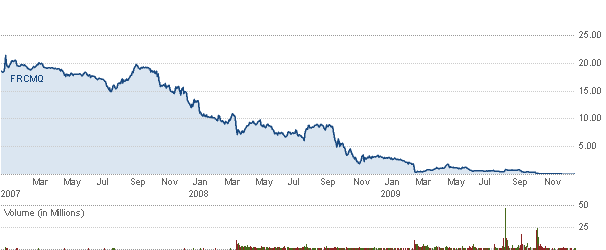
FairPoint's Stock Price from 2007, when it announced the deal with Verizon, to late 2009 when the company declared bankruptcy. By late 2008/early 2009, what seemed like a great deal for investors was apparently not, as the panicked rushed for the exits.

I’ll put my trust in the wisdom of West Virginians who want good service and reasonable prices.  If Cary wants to read from the Good Book of the “paragons of virtue” like AIG, Bear-Stearns and Goldman Sachs, let him sell his TV stations to help finance the bailouts.  Remember that when we went through this before with Hawaii Telecom and FairPoint Communications, the cheerleading session on Wall Street lasted only as long as the quarterly balance sheets looked good.  At the first sign of trouble, they bailed on the stock and both companies ended up in bankruptcy.

For them, it represented just another roll of the dice in the giant financial casino we call Wall Street.

For the rural residents of states like West Virginia who ultimately have to live with the results, this is their phone and broadband service we are talking about.  Before all bets are placed and the dice are thrown, isn’t it worth considering them?

Verizon Does ‘Home Technology Makeovers’ In Infomercials to Pitch Verizon FiOS Service

Phillip Dampier January 6, 2010 Competition, Verizon, Video 2 Comments

Liberally borrowing from ABC’s Extreme Makeover: Home Edition, and those home improvement shows on HGTV, Verizon has been producing their own “home technology makeovers” for infomercials airing in different Verizon service areas, designed to pitch their fiber to the home FiOS product line. It’s a non-threatening introduction for those not so technology-inclined, but love the premise of home makeovers.

The Reyes family of Clearwater, Florida is the latest to receive a Verizon-inspired makeover this March, which will air later as an infomercial in the Tampa Bay area.

The family was chosen from those who auditioned for the role during the past two months.

Verizon traditionally sets up each show by illustrating the challenges busy families face when trying to work with outdated electronics.  It’s also a great chance to bash the competition, suggesting their cable reception isn’t so great, their calls to 911 are broken up and unclear, and their Internet is slow and generally lousy.  At this point, Bright House Networks, Tampa’s predominate cable company, is supposed to be squirming, because you can bet these families aren’t complaining about Verizon phone service or Verizon DSL.

After the family leaves the home, a bandwagon of Verizon workers and self-described “Design,” “Tech,” and “FiOS”-Gurus show up and replace their obsolete equipment with Verizon’s family of products, ranging from FiOS for their television, phone, and broadband needs, and some extra goodies thrown in from Verizon Wireless for mobility.  Add some new electronics and some room makeovers and the job is complete.

When the family returns, they are suitably impressed with Verizon’s products (which they presumably obtain for free, at least for awhile), the company throws a block party for the entire neighborhood, and everyone goes away with a positive feeling about the company.

“I like the concept of the show, how one company can bring so much happiness to a family just by changing their home technology,” said Jessica Reyes. “It may seem simple to some people, but I know this will have a huge impact on our family.”

See?

Actually, it’s a brilliant execution of marketing to those who don’t suddenly start drooling at the mere mention of FiOS in their neighborhood.  For plenty of Americans, a decidedly non-technical demonstration of the technology products Verizon sells is a much better way to sell service to those who think fiber is a matter of diet, not home entertainment.

[flv width=”640″ height=”380″]http://www.phillipdampier.com/video/Verizon MyHome 2.0.mp4[/flv]

Verizon’s promotional reel for My Home 2.0 shows home technology makeovers, and can’t resist taking a few pokes at the competition’s service. (1 minute)

Search This Site:

Contributions:

Recent Comments:

Your Account:

Stop the Cap!