North Carolina: the fight against S.1209, the municipal broadband moratorium bill that stops communities from building their own broadband alternatives now moves to the House Ways and Means/Broadband Connectivity Committee.
All 15 members are listed below. You need to call and e-mail them and let them know you vehemently oppose this anti-consumer legislation as it stands. Let them know you want that one year moratorium out of this bill at all costs. Better yet, considering the study group mandated by the bill doesn’t include any consumers, just throw the whole thing out. The only study that needs to be done is why North Carolina is near the bottom of the 50 states in broadband rankings. Municipal providers can change that and revitalize local economies, create new high-tech jobs and help advance health care and education. You can accomplish none of these things with a one-year roadblock on broadband progress.
Some of our allies on this legislation have been forced to mute their opposition, trying to avoid an even worse bill that could make a municipal broadband moratorium permanent. That means North Carolina residents have to be on the front lines of opposition more than ever.
Let legislators know you understand some groups representing towns and cities in the state may have stopped fighting against the bill, but that doesn’t mean they endorse it. More importantly, as a voter, you oppose the bill. If you are personally served by one of these 15 representatives, let them know their vote is being carefully watched. Will they stand with the people of North Carolina who want better broadband and believe local government should be able to provide it, or do they stand with Time Warner Cable, AT&T and other telecom companies seeking a one year moratorium that guarantees another year of high prices, inadequate broadband, and no alternatives for towns and cities that want better options.
As always, be polite, persuasive, and persistent! Phone calls work wonders, but at least send an e-mail. Doing both is even better. You can click the e-mail addresses in bold to launch your e-mail software. Please do not carbon copy legislators. Send an individually personalized e-mail to the representative(s) of your choice.
House Ways and Means/Broadband Connectivity Committee
“If (Comcast) can’t rape and pillage, it’s probably not a great investment.” — Dr. John Malone, former CEO Tele-Communications, Inc. (TCI Cable)
Susan Crawford
The age of content producers blissfully producing websites and ignoring broadband policy is over.
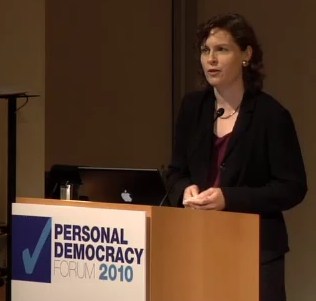
That message comes courtesy of President Barack Obama’s former Special Assistant for Science, Technology, and Innovation Policy, Susan Crawford, who rang warning bells over corporate control of the Internet last week at the Personal Democracy Forum in New York City.
Crawford, now a law professor at the University of Michigan, delivered a presentation arguing that increased corporate dominance over broadband has stalled the Gilded Age of the communications revolution.
Even as broadband becomes an increasingly important component of an American economy in recovery, marketplace concentration and laissez-faire broadband policies have combined to allow a handful of companies to control broadband access, with the potential of limiting access to web services and stalling entrepreneurial online innovation.
Crawford builds her case for a threatened broadband future:
As of 2010, 75-85 percent of the population will have only one choice of provider capable of delivering 50-100Mbps speeds — their local cable company;
Major cable systems have clustered their operations and do not compete with each other;
Verizon has suspended expansion of FiOS, its fiber to the home service, indefinitely;
Comcast, the nation’s largest cable operator with 24 million customers, 16.3 million of which take their broadband service, seeks a merger with NBC-Universal, providing a built-in incentive to limit broadband distribution of video content to non-subscribers who cut cable’s cord.
[flv width=”640″ height=”380″]http://www.phillipdampier.com/video/Susan Crawford at PdF 10 Rethinking Broadband 6-2-2010.flv[/flv]
Watch Susan Crawford’s presentation warning the tech community about the implications of America’s broadband duopoly given free rein. (17 minutes)
Walt Mossberg (left) discusses the current state of American broadband with FCC Chairman Julius Genachowski (right)
FCC Chairman Julius Genachowki told attendees at the D: All Things Digital conference America scores dead last in a study measuring the rate of change in broadband innovation. American broadband is stuck in neutral while every other ranked nation is moving forward faster in understanding the importance of deploying fast, reliable, and universal broadband. Genachowski directly ties broadband to improving local economies, propelling growth in jobs, and improving education and health care.
Unfortunately the American duopoly most Americans cope with maintains a stranglehold on efforts to bring America literally up to speed with competing nations. Worse, there is no end in sight as long as America relies entirely on incumbent providers to get the job done.
Americans pay some of the highest prices in the world for mediocre broadband, and it’s only getting worse with the introduction of usage limiting schemes like data caps and so-called consumption billing.
Genachowski is attempting to facilitate improved broadband across the United States, but is hampered by private industry undermining the FCC’s authority to help push improvements forward. Recent industry-driven court challenges to the FCC’s authority have led to the agency seeking a different path to regain its regulatory footing.
The FCC chairman sees the biggest challenges coming in wireless broadband, where a spectrum shortage is limiting potential capacity and available bandwidth. Genachowski seeks an accommodation with the nation’s television stations to relinquish UHF spectrum where possible to bolster wireless networks.
Conference host Walt Mossberg challenged Genachowski on why more isn’t getting done and why accepting the current state of the marketplace is acceptable. He also criticized providers for charging high prices for slow service and attacked Comcast for its set top box, claiming if there was an open market for these things, no one would buy it, that it would be the worst thing on the shelf.
[flv width=”512″ height=”308″]http://www.phillipdampier.com/video/All Things Digital Genachowski 6-2-10.flv[/flv]
Excerpts from FCC Chairman Julius Genachowski’s visit with Walt Mossberg at the June 2nd D: All Things Digital conference. (6 minutes)
AT&T’s hurry to end unlimited wireless data plans for its customers, many of which are using popular Apple iPhone and iPad devices, signals AT&T’s overburdened network can no longer handle customer demand. With the threat of even higher data usage from today’s release of the next generation iPhone, which will highlight bandwidth-intensive video conferencing and streaming, AT&T put the brakes on before new customers even activate their new phone.
With a penalization program in place, AT&T is sending a message to customers contemplating owning the newest generation of smartphones that its network is in no position to actually provide service to those devices, particularly bandwidth-heavy video streaming.
Customers who dare use these video streaming services face the prospect of paying an overlimit fee up to $15 for just 200 megabytes of data. That’s a compelling reason to think twice about every high bandwidth application. And that may be exactly the point for a network that suffers from congestion problems in several major American cities.
AT&T has consistently ranked at the bottom of consumer surveys done by credible organizations like Consumer Reports, typically because of network capacity issues. Yet the carrier also charges, on average, the highest out-the-door price among the four major carriers — an average of $134 a month for a two-phone plan with a data package. That’s $20 higher than either T-Mobile or Sprint, eight dollars more than Verizon Wireless.
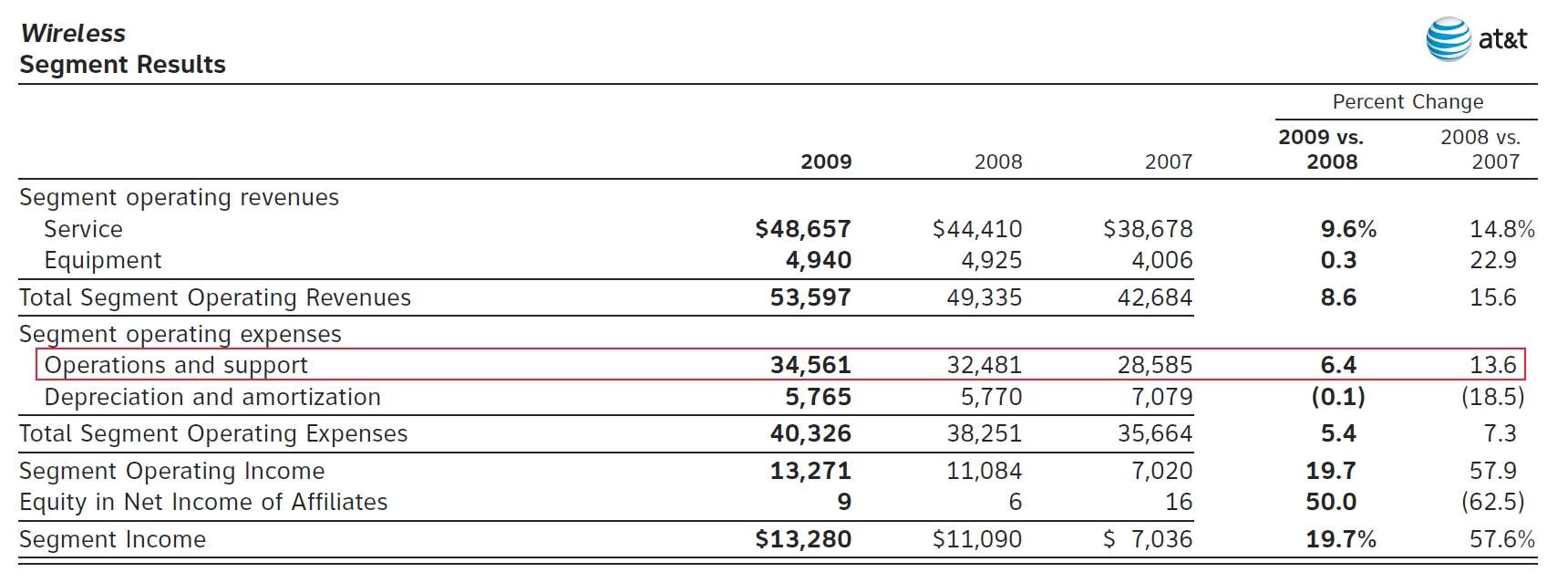
Ranked rock-bottom for voice quality, downright lousy for customer service, and only average for its other services, AT&T has simply not kept up. Yet AT&T raked in more than 13 billion dollars in profits in wireless last year. The New York Timesreports AT&T has at least 33 million smartphone customers, many committed to AT&T’s required $30 data plan. That represents more than $900 million dollars per month in revenue — $10.8 billion dollars annually, and that’s for data services alone.
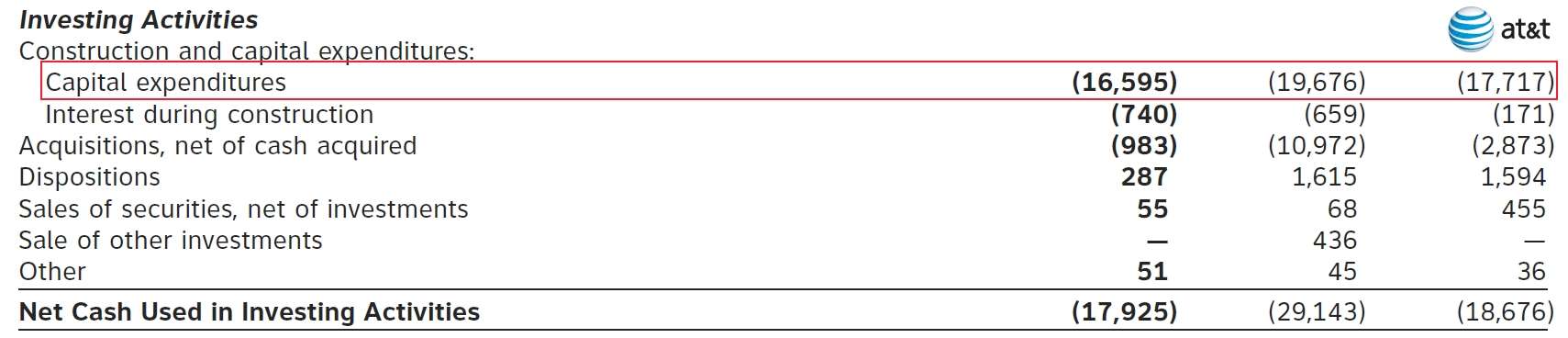
Yet the percentage of the company’s investments committed to expanding its network, measured under AT&T’s 2009 annual financial report, has not kept up with its enormous iPhone customer base, on AT&T’s network since 2007.
Source: AT&T's 2009 Annual Report -- AT&T's capital investments in its network and service don't keep up with the enormous increase in its Apple iPhone customer base introduced to AT&T service. Last year showed a dramatic reduction in investment when compared with 2008. AT&T is not exactly plowing all of its wireless profits back into its wireless business.
According to TownHall Investment Research, between January 2006 and September 2009, AT&T spent about $21.6 billion, or $308 per subscriber, on its wireless network. During that same period, Verizon Wireless spent about $25.4 billion, or nearly $353 per subscriber. Verizon has outspent AT&T each of the past three years on service upgrades without the revenue benefits a stampede of iPhone-owning customers brings. That gap has now grown into a nearly $4 billion dollars difference between the two providers in infrastructure upgrades.
“This is the story of a wireless carrier that is determined not to invest enough to meet the demand of users, but has decided to manage its network as a scarce resource,” says Chris Riley, policy counsel for Free Press. “This is what Wall Street loves: Reduce your expenditures and increase your revenues.”
In a barely competitive wireless marketplace, AT&T can afford to force customers to pay dramatically higher data costs in the months and years ahead, especially for iPhone customers who must use AT&T if they want a subsidized phone. Even if a customer leaves, AT&T will earn up to $325 in cancellation penalties.
That iPhone exclusivity agreement with Apple has been an unlimited goldmine for AT&T. AT&T’s wireless business drives AT&T’s overall profitability, generating 57 percent of its operating income according to Gerard Hallaren, director of research at TownHall.
Senator Hoyle turns his back on consumers and reads from his industry-provided talking points to stop municipal broadband
[Phillip Dampier co-authored this piece.]
North Carolina communities seeking to provide Internet access to their residents would have to wait a year while legislators argue over their terms of entry under a revised bill that swept through the Senate Finance Committee yesterday on a voice vote.
S1209, originally a poison pill bill that would effectively kill municipal broadband projects, was revised into a demand for further study, accompanied by a one-year moratorium for any city contemplating its own broadband project.
That concerns officials in several cities across the state, especially Greensboro, who wants to preserve the option of municipal broadband should Time Warner Cable revisit an Internet Overcharging experiment attempted in 2009 which would have drastically limited broadband usage for its customers.
The bill’s passage with a calling of the “yeas and nays” made it impossible for members of the public to know who voted for and who voted against the compromise measure. But an accidentally open microphone allowed many to get a real sense of how much one member of the Committee disliked consumers fighting back against telecom special interests pulling all the strings.
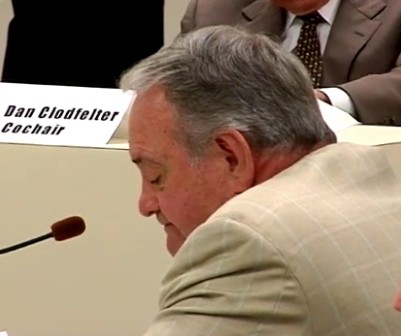
Senator Daniel Clodfelter (D-Mecklenburg) nearly raised a toast to his fellow members during the session praising them for doing the “grown-up” thing and agreeing to his manufactured compromise that phone and cable companies are celebrating as a victory today:
“This is not, I would say to you, a peace treaty. It is an armistice. And what the bill does is provide an armistice so that the shooting war stops and a conversation will occur among those people who’ve been meeting with each other in those conference rooms for the past week,” Clodfelter said. “Thank you all, because you did the grown-up thing, and I really appreciate it.”
Clodfelter’s seemingly-sincere comments might have gone off better had the audience not heard Clodfelter’s private remarks to Senator Dan Blue (D-Wake) a few minutes earlier, inadvertently captured by a live microphone:
“The — what I call the crazies that circulate around this issue are not gonna like this,” Clodfelter told Blue.
Observed WUNC reporter Laura Leslie: “I’m sure Clodfelter isn’t the first lawmaker to think so, but most of them cover the microphone before they say it out loud.”
The bill’s author, Senator David Hoyle (D-Gaston), who spent the day mangling the words “fiber optic,” condescendingly lectured his colleagues and communities about their opposition to his bill. Mistakenly called a Republican in the pages of the Greensboro News-Record, Hoyle complained cities don’t belong in the broadband business. He doesn’t want government competing with private industry, which might explain why the newspaper switched his party affiliation. But considering the amount of telecom special interest money that has flowed into the retiring senator’s campaign coffers, there may be much more to this than a philosophical debate.
Hoyle has gone all out in the North Carolina media on behalf of his telecom industry benefactors.
Money makes legislators do strange things... like disrespect their constituents with obvious industry-backed protectionist legislation
Delivering a series of eyebrow-raising one-liners, Hoyle is hardly ingratiating himself with cities and towns across the state. He inferred most city and town leaders were naive, telling ENC Today he expects all of the attention on municipal broadband will only cause more municipalities to get into the business.
“There are a whole lot of cities that can’t wait to jump on the bandwagon — monkey see, monkey do,” Hoyle said, using language that some have since called inappropriate.
Hoyle argues these systems are destined to fail. Once again he called out the cities of Davidson and Mooresville completing required upgrades to an old Adelphia cable system the community acquired nearly three years ago.
“There’s a couple of cities in this business that they should sure wish the heck they were not into, and that’s Davidson and Mooresville,” Hoyle said.
That came as news to MI-Connection, the municipal provider providing service to the two communities, whose revenues for the quarter that ended March 31st were up 9.4 percent from a year earlier.
Davidson resident and MI-Connection board member John Venzon told the Davidson News he’s worried that the legislation could “unlevel the playing field” for MI-Connection and make it harder to compete.
MI-Connection General Manager Alan Hall also told the News the entire board has concerns about these kinds of bills.
Hoyle and his telecommunications industry friends may wish the communities weren’t in the business, but MI-Connection believes otherwise.
As Stop the Cap! has reported on several occasions, MI-Connection’s challenges have hardly been unique to Davidson and Mooresville. Time Warner Cable ditched over 125 Adelphia systems it purchased, and the company is still coping with legacy equipment left in place at the former Adelphia system it now runs in Calabasas, California. The cost of upgrades for the old Adelphia systems kept by both Time Warner Cable and Comcast ran well into the millions.
Another messy misstep for the state senator has been what one could charitably call “stretching the truth.”
Mayor Susan Kluttz, representing the people of Salisbury, N.C., was called a "gentleman" and "he" by an out of touch David Hoyle
“I got a call from a gentleman yesterday, Mayor Kluttz from Salisbury, and I mean he laid me out. He called me dumb. I had no idea,” Hoyle complained to other members on the Senate Finance Committee.
One person who was not amused by that story was Salisbury Mayor Susan Kluttz, who was seated directly in front of Hoyle. She had no idea what Hoyle was talking about. I later spoke with a representative of the city who told me no one from their staff called Hoyle. With a mistake like that, maybe that phantom caller was onto something after all. Listening to Hoyle, the self-appointed expert on municipal fiber projects, refer to them as “fiber opticals,” “fiber opt,” “fiber install and do all the things they’re going to do,” and “totally fiber project any city,” did not inspire confidence.
At the heart of Hoyle’s opposition is the idea that local municipalities should not be involved in the private sector… ever. In his mind, broadband service is a luxury, and the private marketplace is best equipped to decide who gets it, and who does not. Hoyle brings no answers to the table for communities bypassed by the duopoly of providers who are increasingly focusing their time, attention, and resources on larger cities where average revenue per customer can be higher than in rural areas. If the local cable or phone company doesn’t provide the service, that’s just too bad.
Mirroring the attitude of the state’s telecommunications companies, Hoyle believes municipalities or even private providers that seek broadband stimulus money represent unfair competition, even in cases where existing providers refuse to offer service.
That is the ultimate dilemma. If you believe broadband is not becoming an essential component of most American lives and is simply a nice thing to have, it’s not insane to agree with Hoyle. But hundreds of thousands of North Carolina residents don’t believe that. Parents of children in broadband-disadvantaged schools quickly learn their kids fall behind their peers in larger, wired communities. Businesses will not locate in areas where inadequate broadband exists. Digital economy entrepreneurs cannot start new businesses without good broadband either. Even senior citizens, who are among the most resistant to broadband adoption, often complain about the inherent inequity of being forced to rely on dial-up service.
Senator Purcell
Some of the same arguments about disparity of access went on during the early 1900s in rural North Carolina, deprived of electricity and telephone service by private providers. Once President Roosevelt effectively declared these types of services as essential utilities, where private providers didn’t go, municipalities and co-ops did. In North Carolina, keeping the brakes on an expansion-minded state government came even before Roosevelt was president, with the passage of the 1929 Umstead Act — a law that prohibits the state from directly competing with private enterprise.
The Umstead Act has been seized on by the telecommunications industry, arguing municipal broadband violates the spirit of the law, even though it never applied to local municipalities. Besides, the law has been amended since 1929 because, free market theory notwithstanding, free enterprise doesn’t have every answer and cannot meet every need. Just ask BP.
Only Ayn Rand could appreciate that Hoyle and his allies support an entrenched duopoly that embraces its profitable urban customers while they fight for restraining orders like S1209, blocking efforts by others to deliver service the duopoly won’t provide. We call that corporate welfare and protectionism. But some in the state legislature can’t see that because of the blizzard of cash being dropped in front of them by that duopoly, just to leave things entirely in their hands.
Hoyle noted nobody, including himself, liked the final bill. In Hoyle’s eyes, that adds up to a “good bill.”
Other members on the Committee had different views to share.
Senator William Purcell (D-Anson, Richmond, Scotland, Stanly) is the former mayor of Laurinburg — the same city from the 2005 court victory in BellSouth/AT&T v. Laurinburg, which paved the way for municipal broadband in the state. He asked pointedly, “What assurances do we have that the private companies are going to provide [service] to smaller areas?”
Senator Queen
Hoyle answered by pulling out his talking points generously provided by the cable and phone companies and delivered a non-answer, finally stating, “we are not going to get broadband to everyone in the state.” Perhaps Hoyle is foreshadowing his next job after he retires from the Senate — working for the same telecom companies he seems to represent now.
Senator Joe Sam Queen (D-Avery, Haywood, Madison, McDowell, Mitchell, Yancey) delivered the most passionate presentation of the day on behalf of his constituents, among the least likely to have broadband service available to them. As Hoyle disrespectfully rolled his eyes and winked at the cable industry lobbyists in the audience, Queen blasted the industry’s record of performance in his district, which covers the High Country — the rural Appalachian mountain counties in the western half of the state.
“We don’t have last mile access in the mountains,” Queen told the Committee. “[My constituents are] frustrated that it’s not getting done by the cable companies, the network companies, whoever’s doing it. They’re just cherry-picking and leaving off so many of our citizens, and that’s just unacceptable.”
Queen noted the private industry that refuses to serve many of his areas also refuses to allow others to provide that service.
“The private sector is not getting it done fast enough,” he added. “We have electricity to everybody, we have water to everybody. We should have Internet to everybody in the 21st century. In my counties, we are still struggling to make that happen. Our children don’t have the virtual broadband educational opportunities that they have in the urban areas. Our business owners don’t have the access to markets that our urban citizens have.”
Senator McKissick
One senator had a question about the year-long moratorium. Senator Floyd B. McKissick, Jr. (D-Durham) asked if no action was taken by the end of the 2011 session, would the moratorium expire automatically? Although provisions in S1209 do provide for a firm sunset date, Paul Myer from the North Carolina League of Municipalities told me nothing precludes the Senate from quietly extending the moratorium, or removing the sunset provision altogether, effectively making the ban permanent.
Meanwhile, communities contemplating such projects would have to give 15-days written notice to every private provider potentially impacted, providing more than two weeks for a fear-based opposition propaganda campaign. And we know where they’ll get the money to pay for it, too.
The only good news out of all this:
Cities already providing or constructing broadband projects may continue;
A Google Fiber city in North Carolina gets a pass;
Federal broadband grant recipients may proceed, although many of those grants are going to existing providers anyway;
The bill is headed next to the House, where we have a new opportunity to derail it.
Recognizing the spirit of this entire proceeding which left consumer interests out in the cold, no public comments were heard and no recorded vote was taken.
Needless to say, the revised S1209 is only slightly less loathsome than the original, and must be opposed. But more on that coming shortly.
We couldn’t close this piece without recognizing that when all the talk was over and vote was taken, it was rest and relaxation time for selected senators, brought to you by Electricities who picked up the tab for a fabulous spread of food and drink. WUNC reporter Laura Leslie wrote about what she called an Irony Supplement.
The S1209 compromise also won the grudging support of Senator David “Business-Friendly” Hoyle (D-Gaston).
After telling Senate Finance that “Somebody, maybe a lot of bodies, needs to stand up for our free enterprise system,” Hoyle went on to knock the state’s biggest public utility co-op: “If anybody thinks that the experiment with Electricities was a resounding success, I’d like for you to raise your hand.”
No one did.
But after session today, quite a few of the Hons found their way across the street for free food and drinks provided by – wait for it – Electricities.
As one House Republican told me tonight, “If you can’t bash them and then eat their hors d’oeurves, you’re in the wrong business.”
No, sir, I’m not. But I’m thinking you might be.
Senate Finance Committee deliberations on a revised S1209, a bill to establish a one year moratorium on municipal broadband projects. (June 2, 2010) (34 minutes)
You must remain on this page to hear the clip, or you can download the clip and listen later.
Be Sure to Read Part One: Astroturf Overload — Broadband for America = One Giant Industry Front Group for an important introduction to what this super-sized industry front group is all about. Members of Broadband for America Red: A company or group actively engaging in anti-consumer lobbying, opposes Net Neutrality, supports Internet Overcharging, belongs to […]
Astroturf: One of the underhanded tactics increasingly being used by telecom companies is “Astroturf lobbying” – creating front groups that try to mimic true grassroots, but that are all about corporate money, not citizen power. Astroturf lobbying is hardly a new approach. Senator Lloyd Bentsen is credited with coining the term in the 1980s to […]
Hong Kong remains bullish on broadband. Despite the economic downturn, City Telecom continues to invest millions in constructing one of Hong Kong’s largest fiber optic broadband networks, providing fiber to the home connections to residents. City Telecom’s HK Broadband service relies on an all-fiber optic network, and has been dubbed “the Verizon FiOS of Hong […]
BendBroadband, a small provider serving central Oregon, breathlessly announced the imminent launch of new higher speed broadband service for its customers after completing an upgrade to DOCSIS 3. Along with the launch announcement came a new logo of a sprinting dog the company attaches its new tagline to: “We’re the local dog. We better be […]
Stop the Cap! reader Rick has been educating me about some of the new-found aggression by Shaw Communications, one of western Canada’s largest telecommunications companies, in expanding its business reach across Canada. Woe to those who get in the way. Novus Entertainment is already familiar with this story. As Stop the Cap! reported previously, Shaw […]
The Canadian Radio-television Telecommunications Commission, the Canadian equivalent of the Federal Communications Commission in Washington, may be forced to consider American broadband policy before defining Net Neutrality and its role in Canadian broadband, according to an article published today in The Globe & Mail. [FCC Chairman Julius Genachowski’s] proposal – to codify and enforce some […]
In March 2000, two cable magnates sat down for the cable industry equivalent of My Dinner With Andre. Fine wine, beautiful table linens, an exquisite meal, and a Monopoly board with pieces swapped back and forth representing hundreds of thousands of Canadian consumers. Ted Rogers and Jim Shaw drew a line on the western Ontario […]
Just like FairPoint Communications, the Towering Inferno of phone companies haunting New England, Frontier Communications is making a whole lot of promises to state regulators and consumers, if they’ll only support the deal to transfer ownership of phone service from Verizon to them. This time, Frontier is issuing a self-serving press release touting their investment […]
I see it took all of five minutes for George Ou and his friends at Digital Society to be swayed by the tunnel vision myopia of last week’s latest effort to justify Internet Overcharging schemes. Until recently, I’ve always rationalized my distain for smaller usage caps by ignoring the fact that I’m being subsidized by […]
In 2007, we took our first major trip away from western New York in 20 years and spent two weeks an hour away from Calgary, Alberta. After two weeks in Kananaskis Country, Banff, Calgary, and other spots all over southern Alberta, we came away with the Good, the Bad, and the Ugly: The Good Alberta […]
A federal appeals court in Washington has struck down, for a second time, a rulemaking by the Federal Communications Commission to limit the size of the nation’s largest cable operators to 30% of the nation’s pay television marketplace, calling the rule “arbitrary and capricious.” The 30% rule, designed to keep no single company from controlling […]
Less than half of Americans surveyed by PC Magazine report they are very satisfied with the broadband speed delivered by their Internet service provider. PC Magazine released a comprehensive study this month on speed, provider satisfaction, and consumer opinions about the state of broadband in their community. The publisher sampled more than 17,000 participants, checking […]


 Subscribe
 North Carolina: the fight against S.1209, the municipal broadband moratorium bill that stops communities from building their own broadband alternatives now moves to the House Ways and Means/Broadband Connectivity Committee.