Home » Competition » Recent Articles:

ComedyMonday at The Chuckle Hut — AT&T: “Our Customers Like Usage-Based Billing”

AT&T Mobility thinks it has a winning strategy when it took away unlimited data plans, forcing new customers to choose high-priced, usage-limited alternatives.  But a new survey from Wall Street research firm Sanford Bernstein found AT&T customers will grab, claw, and scream to keep the peace of mind that comes from having the choice of an unlimited use plan.

Sanford Bernstein’s study found a large number of customers willing to abandon any carrier that takes unlimited data away from them.  About a third of the more than 800 people responding said AT&T’s move toward usage-based billing left them with a bad impression of the wireless carrier.  That’s particularly bad for AT&T, which already scores as America’s lowest-rated wireless company according to Consumer Reports.

AT&T mitigated some of the potential damage by letting existing customers keep their unlimited data plans when they ceased selling the unlimited option this past June.  New customers are forced to choose between two limited-use plans — $15 for 200MB or $25 for 2GB of usage (a tethering option is also available.)  Existing customers will only face that hard choice if or when they change phones, presumably in the next year or two.

Had they not grandfathered in existing customers, Sanford Bernstein’s research suggests a large proportion of customers forced to give up unlimited data would quit AT&T even if it meant buying a new phone and paying a higher bill just to get the unlimited data option back.  When AT&T eventually forces these customers’ hands, Sanford Bernstein predicts trouble.

According to the study, more than 58 percent of the lowest data users said they would dump AT&T overboard and switch to another provider with an unlimited plan. For heavier users, more than two-thirds are prepared to take their business elsewhere.

But even with overwhelming evidence like that, AT&T and some Wall Street analysts think Internet Overcharging schemes do customers a favor.
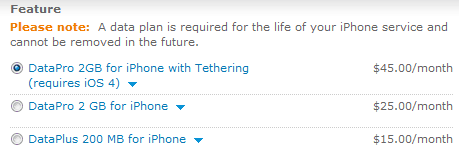
AT&T's mandatory data plans

“Customers generally have strongly negative perceptions about Usage-Based Pricing, and these are often not correlated with self-interest,” Bernstein analyst Craig Moffett said in a research note analyzing the findings of the survey conducted this past summer. “It is fashionable to argue that loyalty to carriers is dead (except perhaps to Verizon Wireless, whose service level is perceived to be markedly higher than that of its competitors). The new conventional wisdom is that carrier loyalty has been replaced with loyalty to the device. But high inclination to switch carriers and phones to maintain an unlimited plan suggest that perhaps the plan itself is more important than either one.”

The Wall Street firm’s research is hardly news to consumers, who have repeatedly expressed loathing contempt for Internet Overcharging schemes like so-called “usage-based billing,” “data caps,” and speed throttles that kick in when carriers decide customers have used the service enough.

Consumers are willing to pay a higher price just knowing they will never face dreaded “bill shock” — a wireless company bill filled with hefty overlimit fees charged for excessive data usage.  They also have no interest in being penalized by arbitrary usage limits that punish offenders with speed throttles that reduce wireless speeds to dial-up or lower.

AT&T was the first major carrier to throw down the gauntlet and force customers into choosing between a “budget plan” that is easy to exceed at just 200MB of usage per month or an inadequate, overpriced 2GB tier that costs just five dollars less than the now-abandoned unlimited use plan.

Wall Street firms like Sanford Bernstein worry their investor clients may be exposed to a revenue massacre when competing carriers like Verizon Wireless, which retains an unlimited plan for now, unveils its own version of the popular Apple iPhone.  The result could be a massive stampede of departing customers headed for top-rated Verizon Wireless, even if it means paying early termination fees.

AT&T spokesman Mark Siegel sees things very differently however, telling CNET News AT&T’s new limited option plans deliver more choice and flexibility for data-hungry users.

“We have found that our customers in fact like usage-based billing,” he said. “They appreciate having choices in data plans. This is probably because a majority of customers can reduce their costs through our plans.”

If true, Siegel could prove that contention by revealing how many of AT&T’s grandfathered-in unlimited data customers were willing to give up that plan and downgrade to one of the new limited use plans.  Siegel declined.

Moffett told CNET News his firm’s study found large numbers of existing customers using just a few hundred megabytes of usage per month who want to pay for an unlimited pricing plan, if only as insurance.  For many, they recognize the smartphone-oriented explosion of data applications will only grow their usage further in the days ahead, and what may be a tolerable usage limit today will be downright paltry tomorrow.

Underusing an unlimited data plan represents fat profits for AT&T, but doesn’t solve the problem of getting price-resistant customers to upgrade their older phones.  AT&T believes cheaper, limited use plans may do the trick.  But the company also decided to eliminate the unlimited use option, fearing some customers could cannibalize profits by downgrading currently underutilized unlimited service, knowing they could always return to an unlimited data plan when use justified it.

Verizon Wireless Sees the Light And Throws a “Sale” on Its Unlimited Data Plan, But for How Long?

Meanwhile, Verizon Wireless has settled on a more aggressive strategy to win many of its month-by-month customers back to two year service agreements with smartphone upgrades tied to an “unlimited data plan sale” that reminds would-be customers they still offer unlimited data, and gives many the chance to pay $10 less per month for it.

Customers either upgrading a current device to a smartphone on a family plan or adding a new line of service with a smartphone on a family plan will get $10 per month credit for each new smartphone line, for up to 24 months.  Although the plan was originally designed to promote “free extra lines” by crediting back Verizon’s $9.99 charge for each additional line of service, in many markets Verizon salespeople are now spinning the credit as a “sale on the unlimited data plan” instead.

Even primary line customers on a family plan can upgrade to a smartphone and get the credit.

But customers with expired contracts on legacy plans no longer sold by Verizon will have to give those up and start a new Family SharePlan starting at $69.99 per month for 700 shared minutes.  For those on popular retired plans like America’s Choice Family SharePlan, that represents a $10 rate hike for the exact same number of minutes and a loss of features including deducting mobile web use from available minutes instead of charging $1.99 per megabyte for access.

The unlimited data plan will effectively cost $20 a month for each smartphone on the account, and customers who want to use text messaging or other messaging features are likely going to need another add-on plan to cover that, starting at $5 a month.  And then the junk fees and government mandated charges further increase the bill:

  • Tolls, taxes, surcharges and other fees, such as E911 and gross receipt charges, vary by market and as of November 1, 2010, add between 5% and 39% to your monthly bill and are in addition to your monthly access fees and airtime charges.
  • Monthly Federal Universal Service Charge on interstate & international telecom charges (varies quarterly based on FCC rate) is 12.9% per line.
  • The Verizon Wireless monthly Regulatory Charge (subject to change) is 13¢ per line.
  • Monthly Administrative Charge (subject to change) is 83¢ per line.

Still, Verizon’s $10 sale may be enough to convince some customers avoiding smartphone upgrades to take the plunge.  Those doing so until the end of today through Verizon’s website can get free activation of their new phones.

Verizon hopes the offer will push a number of its legacy plan customers to abandon their old plans and grab a new smartphone at a subsidized price, putting those customers back on two year contracts.  The offer expires January 7, 2011 (and the $10 credits stop after 24 months).  The sale is only good on the unlimited data plan.
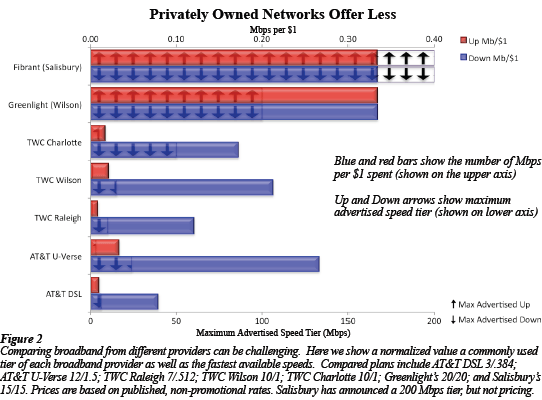
N.C.’s Fastest & Cheapest Broadband Comes from Community-Owned Networks Some Want to Ban

A new report proves what Stop the Cap! has advocated for more than two years now — communities seeking the fastest, most-modern, and most aggressively priced broadband can get all of that and more… if they do it themselves.

The concept of community self-reliance for broadband has been dismissed and derided for years among small government conservatives and corporately-backed dollar-a-holler groups who claim government can’t manage anything, but when it comes to broadband in the state of North Carolina, the evidence is in and it is irrefutable — Tar Heel state residents are getting the most bang for their broadband buck from well-managed and smartly-run community-owned broadband networks.

Christopher Mitchell from the New Rules Project — part of the Institute for Local Self-Reliance, gathered evidence from North Carolina’s different broadband providers and found the best broadband services come from local communities who decided to build their own fiber networks. instead of relying on a handful of cable and phone companies who have kept the state lower in broadband rankings than it deserves.

North Carolina is undergoing a transition from a manufacturing and agricultural-based economy that used to employ hundreds of thousands of workers in textile, tobacco, and furniture manufacturing businesses.  In the last quarter-century, the state has lost one in five jobs to Asian outsourcing and America kicking the tobacco habit.  Its future depends on meeting the challenges of transitioning to a new digital economy, and major cities like Charlotte, Raleigh, and Greensboro have risen as well-recognized leaders in engineering, biotech, and finance.

But for rural and suburban North Carolina, success has been hindered by a lack of necessary infrastructure — particularly broadband for small businesses and entrepreneurs.  It becomes impossible to attract high tech jobs to areas that are forced to rely entirely on low speed DSL service, if that is even available.

In communities like Wilson and Salisbury, long frustrated by area providers not delivering needed services, a decision was reached to build their own broadband infrastructure — modern fiber to the home networks worthy of the 21st century.

Mitchell’s report charts the benefits available to every resident, as communities with state-of-the-art fiber networks consistently deliver the most robust service at the lowest prices, all without risk to local taxpayers.  Better still, when the network construction costs are paid back to bondholders, future profits generated by the community-owned systems will be plowed back into local communities to reduce tax burdens and keep service state-of-the-art.

“Comparing the tiers of residential service from Wilson or Salisbury against the providers in the Raleigh area shows that the communities have invested in a network that offers far faster speeds for less money than any of the private providers,” Mitchell concludes.  “Whether communities in North Carolina are competing against other states or internationally for jobs and quality of life, they are smart to consider investing in a community fiber network.”

Mitchell’s report arrives just a few weeks after voters handed North Carolina’s General Assembly to GOP control for the first time in more than a century.  Both cable and phone companies in the state modestly suggest that is good news for their legislative agenda, which is an understatement equal in proportion to the historic handover of control of both the House (67-52) and the Senate (31-19).  The top items on the agenda of incoming members is a checklist of conservative activist favorites, including a war on unions, mandatory ID cards for voting, opting the state out of recently enacted health care reform, an eminent domain constitutional amendment, sweeping deregulation reform to favor business interests, and redistricting to “restore fairness” in future elections.

The state’s big cable and phone companies are convinced with a list like that, they can come along for the legislative ride and get their agenda passed as “pro-business reform.”  That means a much larger fight in 2011 for the inevitable return of corporate protection legislation banning exactly the kinds of municipal networks that are delivering North Carolina better, faster, and cheaper broadband.

Verizon Targets Frontier, AT&T and Cable ‘Digital Phone’ Landline Customers in Rochester, N.Y. and Conn.

Phillip Dampier November 23, 2010 Competition, Consumer News, Verizon, Video 10 Comments

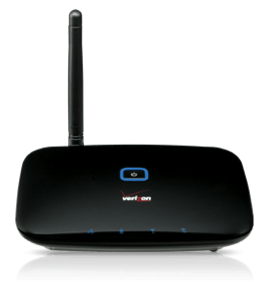
Verizon's Home Phone Connect base station

Verizon Communications has announced a new option for landline customers to ditch their local phone company with a new device that routes home phone calls over Verizon Wireless’ cellular network.

Verizon has chosen two test markets for its new Home Phone Connect service — Rochester, N.Y., serviced by Frontier Communications and Time Warner Cable and Connecticut, which is served by AT&T and Comcast.  (Thanks to our reader Bob for sharing the news with us.)

The service works with your existing home wired and cordless phones.  Customers signing up under a one or two year service contract will receive the base unit free of charge.  Installation is as easy: Just unplug the phone cord from the wall and plug it into the back of the Home Phone Connect device.  The unit supports up to two hard wired (non-cordless) phone lines and a cordless phone base station.  When you pick up any phone around the house, the base station will deliver a familiar dial tone, but all calls are made and received over the Verizon Wireless cell phone network.  You can download an read a copy of the installation manual here.

The service is priced at $9.99 per month for existing Verizon Wireless customers with any existing Family SharePlan that has two or more lines with at least a 700 minutes calling allowance per month.  Customers using Home Phone Connect under this plan will use minutes from their existing wireless service plan.  But since calls to and from Verizon customers and all calls placed during nights and weekends do not eat minutes, this may be a viable option for many customers.

For heavy talkers, or those without a qualifying Verizon Wireless service plan, an unlimited talk time plan is available for a flat $19.99 per month.

All local and domestic long distance calls are included, and the service also comes with these features:

  • Call Waiting
  • Call Forwarding
  • Caller ID (not currently compatible with Caller ID + Name)
  • International Dialing (charged at prevailing Verizon long distance rates)
  • 3-Way Calling
  • Basic Voice Mail (*86)
  • Account Balance (*225)
  • Device Provisioning, (*228)
  • Account Payment (#786)
  • 311, 411, 511, 611, 711 & 911 (some services not available in all areas)
  • Last Number Callback (*69)
  • National Domestic Hope Line (#4673)

The base unit includes a backup battery to power the unit for up to 36 hours idle time/2 hours talk time in the event of a power failure.  Customers relying on landline service that works with a monitored alarm system should check with their alarm company to ensure compatibility with cell network technology.

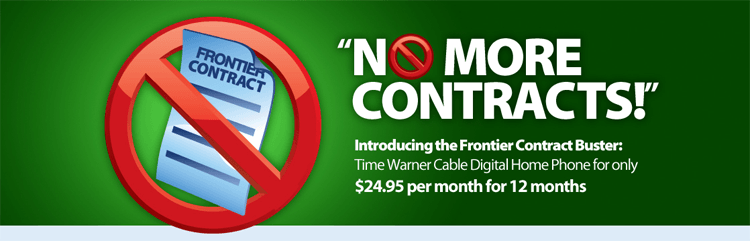
Michael Murphy, Verizon’s public relations manager for the New England Region, said consumers have the option of keeping their existing home phone number or requesting a new one.  Customers who do switch their current home phone number to Verizon will automatically cancel their existing landline service.  Frontier customers should carefully check their bills to make sure they are not on a Frontier “Peace of Mind” contract before switching.  Any expiration dates adjacent to the type of home phone service described on your bill likely means you are on a term contract.

Customers dumping Frontier before their contract expires could be exposed to early termination fees of up to $300 or more, which will appear on a customer’s final bill.  If you did not authorize a service contract, demand that Frontier drop it from your bill before you switch, and follow up with a complaint to the New York Attorney General’s office if the company fails to comply.

The device is intended to be portable, so you can take your “home phone” with you to any area served by a Verizon Wireless signal.  Just pack the Home Phone Connect base station and take it along.

Verizon carefully chose test markets outside of Verizon landline service areas.  That allows them to pick up new “landline” customers without harming their own landline business.

Verizon Wireless has a very large share of the Rochester, N.Y., market because of its ownership of the legacy Rochester Telephone cellular network.  Verizon delivers far more robust coverage than any other regional cellular provider in western New York.  With a built-in customer base wide open to Verizon’s marketing machine, the phone company could grab a significant number of Frontier landline customers who will see significant savings over Frontier’s comparable landline feature plans that run close to $50 a month after taxes and fees.  The company could also poach a number of Time Warner Cable’s Digital Phone customers, especially those whose first year promotional discount has expired.

In Connecticut, Verizon is challenging AT&T, which provides most of the state with its landline service.  Comcast is the dominant cable operator.

Comcast seemed unimpressed with the challenge being raised by Verizon in its service area.  The cable company hinted Verizon’s lack of a bundled service option including phone, cable, and broadband would hurt its chances of success.

Indeed, Verizon will have to develop some creative marketing to make its Home Phone Connect stand out.  Younger customers have no landlines to switch.  Most of those eager to cut their home phone line have already moved to cellular or Voice Over IP services from their local cable company or other providers like Vonage.  Existing Verizon Wireless customers may be hesitant about using a service that burns their wireless minutes away.  Older customers are unlikely to understand the product and have a built-in resistance to dropping traditional phone service.  Many may resist the notion of being stuck with at least a one year contract for an untested service.

T-Mobile attempted to market an almost identical service under its @Home brand, but judged it a failure and disconnected it earlier this year.

Because the service is being test marketed, its availability is limited to selected Verizon Wireless stores:

[flv width=”640″ height=”380″]http://www.phillipdampier.com/video/Verizon Home Phone Connect 11-23-10.mp4[/flv]

The New Haven Register set up a video interview with a Verizon representative to demonstrate its new Home Phone Connect service. (1 minute)

More Nonsense: Industry-Funded Group Claims They Have ‘Proof’ Caps Save $$$

Studies find few surprises for cable and phone companies that pay for them.

Internet plans with term contracts, usage limits, and other pricing tricks are good for consumers and save them money over comparable unlimited usage plans.

That is the conclusion of a new study from the Technology Policy Institute, an industry front group funded by AT&T, Comcast, the National Cable & Telecommunications Association, Qwest, Time Warner Cable, T-Mobile, and Verizon.

Scott Wallsten and James Riso’s “study,”Residential and Business Broadband Prices, Part 1: An Empirical Analysis of Metering and Other Price Determinants,” claims to have taken a comprehensive look at 25,000 plans offered across North America, Europe and the Pacific to make their case that a residential service plan with a 10GB monthly usage cap would save consumers 27 percent over the price of a comparable unlimited plan, as long as data use stays below the cap.  They also suggest additional savings can be had if consumers lock themselves into term contracts with service providers (most of which carry hefty fees to exit early.)

These results suggest that the unlimited data plans typically offered by most U.S. wireline broadband providers may not be optimal for many consumers. The details of capped plans matter, and how an individual user is affected depends on the base price, allowed data usage, and consequences for exceeding the cap. Nevertheless, because capped plans are—all else equal—cheaper than unlimited plans, many consumers, particularly the low-volume users, are likely to pay less for broadband with data caps than they would for plans offering unlimited data transfer.

Wallsten and Riso make much of AT&T’s recent decision to end unlimited usage for wireless broadband, suggesting that consumers are saving money with new, low-use plans over the company’s old unlimited pricing.  The authors claim close to 70 percent of iPhone users consume less than 200 MB per month, which is the cap for AT&T’s cheaper data plan.

But the authors concede that usage is growing — rapidly in the case of online video, which sets the stage for consumers saving money today, but facing serious overlimit charges on their bills tomorrow:

Some analysts, however, remain concerned that these plans make video streaming impractical given the bandwidth it consumes, could eventually cost consumers more as they use their wireless devices more intensively, and generally make it less likely for wireless to become a viable substitute for wireline broadband. To be sure, while Figure 3 shows that the vast majority of users consume small amounts of data today, it also shows per user mobile data consumption growing quickly, so the number of people who exceed the caps could increase significantly in a relatively short period of time.

Major U.S. wireline providers have not yet introduced metered pricing successfully, though, as shown above, it is common in other countries. An experimental metered pricing plan by Time Warner Cable garnered strong reaction, prompting one group to demand that Congress ―investigate ongoing metered pricing practices to determine the impact on consumers. Some in Congress did, in fact, hold hearings on the plans. In response to this backlash, Time Warner Cable canceled its experiment.

Despite the political reaction, all consumers are not inherently worse off or better off with metered pricing. Low-volume users are likely to be better off under metered plans and high volume users worse off. The net effect on any given consumer depends on his data use, the base price, how much data the base price allows, the price of data when exceeding the cap, and how much he would have paid for an unlimited plan.

Wallsten and Riso also admit several parts of their study are “incomplete,” and “lack data.” We would also include the facts they ignored whether consumers prefer unlimited plans, how customers would feel about a bill with overlimit fees attached, or whether the usage cap levels the authors note in their study are adequate.  They also completely ignore the critical issue of bandwidth cost trends and their relationship to consumer pricing.

But of course they would, considering the same providers who want these pricing schemes are paying the costs for the study.

Welcome to the world of Hired Gun Research.

Wallsten, in particular, has been singing the same cap-happy tune for several years now, churning out the same industry-financed conclusions about broadband.  Back in 2007, he delivered a piece trumpeted by the Progress & Freedom Foundation and the Heartland Institute — two groups notorious for parroting corporate-friendly talking points.  Back then it was about Internet overloads and supporting Internet toll booths for “congestion pricing” after Comcast got caught secretly throttling broadband customer speeds.

Dave Burstein of DSL Prime notes most consumers don’t like caps, lock-in contracts, or speed throttles.

“Policymakers should normally assume that imposing caps generally results in negative consumer welfare. The small efficiency gains don’t come close to making up for a second rate Internet,” Burstein writes. “Everyone is better off with a robust, unthrottled Internet. It allows for an important form of video competition and market access for innovative new net offerings. It’s a better experience for the user and hence more people will be connected, a good thing.”

In this latest study, the two authors completely ignore some very important facts:

  • Who sets the pricing for unlimited and usage-capped broadband?  Providers.  Do consumers save money from usage limited plans because of decreased provider costs passed along to consumers or pricing schemes that artificially inflate unlimited broadband pricing to drive customers to “money-saving” limited plans that teach usage restraint or expose consumers to dramatic overlimit fees?
  • What are the trends for wholesale bandwidth costs and how does that trend comport with industry pricing schemes that have increased broadband pricing in the United States?  An honest study would reflect these costs are dropping… dramatically, and would introduce the very real question of whether unlimited broadband is a problem in search of a revenue-generating solution that would come from further monetizing broadband with so-called “consumption pricing.”
  • What is the consumer perception of usage-limited broadband?  An important part of this equation is whether consumers want unlimited broadband service to be discontinued.  Every study to date not paid for by the providers themselves shows consumers are willing to pay today’s prices for the peace of mind they receive in not being exposed to limits or overlimit fees.  Wallsten and Riso touched on the consumer backlash, to a considerable part coordinated by Stop the Cap!, over Time Warner’s pricing scheme which would have tripled broadband pricing for an equivalent level of service.  But the authors charge on with their pro-cap conclusions regardless.
  • Wallsten and Riso’s study only casually mentions the dramatically different paradigms of wireless and wireline broadband.  The former is delivered using technology that is recognized to have limitations that can only be seriously addressed with additional spectrum allocation that could take years to address.  The latter is already being mitigated by cable broadband technology upgrades, fiber optics, and improved backbone connections that often deliver much better access at a fraction of the price providers paid just a few years earlier.  Drawing comparisons between AT&T’s wireless broadband pricing and wireline broadband is dubious at best, especially since two companies largely control pricing and service for the majority of wireless customers in the United States.
  • To prove its contention limited broadband service is “common in other countries,” the authors cite a Frequently Asked Questions article by Comcast trying to justify that company’s own usage cap to its customers.  So because Comcast’s PR department says it, it must be true.  In fact, in countries where usage capped broadband has been a traditional problem, consumer demand and public policy efforts have moved providers towards offering unlimited service plans to meet popular demand.  In fact, in countries like Australia, New Zealand, and South Africa, governments have cited usage caps as a serious disadvantage to growth of the digital economy.  Consumers certainly agree.

Dave Burstein, DSL Prime

Burstein adds:

Caps or other throttling measures are almost never imposed because of actual congestion problems (on large, wired networks.)  The caps would be at far higher levels if they were, like Comcast’s 250 gigabytes. The usual explanation is bogus. The typical consumer advocate believes the caps are about preventing competition to the carriers’ own video package. That’s certainly common, but so is price discrimination to yield increased potential revenues. As Scott notes, price discrimination in a strongly competitive market can work out well for all concerned. With strong competition, the benefits flow through to consumers. Since competition in broadband is typically weak, I believe it far more often has little consumer benefit but is good for company profits.

The authors conclude that despite limitations on data available, “The policy implications, however, are clear.  Policymakers should not immediately conclude that data caps and other pricing schemes that differ from traditional unlimited plans are necessarily bad.”  Instead, the authors suggest pricing trends should be evaluated over time to identify the effects on prices, investment and usage.

Although that’s a point Burstein agrees with, we feel there is substantial evidence this debate is based not on experimental pricing to find new customers, but rather a defensive position to respond to an inevitable public backlash against Internet Overcharging schemes.  Providers are desperately looking for excuses to further monetize broadband, cut costs, and deliver an effective impediment to online video competitors using broadband networks to deliver alternative, less expensive services to consumers.

Policymakers should listen to their constituents, who are more than comfortable with today’s unlimited broadband experience.  Nobody objects to experimental low usage plans with discount pricing, but not at the expense of ending or repricing existing unlimited service into the stratosphere.  Today’s broadband industry earns billions in annual profits, even as their costs decline.  Providers have done considerable profit-taking in the last few years from their broadband divisions, slashing upgrades and other investments to keep pace with traffic demands.

Frontier’s Future Plans: Delivering DSL and DirecTV Options for Its FiOS Customers, Contracts for Others

Phillip Dampier November 18, 2010 Audio, Broadband Speed, Competition, Frontier, Rural Broadband, Video 5 Comments

Don’t want blazing fast fiber optic broadband speeds?  Unhappy with fiber optic quality video and want to go back to putting a satellite dish on your roof?  If the answer to either question is “yes,” Frontier Communications has good news for you.

The phone company, which assumed control of a handful of communities formerly served by Verizon’s fiber-to-the-home FiOS network, has announced it will begin marketing DSL and satellite TV services to its fiber customers.

Frontier CEO Maggie Wilderotter told investors on a third quarter results conference call that FiOS broadband could be too expensive.

Wilderotter noted Verizon would not allow customers in a FiOS neighborhood to buy DSL service, which leaves budget-minded customers behind.

“Now, FiOS starts at like 50Mbps and it’s very expensive. It’s like $50 a month for a customer. So they left a whole host of customers behind from an affordability perspective who didn’t need that kind of capability on broadband.” Wilderotter explained. “We have just over the last 30 to 60 days opened up DSL in all of the FiOS markets to give the customer choice. So the customer can choose whether they want FiOS broadband or they want high-speed Internet service, typically, and in those markets we’re offering around 6 to 7Mbps.”

Time Warner Cable occasionally runs promotions helping customers break free from Frontier's multi-year service contracts.

Of course, Frontier FiOS starts at 15Mbps — not 50, and that costs $50 a month for standalone service.  For $99, ($89 in Verizon FiOS areas), customers can get broadband, cable TV and unlimited phone service.  Frontier’s “Turbo” DSL service is priced at $40 a month for up to 7.1Mbps service.

Wilderotter also noted their FiOS customers can also choose to skip fiber video and go with DirecTV.

“We think that customers should be able to choose what kind of video they want,” she said. “We have aggressive offers in the market for both DirecTV and for FiOS video, but in our vernacular, what we care about is keeping the customer, getting the customer to take more products and services from us and making sure the customer is happy with the choice.”

Wilderotter said Frontier is prepared to tolerate more congestion on its DSL circuits than Verizon permitted, which opens the door to potential traffic slow-downs down the road.

“We’ve opened up in many of these locations the opportunity to sell high-speed service up to 95% capacity on the equipment that we have out in the field. Verizon had set a parameter at 75%,” Wilderotter said.

The company continues to study whether Frontier FiOS is worth maintaining or expanding outside of the Verizon territories where it was originally constructed.

“We are still evaluating it from a financial perspective and a customer perspective, and from a cost perspective and a revenue perspective,” Wilderotter told investors. “In terms of what that does for us overall, what it does for churn, how much does it really cost to extend this capability in the markets that we’re in today — we think that analysis and evaluation will go on through the first quarter [of 2011] and then we’ll be able to make some [decisions] in terms of what we want to do with FiOS from an expansion perspective or a maintenance perspective.”

Frontier Communications CEO Maggie Wilderotter answered questions about broadband expansion and the impact of the fall elections on telecommunications policy in Washington. (11 minutes)
You must remain on this page to hear the clip, or you can download the clip and listen later.

<

p style=”text-align: center;”>

Frontier's largely rural service areas provide a captive audience for the company's DSL broadband service.

In the near term Frontier has several plans to get more aggressive in the marketplace to meet its target goal of losing only 8 percent of their customers per year — a goal that illustrates legacy phone companies are still on a trajectory towards fewer and fewer customers:

  1. Don Shassian, executive vice president and chief financial officer of Frontier reports expansion of DSL remains a top priority for Frontier.  The company is on track to deliver access to 300,000 additional homes by the end of the year.  Verizon delivered access to 64 percent of Frontier’s acquired territories.  Frontier wants to get that number up to 85 percent.  But part of that target is not just expanding service to unserved areas.  It’s also trying to win back customers lost to other providers through promotions and incentives.
  2. Frontier plans to resume aggressive promotions in the coming weeks and months, including its “free Netbook” promotion, which provides a Netbook computer to new customers signing up for several packages of services, committing to remain with Frontier for at least two years.
  3. Frontier intends to push “price protection agreements” on as many customers as possible.  Their “Peace of Mind” program locks customers into multi-year contracts with stiff cancellation penalties.  Wilderotter noted: “I think, as you know, in our legacy markets, 96% of all of our sales are on a price protection plan and we have close to 60% of our residential customers on a one-, two- or three-year price protection plans. That number is below 15% in the acquired markets. So we’re also driving for price protection plans with every sale that we’re doing in these new markets as well.”  Such contracts dramatically discourage a customer from disconnecting Frontier, because fees for doing so can exceed $300 in some cases.  Frontier has been heavily criticized by some customers and State Attorneys General for deceptive business practices regarding contracts.

Frontier continues to enjoy a lack of solid cable competition in its largely rural service areas.  Shassian reports Comcast competes with Frontier in only about 32% of homes in some areas, Time Warner Cable in about 23%, and Charter below 15%.  With reduced competition, Frontier often represents the only broadband option in town.

Frontier is also spending an increased amount of time coping with copper thefts, especially in West Virginia where the company is warning would-be thieves it will prosecute to the fullest extent of the law.

“Damage to our facilities can affect communications access in an emergency, increase company costs and consumer rates, and disrupt community phone and broadband connections,” said Lynne Monaco, Frontier’s Director of Security. “When network connections are severed by copper thieves, it endangers customers and emergency responders and poses significant risks of personal injury and property damage.”

Just last week, West Virginia state police solved another copper caper that disrupted service for some customers.

The Charleston Daily Mail reports:

Photo Credit: West Virginia Regional Jail Authority

Stephanie Burdette of Charleston was arrested in connection with a copper wire theft.

Trooper A.B. Ward from the South Charleston detachment went to the Fishers Branch area of Sissonville last Thursday afternoon when a Frontier worker discovered a section of the communications line missing. The worker found that 300-feet of the 400-pair line, valued at about $5,000, was missing, according to a complaint filed in Kanawha Magistrate Court.

A trooper who had worked on a similar investigation told Ward to check the home of Ervin “Tubby” Page, 49, where troopers had previously found evidence of wire burning. Ward went to Page’s home, described as a Goose Neck travel trailer parked next to the Guthrie Agricultural Center in Sissonville, and found three burn barrels about 50 feet in front of the trailer. One of them was on fire.

Page’s girlfriend Stephanie Marie Burdette, 25, of Cross Lanes, was at the scene when the trooper arrived. Ward spoke to her then checked out the barrels where he found aluminum wrap, which is used to cover the copper communications wiring, and pieces of copper cabling, the complaint said.

Frontier customers are encouraged to report any suspicious activity around telecommunications equipment and facilities by calling the company’s toll free security line 1-800-590-6605. Anyone witnessing a theft in progress should not confront the suspects but should immediately call 911 and then call Frontier. Vehicle and suspect descriptions are very useful. This is a community safety problem, and the cooperation of the public is critical.

[flv width=”500″ height=”395″]http://www.phillipdampier.com/video/WOWK Charleston Copper Thieves 11-15-10.flv[/flv]

WOWK-TV in Charleston covers Frontier’s difficulties with copper wire thieves across the state of West Virginia.  (1 minute)

Search This Site:

Contributions:

Recent Comments:

Your Account:

Stop the Cap!