Up to 60 percent of callers to America’s big telecom companies experience rage when their calls go unanswered, their problems go unresolved, or they literally cannot get past the language barrier of today’s outsourced customer service agents working half a world away.
Cable and phone companies are among the worst at delivering quality customer service, with Comcast in particular causing enough frustration to bring a Virginia woman into a local Comcast office armed with a hammer, smashing company computers to get attention.
Only credit card companies have a worse reputation.
A compilation of six different “Peggy” Ads from Discover Card lampoon poor customer service among many credit card companies (2 minutes)
Unconscious Comcast employee
“When we call, what we want is ‘yes’ — that’s it,” says Emily Yellin, author of the book Your Call Is (not that) Important to Us, chronicling corporate America’s quest for cheaper customer service, usually alienating customers along the way.
Too often, American hear “no” or nothing at all, thanks to customer service representatives that lack the authority to solve problems or simply don’t care.
For many years, customers either took it or left. But the Internet has changed everything, allowing customers to take their complaints to a wider audience, often embarrassing bad acting companies and creating tremendous damage to corporate reputations along the way.
An infamous example was the case of the Comcast employee who literally fell asleep waiting more than an hour to talk to co-workers about a customer’s problem. A video of the sleeping worker became an online sensation.
Women like Mona Shaw, dubbed the Comcast Hammer Lady, also come away as folk heroes when customers can relate to the level of frustration she experienced from a company that only cared if she was a few days late paying her cable bill.
[flv width=”640″ height=”380″]http://www.phillipdampier.com/video/CBS News Combating Poor Customer Service 11-14-10.flv[/flv]
CBS News took an in-depth look into the customer service crisis — starting with Comcast. (8 minutes)
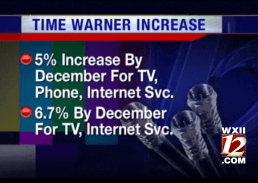
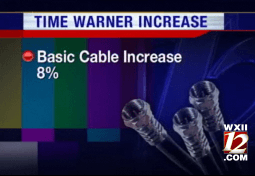
Time Warner Cable customers in North Carolina are getting rate hike letters from the cable company that foreshadows what other Time Warner Cable customers around the country can expect in the coming months.
For residents in Charlotte and the Triad region, Time Warner is boosting prices for unbundled customers an average of six percent, which will impact customers not on promotional plans or who are not locked into a “price protection agreement.”
The rate increases particularly target standalone service customers. Those with the fewest services will pay the biggest increases. Those who subscribe to cable, phone, and broadband service from the company will suffer the least.
A Time Warner Cable spokesman claimed the company is just passing on the cost of programming.
WXII-TV in Greensboro reported that for many customers already struggling with their bills, they don’t want to hear anything about a price hike.
“I think it’s ridiculous at this time with the economy — it’s hard to make it as it is,” one customer told the station.
“I wish there was a better option out there, but it’s about the only thing you can get,” said another viewer.
Time Warner has been developing pricing models that increasingly push customers towards bundled packages of services. Standalone broadband service saw dramatic price increases in many areas in 2010, and the company’s most aggressive new customer promotions encourage customers to take all three of its services.
But broadband customers need not expose themselves to inflated broadband prices for standalone service. Most Time Warner Cable franchises offer Earthlink broadband at comparable speeds at prices as low as $29.95 per month for the first six months. When the promotion expires, customers can switch back to Road Runner at Time Warner’s promotional price.
Time Warner does face competition in some areas of North Carolina from AT&T U-verse, which offers attractive promotional pricing for new customers. But the phone company’s broadband speeds come up short after Time Warner boosted speeds across much of the state. The cable company now delivers Road Runner at speeds of up to 50/5Mbps. AT&T tops out at 24Mbps, and not in every area.
When a competitor can’t deliver the fastest speeds, they inevitably claim consumers don’t want or care about super-fast broadband.
“We are focused on offering the broadband speeds that our customers need, at a price that they can afford,” said AT&T spokeswoman Gretchen Schultz.
Greenlight promotes its local connection to Wilson residents
Some North Carolina consumers are watching AT&T’s slower speeds and Time Warner’s price hikes from the sidelines, because they are signed up with municipal competitors.
Residents in Wilson with Greenlight service from the city don’t have to sign a contract to get the best prices and obtain service run and maintained by Wilson-area employees. The provider has embarked on a campaign to remind residents that money spent on the city-owned provider stays in the city.
In Salisbury, Fibrant is making headway against incumbent Time Warner as it works through a waiting list for customers anxious to cut Time Warner’s cable for good. Fibrant customers are assured they’ll always get the fastest possible service in town on a network capable of delivering up to 1Gbps to businesses -and- residents.
MI-Connection, the rebuilt former Adelphia cable system now owned by a group of local municipalities is managing to keep up with Time Warner with its own top broadband speeds of 20/2Mbps. The system is comparable to a traditional cable operator and does not provide fiber to the home service. Its 15,000 customers in Mooresville, Cornelius and Davidson are likely to stay with the system, but it is vulnerable to Time Warner’s bragging rights made possible from DOCSIS 3 upgrades. Since Time Warner does not provide service in most of MI-Connection’s service area, city officials don’t face an exodus of departing customers.
But that could eventually change. Some MI-Connection customers have reported to Stop the Cap! they have begun to receive promotional literature from Time Warner Cable for the first time, and there are growing questions whether the cable company may plan to invade some of MI-Connection’s more affluent service areas. Cable companies generally refuse to compete with each other, but all bets are off when that cable company is owned by a local municipality.
For most North Carolina residents, AT&T will likely be the first wired competitor, with its U-verse system. To date, U-verse has drawn mixed reviews from North Carolina consumers. Many appreciate AT&T’s broadband network is currently less congested than Road Runner, and speeds promised are closer to reality on U-verse compared with Road Runner during the early evening. But some AT&T customers are not thrilled being nickle-and-dimed for HD channels Time Warner bundles with its digital cable service at no additional charge. And for households with a lot of users, AT&T can run short on bandwidth.
“We have five kids — three now teenagers, and between my husband’s Internet usage and me recording a whole bunch of shows to watch later, we have run into messages on U-verse telling us we are trying to do too much and certain TV sets won’t work until we reduce our usage,” writes Angela. “AT&T doesn’t tell you that you all share a preset amount of bandwidth which gets divided up and if you use it up, services stop working.”
Angela says when she called AT&T, the company gave her a $15 credit for her inconvenience, and the company claims it is working on ways to eliminate these limits in particularly active households. For now, the family is sticking with U-verse because the broadband works better in the evenings and she loves the DVR which records more shows at once than Time Warner offers. Their U-verse new customer promotional offer saves them $35 a month over Time Warner, at least until it expires.
“From reading about Fibrant and Greenlight on your site, my husband still wishes we lived in Salisbury or Wilson because nothing beats fiber, but at least what we have is better than what we used to have,” she adds.
Although the cable trade press reports it is business as usual at most of the nation’s largest cable companies, news that several companies are losing more cable-TV subscribers than they are adding is creating concern in boardrooms and on Wall Street. Although the power of the perennial “rate increase” has kept revenues up, cable operators like Time Warner Cable are beginning to realize they can’t just keep raising rates expecting customers to sit still for it.
For more than 30 years, cable operators have assumed (correctly) that raising rates far in excess of inflation will bring about a lot of grumbling from upset subscribers, but few will actually resort to cutting the cord and going back to free TV (or books). But as many cable households now routinely pay “triple-play” bills well in excess of $200 a month, that is finally starting to change:
For many households, the switch to digital TV and an increasing number of sub-channels has proved adequate to meet the needs of many viewers, so long as they receive a decent picture and at least a handful of digital sub-channels;
Online access to at least some cable programming, movies, and television shows on-demand has solved the problem of having too few viewing options. If nothing of interest is running on local channels, a quick visit to Netflix or Hulu can satisfy most viewers;
Many increasingly prefer spending their free time online instead of parked in front of the television;
The realities of the current economy and tightened middle class budgets make many cable packages simply unaffordable, even if customers wanted them.
Time Warner Cable has recognized the growing strain on their video side of the business and has initiated some strong marketing efforts to hold onto customers who are one rate increase away from canceling.
This fall, the cable company unveiled its $33 per service promotion, charging that price for each component of their triple-play package for a year. While Time Warner has more aggressively priced individual services in the past for new customers, this one is unique because it is open to existing customers as well. Customers speaking to Time Warner’s retention agents are being offered this package in an effort to keep customers hooked up to the company’s video, broadband, and phone services. Currently, many markets also include a free year of Showtime or at least six months of DVR service, and a year of Road Runner Turbo. In highly competitive markets, informal promotions can bring even lower prices or extra add-ons.
A few weeks ago, the cable company unveiled online video streaming of ESPN Networks for existing cable subscribers, and an online remote DVR-programming application that lets subscribers set up recordings while away from home.
Now the company is further bolstering its video packages:
As part of its long term agreement with Disney, ABC and ESPN, this week Time Warner Cable added over 300 hours of new On Demand programming content from ABC, Disney and ESPN. In addition, the company will launch Primetime HD On Demand tomorrow, which will also be available to Digital Cable customers at no additional cost. The new channel Primetime HD On Demand will carry primetime programming from ABC, NBC and CBS in High Definition. Subscribers will have over 100 hours of the networks’ popular primetime programs including NBC’s 30 Rock and The Office; ABC’s Grey’s Anatomy and Desperate Housewives; and CBS’ Medium and CSI.
Time Warner Cable Look Back will bolster the existing “Start Over” feature by archiving up to three days of programming on more than two dozen different networks and cable channels. Now, if you missed a favorite show that aired the evening before, you can watch it on demand. As with “Start Over,” Time Warner has disabled fast-forwarding, so no zipping through commercials is allowed. But the service comes free of charge, and includes an impressive lineup of participating networks including ABC, NBC, Fox Cable Networks, Discovery Networks, and Scripps’ Food Network, Cooking Channel, HGTV, and DIY.
HBO Max and Go Max, part of TV Everywhere, will reach more than 50 million Time Warner Cable customers by the end of the month. These services deliver online on-demand access to movies, series, and specials airing on HBO and Cinemax and will be available to customers paying for the premium channels at no additional charge. More than 70 million customers will have access by the second quarter of 2011.
Time Warner Cable CEO Glenn Britt told investors on a conference call held last week that the cable company is aggressively pursuing renewal agreements with programmers that allow the cable company to begin offering smaller, budget priced packages of cable-TV programming. While it won’t be the a-la-carte option many consumers crave, cable programming packages could begin to resemble what home satellite dish customers used to receive — a core package of two dozen channels with theme or network-based add-on “programming packs” for additional fees. For example, customers looking for reality or educational programming might buy a “Home and Garden” package consisting of Food TV, HGTV, The Weather Channel, Discovery and The Learning Channel. Movie fans might get a package of Encore, AMC, Turner Classic Movies, Fox Movies and MGM. “We have negotiated some additional flexibility beyond what we had a few years ago that will allow us to begin to offer some smaller packages at lower prices. Probably not all the way where we’d like to be. But we’re moving in the right direction,” Britt told investors.
The cable company’s friendly former owner — Time Warner, Inc., has also helped man the barricades against cable’s competitors. For Netflix and Redbox customers: longer waiting times for access to the latest Time Warner movies are likely. The current delay of 28 days could be extended, according to CEO Jeff Bewkes.
“So far the 28-day window has clearly been a success versus no delay,” Bewkes told investors. “The question of whether we ought to go longer is very much under scrutiny. It may well be a good idea.”
Even local movie theaters face some potential competition, as Time Warner considers introducing a premium pay-per-view option that would allow cable customers to watch movies currently in theaters at home. But they’ll pay a heavy price to watch — reportedly between $30-50 per title, and the cable operator will insert anti-recording technology into the signal to prevent digital recordings.
Will these new services ultimately stop the bleeding from departing cable customers? For most it’s a matter of dollars and sense.
The media has gotten aggressive about talking to viewers about how they can get rid of their cable-TV subscription and save plenty. (10 minutes)
Thomas Clancy Jr., 35, in Long Beach, N.Y., canceled the family’s Cablevision subscription this spring. He said he has been happy with Netflix and other Internet video services since then, even though there isn’t a lot of live sports to be had online.
“The amount of sports that I watched certainly didn’t justify a hundred-dollar-a-month expense for all this stuff. I mean, that’s twelve hundred dollars a year,” Clancy told the Associated Press. “Twelve hundred dollars is … near a vacation.”
Customers like Clancy are comfortable with technology and well-versed on how to hook up Internet video and integrate it with the family’s TV sets. For customers like him, online video will increasingly be an attractive alternative to high cable TV bills.
For some western New Yorkers, Wegmans' Redbox kiosk is their new "cable company."
For homes with less tech-savvy subscribers who have watched their wages fall over the past decade even as cable rates keep increasing, economic realities driven home by the Great Recession are making the decision for them.
“The price of cable TV has risen to the point where it’s simply not affordable to lots of lower-income homes. And right now there are an awful lot of lower-income homes,” Craig Moffett, a Wall Street analyst who favors the cable industry said. “The evidence suggests that what we’re seeing is a poverty problem rather than a technology phenomenon.”
For these customers, including many in the middle class, each time cable companies like Time Warner increase cable rates, they drop a service or two.
“First it was Showtime, the Movie Channel, and Starz!,” writes Stop the Cap! reader Joanne in Penfield, N.Y., a suburb of Rochester. “Then when they raised the rates again on the premium channels, we dropped them all — bye bye HBO and Cinemax.”
“When Time Warner sends us their rate increase notice right after Christmas as they’ve done for years, we’re dropping digital cable and returning our cable boxes,” she writes. “If they keep it up, we’ll drop cable altogether — something we might have done earlier if we had some competition around here.”
“I don’t care how much they claim it’s a ‘great value,'” Joanne says. “My husband got laid off from his job at Xerox in 2009 and was just let go from his new job at Carestream. I already work myself and we have three kids, and our health insurance premiums are skyrocketing at the end of the year. We haven’t had a real raise in five years, so that made the decision for us.”
Joanne now rents movies from Redbox just inside the local Wegmans grocery store and has a $9 monthly subscription with Netflix, mostly for online streaming.
“It’s more than made up for the $40+ a month we used to spend on premium channels with Time Warner,” she said.
[flv width=”640″ height=”500″]http://www.phillipdampier.com/video/WISN Milwaukee Time Warner Cable Offers Start Over For WISN 12 ABC Programs 11-9-10.flv[/flv]
WISN-TV in Milwaukee introduces viewers to Time Warner Cable’s newest on-demand features. (1 minute)
Fibrant ruins Time Warner Cable's Speed Party by delivering faster service at a lower price, without the cable company's rate increase notice sitting in Charlotte-area mailboxes.
Residents of Salisbury, N.C. are going to get some of the state’s fastest broadband speeds as the community-owned broadband provider prepares to introduce 200/200Mbps service, leaving Time Warner Cable’s Road Runner service behind in the dust.
Time Warner Cable enjoyed a few moments in the spotlight last week announcing free speed upgrades for the Charlotte region, which includes Salisbury. But Fibrant’s fiber to the home network is well-equipped to turn Time Warner’s temporary speed advantage on its head.
Last week, the cable operator promoted the introduction of its new maximum speed 50/5Mbps Road Runner Wideband service, which carries a monthly price of $99.95.
But Salisbury city officials were unimpressed, claiming Fibrant already offers 50/50Mbps service — they just haven’t advertised it.
Assistant City Manager Doug Paris said Fibrant’s top available speed is 10 times faster than the cable giant’s when uploading.
“We’re cheaper, and we’re faster,” Paris told the Salisbury Post. Fibrant sells the 50Mbps service for $85 a month, about 15 dollars less than Time Warner Cable’s slower Wideband service.
City officials also weren’t surprised that Time Warner announced faster Internet speeds the day after Fibrant launched.
“We’ve seen this in every other city that has invested in fiber optics,” he said. “They are trying to match our speeds, but they can’t.”
The Salisbury Post needs a few cans for its message boards, filled with anonymous lunacy.
Time Warner Cable claimed its new speeds were not in response to Fibrant but were part of a service upgrade for the entire Charlotte area, a claim every cable company makes in response to new competition on their doorstep.
Fibrant’s upstream streams are dramatically better than those offered by Time Warner Cable, which uses an inferior network architecture not currently capable of delivering the same upstream and downstream speeds to consumers. Cable broadband networks are constructed with the assumption most users will download far more than they upload, so the networks emphasize downstream speeds. Time Warner Cable has dramatically increased those download speeds, but has been forced so far to limit uploads to just 5Mbps.
Fiber to the home networks like Fibrant do not suffer those limitations, and the city plans to exploit that in their marketing.
Fibrant has the capacity to provide up to 1 gigabit per second upload and download, Paris said. Forthcoming are plans offering 100/100 and 200/200Mbps service, with prices yet to be determined.
Fibrant continues to have a waiting list of several hundred area residents waiting for service, but you wouldn’t know it from the raucous anonymous postings on the Post’s website. Virtually all of the anonymous comments about Fibrant have been negative and wildly uninformed, to the point of hilarity. From a Korean War veteran talking about eating blueberries and living life in the Windstream DSL slow lane (and loving it) to comments proclaiming fiber optics as woefully slower than WiMax, the Internet trolls have managed to prove why an increasing number of newspapers have learned to adopt “real names-only” posting policies or have just turned the comment section off altogether.
For those fans of Time Warner Cable, the price of that love is about to go up.
Time Warner is mailing notices to Charlotte area customers announcing broadband rate hikes for some customers this December. Time Warner customers who bundle their services or are on price protection promotions will be exempted from the rate increases… for now.
Frontier Communications is continuing to suffer service outages and problems across many of their respective service areas. Some of the most serious continue in West Virginia, especially in the northern panhandle region where emergency response agencies continue to complain about sub-standard service from the phone company that took over Verizon phone lines this past summer.
Hancock County officials report their T1 line that connects emergency dispatchers with the county’s dispatch radio system was out of service again early Wednesday evening. This Frontier-owned and maintained circuit has suffered repeated outages over the past year, and the latest outage comes after company officials promised to inspect the 12,000 foot line inch-by-inch. Once again, the county’s emergency agency is relying on help from nearby counties and a backup radio system to communicate with at least some of the area’s police and fire departments.
Outages of 911 service are not just limited to West Virginia. Illinois Valley (Oregon) Fire District Chief Harry Rich was forced to rely on amateur radio operators and extra staffing in county firehouses to cope with a 911 system failure caused by Frontier service problems in late September. Rich called a public meeting in late October with Cave Junction Mayor Don Moore, Josephine County Sheriff Gil Gilbertson and Josephine County Commissioner Dave Toler to discuss the implications of Frontier’s outage and what steps the region needs to take to mitigate future outages.
In Greencastle, Indiana a Frontier phone outage disrupted service for DePauw University and the Putnam County Hospital Oct. 20. In Meshoppen, Pennsylvania an outage caused by a downtown fire on Oct. 24 left 1,200 homes in the community without telephone service for most of the day. Frontier has also suffered periodic copper wire thefts, particularly in the Appalachian region where illicit sales of copper can bring quick cash for those addicted to drugs. In Eastern Kanawha County, West Virginia, some 100 customers lost service for at least a day after thieves yanked phone cables right off the poles.
Sandman
In Minster, Ohio village officials have hired a law firm to sue Frontier Communications over a wiring dispute. Village officials accuse Frontier of being intransigent over the removal of telephone lines from poles to bury them underground. Village Solicitor Jim Hearn told the local newspaper utility companies should be responsible for the costs of installing underground wiring.
In Wenatchee, a community in north-central Washington state, Frontier’s general manager is going all out to try and assuage customers Frontier will provide better service than Verizon. Steve Sandman went as far as to hand out his direct number to the local media, inviting residents with service problems to call. It’s (509) 662-9242.
Sandman promises other changes for his customers, according toThe Wenatchee World:
Sandman said all Frontier technicians will be fully trained in the installation of phones, internet and TV. No more modems sent through the mail for the customer to install by themselves, he said.
“We’ll be there on the premises for complete installation,” he said. “And, if the customer needs it, we’ll provide some fundamental training on how to turn on the computer, hook up to the internet and get started using online services. Or give advice on how to use the TV remote.”
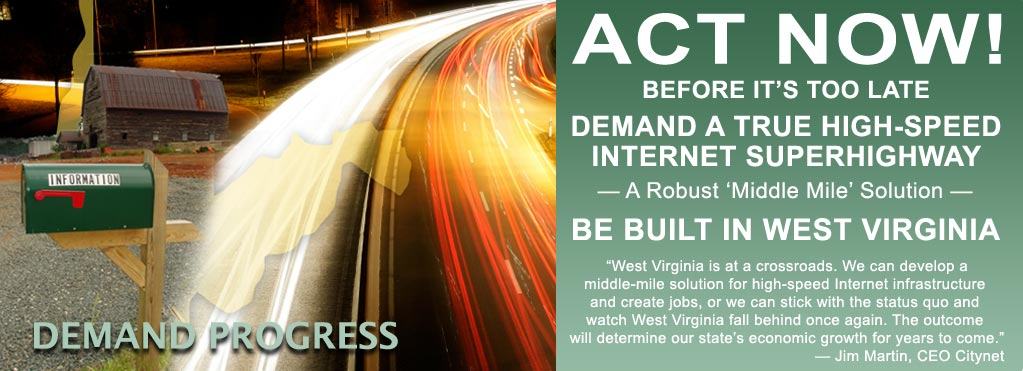
But all of these issues pale in comparison to the all-out battle forming in the state of West Virginia over broadband stimulus money awarded to help Frontier extend fiber broadband service to local government and community institutions. One of their biggest competitors, Citynet, has launched a well-coordinated attack on what it calls “a flawed plan that does nothing to provide faster Internet speeds or lower the majority of Internet costs for West Virginians.”
Frontier will spend $40 million of federal broadband stimulus money on a network that will deliver fiber-fast speeds only to government, educational, and health care institutions.
Martin
James Martin II, president and CEO of Citynet argues Frontier is building a state of the art fiber network very few West Virginians will ever get to use, from which it will profit handsomely delivering service to government entities with which it already has contracts. For the rest of West Virginian homes and businesses, Frontier will deliver outdated DSL service delivering an average of 3Mbps service at a time when adjacent states are enjoying service 2-4 times faster.
Citynet argues funding would be better spent on a middle mile, open fiber backbone available for use by all-comers. Martin notes West Virginia is one of the few states in the northeast and mid-Atlantic region almost completely bypassed by the core Internet backbone. The only exception is a fiber link connecting Pittsburgh with Columbus, Ohio, which briefly traverses the northern panhandle of West Virginia. Citynet’s perspective is that West Virginia cannot improve its poor broadband standing — 48th in the nation, unless it has appropriate infrastructure to tap into for service.
As an example, Martin points to the community of Philippi, served by fiber to the home cable TV and broadband service. The community’s fiber network is capable of Lamborghini speeds between homes within Philippi. But the community can only afford a single 45 megabit DS-3 connection to the outside world, provided by Citynet for just under $8,000 a month. That line is shared among every broadband customer in Philippi trying to get out onto the Internet. The result is that Philippi residents can only buy a broadband account with speeds up to 2Mbps for $60 a month on that all-fiber network. That’s equivalent to being forced to drive that Lamborghini on a dirt road.
Martin says if the broadband stimulus money was spent on constructing a statewide open fiber backbone, they could sell the community a 1Gbps pipeline for around $3,000 a month.
Philippi's fiber optic broadband is not so fast, thanks to a bottleneck between the community and the rest of the Internet
“West Virginia is at a crossroads,” Martin said in a prepared statement. “We can build a ‘middle-mile’ solution for high-speed Internet infrastructure and create jobs, or we can stick with the status quo and watch West Virginia fall behind once again. The outcome will determine our state’s economic growth for years to come.”
The state, according to Martin, is reneging on its promise to build a broadband network that will deliver improved service to institutional users as well as at least 700,000 homes and 110,000 business in the state.
Instead, the project would only serve 1,000 “points of interest,” he said. The state’s plan would limit Internet speeds and make broadband service unaffordable, Martin argues.
“If the state were to build a true middle-mile solution, then businesses and residential Internet customers would see a significant reduction in price, as well as an increase in quality, capacity and speed,” Martin said. “Regretfully, the state chose to support a plan that relies on outdated telephone lines and a monopoly.”
Of course, Citynet does have a vested interest in the outcome of the project. As a provider specializing in selling bulk broadband lines, they would be a prime beneficiary of a government-backed middle-mile broadband network. Citynet’s argument that funding should be spent primarily on that network ignores the reality few new entrants are likely to enter West Virginia’s rural broadband market, with or without the benefit of a robust broadband backbone. One of the biggest flaws of broadband stimulus spending is that much of the money will never directly provide “last mile” access to individual consumers and businesses that want broadband service where none is available.
Citynet needs to acknowledge much of West Virginia’s broadband is going to come from the phone company or a local municipality that elects to build its own network. While cable companies deliver service in larger cities and suburban areas, large swaths of the state will never be wired for cable. In fact, West Virginia is poorly covered even by wireless companies who see little benefit building extensive cell tower networks in the notoriously mountainous areas of the state that serve few residents. The only existing rural telecommunications infrastructure universally available is copper telephone wires. Like it or not, Frontier Communications will be the biggest provider of broadband in rural West Virginia. A fiber backbone network alone delivers minor benefits to those residents who either cannot connect at any broadband speed, or are stuck with Frontier’s current 1-3Mbps DSL service.
Still, Citynet’s campaign is a useful reminder that too many broadband stimulus projects direct most of their money to networks ordinary consumers and businesses will never access. And so long as local governments, schools, and hospitals “get theirs,” they have little interest in fighting to share those networks with consumers and for-profit businesses.
Citynet produced two radio ads criticizing West Virginia’s allocation of broadband stimulus money, and Jim Martin appeared on a local radio show to explain to West Virginia why this issue matters. (Ads from 11/2010 — Interview with Jim Martin: September 16, 2010) (18 minutes)
You must remain on this page to hear the clip, or you can download the clip and listen later.
<
p style=”text-align: center;”>
Ultimately, Verizon may get the last word, even after they abandoned the state’s landline customers. Charleston, the state capital, has been selected as one of the early communities to receive Verizon Wireless’ new 4G LTE wireless broadband network, according to WTRF-TV:
Verizon subscribers in Charleston with devices that are 4G compatible will see changes within the next six to seven weeks. The whole city is expected to be covered by the network by mid-2011, according to company officials. From there, it will be expanded to cover Huntington, Parkersburg, Wheeling, Weirton, Beckley, Clarksburg, Morgantown, Fairmont and Martinsburg by 2013.
The company also plans to expand coverage along the entire Interstate 79 corridor from Charleston to Clarksburg.
The decision to include Charleston among the 39 metropolitan areas where Verizon would deploy its 4G network left many analysts of the industry scratching their heads, although they noted in online posts that Rockefeller chairs the Senate committee that regulates the telecommunications industry.
Should West Virginians find Verizon Wireless a suitable replacement for their landlines, Frontier may have bought themselves a pig in the poke.
[flv width=”640″ height=”500″]http://www.phillipdampier.com/video/West Virginia Frontier 11-4-10.flv[/flv]
WTOV-TV covers the emergency services outage in northwestern West Virginia in two reports, WBOY-TV covers the Citynet-Frontier controversy, and WTRF-TV covers the arrival of Verizon’s LTE upgrade, starting with Charleston. (7 minutes)
Be Sure to Read Part One: Astroturf Overload — Broadband for America = One Giant Industry Front Group for an important introduction to what this super-sized industry front group is all about. Members of Broadband for America Red: A company or group actively engaging in anti-consumer lobbying, opposes Net Neutrality, supports Internet Overcharging, belongs to […]
Astroturf: One of the underhanded tactics increasingly being used by telecom companies is “Astroturf lobbying” – creating front groups that try to mimic true grassroots, but that are all about corporate money, not citizen power. Astroturf lobbying is hardly a new approach. Senator Lloyd Bentsen is credited with coining the term in the 1980s to […]
Hong Kong remains bullish on broadband. Despite the economic downturn, City Telecom continues to invest millions in constructing one of Hong Kong’s largest fiber optic broadband networks, providing fiber to the home connections to residents. City Telecom’s HK Broadband service relies on an all-fiber optic network, and has been dubbed “the Verizon FiOS of Hong […]
BendBroadband, a small provider serving central Oregon, breathlessly announced the imminent launch of new higher speed broadband service for its customers after completing an upgrade to DOCSIS 3. Along with the launch announcement came a new logo of a sprinting dog the company attaches its new tagline to: “We’re the local dog. We better be […]
Stop the Cap! reader Rick has been educating me about some of the new-found aggression by Shaw Communications, one of western Canada’s largest telecommunications companies, in expanding its business reach across Canada. Woe to those who get in the way. Novus Entertainment is already familiar with this story. As Stop the Cap! reported previously, Shaw […]
The Canadian Radio-television Telecommunications Commission, the Canadian equivalent of the Federal Communications Commission in Washington, may be forced to consider American broadband policy before defining Net Neutrality and its role in Canadian broadband, according to an article published today in The Globe & Mail. [FCC Chairman Julius Genachowski’s] proposal – to codify and enforce some […]
In March 2000, two cable magnates sat down for the cable industry equivalent of My Dinner With Andre. Fine wine, beautiful table linens, an exquisite meal, and a Monopoly board with pieces swapped back and forth representing hundreds of thousands of Canadian consumers. Ted Rogers and Jim Shaw drew a line on the western Ontario […]
Just like FairPoint Communications, the Towering Inferno of phone companies haunting New England, Frontier Communications is making a whole lot of promises to state regulators and consumers, if they’ll only support the deal to transfer ownership of phone service from Verizon to them. This time, Frontier is issuing a self-serving press release touting their investment […]
I see it took all of five minutes for George Ou and his friends at Digital Society to be swayed by the tunnel vision myopia of last week’s latest effort to justify Internet Overcharging schemes. Until recently, I’ve always rationalized my distain for smaller usage caps by ignoring the fact that I’m being subsidized by […]
In 2007, we took our first major trip away from western New York in 20 years and spent two weeks an hour away from Calgary, Alberta. After two weeks in Kananaskis Country, Banff, Calgary, and other spots all over southern Alberta, we came away with the Good, the Bad, and the Ugly: The Good Alberta […]
A federal appeals court in Washington has struck down, for a second time, a rulemaking by the Federal Communications Commission to limit the size of the nation’s largest cable operators to 30% of the nation’s pay television marketplace, calling the rule “arbitrary and capricious.” The 30% rule, designed to keep no single company from controlling […]
Less than half of Americans surveyed by PC Magazine report they are very satisfied with the broadband speed delivered by their Internet service provider. PC Magazine released a comprehensive study this month on speed, provider satisfaction, and consumer opinions about the state of broadband in their community. The publisher sampled more than 17,000 participants, checking […]


 Subscribe