Home » Competition » Recent Articles:

Glenn Britt’s Fireside Chat: Time Warner Cable Wants to “Remain Focused on the Customer” in 2011

Phillip Dampier December 6, 2010 Competition, Consumer News, Data Caps, Online Video, Video 2 Comments

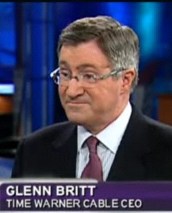
Glenn Britt, Time Warner Cable’s CEO, says the cable company’s biggest challenge in 2011 is remaining “completely focused on the customer.”

Britt told Michael Grebb, writing for CableFAX, that America’s second largest cable company cannot succeed if it dictates terms to customers.

“We have to deliver a differentiated customer experience that’s linked to our brand—a brand that says ‘we give you more control in ways that are simple and easy for you, the customer,'” Britt said. “We’ve heard loud and clear from customers that they want flexibility in packaging, including the ability to buy smaller packages. We’re working hard to deliver what they’re asking for.”

Britt is referring to Time Warner’s new pared-down cable-TV tier, TV Essentials.  Currently undergoing a market trial in northeast Ohio and New York City, it deletes more expensive basic cable networks from the cable package to provide a discounted, smaller lineup to customers.

Britt’s remarks come more than a year after the cable company experimented with an Internet Overcharging scheme that would have restricted consumers’ use of Road Runner unless they were willing to pay triple the price — $150 a month — for unlimited use.  The company shelved the test after an outpouring of customer complaints and threatened congressional action.

Britt’s remarks would seem to indicate Time Warner is not going to antagonize its customers in the coming year, especially considering the economic challenges many face.  Time Warner lost more than 100,000 subscribers in the last quarter alone.

“Even if we weren’t in a bad economy, we’d still want to deliver customized products and experiences to specific customer segments, which is smart business in any environment,” Britt said. “And it just so happens our lower [revenue] customer segments are most affected by the economy and are the same customers who are really shouting about smaller packages. With respect to ‘higher-end fare,’ I would add that, even with the tough economy, we’re still seeing good demand from higher [revenue] customer segments.”

Britt added Time Warner plans to be more aggressive about its own TV Everywhere project in the coming year.  TV Everywhere delivers on-demand programming online for “authenticated” customers who also subscribe to a corresponding cable-TV package.  No cable-TV package means no access to that programming online.

“Our firm belief is that consumers want access to any content, anywhere, any time and from any device,” Britt said.

Britt signaled the cable company feels on-demand is only part of the online video equation.  Portability — the ability to access content on-the-go, is also a very high priority for Time Warner.  Britt encouraged cable programmers to get on board and participate in the TV Everywhere project to help grow awareness of the service for existing cable-TV subscribers.

Britt also telegraphed the company was moderating its tone over retransmission consent agreement battles with cable networks and broadcasters.  While previous statements from the cable operator indicated the company was prepared to “get tough” with programmers seeking dramatic price increases, Britt’s latest comments suggest the company recognized consumers do not want to be put in the middle of the disputes and the company was taking the matter to Washington lawmakers to adjudicate instead.

Time Warner faces a major showdown with Sinclair Broadcasting, owner of several network affiliate stations, which will come to a head on New Year’s Eve.

“We will continue to work hard to reach fair agreements, but we believe existing retransmission consent rules – set by the government almost 20 years ago – have not kept up with a changing marketplace,” Britt noted. “The rules are outdated, and they’re in urgent need of reform in order to avoid more public battles.”

[flv width=”640″ height=”500″]http://www.phillipdampier.com/video/Bloomberg Britt Calls for Cable Content Dispute Resolution Process 11-23-10.flv[/flv]

Time Warner Cable CEO Glenn Britt told Bloomberg News the company wants to reform the retransmission consent dispute process.  (3 minutes)

Australia Continues March to Abolish Usage Caps As Terabyte Usage Allowances Debut

Phillip Dampier December 6, 2010 Competition, Data Caps, Optus (Australia), Video 2 Comments

While some American broadband providers continue to dream of Internet Overcharging schemes for American customers, one of the world’s most usage-capped countries continues its march forward to abolish them.  Australia’s Optus, a major broadband provider, today announced it was dramatically increasing usage allowances on customers, effective immediately.

The Fusion 99 plan, which bundles telephone and broadband service, sees its data allowance increased from just 15GB of usage per month to 500GB (twice that of American cable giant Comcast).  Ditto for the Fusion 109 plan, which originally doubled the 15GB limit to 30.  Now it offers a 500GB allowance of usage.

If 500GB isn’t enough, Optus has announced its Fusion 129 plan includes 1000GB — a terabyte — of usage per month, which includes unlimited long distance calling and calls to Australia’s mobile phone customers (most countries outside of North America require the calling party to pay mobile rates when calling a mobile customer).  Even customers on Optus’ budget-minded standard and “naked” (standalone) broadband plans will benefit from new 500GB allowances.  Those who manage to exceed their allowance will find broadband speeds reduced to 250kbps until the end of the billing cycle.

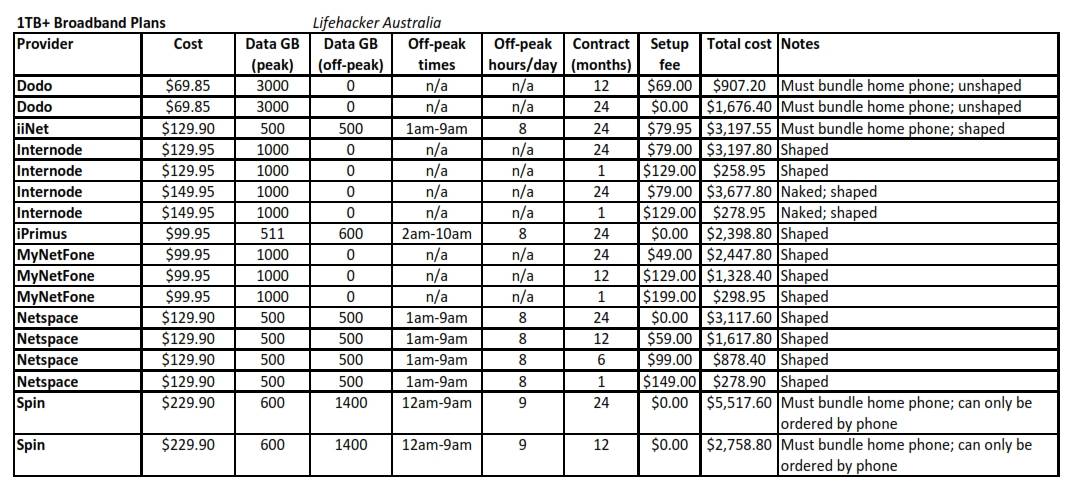
Some Australian ISP’s take all limits off during off-peak usage hours.  The country has traditionally suffered from usage caps because of international undersea cable capacity problems which restrict how much traffic can be sent and received between the South Pacific and North America and Europe.  Increased undersea fiber capacity is tempering those traffic restrictions, and momentum towards unlimited use plans (or those with ridiculously high allowances) is the result.

Lifehacker produced a broadband plan breakdown showing the dramatically increasing usage allowances for Australian broadband customers. Traffic shaping continues to be an issue, however. Such speed control measures traditionally target peer-to-peer traffic. Total cost is the total price of the service over the length of the term contract. This chart represents high end plans, typically offering the highest speed tiers. All dollar amounts are in Australian dollars.

[flv]http://www.phillipdampier.com/video/ABC The Gruen Transfer Telco Ads 11-2010.flv[/flv]

The Australian Broadcasting Corporation’s ‘The Gruen Transfer’ takes a humorous look at how phone companies Down Under advertise their services, including a reference about how “capped” services represent revenue gold to service providers.  (15 minutes)

Comcast Bans Twin Cities Wi-Fi Upstart’s Ads After Pointing Out Comcast CEO’s Salary on Billboards

USI Wireless' TV Ad was rejected by Comcast

“Our competitor’s CEO made $27 million last year. Ever wonder why you pay so much for Internet?”

That question is posed on an enormous billboard over downtown Minneapolis.  It comes courtesy of US Internet of Minnetonka, a tiny wireless provider competing against Comcast in Minneapolis.  The Wi-Fi upstart has taken center stage in another dispute with Comcast that threatens to have national implications.

For US Internet, the cable giant is already big enough to throw its weight around, because the Wi-Fi competitor has been notified it is not going to get its television ads seen by Comcast subscribers.

That struck Joe Caldwell, CEO of USI Wireless, as anti-competitive.

“I spent thousands of dollars to get this ad produced, and now Comcast won’t run it,” Caldwell told the Minneapolis Star-Tribune. “I think maybe they’re mad at me because I said the CEO of Comcast made too much money.”

Although Caldwell’s billboard only names Comcast in fine print, barely visible from Minneapolis streets, his company’s door-hangers are more direct:

“We at USI Wireless would like to congratulate Qwest & Comcast for both having sports arenas named after them. Ever wonder why you pay so much for Internet?”

Comcast told Caldwell it could not run his ads because they are a competitor.

USI Wireless charges $14.95 a month for wireless access across the city.  Comcast charges between $40-115 for its standalone broadband service.

It’s not the first ad controversy for USI, which irritated some residents back in May with some edgy billboards featuring a woman some described as a prostitute next to big, bold print: “Fast, Cheap, and Satisfaction Guaranteed.”

USI got into some controversy with its earlier billboards, which raised more than a few eyebrows.

Caldwell’s television ad features Fancy Ray McCloney, head of Minneapolis-based ad agency Chocolate Orchid Productions, as its pitchman, loudly asking, “Why pay $30 to $60 a month when you can get the same quality service for as low as $14.95?”

McCloney adds salt to USI’s wounded bank account because, as he tells it, it was Comcast that invited him to produce the ad and get it running on the system.  McCloney claims a Comcast advertising representative contacted him after seeing the billboard and invited USI to buy TV advertising.

“They saw the billboards, and they asked if they could get some of that advertising business on Comcast cable,” McCloney told the Star-Tribune.

After Caldwell spent $7,500 producing the TV ad, Comcast now says it cannot run on their system.

A local Comcast spokesperson told the newspaper he didn’t know if McCloney’s story was true or not.  A national spokesperson for the cable company said Comcast decides on a case-by-case basis whether to take advertising for services that compete with Comcast.

The dispute threatens to have national implications as Comcast pushes to have its merger with NBC-Universal approved.

With ownership of additional broadcast outlets, would-be competitors to Comcast could find themselves banned from advertising on broadcast stations with ties to the cable operator.

[flv width=”640″ height=”380″]http://www.phillipdampier.com/video/USI Wireless Ad.flv[/flv]

USI Wireless’ “banned” TV ad, which makes no mention of Comcast by name, or the current controversy.  (1 minute)

Wealth Has Its Privileges – Time Warner Cable Unveiling $189-199 Package for Ultra-Premium Customers

Phillip Dampier November 29, 2010 Broadband Speed, Competition, Consumer News, Video 1 Comment

If you have nearly $200 a month burning a hole in your pocket that you’d be willing to give Time Warner Cable for a cable-TV, phone and broadband package, have we got a deal for you.

Time Warner Cable is completing a test of its Cadillac cable plan for ultra-premium customers in Charlotte, N.C.  Dubbed “Signature Home,” the plan targets the cable company’s biggest spenders with a deluxe package of cable television, phone, Road Runner Wideband high speed Internet, two premium whole-home DVR units, and a wireless home network.  Customers in Charlotte paid $179.95 a month for the service during the test.  One of the conclusions apparently reached — Time Warner was not charging enough.  As the service goes national, its price will increase by $10 a month for some, $20 for others, topping out just a nickel shy of $200 a month before taxes and fees.

For that price, customers get just about everything Time Warner Cable offers, except premium movie channels:

Personal Customer Service Team, 24/7

  • Convenient priority reservations
  • No-fee installation and customization of up to 13 devices, including TVs, computers, gaming and mobile phones
  • Specially trained Personal Solutions Advisors (PSA) available by phone and online chat

Digital Cable

  • Whole House DVR includes two networked
    HD DVR set-top boxes
  • Storage for up to 150 hours of HD programming
    or 400 hours of Standard Definition programming
  • Record up to 4 HD shows on 2 DVRs at once
  • Remote DVR Manager web-based application
    to program your DVR via PC, Macintosh or any smartphone using the WAP2.0 protocol
  • Look Back® – Travel back three days in time
    on your TV menu and non-recorded TV shows*
  • Start Over® – Restart non-recorded TV shows from the beginning*
  • Digital package with over 180 channels,
    including HD and On Demand

Wideband Internet

  • Features the next generation Internet with the fastest speed available—up to 50 Mbps downloads and 5 Mbps uploads
  • Enables simultaneous downloading and uploading of photos and songs in seconds, movies in minutes
  • Family members can game, watch a movie and surf on various devices, all at the same time
  • Wireless home network with DOCSIS 3.0 modem with 802.11n wireless router included
  • Create up to 30 email addresses
  • Free Internet Security Suite, including Parental Controls and anti-virus software

Digital Home Phone

  • Home voicemail to email
  • Caller ID on PC and TV (requires AOL Instant Messenger)
  • Call forwarding
  • Two distinctive ring patterns—one for friends and family and one for everyone else
  • Unlimited nationwide calling, including Canada and Puerto Rico
  • Arris Touchstone® Telephony Modem
    TM602G/TW-4
  • VoiceZone™ to screen and track calls and
    check voicemail from any PC or Macintosh

Time Warner Cable expects to unveil the service in other areas of the country in a matter of weeks.

CEO Glenn Britt told Bloomberg News the targeted packages of services are designed to retain different classes of customers.

“If this were a BMW this would be the 750 IL, with all the whiz-bang things,” said Britt. “It’s our package with everything we have to offer and a different service experience all wrapped up in one.”

[flv width=”640″ height=”380″]http://www.phillipdampier.com/video/Signature Home Time Warner Cable East.flv[/flv]

Time Warner Cable produced a brief promotional video for Charlotte customers explaining the benefits of its new Signature Home service.  (2 minutes)

Search This Site:

Contributions:

Recent Comments:

Your Account:

Stop the Cap!