
Home » Competition » Recent Articles:

Dish Network Buys Denver-Based Liberty-Bell Phone Company: Start of a New Trend?

Satellite company Dish Network suffers a competitive disadvantage its grounded competition doesn’t — the ability to offer a broadband and phone service package along with a lineup of video channels.

Not anymore.

On Monday, Dish announced its intention to acquire Denver-based Liberty-Bell Telecom, a small telephone company serving 6,000 residential and 4,000 business customers in Colorado, New Mexico and Utah.

The purchase, if approved by the Federal Communications Commission, would give Dish the chance to sell a “triple-play” bundle of telephone, broadband, and satellite-delivered TV channels to Liberty-Bell customers.

Martino

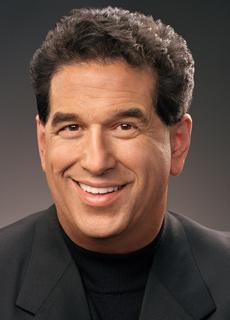
Liberty-Bell was started by a consumer reporter, Tom Martino, currently working for KDVR-TV in Denver and host of the national radio program, The Troubleshooter Show.  The acquisition would deliver a 90 percent stake to Dish.  The phone company has an established reputation for consumer-friendly service, even giving out the personal cell phone number of company owner Nigel Alexander in case customers run into trouble.

The phone company already had an extensive bundling arrangement with Dish, heavily promoting the satellite service as part of its phone and broadband service package.

The move to acquire Liberty-Bell may be Dish’s first foray into developing its own triple-play package to compete with cable and phone companies.  Liberty-Bell delivers service to customers under a wholesale agreement with incumbent provider Qwest and is licensed to provide service to residential and business customers in 10 states.  Theoretically, Liberty-Bell could develop a much larger reach with wholesale agreements with incumbent phone companies around the country, especially with the financial backing by Dish.

That could create opportunities for the satellite company to meet the needs of an increasing number of Americans seeking telecommunications services from a single company.

Dish currently has reseller agreements with other independent phone companies, including Frontier Communications.

Frontier’s Merry Xmas: You Used Too Much Internet, Now Pay $99.99 a Month or Lose It

Phillip Dampier December 13, 2010 Competition, Data Caps, Frontier, Rural Broadband 16 Comments

Frontier Communications is trying to enforce an Internet Overcharging scheme it deleted from its Acceptable Use Policy months earlier, telling customers the company generously extended them an allowance “well above our usual 5GB monthly limit,” but using 100GB per month is “just too much.”

Customers in suburban Sacramento are the latest recipients of letters some are calling “extortion,” giving them seven days to call the company with a promise to cut back or move up to “the next price tier,” priced at $99.99 per month.

Ironically, some of Frontier’s customers receiving the letter say it’s the company’s own fault — they’ve been watching Frontier’s heavily promoted online video website, ‘my fitv.’

“You may not be aware that your specific usage has consistently exceeded 100GB over a 30-day period.  This is excessive for residential usage and more represents the amount of bandwidth usage of a typical business,” the letter says.  “If you wish to maintain your current pricing plan, you may work with us to reduce your Internet usage.  Another option is to move to the next price tier of $99.99 per month, which reflects your current average monthly usage.”

The letter adds if the customer does not make a decision, the company will terminate the account in 20 days.  No word if the customer is on the hook for an early termination fee amounting to more than $100 in most cases.
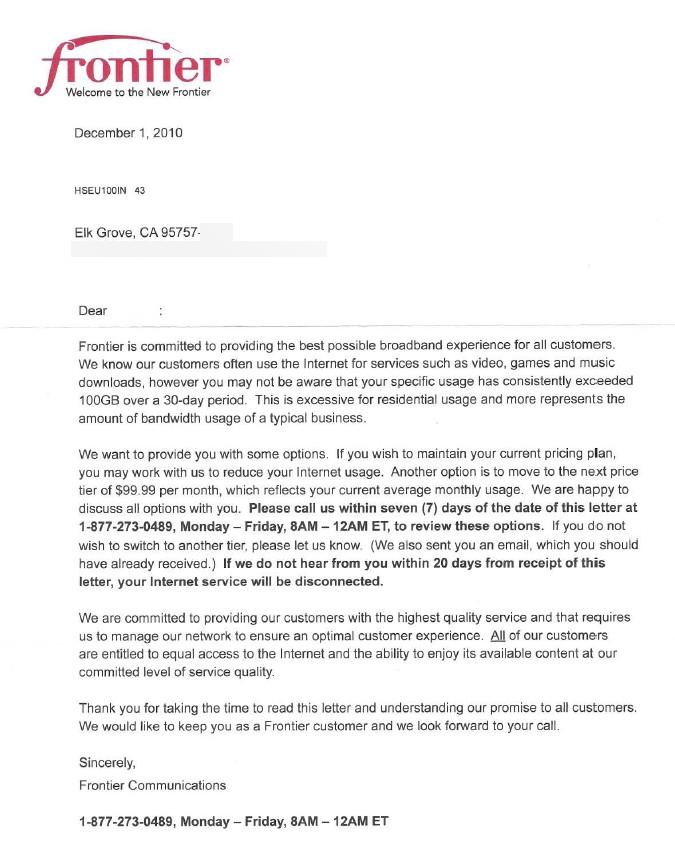
Frontier customers in Elk Grove, Calif., started receiving "you use too much" letters at the beginning of December (click to enlarge)The customer who received the letter, who lives in Elk Grove and wishes to remain anonymous, was highly annoyed.  He sent Stop the Cap! a screenshot of Frontier’s new “Flexnet/Account Editor,” poorly documented on Frontier’s own website, which shows over the last three months, he only broke the invisible 100GB Frontier barrier once, by just 38GB.  For that, Frontier wants to more than double his monthly Internet rate for its DSL service.

The monthly usage limit was news to him… and us… and everyone else.

A well-placed source at Frontier tells Stop the Cap! the company is making the rules up as it goes.

“There is no set plan here — Frontier’s corporate office is testing the waters in different communities to see what kind of response they get,” our source says. “We have been quietly collecting usage statistics on our customers for a year now, and here and there we are chasing those outliers using far above the norm in order to keep our costs as low as possible.”

Our source adds the company wants to keep bad publicity to a minimum, so these kinds of Overcharging schemes are not publicized, and unless customers make a federal case out of it, most will simply reduce usage to avoid the overlimit rates.

“They absolutely do not want a big political stink over this, because it creates headaches and leaves customers with a negative impression about the company and that usually means a disconnect order will follow, usually taking all of their business somewhere else.  That’s why we usually are strictest in places where the customer has nowhere else to go.”

Our reader was perplexed by the letter, the policy, and his options, especially since Frontier does not disclose either a usage limit or a $99.99 plan on their website.

“The [representative] from Frontier told me that the monthly usage limit is 5GB. I told him this is not enough for checking e-mail and surfing the web and reading news.” our reader writes. “He did not answer [when I challenged him about this].”

But no worries, the representative told the Elk Grove customer. If he exceeded 100GB of usage again, he’d automatically be billed the $99.99 rate — no decision needed.

Our reader adds when he signed up, nobody told him about a monthly limit, and there is none disclosed on the website.  Stop the Cap! fought to remove Frontier’s 5GB usage limit from its Acceptable Use Policy for more than a year, finally succeeding earlier this year.  But now it appears Frontier wants to enforce limits anyway, with no disclosure and little recourse for customers who don’t have access to a competing provider.

Before our reader started watching online video, he used about 16GB per month just web browsing, checking e-mail, and downloading the usual software updates.

Didn’t that put him over Frontier’s invisible 5GB cap already?

“The representative told me if I kept it under 50GB a month, I’d be safe,” our reader writes.

So is the usage cap 50 or 100GB per month?
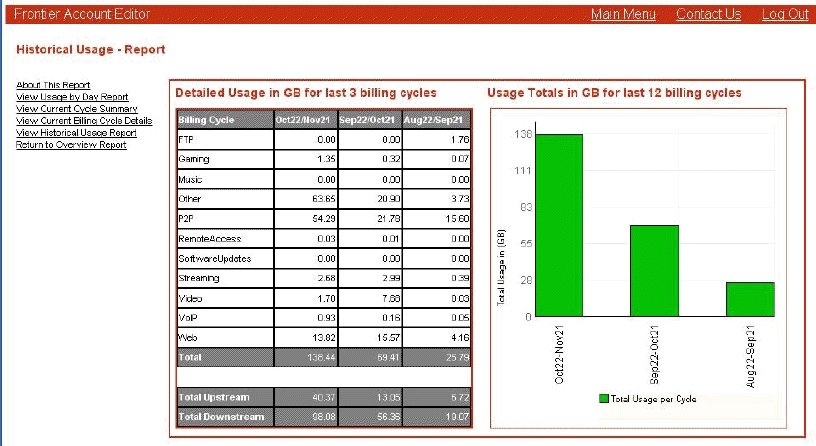
Our customer exceeded Frontier's arbitrary, unpublished usage cap just once in the last three months (click to enlarge)

Stop the Cap! called Frontier customer service three times this morning as a potential new customer.  The responses we received:

  • “There is no usage cap I am aware of.”
  • “We don’t limit your Internet service.”
  • “I don’t understand what you mean when you say limit?  We don’t censor websites.”

Sandy, who also contacted Stop the Cap! also received a letter, and ironically blames Frontier for the usage.

Frontier's own video website was responsible for one customer using "too much" Frontier Internet service.

“I received a warning letter from Frontier for using too much Internet, but get this — all of the growth in my usage came after the company started promoting its new online video website, which my family has fallen in love with,” Sandy writes. “We hooked up a video box on our television, something Frontier helped us with, and we’ve been streaming my fitv a lot.”

“That is extortion plain and simple and is illegal under California state law, especially because the representative told us we’d be charged $99.99 the moment we went over the limit again, and we are on a two-year ‘price protection agreement’ Frontier says locks in our price, which is a lie,” Sandy says.

Her next call was to the California State Attorney General.  Sandy was told the office has already received more than a dozen complaints from Frontier customers in the Sacramento area alleging violations of California contract law.

Jeff, a Broadband Reports reader, also received a letter from Frontier and was told the company was getting plenty of pushback from angry customers.

“The tech guy said they just started metering and have been getting a ton of calls regarding the letters being sent out. He then asked if I got the 100GB or the 250GB letter, as apparently the 250GB warning letters were more severe stating to pay up or get cut off.  The 100GB letter stated they’d work with you to help ease usage or recommended a business plan. They said the “work with you to help with usage” was new and just added if you call within 7 days or else get cut off after 20 days.”

Jeff’s response to all this?

“Comcast is looking better every day now.”

So far, Frontier has not imposed its usage cap on its ex-Verizon FiOS customers.

“Putting a 5, 100, or even 250GB cap on a fiber optic connection would just be plain greed,” says our reader Ajai. “But of course, Frontier needs as much cash as possible to pay out those high dividends to shareholders that often exceed the company’s earnings.  There is nothing to like about this company, period.”

Frontier’s letters sound suspiciously similar to the enforcement letters sent to some of their customers in Mound, Minn. Those letters stopped after Stop the Cap! distributed copies to a wider national audience.  Our source at Frontier says the company doesn’t appreciate our help one bit.

“The higher ups on the corporate level despise your website, but they also pretend to dismiss you as an angry blogger that nobody reads,” our source says.  “I get a laugh out of that whenever I get another memo from the executive office basically delivering talking points to counter your arguments, so they very much do care what you and your readers say and apparently read Stop the Cap! regularly.”

For our source, it’s all “so stupid.”

“Trust me, a lot of guys who deal with customers every day want nothing to do with their usage caps which do nothing but infuriate customers,” he says. “They wonder why people are disconnecting Frontier landlines and taking their Internet business elsewhere — it’s policies exactly like these combined with pretty low speed DSL service which makes our customers easy pickings for our competitors.”

But not every customer has a choice.

“Where we own the broadband market, it’s too bad for customers — either ration your use, pay us double, or go without.  It is as simple as that.”

Cellular South Offers AT&T Customers Up to $300 to Throw the Carrier Under the Bus

Phillip Dampier December 9, 2010 AT&T, C Spire, Competition, Consumer News, Data Caps, HissyFitWatch, Public Policy & Gov't, Rural Broadband, Verizon, Video, Wireless Broadband Comments Off on Cellular South Offers AT&T Customers Up to $300 to Throw the Carrier Under the Bus

While America’s largest cell phone companies battle over map coverage and work towards limiting wireless data usage, one super-regional wireless carrier is willing to pay customers to dump their old carrier and switch.

Privately owned Cellular South, which delivers home coverage over its own network in Memphis, the Florida Panhandle, Rome, Georgia, and parts of Mississippi and Alabama, is offering $100 to hand over your AT&T iPhone and get a brand new Android phone.  The company will even cover up to $200 of any early termination fees charged by AT&T or other carriers.

The company offers smartphone plans starting at $50 a month that includes unlimited mobile web access.  Customers with two or more smartphones on one account can get “unlimited everything” service for $59.99 per line.

Cellular South, virtually unknown outside of its service areas, has gained wider attention in recent days because of its stand against Verizon Wireless’ LTE network policies and an unrelated total meltdown of a Lauderdale County, Mississippi Board of Supervisors meeting that began with a debate about switching away from AT&T.

[flv width=”640″ height=”447″]http://www.phillipdampier.com/video/Cellular South Ad.flv[/flv]

An ad for Cellular South promotes the fact its smartphone data plan delivers unlimited usage.  (1 minute)

The company is planning its own LTE network for its local coverage areas and got into a major dispute with Verizon Wireless, a fellow CDMA carrier, over the LTE standard’s roaming capabilities.  Wireless providers who belong to the Rural Cellular Association are disturbed that without interoperability requirements from the FCC, big national carriers will be able to exclude small players from their networks.  Even worse, companies like Cellular South may have trouble finding affordable wireless equipment that works on the frequency bands they are allocated to use.  What this means for consumers is that equipment purchased for Cellular South’s LTE network may not function while roaming.  The carrier told the FCC:

Lack of interoperability in the 700 MHz band will impose significant costs and burdens upon A Block licensees, which will competitively disadvantage smaller and regional carriers and their consumers. By delaying a decision on interoperability, the FCC is denying rural America access to 4G service. Cellular South paid $192 million dollars for licenses in Auction No. 73 and for months has been prepared to immediately put available capital to work to deploy its 700 MHz network in compliance with the FCC’s build-out requirements and for the benefit of its rural and regional consumers. But, without the certainty of interoperability across the 700 MHz spectrum, Cellular South’s capital will remain on the sidelines – unable to create jobs or increase economic activity within its 700 MHz license area.

Collectively, the rural and regional carriers holding Lower A licenses do not have the scale or scope to attract equipment manufactures making Band Class 17 or Band Class 13 equipment to produce Band Class 12 equipment at reasonable costs. Even where Band 12 equipment can be made available, the costs are unnecessarily inflated by the limited scale resulting from the lack of interoperability across the 700 MHz bands. If such equipment were produced, it would not be technically capable of roaming outside of Band Class 12 deployed networks. Nevertheless, rural and regional carriers like Cellular South may have no choice but to reduce the speed and size of their 700 MHz deployment and pay the unnecessarily inflated costs of Band 12 equipment and devices if it wants to compete with Verizon Wireless and AT&T in the 4G market.

The Rural Cellular Association noted the FCC inquired whether or not rural carriers could simply rely on the good will of Verizon Wireless, which is running its own private interoperability initiative, the Rural American Partnership Program.  Verizon says it will work with rural carriers and sign roaming agreements with participants to help ensure equipment was standardized across multiple carriers.  But the Rural Cellular Association claims Verizon’s offer was akin to a digital Trojan Horse — a gift to rural operators on the outside, but one that benefits Verizon far more than rural carriers on the inside.

“Verizon’s Plan provides a limited number of rural carriers with nominal opportunity to add or extend their 4G coverage in a way that only fills Verizon’s coverage gaps. Additionally, Lower A licensees paid a significant amount of money for their spectrum, more than Verizon paid for the C block per MHz/pop, and have stringent geographic-based build-out requirements,” Rebecca Murphy Thompson, the rural carriers’ general counsel wrote the Commission. “Considering these strict build-out requirements, Cellular South will focus on building its own business, not helping Verizon expand its network.”

The Rural Cellular Association (RCA) also continued its campaign against what it sees as anti-competitive behavior on the part of AT&T and Verizon.

“In addition to interoperability, RCA described how its members have limited options to obtain nationwide data roaming, but their customers still expect nationwide coverage and comparable services to their urban counterparts. Larger carriers are blocking rural and regional carriers from obtaining data roaming with reasonable terms and conditions because there is no regulatory mandate. RCA plans to supplement the record to provide examples of how AT&T and Verizon have blocked rural and regional carriers from negotiating data roaming agreements with reasonable rates. After a year of negotiations, Cellular South now has a data roaming agreement with one of the larger carriers.”

Lauderdale County, Miss.

For rural America, unaccustomed to getting good cellular coverage, the presence of rural carriers specifically targeting underserved communities as their main business function is a welcome change from “extended service” provided by larger carriers, mostly for travelers, as an afterthought.  These smaller carriers also often deliver savings in the communities they serve.

In Lauderdale County, Mississippi, the Board of Supervisors met earlier this week to review potential savings of at least $10,000 a year for the county sheriff’s department, just by ditching AT&T for Cellular South.  While Sheriff Billy Sollie had no objections to that, a follow up discussion about what to do with the savings started an on-camera debate that quickly descended into personal attacks and traded accusations.

District 5 supervisor Ray Boswell and Sheriff Sollie turned the meeting into a spectacle with allegations of drug and alcohol abuse, illegal use of county property, culminating in claims the sheriff was a “crybaby” and “a disgrace.”  A sheriff’s deputy even joined in at one point, yelling at Boswell for making unsubstantiated allegations and suggesting Boswell was arrested on felony charges but had his record expunged.

While other members of the board, including its president, sat stunned into silence, no one bothered to gavel the shouting match out of order.  The resulting 15 minutes of fame has created a sensation, and many area residents are embarrassed and upset.

Cellular South will probably win the county’s business, but heaven help the customer service representative that takes a call from Ray Boswell about a service problem.

[flv]http://www.phillipdampier.com/video/Lauderdale County Meltdown 12-6-10.flv[/flv]

Watch for yourself as a county meeting descends into chaos.  As it goes from bad to worse, nobody bothered to intervene to stop the escalating accusations and counter-accusations that have since become an embarrassment for residents of Lauderdale County, Miss.  (18 minutes)

Verizon Downplays Industry Calls for Internet Overcharging: ‘Unlimited’ Part of the Value Proposition

Phillip Dampier December 8, 2010 Broadband Speed, Competition, Data Caps, Online Video, Verizon, Video Comments Off on Verizon Downplays Industry Calls for Internet Overcharging: ‘Unlimited’ Part of the Value Proposition

Verizon’s chief operating officer thinks industry calls for Internet Overcharging schemes like metered billing and usage capped-broadband will harm providers trying to convince customers their multi-service packages represent the best value.

Bob Mudge told Bloomberg News Verizon has little interest heading down the road to charge customers based on what they use, particularly on its FiOS fiber to the home network.  Although Verizon does limit usage on its wireless network, to enforce limits on its fiber network could harm the company’s “value proposition” to consumers.

“The way we’ve structured our pricing is we have a great value proposition with the best speeds in the industry,” Mudge said.  “What we’re thinking about here is to make sure that if you are an Internet user, the total triple or quad play will have so much value and flexibility to you it will prevent you from becoming a niche buyer or seeking to cut the cord.”

Mudge believes customers want to be able to access content across several different device platforms, from home-based televisions, to computers around the home, to wireless devices while out on the go.

Despite Verizon’s enthusiasm for FiOS, the company has continued to put further expansion to new areas on hold.  Only communities already holding signed franchise agreements from Verizon will see fiber to the home from the company anytime soon.

[flv width=”640″ height=”500″]http://www.phillipdampier.com/video/Bloomberg Mudge Says Verizon Is Expanding Its Fios Service 12-7-10.flv[/flv]

Bloomberg News interviews Bob Mudge from Verizon about FiOS and Verizon’s future plans.  (5 minutes)

Qwest’s Chief Financial Officer: “There Needed to Be More Industry Consolidation, Like Cable TV”

Phillip Dampier December 6, 2010 Broadband Speed, CenturyLink, Competition, Public Policy & Gov't, Rural Broadband, Video Comments Off on Qwest’s Chief Financial Officer: “There Needed to Be More Industry Consolidation, Like Cable TV”

Qwest’s head of financial matters told Bloomberg News the company’s decision to sell out to CenturyLink made good financial sense because the telecommunications industry needs more industry consolidation.

Chief Financial Officer Joe Euteneuer said the time was right for Qwest to sell operations in the north-central and mountain west region because there were too many competitors in the marketplace.  Euteneuer said the telecommunications market needs to resemble the cable-TV business, which has been heavily concentrated into two huge powerhouses — Comcast and Time Warner Cable.

Qwest’s merger with independent telephone company CenturyLink continues the consolidation underway among independent phone companies not affiliated with AT&T or Verizon Communications.  The merged entity will challenge Frontier Communications’ position in the landline marketplace.  Regulators in Qwest’s service area have been giving cursory review of the proposed merger and the company expects few problems in getting the merger deal approved in every state affected.

Euteneuer

The merged entity, tentatively to be called CenturyLink, has been spending most of its public relations efforts talking up the reshuffling of its management and executive office operations.

CenturyLink is promoting executives to new regional management positions the company unveiled Friday.  CenturyLink’s new regional structure:

  • Eastern, headquarters in Wake Forest: President Todd Schafer, current president of Century Link’s Mid-Atlantic region. Member states are Georgia, New Jersey, North Carolina, Ohio, Pennsylvania, South Carolina, Tennessee and Virginia.
  • Midwest, headquarters in Minneapolis: President Duane Ring, current president of CenturyLink’s Northeast region; Illinois, Indiana, Iowa, Michigan, Minnesota, Nebraska, North Dakota, South Dakota, Wisconsin.
  • Mountain, headquarters in Denver: President Kenny Wyatt, current president of CenturyLink’s South Central region; Colorado, Montana, Utah, Wyoming.
  • Southern, headquarters in Orlando: President Dana Chase, current president of CenturyLink’s Southern region; Alabama, Arkansas, Florida, Kansas, Louisiana; Mississippi, Missouri, Oklahoma, Texas.
  • Northwest, headquarters in Seattle: President Brian Stading, current vice president of network operations and engineering for Qwest; California, Idaho, Oregon, Washington.
  • Southwest, headquarters in Phoenix: President Terry Beeler, current president of CenturyLink’s Western region; Arizona, New Mexico, Nevada.

For both companies’ tens of thousands of employees, there is some trepidation about “cost savings” (translation: job losses) that are also expected from this deal.

In Nebraska, more than one thousand employees remain unsure whether they’ll still have jobs after the merger.

Qwest’s president for Nebraska operations, Rex Fisher, is not waiting around to find out.  He’s leaving, saying CenturyLink’s plan to restructure management roles “weren’t opportunities I was interested in,” the 53-year-old executive said.

A Qwest spokeswoman told the Omaha World-Herald the change in itself will have minimal immediate impact on the workforce level in Omaha.

Joanna Hjelmeland told the newspaper specific changes for Omaha’s workforce will “become more clear down the road,” Hjelmeland said.

“We are combining two companies, and in some instances there are going to be redundancies,” she said. “Eventually there are going to be job reductions as a result of the merger.”

[flv width=”512″ height=”404″]http://www.phillipdampier.com/video/WKBT La Crosse WI CenturyLink moving regional headquarters out of La Crosse 12-1-10.flv[/flv]

WKBT-TV in La Crosse, Wis., reports the city is going to lose Qwest’s regional headquarters, formerly located in La Crosse, as part of the merger shuffle.  (1 minute)

Brian Stading, current vice president of customer operations for Qwest in Denver, is now preparing to relocate to head the regional office in Seattle.  He outlined some of the changes expected to impact Qwest/CenturyLink customers in the region.

“I think you’ll see the continued focus on providing the highest quality service at the best possible price, both from a local phone service as well as from a high-speed Internet perspective and you’ll see a continued emphasis on expanding our broadband capability both in the city as well as in regional areas,” Stading told the Puget Sound Business Journal.

Stading claims the company will be refocusing efforts to improve the reliability of its core business – landline service, and make incremental upgrades to broadband capability and speed.

“A lot of that does overlap with our high-speed broad deployment because any time we have the opportunity to go put in new fiber lines, it just provides additional quality throughout our backbone networks, so the two really do go hand in hand, both the expansion as well as the continued emphasis on reliability,” Stading said.

But there is every indication Stading is referring to middle-mile fiber infrastructure — cable that runs between telephone company central office facilities, and not to individual customer homes.  CenturyLink, like Qwest, relies almost exclusively on DSL service delivered over standard telephone lines for broadband services.  Qwest has also been deploying ADSL 2+ technology, a more advanced form of traditional DSL, in some areas in the Pacific Northwest and mountain west region.  But many Qwest customers have no access to broadband at all, because of the remote areas the phone company serves in many states.

[flv width=”640″ height=”500″]http://www.phillipdampier.com/video/Bloomberg Qwest’s Euteneuer Says Industry Consolidation Was Needed 11-18-10.flv[/flv]

Bloomberg News talks to Joe Euteneuer, Qwest’s CFO about why Qwest merged with CenturyLink.  (4 minutes)

Search This Site:

Contributions:

Recent Comments:

Your Account:

Stop the Cap!