
Home » Competition » Recent Articles:

Updated: Frontier’s Fiber Mess: Company Losing FiOS Subs, Landline Customers, But Adds Bonded DSL

Losing customers.

A year after Frontier Communications assumed control of Verizon’s assets in the Pacific Northwest, customers are fleeing the company’s inherited fiber-to-the-home service FiOS, after announcing a massive (since suspended, except in Indiana) 46 percent rate hike for the television portion of the service.  A new $500 installation fee has kept all but the bravest from considering replacing customers who have left for Comcast and various satellite TV providers.

Frontier’s second-quarter financial results revealed the company has lost at least 14,000 out of 112,000 FiOS TV customers in the region (and in the Fort Wayne, Ind. market, where the service is also available.)

Early reaction to the original rate hike announcement started customers shopping for another provider — mostly Comcast, which competes in all three states where Frontier FiOS operates.  Even after the rate hike was suspended in some markets, intense marketing activity by Frontier to drive customers towards its partnership with satellite provider DirecTV managed to convince at least some of those customers to pull the plug on fiber in return for a free year of satellite TV, although an even larger number presumably switched to the cable competition.

D.A. Davidson, a financial consulting firm, told The Oregonian the message was clear.

“They would love to get rid of the FiOS TV customers,” Donna Jaegers, who follows Frontier, told the newspaper. “They’re programming costs are very high compared to the rates that they charge.”

Jaegers said Frontier Communications completely botched their efforts to transition customers away from FiOS TV towards satellite, because most of those departing headed for the cable competition, attracted by promotional offers and convenient billing.

Many others simply don’t want a satellite dish on their roof, and are confounded about Frontier’s message that satellite TV is somehow better than fiber-to-the-home service.

Frontier admits its FiOS service is now underutilized, but claims it will continue to provide the service where it already exists.

Wilderotter

Frontier Claims Its DSL Service is Better Than Cable Broadband

Frontier’s general business plan is to provide DSL service in rural areas where it faces little or no competition, and most of Frontier’s investment has been to upgrade Verizon’s landline network to sustain 1-3Mbps DSL service, for which it routinely charges the same (or more) for standalone broadband service that its cable competitors charge for much faster speeds.

But Frontier Communications CEO Maggie Wilderotter says their DSL service is better than the cable competition.

“A key differentiator between our network and cable competition is that you consistently get the speed you pay for,” Wilderotter told investors on a conference call. “There’s no sharing at the local level. High demand for bandwidth-intensive applications like video are putting pressure on all wired networks. To that end, we want to make sure that we have more than enough capacity to satisfy the expectations of our customers. We’re spending capital in all parts of the network with specific emphasis in the middle mile, which will enable us to consistently deliver a quality customer experience for our customers of today and tomorrow.”

Frontier Communications CEO Maggie Wilderotter defends anemic broadband additions during the 2nd quarter of 2011 and tries to convince investors DSL service is better than the cable competition. August 3, 2011. (4 minutes)
You must remain on this page to hear the clip, or you can download the clip and listen later.

Netflix Traffic Represents 25% of Frontier’s Broadband Traffic; Online Video — 50%

Wilderotter admitted Frontier’s broadband network is overcongested in many regions, which she partly blamed for the company’s anemic addition of new broadband customers.

She noted Netflix, which has itself consistently rated Frontier the worst wired broadband provider in the country for being able to deliver consistent, high quality access to their streaming service, represents one-quarter of all capacity usage of Frontier’s broadband network.

“Video is about 50 percent,” Wilderotter added.  In an investor conference call, she explained network congestion in more detail:

“In [the second quarter], we had many areas with unacceptable levels of network congestion, which negatively impacted our growth in net high-speed additions.” Wilderotter said. “We believe all of the major congestion issues will be fixed by the end of [the third quarter], and that will enable us to drive higher growth and net broadband activation in [former Verizon service areas.]”

“What we decided to do is to go for fixing the middle mile, which is the [central office] to the […] neighborhood and to expand that capability by 100-fold. And then also, expand from the [central office] out to the Internet and make sure that we have huge capacity to deliver and receive capability to our customers. So when we sell 6 meg, 10 meg, 25 meg, 50 meg, the customer gets what we sell them and that was extremely important for us.”

“So what we did is in the areas where we saw the congestion increase based upon usage increases, and we’ve built new households. We’ve held off on marketing to a lot of those new households until we fixed the congestion problem because we didn’t want to exacerbate what we had already. We’ve shifted capital in terms of the mix of how we’ve spent capital to fix this problem. I’d say we’re probably 75% of the way there in fixing congestion. This quarter is another big quarter for us to get all of the major issues out of the network, which will allow us in the back end of this quarter through the fourth quarter, to really start pushing the penetration levels where we’ve built new households in the areas that have been affected by congestion.”

Frontier Introduces Line Bonded DSL — Two Connections Can Improve DSL Speeds

Frontier Faster? Frontier announces line bonded DSL.

Frontier Communications also announced the introduction of Frontier Second Connect, a DSL line bonding product that delivers two physical connections to a single household.  Line bonding allows for improved broadband speeds.

“Second Connect gives our customers two exclusive connections in one household, and we’re the only provider in every market that can do that,” Wilderotter claimed.

In more urban markets, Frontier’s DSL speeds are woefully behind those available from most cable competitors.  Frontier has begun upgrading some of their legacy service areas and retiring older equipment in an effort to improve the quality of service.

“The real initiatives that we have underway are called middle mile, interoffice facilities, as well as some of the more aged equipment that’s in the network,” said Dan McCarthy, Frontier’s chief operating officer. “So as we go through, there’s about 600 projects that are underway today that will improve both the speed and capability.”

“We’ve inherited markets that there has not been upgrades to capacity in these markets for many years and fixes to the networks, plus the elements as the DSLAMs, even the DSLAMs themselves are old,” Wilderotter said. “So we’re replacing network elements in the neighborhood. We’re splitting them and moving customers to other network elements to make sure that they have a good experience.”

Frontier executives answer a question from a Wall Street banker about DSL speeds and congestion problems on Frontier’s broadband network. A detailed technical discussion ensues as the company tells investors it is redirecting some capital to fixing Frontier’s overcongested network. August 3, 2011. (5 minutes)
You must remain on this page to hear the clip, or you can download the clip and listen later.

Frontier Still Losing More than 8% Of Its Landline Customers Every Year

Despite broadband rollouts and incremental improvements, more than eight percent of Frontier’s landline customers disconnect service permanently every year.  Frontier called that disconnect rate an improvement over its line losses last year, which exceeded 11 percent in some areas.

“Total line losses improved to an 8.6% year-over-year decline, our lowest level since taking ownership when the pro forma loss rate was 9.7%,” reported Wilderotter. “We also improved [the] loss rate [in former Verizon service areas to] 10.1% compared to 11.4% in Q2 2010.”

Most of Frontier’s departing customers are switching to cable providers and/or cell phone service.

(Update 8-23-2011: We are now told in many areas, Frontier’s Second Connect service is not actually a bonded DSL product, but rather a “dry loop” second DSL line that carries the same speed as your primary line.  Presumably, household members can divide up who uses which DSL circuit for Internet access.  The charge for Second Connect in ex-Verizon service areas is $14.99 per month plus a second mandatory monthly modem rental fee of $6.99. If the web link does not work, it means the service is not available in your service area.)
Welcome to AT&T’s Document Dump: What the Company Hopes You Don’t Find Out

The AT&T Document Dump

On Friday, the tech-wireless media was in a frenzy over news one of AT&T’s law firms accidentally posted an un-censored copy of “highly confidential information” regarding its merger proposal with T-Mobile on the Federal Communications Commission website.  Although nobody seems to have a complete copy of the notorious filing to share (it was quickly pulled down after Wireless Week — an industry trade publication — blew the whistle), it turns out if you are willing to plow through AT&T’s periodic publicly-available document dumps, you don’t really need “top secret” information to realize how AT&T is trying to sucker America into accepting its competition-busting merger deal with T-Mobile USA.

What AT&T is Telling the FCC’s Lawyers But Hiding from You

As part of the approval process, the FCC sent AT&T a significant homework assignment, demanding answers to some detailed questions about the justification for the merger, how AT&T intends to use both its existing and newly-acquired wireless spectrum from both Qualcomm and, presumably, T-Mobile, and what specific plans the company has to expand its next generation wireless data network to rural America.

Last week, we learned from the unredacted filing that AT&T will pay $39 billion for T-Mobile to expand a 4G network that AT&T refused to spend $3.8 billion dollars to build themselves.  You read that right.  AT&T says it can expand its own 4G network to an additional 55 million people for just under $4 billion, or buy T-Mobile for nearly $40 billion to accomplish the same thing.

And what exactly does AT&T get from T-Mobile?  A largely urban network running a 4G network that goes nowhere near the 55 million largely rural Americans AT&T claims it intends to serve if the merger wins approval.

So scratch AT&T’s claim that the acquisition of T-Mobile’s network will do anything directly for the rural Americans T-Mobile never directly served.

AT&T’s biggest selling point is that its acquisition of T-Mobile will allow it to reach “97 percent of America” with its improved 4G network:

Because of the spectrum gains and the overall economic benefits resulting from the transaction, senior management made a business judgment that the merger with T-Mobile USA allowed AT&T to expand its LTE build-out to 97 percent of the population. These economic benefits include incremental reductions in cost due to the addition of T-Mobile USA resources, greater scale economies, such as higher volume discounts on handsets and equipment, a larger customer base, and the expectation of a higher take-rate for its LTE service. In addition, the transaction will enable AT&T to re-purpose its existing capital budget allocated to spectrum acquisitions to be allocated for other uses. Overall, the scale and scope of the larger combined wireless business will permit the additional capital investment to be spread over a larger revenue base than would be the case absent the merger.

But the unredacted, “highly confidential” part of the same document exposes important facts AT&T didn’t want the public to know:

“AT&T senior management concluded that, unless AT&T could find a way to expand its LTE footprint on a significantly more cost-effective basis, an LTE deployment to 80 percent of the U.S. population was the most that could be justified,” wrote AT&T counsel Richard Rosen.

In other words, by collecting T-Mobile customers’ monthly payments, AT&T can utilize that additional revenue, earned mostly from T-Mobile’s urban customer base, and use it to pay for rural cell sites the company itself won’t spend the money to upgrade to achieve that 97 percent coverage.

You can read between the lines of AT&T’s public statements and come to the same conclusion Rosen made confidentially, but it helps when the company’s own lawyer says it out loud.

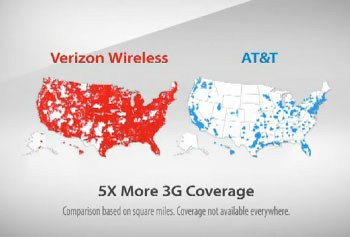
Karl Bode from Broadband Reports thinks there is something familiar about that 97 percent figure.  It just so happens to be Verizon’s existing 3G coverage area.  Verizon pointed to their more robust 3G coverage in a major ad campaign that began just prior to the Christmas shopping season in 2009.  It did enough damage to bring AT&T to court in an effort to stop the ads, and reacquainted America with Luke Wilson, who threw postcards on a floor map touting AT&T’s more robust, but considerably less speedy, last-generation EDGE data network.

Verizon completed their expansive 3G network without the benefit of a merger and is in the process of building their 4G LTE network on their own as well — capable of eventually reaching the majority of Americans without taking out the fourth largest wireless carrier in the country.  AT&T, on the other hand, spent its time in court and handing Wilson more postcards to throw  instead of investing appropriately in its network over the last three years.

AT&T’s Document Dump: More than 1 Million Documents Bury FCC and Justice Lawyers

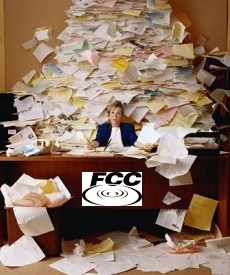
Another important revelation that doesn’t require the accidental disclosure of redacted data is the fact AT&T is burying government lawyers at both the FCC and Department of Justice in virtual paper.  The company admits to sending at least 1.2 million documents to Justice alone.  Reviewing AT&T’s filings with the FCC exposes the use of the old legal trick of burying your opponents in paper, hoping they will miss important documents that could call into question the veracity of the company’s arguments.

With the FCC, AT&T’s lawyers love to use appendices and attachments as virtual dumping grounds, adding copies of virtually any company document that contain “key words” or “search terms” in response to the Commission’s questions.

Take this Q&A exchange:

FCC Question: Provide all plans, analyses, and reports discussing: (a) spectrum requirements for all band segments; (b) the average data transmission speeds that the Company expects customers will be able to obtain; (c) actual and forecasted traffic and busy hour analyses, (d) total data tonnage; (e) capacity utilization rate; (f) vertically integrated operations; or (g) other technical or engineering factors required to attain any available cost savings or other efficiencies necessary to compete profitably in the sale or provision of any relevant product or any relevant service.

AT&T’s Answer: To respond to this request, AT&T conducted key word searches of custodian files as detailed in the tables appended as Exhibit A. Documents responsive to this request are included in AT&T’s production.

It’s the equivalent of putting the phrase “data transmission speeds” into a search engine and then attaching every document that appears in the results and calling it “your answer,” relevant or not.

AT&T used the same approach in answering the FCC’s questions about how the merger would specifically bring improved 4G service to areas without service today, what impact the merger will have on roaming agreements and wholesale access to the combined AT&T/T-Mobile network, and even in response to a basic question about plans for targeting particular competitors, customers, or customer segments after the merger.

Reality: AT&T Doesn’t Care About T-Mobile’s Network

So what else does AT&T win from a nearly $40 billion investment in T-Mobile?  While the leak of confidential information continues to be largely protected by a trade industry publication that has not released it publicly in full, anyone versed in telecommunications can easily find plenty in AT&T’s public documents.

The most important point is that AT&T admits, publicly,  it has not determined exactly what it intends to do with T-Mobile’s most important asset — its network:

  • “AT&T, however, will not be in a position to make any final determinations until it is able to obtain more detailed information about T-Mobile USA’s operations, which will occur later in the acquisition process.”
  • “AT&T has not yet begun detailed integration planning efforts.”

Would you spend $40 billion to buy a cellular service provider and not have the first clue what you would do with it?

But it gets even sillier.  AT&T doesn’t even know, several months after the merger was announced, exactly where T-Mobile’s cell towers are and what kind of backhaul connectivity they have:

AT&T has not yet begun detailed integration planning and its knowledge of T-Mobile USA’s operations is necessarily limited at this early stage. The actual process of determining which specific T-Mobile USA sites to integrate and which to decommission will require substantially more data from T-Mobile USA regarding its network as well as a more thorough engineering analysis of each area’s characteristics and capacity needs, which could change by the time the Transaction closes. Consequently, AT&T has not yet determined the exact number or location of T-Mobile USA towers or other locations used for transmission of signals that will be integrated into the combined company’s network to increase network density.

Because AT&T has not yet begun detailed integration planning and its knowledge of T-Mobile USA’s operation is necessarily limited at this early stage, AT&T does not have documents regarding the integration of the two companies’ switching facilities and backhaul.

These facts have made it impossible for AT&T to be responsive to specific questions from the FCC about the impact of acquiring and integrating T-Mobile’s operations into AT&T’s.  That left the company answering the Commission’s questions with statements like this:

Q. Provide all plans, analyses, and reports discussing any possible modification by the Merged Company of the terms, including prices, for providing backhaul for unaffiliated mobile wireless service providers to new or existing towers.

A. AT&T has not yet begun detailed integration planning, and its knowledge of T-Mobile USA’s operations is necessarily preliminary at this early stage. Any consideration regarding potential modification of terms and pricing for backhaul has not yet occurred. Thus, AT&T does not have any documents responsive to this request.

Good to know… or not know.

So if AT&T isn’t dwelling on the details of T-Mobile’s network, what do they expect to obtain from its purchase?

Here are AT&T’s “assumptions.”  That’s right, AT&T isn’t actually promising to do any of this.  It just “assumes” it will based on earlier planning — the same kind of planning that was supposed to deliver 4G upgrades without T-Mobile in the equation, until company executives changed their minds:

  • Utilize the parties’ combined scale, spectrum, and other resources to extend AT&T’s deployment of LTE services to over 97% of the U.S. population, extending service to an additional 55 million Americans;
  • Integrate AT&T’s and T-Mobile USA’s wireless networks, including:
  1. Integrate T-Mobile USA cell sites into the AT&T wireless network, resulting in a more robust network grid;
  2. Combine AT&T’s and T-Mobile USA’s GSM networks, eliminate redundant GSM control channels and maximize utilization efficiencies;
  3. Combine AT&T’s and T-Mobile USA’s GSM spectrum holdings, resulting in channel pooling efficiencies and improved coverage;
  4. Optimize usage of the parties’ combined spectrum holdings and deploy additional spectrum to support more spectrally efficient network technologies; and
  5. Decommission redundant cell sites and reuse radios and other equipment from decommissioned sites to enhance network efficiency and performance.
  • Make AT&T rate plans available to T-Mobile USA customers, while preserving rate plans for T-Mobile USA consumers who wish to maintain their existing plan of choice;
  • Make AT&T services, smartphones, and other devices available to current T-Mobile USA customers;
  • Integrate retail outlets, dealers, and marketing efforts under the AT&T brand;
  • Integrate billing, customer care, and other support services;
  • Integrate certain functional units, including, but not limited to human resources, general & administrative, information technology, finance, procurement, and legal.
  • Achieve savings in network infrastructure investment and network and customer equipment purchases; and
  • Achieve efficiencies in interconnection and transport costs.

During AT&T’s periodic communications with shareholders, the company has spent most of its time talking about cost savings made possible from closing redundant retail outlets, integrating networks, and the always-vague savings from job redundancies (read that major layoffs).  In fact, AT&T has said they will save up to $10 billion dollars in infrastructure expenses with the merger.  At the same time, its public relations efforts promise the company will spend a veritable fortune — up to $8 billion, improving AT&T’s own network.

You can be certain to the uninitiated, eight billion dollars sounds like a lot of money.  It’s a dollar amount that is sure to razzle-dazzle plenty of people.  That is, until you realize during the same period of time, T-Mobile itself would have been spending up to $18 billion of its own money upgrading its network.  Eighteen billion minus eight billion equals the aforementioned $10 billion — the savings AT&T will realize from continuing to under-spend on both its network and T-Mobile’s.

More Fun Facts: AT&T Cares More About Counting Your Usage Than Measuring Network Capacity & Utilization

Wading through AT&T’s filings has revealed another important fact pertinent to Stop the Cap! readers: AT&T obsesses about measuring your wireless data usage but doesn’t have much of a clue about how much network capacity it has at different cell sites, nor the utilization rates at those sites.  No wonder AT&T drops calls.  If the company isn’t carefully measuring network utilization at a granular level, it can’t hope to find overcongested sites that badly need upgrades to stop the problem of dropped calls and slow speed data:

AT&T does not maintain in the ordinary course of business a nationwide list of all CMAs where its individual network is underutilized. With regard to the areas where AT&T’s and T-Mobile USA’s networks may be underutilized relative to each other, AT&T does not have this information on a CMA by CMA basis, nor does AT&T have engineering data that would provide this granular information for T-Mobile USA.

Money - Better Earned Than Spent

However, when the opportunity to engage in highly-profitable Internet Overcharging exists, measuring customer usage takes a high priority, as we learn from AT&T in response to another question from the FCC:

The .csv file in Exhibit 19-1 contains current (as of March 11, 2011) data usage for each UMTS site (by USID) measured in kilobytes, during the monthly busy hour, and separately for the uplink and the downlink. The .csv file in Exhibit 19-2 contains current (as of March 11, 2011) data usage for each GSM site, measured in Erlangs, combined for the uplink and downlink, for the monthly busy hour. At the Commission’s request, AT&T also provides an estimate of GSM data usage in terms of Kilobytes, using a formula that converts Erlangs to Kilobytes. ll Both exhibits identify the CMA associated with each site. The .xlsx file in Exhibit 19-3 contains usage projections that are currently used by the network engineers for each of AT&T’s 27 regional clusters in the ordinary course of business.

AT&T doesn’t lose any money when it drops your call from an overcongested cell site (unless you grow weary enough of it to cancel service), but can lose plenty if it doesn’t measure customer data usage in hopes of limiting customer use or charging them an overlimit fee when they don’t.

AT&T’s Mother-of-all-Disclaimers: AT&T Has Not Verified It Has Produced All Requested Documents

The most flippant part of AT&T’s document dump is the revelation that despite the million plus documents thrown at two government agencies, AT&T isn’t willing to affirm it actually produced copies of the relevant documents the government wants as part of the review process.  In a host of disclaimers and AT&T’s own descriptions of how it defines the meaning of the government requests, the company notes:

Pursuant to discussions with the Commission staff, AT&T is submitting its Response consistent with the following qualifications:

  • Custodian files were searched covering the period from January 1, 2009 through March 21, 2011, except for certain custodians, whose files were searched through early May, 2011.
  • AT&T has not verified that it has produced “all other documents referred to in the document or attachments,” pursuant to instruction 4.
  • AT&T has not searched backup disks and tapes for documents.

Nothing to slip through scrutiny there, right?

All You Can Eat: New Zealand ISP Reintroduces Unlimited Usage Internet Service

Phillip Dampier August 11, 2011 Broadband Speed, Competition, Consumer News, Data Caps, Net Neutrality Comments Off on All You Can Eat: New Zealand ISP Reintroduces Unlimited Usage Internet Service

New Zealand is one of a handful of countries stuck with pervasive Internet Overcharging schemes that limit usage or throttle broadband speeds because of international connectivity limitations.  But as international underseas fiber cables ease traffic congestion, Internet Service Providers are increasingly relaxing usage caps and reducing the level of speed throttling during prime time usage hours.

Now one ISP, Slingshot, has gone all-out, reintroducing an unlimited, flat rate broadband option for New Zealanders who don’t want to worry about how much usage they’ve racked up over the past month.

For roughly $32.50US for the first six months, $65 after that, customers don’t have to watch a usage meter or “gas gauge” or face a wholesale heavy speed throttle when deemed to be using “too much” Internet service.

Slingshot’s “All You Can Eat” broadband plan thumbs its nose at providers who want to end an unlimited broadband buffet.

The promotion is limited to the first 5,000 new customers who sign-up before Sept. 30, and customers must bring their own modem and maintain a Slingshot landline to qualify.

Slingshot general manager Scott Page said the plan has proved attractive to customers who value knowing they will pay the same flat rate month after month, regardless of usage.  For these customers, having unlimited download capacity is more important than achieving the fastest possible broadband speeds.  But Page noted they have customers who manage to download more than a terabyte a month on their unlimited plan.

Like many providers in the South Pacific, Slingshot uses “network management” to prioritize traffic under this scheme, in order of highest priority to least:

VOIP > Gaming > Browsing > Streaming > Local traffic > File sharing, including Peer-to-Peer (P2P)

Slingshot has received mixed reviews from customers in different parts of the country.  Some areas achieve faster speeds than others, primarily because the company relies on Telecom-provided landlines for its DSL service.  When the network is especially busy, those using peer-to-peer software may find that service considerably slowed.

New Zealand is moving incrementally away from usage limits.  Vodafone recently increased data allowances by 50 percent for their landline broadband customers and Telecom is doubling broadband allowances for many of their customers as well.

California Probes AT&T/T-Mobile Merger: ‘Amazed the PUC is Doing So Much’

Phillip Dampier August 10, 2011 AT&T, Competition, Consumer News, Public Policy & Gov't, T-Mobile, Video, Wireless Broadband Comments Off on California Probes AT&T/T-Mobile Merger: ‘Amazed the PUC is Doing So Much’

California’s Public Utilities Commission promises a thorough review of the merger proposal from AT&T and T-Mobile, now under increasing scrutiny by the state’s regulators for potentially reduced competition and higher prices for cell phone customers.

The PUC has held seven public meetings so far regarding the proposal, with particular focus on what T-Mobile’s exit would mean for rural communities in northern, central, and eastern California.  Under the leadership of Commissioner Catherine Sandoval, California’s review of the merger proposal is proving to be the most aggressive nationwide, surprising even seasoned regulators.

“This is pretty unheard of,” Brian O’Hara, a legislative director at the National Association of Regulatory Utility Commissioners, said in an interview with Bloomberg News. “California’s seems to be the most in-depth review. It’s amazing to me that the PUC is doing so much.”

The public-interest group Consumer Watchdog has recommended a rejection of the deal, saying it will lead to higher prices.  This week, the group sent a letter to Sandoval, the Justice Department, and the Federal Communications Commission opposing the merger.  Bloomberg notes aggressive investigations may force AT&T to sell off a growing percentage of their T-Mobile acquisition to win approval:

With the pressure from California and other regulators, AT&T may have to divest 30 percent to 40 percent of T-Mobile USA’s spectrum and subscribers nationwide, Michael Nelson, an analyst with Mizuho Securities USA, said in an interview.

“I expect the requirements to be extremely high,” he said.

California could even seek to block the deal outright, a step usually taken by the FCC or Justice Department. If federal regulators approve the deal and California objects, the commission could go to the state’s attorney general to file a lawsuit to stop it, said Naruc’s O’Hara.

“An attorney general lawsuit may be the only recourse,” he said.

[flv]http://www.phillipdampier.com/video/CNBC ATT T-Mobile Merger Backlash 7-11.flv[/flv]

CNBC reports some members of Congress are coming out against the merger proposal, claiming it will reduce competition and raise prices.  (2 minutes)

FCC to AT&T: Justify Your Spectrum Demands, Merger With T-Mobile

Phillip Dampier August 9, 2011 Astroturf, AT&T, Broadband "Shortage", Competition, Consumer News, Editorial & Site News, Public Policy & Gov't, Rural Broadband, T-Mobile, Wireless Broadband Comments Off on FCC to AT&T: Justify Your Spectrum Demands, Merger With T-Mobile

The Federal Communications Commission today raised the hurdle for AT&T when it told the wireless company it would consider its proposed acquisition of wireless spectrum from Qualcomm in concert with its application to acquire T-Mobile USA.

The FCC wrote both AT&T and Qualcomm regarding the ongoing review of both transactions:

“The Commission’s ongoing review has confirmed that the proposed transactions raise a number of related issues, including, but not limited to, questions regarding AT&T’s aggregation of spectrum throughout the nation, particularly in overlapping areas. As a result, we have concluded that the best way to determine whether either or both of the proposed transactions serve the public interest is to consider them in a coordinated manner at this time.”

AT&T Donates $9,000 to the United Way of Northwest Florida, which promptly returns the favor with a nice letter to the FCC supporting the telecom company's agenda.

At issue is whether AT&T is warehousing wireless spectrum it actually has little intention to use and whether or not AT&T is being honest when it suggests it needs to acquire T-Mobile USA to expand the number of frequencies open for its growing wireless network.

Critics of the merger claim AT&T has plenty of unused spectrum available to deliver service, particularly in the rural areas AT&T claims T-Mobile can help it serve.  T-Mobile is not well-known for its service in smaller communities and rural areas, preferring to rely on roaming agreements to achieve national coverage.  With its proposed acquisition of valuable spectrum in the 700MHz range from Qualcomm, excellent for penetrating buildings and delivering reliable service, the FCC may be wondering if the proposed merger with T-Mobile is necessary at all.

Gigi Sohn from Public Knowledge doesn’t think so.

“We are pleased that the Commission has decided to consider AT&T’s purchase of Qualcomm spectrum in the context of AT&T’s takeover of T-Mobile.  It doesn’t matter whether both transactions are in the same docket; the fact that the Bureau will consider them together in any manner is a strong statement,” Sohn said.

“This April, several public interest groups, Consumers Union, Free Press, the Media Access Project, Public Knowledge, and the New America Foundation, asked for the Commission to take that action because we said that both deals together would ‘further empower an already dominant wireless carrier to leverage its control over devices, backhaul, and consumers in ways that stifle competition,” Sohn added.  “We look forward to working with the Commission on these issues which are so vital to the economy of this country.”

Companies that have acquired wireless spectrum at government auctions have not always put those frequencies to use.  At least one firm warehoused spectrum as an investment tool, earning proceeds reselling it to other providers.  Others have simply squatted on their spectrum, sometimes to keep it away from would-be competitors.

Of course, considering AT&T is a master of dollar-a-holler astroturf operations and lobbying, it’s only a matter of time before a renewed blizzard of company-ghost-written letters start arriving at the Commission telling them AT&T needs both the Qualcomm spectrum -and- the merger with T-Mobile.

Groups like the NAACP, United Way of Northwest Florida, the National Puerto Rican Coalition, and the U.S. Cattlemen’s Association ought to know, right?

Thanks to Stop the Cap! reader Bones for alerting us.

Search This Site:

Contributions:

Recent Comments:

Your Account:

Stop the Cap!