Home » Competition » Recent Articles:

Frontier Adds New $1.50 Surcharge to Broadband Bills; Customers Told It Will Improve Service

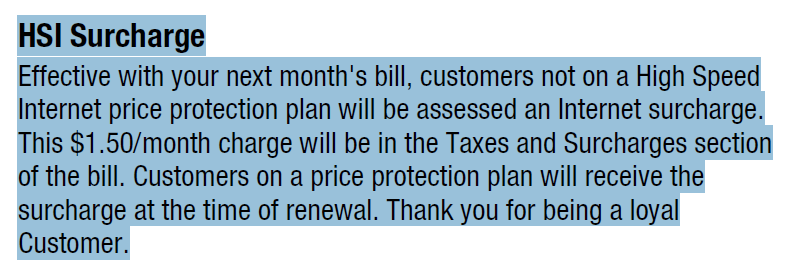
Frontier Communications is adding a new $1.50 monthly surcharge for broadband customers not currently enrolled in a “price protection agreement.”  Labeled the HSI Surcharge, the new fee started showing up on customer bills this month, with only a vague explanation buried inside the bill:

Courtesy: Manmaniac

Frontier's Fast One.

Customers attempting to get an explanation of what this charge was all about got a myriad of answers from Frontier customer service representatives:

  • It’s a broadband tax;
  • It’s a surcharge to help pay for network improvements;
  • It’s a charge for customers who refuse to take a price protection plan;
  • It’s a rate increase.

Stop the Cap! called Frontier this afternoon and was told it was designed to collect additional revenue to fund network expansion and was, effectively a rate increase.  Even customers on 1-3 year price protection agreements will eventually pay the “surcharge” as their agreements expire.  It is not a government-mandated charge or tax.

Effectively, this rate increase allows the company to advertise their Internet service at a deceptively low price, until customers discover Frontier’s modem rental fees and surcharges.  In 2009, during Stop the Cap!‘s flirtation with Frontier DSL, we found the “out the door” price for their 3.1Mbps service was actually higher than that charged by Time Warner Cable’s 10Mbps Road Runner service.

A Year of Internet Overcharging Suits Some Wireless ISPs Just Fine

Their prices are sky high.

Back in May 2010, Stop the Cap! launched a debate with a few Wireless Internet Service Providers (WISPs) that provide largely rural America with wireless access to the Internet over long range Wi-Fi networks.  The debate got started when Matthew Larsen, who runs the Wireless Cowboys blog, announced the arrival of an Internet Overcharging scheme at his WISP — Vistabeam, which serves residents in rural Wyoming and Nebraska.

WISPs are being increasingly challenged by the changing tastes of Internet customers, who are gravitating towards broadband multimedia content, saturating limited capacity networks and forcing regular infrastructure upgrades to keep up with increasing usage demands.  Unlike larger providers, many WISPs are independent, family-run businesses that lack easy access to capital and resources to rapidly respond to demand, especially when most have a rural customer base that numbers in the hundreds or thousands.

That’s one of the reasons why Stop the Cap! has not been as harsh on these providers when they implement usage limit schemes on their customers.  Because WISPs provide service where cable and phone companies usually don’t bother to serve, these wireless providers are the only option beyond satellite Internet, which we regularly label “fraudband” for claims of broadband speeds that are rarely delivered.  Still, we were not impressed last year with some of Larsen’s language about what his usage caps were intended to do (underlining ours):

I feel that these caps are more than generous, and should have a minimal effect on the majority of our customers.   With our backbone consumption per customer increasing, implementing caps of some kind became a necessity.    I am not looking at the caps as a new “profit center” – they are a deterrent as much as anything.    It will provide an incentive for customers to upgrade to a faster plan with a higher cap, or take their download habits to a competitor and chew up someone else’s bandwidth.

Ouch.

It’s been over a year, and Larsen is back with an editorial patting himself on the back for an Internet Overcharging success story well-implemented:

We have never raised prices on our services.    We still have a customer note on the wall that reads “Your bill was the only one I got this month that DIDN’T go up.   Thank you!”     I would have a hard time raising prices on this person because of their neighbors that are downloading 20x as much.   Usage Based Billing is a much fairer way to go, especially when the provider faces so much reinvestment cost to accommodate the heavier users.   After the first year of implementation, I am very glad that we took the time to implement it and intend to use the revenue to build a better network for all of our customers.

Larsen is also upset with those who believe in the concept of unlimited Internet:

Operating a broadband network is not free, and it is not a low-maintenance business.   I have a group of dedicated employees and subcontractors that have spent a lot of late nights and early mornings away from their families to build and maintain our network.   Anyone who thinks that unlimited broadband is a God given right should be forced to spend a few days in my lead tech’s shoes, getting a good look at what a broadband provider has to do to build a network and keep it running.

Larsen, like other WISPs are confronting the reality that Internet usage is on the upswing, and while we sympathize with the challenges faced by Vistabeam and other WISPs, his statements do not apply to every broadband network around.  And frankly, an increasing number of customers simply aren’t interested in Larsen’s challenges, especially if another provider can deliver service more cheaply and efficiently.  Vistabeam better hope nobody does, because their prices are simply not competitive if just about any other provider manages to work their way into his territory.

Vistabeam prices start at $29.95 a month for 384kbps/128kbps service with a monthly usage limit of 10GB.  Exceed that and you will pay an additional $1 per gigabyte.  Customers who need more speed pay dearly for it.  A tier providing 4/2Mbps service will run you $99.95 a month with a 60GB monthly usage allowance.

As of late, Larsen has been railing against the U.S. Department of Agriculture over recent broadband stimulus awards designed to improve coverage of broadband Internet in the same rural regions of the country Vistabeam serves.  He’s upset the USDA has awarded a $10.2 million infrastructure loan to the Hemingford Cooperative Telephone Company, which provides service in western Nebraska under the name Mobius Communications.

Larsen speaks highly of the fact Vistabeam delivers service in the absence of government funding or stimulus. But average consumers are not likely to care when they compare prices and consider the fact Mobius doesn’t appear to limit customers’ usage.

Mobius DSL Prices:

  • 500kbps – $35.00
  • 1.5Mbps – $40.00
  • 3Mbps – $50.00
  • 5Mbps – $60.00 (Currently available in Alliance and Chadron.)

Mobius charges effectively half the price Vistabeam charges, and offers faster tiers of service in some areas, without fear of overlimit fees.  It’s also important to recognize the “award” was actually a “loan,” which must be repaid.  Larsen seems less upset with the fact there are broadband stimulus programs than with the reality industry lobbying has effectively cut out many Wireless ISPs from standing any chance of winning one.

I get especially frustrated by loan awards like this one because I have operated two ISPs that have had to compete directly with Mobius and did not have access to any federal grant or loan programs.   The USDA Broadband and Loan programs are essentially only available to [regional phone companies].   When I made inquiries into the programs several years ago, I found that they would only loan to a single recipient in a region so that they were not funding competing projects.

Phillip Dampier

For Stop the Cap!, our constituents are consumers interested in obtaining the best possible broadband service at the best price.  Larsen’s views, understandable from the perspective of a business owner, would leave a number of consumers paying effectively double the price for usage-limited broadband. That would, however, satisfy a business argument that self-funded private providers should not face competition from other providers that can extend faster, unlimited DSL, cable, or fiber service with low interest loans.

Wouldn’t a better solution be to form a coalition to force open the same beneficial loan programs to Wireless ISPs who can more readily and affordably build up their networks and ease the Internet Overcharging that too often comes along for the ride?  We’re not accusing Larsen of gouging his customers for fun and profit, but we would like to see WISPs like Vistabeam develop win-win strategies that deliver success for their innovative efforts and lower priced, faster service for their customers.

The alternative may be the eventual arrival of those rural phone companies, increasingly equipped to deliver faster and cheaper service to Vistabeam’s current customers, eventually spelling disaster to that company’s business plan.  It has happened before.  Anyone remember the “wireless cable” industry that delivered a few dozen cable channels over microwave signals?  That’s a service whose time came and went, largely replaced with satellite television and rural telephone cable TV, better equipped to provide the kind of service consumers actually wanted, but wireless cable was ill-equipped to provide.

Gouge Train: AT&T Wireless Eliminates Budget Texting Plans: Welcome to $20+ Texting

AT&T “streamlined” its text messaging plans over the weekend for new customers, eliminating a less-expensive $10/1000 text budget plan in favor of unlimited texting plans that cost much more.

That means new AT&T customers who want to text will pay dearly for the privilege:

  • $0.20 per text message sent/received,
  • $20.00 Unlimited texting (individual line)
  • $30.00 Unlimited texting (family plan)

So much for asking customers to ‘pay for what they use.’  AT&T is moving towards unlimited texting — at a very high price — while moving away from unlimited data.

AT&T released a statement about the changes:

“We regularly evaluate our offers and are making some adjustments to our messaging lineup. Starting August 21, we’re streamlining our text messaging plans for new customers and will offer an unlimited plan for individuals for $20 per month and an unlimited plan for families of up to five lines for $30 per month. The vast majority of our messaging customers prefer unlimited plans and with text messaging growth stronger than ever, that number continues to climb among new customers. Existing customers don’t have to change any messaging plan they have today, even when changing handsets.”

Gizmodo points out AT&T is charging customers who don’t have a text plan 100,000 percent more than what they charge for online data:

Here’s how it breaks down:

AT&T charges $25 for 2 gigabytes of mobile data, which states how much they think their bits and bytes are worth. That comes out to 80 megabytes per dollar. 80 megabytes will get you 500,000 text messages—assuming you’re writing the largest possible message, which you’re often not (i.e. “Hey” “Nothing” “lol”).

Now divide that dollar by the 500,000 potential texts. That comes out to $0.000002 per text—two ten thousandths of a cent. A very, very, very small amount of money.

Now, let’s say you send 5,000 texts a month. That’s a large, though wholly realistic number. Multiply that by the above worthless cost per text, and you’ve got—hold onto your wallet!—$0.01. A penny for five thousand texts, according to how much AT&T says its data is worth in a data plan.

But outside of the data plan? Oh boy! Things get very different very fast. And by very different, I mean inordinately overpriced. Those same 5,000 texts, at a rate of $0.20 per message, will cost you $1,000. Not a penny—a grand. Two very different prices for literally the exact same thing.
For customers who only send and receive occasional text messages, losing the $10 option means most will either pay the heavily marked-up $0.20 a-la-carte price, or pay double and not worry about how many messages they send.

Ultimately, AT&T’s new prices may drive an increasing number of users to alternative ways of communicating with friends and family, especially as prices keep rising.  Some AT&T customers remain grandfathered on text plans that offer 200 messages for $5 a month.  But for customers like Ben Chinn of San Francisco, even $5 is asking a lot.

“With everything with the mobile carriers, I feel I’m getting nickeled and dimed,” Chinn told the Los Angeles Times. “I resent paying so much for text messaging, and I feel that it’s not a reasonable price to pay for something that costs the carriers next to nothing.”

Free Press Research Director S. Derek Turner says AT&T’s new prices foreshadow the kinds of higher prices all Americans will pay if the wireless industry continues its march towards consolidation.

“This move is simply another example of AT&T passing off a price increase for consumers as a benefit,” Turner said. “If this were a truly competitive market, AT&T would offer its customers more choice and value, and no carrier would get away with a 10-million-percent markup on its services. This should serve as a warning to the Department of Justice and the Federal Communications Commission — if AT&T is already able to unilaterally increase prices, allowing the company to eliminate low-cost competitor T-Mobile will only make things worse.”

The Times notes Juniper Research has predicted that global revenue for text messaging will peak this year and begin to drift down. And in a recent report, UBS Investment Research warned that “customers could elect not to pay for texting as smartphones and third-party applications become pervasive.”

Facebook has introduced Messenger, a free smartphone app that allows members to exchange text messages with friends, as well as anyone else who happens to have a cell phone.  Google Voice includes unlimited free texting, if those sending messages remember your Google Voice number.  Apple’s forthcoming iMessage will be pre-installed on most Apple devices, offering a ready-made opportunity to bypass high-priced text plans.  There are dozens of other apps that offload text traffic to your smartphone data plan, where the added traffic is so insignificant, it has largely no impact on even the lowest usage plans.

The preferred outcome of using any of these third-party apps is to cancel expensive texting plans from your phone carrier.  But there are obstacles:

  1. Many friends may continue to text your primary cell phone number directly, incurring a-la-carte text messaging fees if you cancel your text plan;
  2. Many require all of your contacts to run specific apps to exchange messages, which can quickly become a burden;
  3. Apple’s iMessage assumes all of your friends are using Apple phones or devices.  Everyone else will have to hope for, find, and install another app to support the service.

The trade-off works for some, but not for others.

Hieu Do of St. Louis tells the Times he’s had to pay for individual text messages after dropping his text plan, but Google Voice has still helped him save money:

“At the beginning of every month I would lose a dollar here and there from people texting my old number, but it’s worth it more than paying $5 or $10 a month for a texting plan,” he said.

But Jim Jeffords, one of our readers, tried Google Voice for awhile and decided it was just too cumbersome for texting.

“I ended up getting text messages from a lot of business contacts that didn’t know about my Google Voice number, but had my cell phone number,” Jeffords says. “I was not about to throw a Google Voice number into the mix and come across as cheap and make them remember what number to text.”

Jeffords went back to a basic text plan with a few hundred messages a month included.

“It wasn’t worth the hassle to deal with,” he said.

Canada’s Cellular Cartel: 3 Wireless Companies Control 94 Percent of the Market

Next time you wonder why you are paying substantially higher cell phone bills than your neighbors abroad, take note: just three cell phone companies control 94 percent of the wireless marketplace in Canada, with more than 23.5 million combined subscribers.  The four other significant carriers have a combined subscriber base of around 1.5 million, hardly worth noticing by the largest three:

Rogers Communications

The telecom giant Rogers controls the largest share of the Canadian wireless market with 9,127,000 subscribers as of the end of June.  Nearly 7.5 million of those customers are on two year contracts and pay an average bill of $70.07 per month.  Prepaid customers pay substantially less for their occasional-use phones: $16.14 a month.  Rogers adds more subscribers than it loses, picking up 591,000 new customers during the first quarter, while losing 456,000 current customers, winning a net gain of 135,000.

Data revenue is becoming increasingly important for Rogers, now constituting 35 percent of earnings for the company’s wireless division.

Bell

Coming in at second place is Bell Canada, with 7,283,000 customers.  Over 5.7 million are on contract, 1.6 million are using Bell prepaid phones.  Bell added just under 38,000 new customers last quarter, the smallest net add among the three largest providers.  The average contract customer pays Bell $63.18 a month; prepaid customers pay $16.88.

Telus Mobility

Telus, western Canada’s largest phone company, sells wireless service across the country and has become the third largest wireless provider with 5.8 million contract customers and 1.2 million prepaid clients.  Together, they pay an average of $58.88 a month.  Telus picked up 94,000 net additions last quarter, which is better than Bell but worse than Rogers.

Everyone Else

Among the rest, Saskatchewan’s phone company Sasktel had managed to reach 568,000 subscribers, mostly in the province, as of late March.  MTS Allstream Inc., a wholly-owned subsidiary of Manitoba Telecom came in with 489,722 customers.  Videotron, Quebec’s biggest cable company, had 210,600 clients, mostly in Quebec.

Among the newest entrants, Wind Mobile, subject to considerable controversy for its foreign financial backing, may one day be a much larger player in Canada’s wireless marketplace, but not today.  It had just 271,000 customers as of March 31st.

Even fewer customers rely on some of Canada’s regional providers, which include companies like Thunder Bay Telephone, Lynx Mobility (co-owned by an aboriginal partner with a mission to serve rural Canada), Calgary-based AirTel, which is popular with oil/gas workers for its “push to talk” service, and Ice Wireless, which is the largest GSM carrier in northern Canada, reaching 70% of the population of Nunavut and the Northwest Territories.

Canada’s largest three providers also own or control several “competitors” that mostly sell prepaid service.  Customers thinking they are escaping the big boys often really are not:

  • Fido is owned by Rogers;
  • Virgin Mobile Canada is owned by Bell;
  • Koodo Mobile is owned by Telus

Verizon Wireless Heads to Alaska, Providers on the Ground Expect AT&T to Suffer the Most

Verizon Wireless is expected to enter the Alaskan mobile market sometime in 2013-2014, according to incumbent competitors, who expect Verizon’s largest impact will be to bleed AT&T of customers.

Alaska’s two primary local providers — Alaska Communications, Inc. (ACS) and General Communications, Inc. (GCI), are telling shareholders to relax because they don’t expect to see Big Red in the Alaskan market for at least 2-3 years.  Both companies reported net losses for the quarter, and GCI lost 2,400 subscribers recently when more than 4,000 soldiers at Fort Wainwright in Fairbanks were deployed to Afghanistan.

Both ACS and GCI have been using the current poor economic climate and their respective stockpiles of cash-on-hand to retire debt or reissue long-term-debt at more favorable low interest rates.  Both companies are also hurrying to outdo each other’s 4G wireless network deployments before Verizon Wireless shows up, making use of spectrum it acquired last August to enter the Alaskan market.  Government rules require Verizon to sign-on its new network by June 13, 2013.  But Verizon admits it will take up to five years after that to completely build a new network from scratch.

Right now, Verizon Wireless customers taking their phones to Alaska roam on ACS’ network, for which the company is compensated with an increasing amount of extra revenue.  ACS boosted earnings in part on that roaming revenue, even as it lost more of its own customers.  When Verizon switches on its own network, that roaming revenue will rapidly decline, but ACS executives reassured shareholders their knowledge and experience of construction seasons in Alaska guarantee Verizon won’t be able to get its network together until 2013 at the earliest.

But when Verizon opens their doors, Ron Duncan, CEO of GCI expects a hard fight on his hands.

“We recognize ultimately they’ll be a significant competitor, although I see AT&T share more at risk because Verizon’s main claim to fame when they get to Alaska is going to be devices. We’ll still outpace them on coverage. We’ll continue to be the only ones with statewide coverage,” Duncan said. “People who want to buy the coverage buy from us today; people who want devices buy from AT&T because AT&T gets much better devices than we do.”

Just months after Verizon announced they were headed north, both ACS and GCI accelerated plans to roll out respective “4G” networks for wireless customers, although each company is deploying different standards.

GCI

GCI’s cell phone network is a combination of some of its own infrastructure, the acquisition of Alaska Digitel, and a resale agreement to use parts of AT&T Wireless’ coverage it acquired from Dobson Communications Systems.  In and around Fairbanks, Anchorage, Glennallen, Valdez, Prudhoe Bay, Wasilla, and Kenai, GCI offers CDMA service.  In those communities and many other rural regions in western Alaska, GCI relies on AT&T Alascom GSM networks.  GCI pitches its CDMA network’s 3G wireless data capabilities, which offer faster wireless data speeds, if you can get coverage.  For wider coverage in Alaska’s smaller communities, GCI markets GSM phones, which currently only offer 2G EDGE/GPRS data speeds.  If you use a cell phone mostly for voice calls, the wider coverage afforded by GCI’s GSM network is a popular choice.  But if you want faster data, CDMA 3G data speeds are required.

Eventually, GCI’s 4G network may help deliver coverage and faster speeds in both urban and rural areas, particularly as GCI plans to invest up to $100 million to construct more of its own network, instead of relying on resale agreements and acquisitions.

GCI has chosen HSPA+ for 4G service on the GSM network, and will introduce the service in Anchorage later this month.  That’s the same standard used by AT&T and T-Mobile in some areas.  It’s not as fast as LTE service from Verizon Wireless, but is much cheaper to deploy because cell sites need not be linked with fiber optic cables — an expensive proposition.

ACS

Alaska Communications has a large 3G CDMA network in Alaska all its own.  Its coverage is primarily in eastern Alaska adjacent to major cities like Anchorage, Juneau, and Fairbanks, and where it does provide 3G data coverage, the company claims it extends further out than GCI.  ACS doesn’t offer much coverage in small villages and communities in western Alaska, however.

ACS expects to skip incremental upgrades and launch its own 4G LTE service in the future.  It may help the company regain its second place standing, lost to GCI last year, and protect it from Verizon Wireless poaching its customers.

Search This Site:

Contributions:

Recent Comments:

Your Account:

Stop the Cap!