Home » Competition » Recent Articles:

Public-Private Failure: How Mediacom Killed Marshalltown’s Free Community Wi-Fi

Five years ago, municipal Wi-Fi projects were enjoying a small boom.  The concept of providing low-cost or free Internet access seemed like a winner because it could provide service to those who could not afford traditional broadband, would stimulate economic development downtown, and possibly attract business as shoppers stopped in cafes or stores to use their wireless devices.  In some communities, just the spectacle of a city-wide high technology wireless network delivered worthwhile bragging rights that adjacent communities didn’t have.

For most city or town officials pondering investment in a Wi-Fi network, the idea germinates from a perceived lack of service from private providers.  If private companies were delivering the service, few communities would spend the time, effort, and money duplicating it.

In the community of Marshalltown, public Wi-Fi in 2005 was a service only found in a small selection of stores and cafes in the central business district.  The Marshalltown Economic Development Impact Committee sought to change that, promoting a plan to construct a free-to-use Wi-Fi network covering a 20-block radius centered on the Marshall County Courthouse.  The community of 27,000 got a three month trial of the downtown Wi-Fi network in 1995, with the city and county sharing 50 percent of its cost, with the remaining 50 percent paid for by private donations.

Mediacom, the cable company serving Marshalltown, was incensed by the notion of a community-owned broadband provider delivering improved (and free) Internet access across the city.  Even worse in their eyes, local government officials were pondering creating a public broadband utility.

Marshalltown (Marshall County), Iowa

It wasn’t long before new, shadowy groups with names like “Project Taxpayer Protection” showed up in town attacking the concept of municipal Internet access.  After a blizzard of brochures and exaggerated claims about “government broadband,” the network became a point of controversy among the locals.

Only later would the community learn the group (whose status as a non-profit was later revoked by the Internet Revenue Service for failure to file timely reports on its funding and activities) was actually funded mostly by Mediacom itself, with the full support of the Iowa Cable Association.

The astroturf campaign against public involvement in Wi-Fi, which could threaten Mediacom’s broadband service profits, was effectively an investment against competition.  It was an effort that paid dividends by late 2005, when the city and Mediacom suddenly announced a new “public-private partnership” to administer and expand the Wi-Fi network.  There were a few important changes, however:

  1. Mediacom’s concept of “free” was markedly different than the designers’ original vision.  The cable company had other ideas, placing restrictions on how much “free use” was allowed;
  2. Customers who used the newly-announced “free service” got it at speeds not much better than dial-up and definitely slower than 3G;
  3. Residential Mediacom broadband customers could get unlimited time on the formerly-free network, if they paid $19.95 a month for 256kbps access;
  4. To make the network seem business-friendly, business customers were told they could get up to 10Mbps service for $59.95 a month.

The goal of the partnership, according to Mike Miller, chairman of the Marshalltown Economic Development Impact Committee, was to see low-cost broadband Internet access citywide by the end of 2006.

Oh, and Mediacom insisted on something else: no more talk of a city-created municipal telecommunications provider, at least for a year anyway.

“We commend you on the foresight and vision to do this,” Bill Peard, Mediacom’s government affairs manager, told city officials at the time the deal was announced.

Friends until the community-owned...

Once Mediacom got its hands on the formerly community-owned network, it was the beginning of the end.

Business customers could not get Mediacom to sell them access at the promised price because representatives could not find the offer.

It was much worse for residential users.

Free Wi-Fi access soon became limited to one hour a day, up to 10 hours per month for non-Mediacom customers.  After that, you paid if you wanted more.

City and company officials spent most of their time wrangling over the costs of the service and its future potential.  What city officials were not planning for was the network’s virtual demise at the hands of the cable company.

...free Wi-Fi network is at an end.

Today, free access is a distant memory, as Mediacom pulled the plug claiming there was “limited interest.”

Effectively, Mediacom’s idea of a public-private partnership was the systematic decommissioning of a community’s public Internet alternative, all to protect its own broadband business.

That’s a lesson of caution for any community seeking to team up with private broadband providers.  Marshalltown allowed that partnership to first and foremost serve Mediacom’s business interests, not the public.  Now that network is effectively gone and largely-forgotten.

That suits Mediacom just fine.

An Unsolicited Testimonial: Stop the Cap! Saved Us Over $20 A Month on Our Cable Bill

Phillip Dampier September 2, 2011 Broadband Speed, Competition, Consumer News, Earthlink 4 Comments

These kinds of testimonials help fuel our fight on behalf of consumers for better (and cheaper) broadband:

Hi Guys,

I don’t usually take the time to write thank you’s, but I found your site the other day and managed to save over $20 on my cable bill by switching to ”Earthlink” which I had no idea was possible. When I signed up with Bright House I was promised the $45 a month price for standard Internet, but I signed up a day before their prices jumped to $50. I managed to fight to get my price down for $45, but all of a sudden that stopped and they were refusing to give me the price I signed up for, for the remainder of the year. Due to that, I switched to the Earthlink promo prices and got Bright House to switch me over. They tried to lie to me on the phone to make me think I couldn’t get the Earthlink promo pricing, but I won the argument and am now very happy.

In six months, I’ll try to switch back to Road Runner and get their promo prices.

This is such a hidden unknown gem and has saved my family lots of money. Thank you!

— Scott

Thanks Scott.  Time Warner Cable and Bright House Networks have Earthlink as a hidden little secret most customers know nothing about.  It’s an arrangement that started way back in 2001 with the now-long-forgotten (and broken up) merger between AOL and Time Warner.  A voluntary agreement to allow third party ISPs to sell broadband service over Time Warner Cable has been ongoing ever since, even though customers would routinely find Earthlink’s regular prices not so exciting, if they found them at all.

The Earthlink savings are best realized for broadband-only customers who do not want to get tied down with a double or triple-play package from their cable company.  Both Time Warner Cable and Bright House charge considerably higher prices for standalone broadband service.  It’s part of a marketing tactic to convince you better savings are possible with a bundled service package.  But if you don’t care about the phone line or cable TV, why pay for either?

For every third-party ISP we’ve encountered reselling service on Time Warner Cable or Bright House, it seems mostly an exercise in branding.  For example, Earthlink’s standard and “turbo” products are totally identical to Road Runner offered by both cable companies, with two important distinctions:

  • You do not get the benefit of SpeedBoost, a temporary speed increase during the first few seconds of a file transfer;
  • You are assigned an Earthlink e-mail address, not one from Bright House or Time Warner Cable.

In fact, Earthlink as a company seems to be running mostly on auto-pilot these days.  We found their website woefully outdated, still selling speeds upgraded several years ago. If Bright House locally sells 10/1Mbps standard Road Runner service and Earthlink offers 7Mbps with a 384kbps upload speed, you will actually get 10/1Mbps from Earthlink as well.  The only difference is the name of the service as it appears on your monthly Time Warner Cable or Bright House bill.  Both cable companies literally just select Earthlink from a drop-down menu on the customer service computer screen.  All service calls and billing are handled by the cable companies.  If you need technical support, however, it will come from an overseas call center or online “chat” platform Earthlink runs.  But Earthlink includes something Time Warner Cable and Bright House customers lost several years ago — up to 20 hours a month of free dial-up usage when away from home.

After the Six Month Promotion….

Earthlink charges $29.99 a month for speeds that are identical to Time Warner Cable or Bright House’s Road Runner Standard service.  In most areas this is or will soon be 10/1Mbps.  Turbo, which usually increases speeds to 15/1Mbps, costs another $10 a month.  These promotional prices are good for six months.

When the six months are up, you are then qualified to participate in whatever New Customer Promotions Time Warner and Bright House are running for their broadband service.  We are commonly seeing offers of $29.99 a month for a year of standard Road Runner service in upstate New York, with occasional offers of a year of free Road Runner Turbo service thrown in.  Assuming those prices remain in effect, you should be able to secure at least 1.5 years of broadband service for $30 a month.  Remember, if your cable company charges you a modem rental fee, consider investing in your own to save that additional charge.  They are priced well under $100.

When your six months of Earthlink and a year of Time Warner/Bright House promotional pricing is up, simply threaten to take your business elsewhere, and you will usually find them willing to extend the promotion for an additional year.  If not, schedule a cancellation date two weeks out and wait for an inevitable phone call from the customer retentions department with a special “winback” offer.

Also remember you can always start new service under the name of a spouse or family member.  Third party resellers (Google “Time Warner Cable “and pay attention to the online ads) may even throw in a prepaid rebate card for signing up for service through them, so shop around when the promotions expire.

These shopping tips may apply to other cable broadband providers as well.  Remember, if your local phone company is now providing more than traditional DSL, most cable companies will go out of their way to hang on to a customer threatening to walk to AT&T U-verse or Verizon FiOS.  Let them fight to keep you as a customer, and you keep the savings.

AT&T KO’s “A List” — Another Consumer Friendly Feature Bites the Dust

Phillip Dampier September 1, 2011 AT&T, Competition, Consumer News, Issues Comments Off on AT&T KO’s “A List” — Another Consumer Friendly Feature Bites the Dust

Gone for new customers

AT&T has stopped allowing new customers to sign up for its “A-List” feature, which allowed AT&T Wireless customers on individual service plans to make unlimited calls to up to five mobile or landline numbers; Family Plan members were able to pre-select up to 10 numbers.  It’s particularly bad news for users of Google Voice, who added their Google-assigned phone number to their calling list to make unlimited Google Voice calls over their AT&T phones.

For now, existing A-List customers can keep the feature as long as they stick with the same rate plan, but AT&T warns it reserves the right to discontinue it at any time.

Engadget received a leaked memo regarding the change, which AT&T sprung on customers with no warning earlier today.

AT&T says A-List is a feature whose time has come and gone.  In its place, the company is allowing free mobile-to-mobile calling, according to an official company statement:

With automatic addition at no-cost of AT&T’s Mobile to Any Mobile offer for our wireless customers with an unlimited messaging plan, AT&T A-List is being discontinued for new users. Existing A-List users are not affected. We have seen a very enthusiastic response to the value of Mobile to Any Mobile which lets users with an unlimited messaging plan call any mobile number in America, regardless of the wireless provider.

While AT&T’s mobile calling feature is unique because it works with any mobile customer using any provider, the loss of A-List means numerous calls to landline numbers (including Google Voice numbers) could burn through your plan minutes much faster.  AT&T probably pays a higher connection fee to complete calls to landline numbers, especially in rural areas where connection charges are higher.

Ironically, competition from T-Mobile’s myFaves feature helped inspire AT&T to match the competition with the launch of A-List.  It is this kind of innovative, disruptive marketing that benefits every mobile customer, as competing carriers are forced to match features offered by other carriers.

In the last month, AT&T has been paring back customer-friendly value options such as its discounted, light user text plan.

Thanks to Stop the Cap! reader Scott, who notes: “Again, the merger isn’t even through or likely and AT&T is still slashing consumer friendly and money saving features put in place to fend off the competition.”

Analysis: Digging Deeper Into the Justice Department’s Rejection of AT&T Merger Deal

Phillip Dampier September 1, 2011 AT&T, Competition, Editorial & Site News, Public Policy & Gov't, Sprint, T-Mobile, Video, Wireless Broadband Comments Off on Analysis: Digging Deeper Into the Justice Department’s Rejection of AT&T Merger Deal

Phillip Dampier

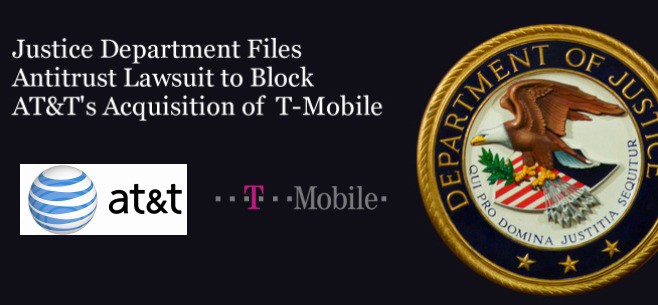
Now that the initial shock of an aggressive — some say “audacious” — move by the Justice Department to block a merger AT&T confidently called “a done deal” is past, analysts of all kinds are attempting to discern the inside reasons for the merger’s rejection, where the deal can go from here, and what signals this will send the rest of America’s telecom industry.

In short — was this one merger proposal too far over the line?

The Justice Department reviewed reams of data, document-dumped by AT&T, on the company’s rationale for wanting to absorb T-Mobile and its implications for employees, consumers, and the dwindling number of wireless competitors.

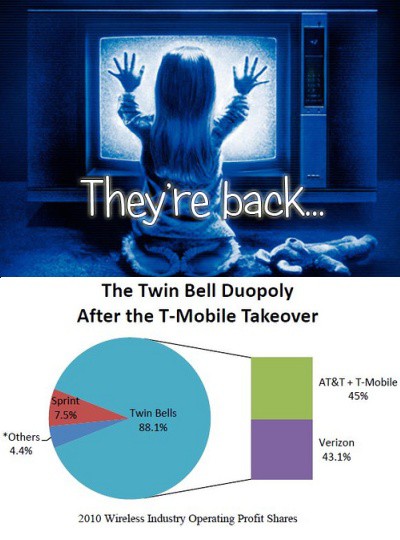
They quickly discovered they did not like what they were seeing:  an all-new AT&T with a combined 132 million wireless customers, completely dwarfing all of their competitors and signaling a full-scale retreat from the company’s historic landline network.  An unregulated, increasingly concentrated wireless marketplace, represents the Wild West of fat profits, ripe for the picking by those large enough to control the market.  Increasingly, that means two former Baby Bells — AT&T and Verizon.

The Wall Street Journal charted more than two decades of mergers and acquisitions, which reduced nearly two dozen players down to five supersized telecom companies.

The Politics

Decisions at Justice are hardly made in a vacuum.  Politics always plays a role, and it’s a safe bet Obama Administration officials well-above rank-and-file lawyers in the Antitrust Division sent clear signals to the Department about how it wanted the review handled.  After all, this same team of lawyers had almost no trouble approving a mega-merger between NBC-Universal and Comcast Corporation, not finding anything ‘antitrust’ about that deal.  But Justice officials hurried out their own lawsuit with a wide-ranging, harsh condemnation of the deal at yesterday’s press conference.  As most Americans already know, competition in the cable industry is hardly robust, but market concentrating mergers and acquisitions are approved regularly in that industry.  So why did the Justice Department have such a problem with AT&T?

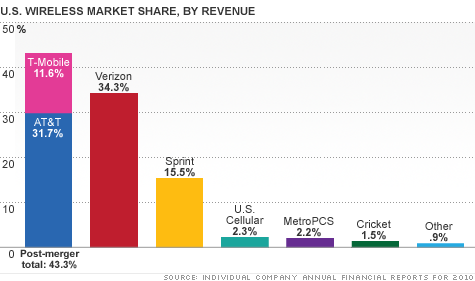
America's Wireless Market: Beyond well-behind, third-place Sprint, no other carrier comes close to AT&T or Verizon Wireless.

Many analysts seem to blame the company’s “arrogance” in telling reporters the merger was a breeze to be approved, others point to spectrum issues, as well as complaints about AT&T’s poor service potentially ensnaring T-Mobile customers.  But above all, Justice lawyers believe that America’s wireless marketplace needs at least four national wireless carriers, particularly scrappy T-Mobile, which has a long history of being a disruptive player in the market, loathe to offer the kind of “identical twin”-pricing common at AT&T and Verizon Wireless.  Losing T-Mobile’s aggressive performance in the market would mean declaring open season for price increases and abusive business practices.  After all, where would wireless consumers go?

That “four national carrier”-test could be a big problem for T-Mobile, as it could mean Justice lawyers would also reject an presumed alternative — combining Sprint and T-Mobile,  rumored before AT&T moved in and stole the show.  A new entrant willing to buy-out Deutsche Telekom’s U.S. wireless interests may be the only palatable solution acceptable to Justice lawyers because it would keep T-Mobile intact and running, independent of other wireless carriers.

Justice also completely discounted the relevance of regional carriers like MetroPCS, Cricket, U.S. Cellular, and other smaller providers.  The reason is simple: roaming.  All of these smaller providers are completely dependent on the four large national carriers to deliver essential roaming services for their customers who travel outside of the regions where these smaller companies deliver service themselves.  All national carriers would have to do to control an overly-competitive “problem” carrier is withdraw roaming agreements or raise prices for them.

Sprint, among others, is obviously the most relieved by yesterday’s events.  Their long term viability as a national carrier dwarfed by AT&T and Verizon Wireless would have raised numerous questions about whether that company could survive in the long term.  Sprint would have also felt pressure to beef up its own operations, likely through acquisitions of several regional carriers, particularly MetroPCS and Cricket, which share its CDMA network standard.

Wall Street is livid, of course.

The great gnashing of teeth has begun on Wall Street, evident as stock analysts begin raising questions about President Obama’s “anti-business” policies.  While executives at both AT&T and T-Mobile are at risk of losing substantial bonuses for pulling the deal off (and providing special retention packages to keep key talent from leaving), there is also a lot of money to be lost in New York and Washington should the deal collapse.  Take the “little people” that will be out tens of millions in deal fees and proceeds from extending credit, implementing the merger itself, and structuring the legal mechanics.  They include:

Arnold & Porter: The now infamous law firm that accidentally posted an un-redacted document on the Federal Communications Commission website that exposed, in AT&T’s own words, what consumer groups already strongly suspected: AT&T preferred the long term benefits of knocking pesky T-Mobile out of the marketplace, even though the $39 billion dollar price tag dwarfed the $4 billion estimated cost of building AT&T’s own 4G LTE network.  That’s the 4G network executives deemed “too expensive” earlier this year.  With a deal collapse, the firm can say goodbye to lucrative legal fees and perhaps more importantly, their reputation of properly managing their clients’ business affairs.

Greenhill & Co.: Greenhill is one of several all-star, platinum-priced advisory firms hired by companies acquiring other companies to structure and implement their mergers.  With Greenhill hoping for a substantial piece of at least $150 million set aside by AT&T to cover these specific costs, a merger-interrupted could cost key people some nice year-end bonuses.

JPMorgan (Chase): The House of J.P. Morgan handed over a check for AT&T worth up to $20 billion to help finance the deal.  JPMorgan doesn’t do that for free.  In addition to any interest proceeds, JPMorgan also charges a range of underwriting and administrative fees that could easily total $85 million dollars.  AT&T might have to send the check back.

Cable Business News & Business Media: One of the most ironic developments watching the Justice Dept. decision unfold was the unintentional amount of AT&T advertising promoting the merger that preceded video reports and appeared adjacent to AT&T-related stories.  Those ads may soon end, costing cable news and the business press substantial ad revenue.

Cable business news networks offered up scathing analyses. Among anchors and analysts upset with the news of the merger’s potential derailment, it didn’t take long for “couched questions” to begin, pondering whether President Obama was against big companies, jobs, or the concept of the private sector in general.  Completely missing: coverage of the benefits for consumers who potentially don’t have to endure a further concentration in the wireless marketplace.

Craig Moffett from Sanford Bernstein, who usually celebrates all-things-cable, today told the Wall Street Journal the actions at Justice will harm business at every U.S. wireless carrier.

“Put simply, the industry will be structurally less attractive than it would otherwise have been,” he said. “Pricing is likely to be less stable, and profound technological risks, including free texting and bandwidth arbitrage, that would be manageable in the context of a significantly consolidated industry now become much more threatening.”

Judge Ellen

In other words, a hegemony of AT&T and Verizon Wireless could play rough with third party developers trying to undercut text message pricing and deliver data plan workarounds. With more competitors, consumers could simply abandon abusive providers.  Without those competitors, consumers have to pay AT&T’s asking price or go without service.

The Law

AT&T may be hoping it scored one potential success in its anticipated legal challenge against the Justice Department’s antitrust case.

The judge assigned to hear arguments is Ellen Segal Huvelle, who has a track record of slapping down government overreach.  Huvelle previously rejected Justice Department objections to the merger of SunGard and Comdisco — two disaster-recovery businesses.  The government argued the merger would leave just two major players in that business.  Judge Huvelle dismissed that, claiming the government too-narrowly defined what a disaster-recovery business entailed.  If she finds AT&T’s arguments of robust competition from regional carriers, landlines, and Voice Over IP credible, Justice lawyers may have a problem.  So could consumers.

[flv width=”512″ height=”308″]http://www.phillipdampier.com/video/PBS Audacious Move to Block Merger 8-31-11.flv[/flv]

PBS Newshour explores where the AT&T/T-Mobile merger goes next, now that the Justice Dept. sued to stop it on antitrust grounds.  (7 minutes)

AT&T’s $3 Billion Dollar Early Contract Termination Fee, Payable to T-Mobile

Any consumer who has ever paid an early termination contract cancellation fee to a wireless carrier might feel a little satisfaction today knowing AT&T’s languishing deal to acquire T-Mobile comes with its own $3 billion dollar penalty payable to Deutsche Telekom if the merger fails to come to fruition.

Sachin Shah, merger arbitrage strategist with Tullett Prebon Americas Corp., suggests that $3 billion dollar fee (and the spectrum giveaway that goes with it) delivers a real incentive for AT&T executives to find a way to force the deal through, and their next venue will likely be federal court in the District of Columbia to keep the government from getting a preliminary injunction against the merger deal.

For AT&T, any legal action will certainly cost far less than $3 billion dollars, so the company has little to lose rolling the dice trying to find a remedy in a district court that has become increasingly business-friendly.

Shah believes yesterday’s announcement by the Justice Department also provides additional paths for AT&T to consider:

  • Renegotiate the deal: AT&T could go back to the bargaining table with T-Mobile and return to the DOJ with an amended proposal it hopes will be more acceptable to the government’s antitrust lawyers;
  • Reboot the lobbying campaign: AT&T could claim scuttling the deal will cost American jobs — a particularly sensitive topic with unemployment around 9 percent;
  • Re-engage AT&T Employee Unions: The Communications Workers of America are true believers in the AT&T/T-Mobile deal, if only because it is likely to broaden union membership to include T-Mobile workers.  Shah thinks the unions might speak to a more receptive audience among certain union-friendly lawmakers who have also been concerned AT&T will use the merger to clear-cut T-Mobile’s employees.

Shah thinks the Justice Department has not entirely slammed the door shut on AT&T’s proposed merger, and there have been precedents of DOJ lawyers changing their minds.

Meanwhile, the Federal Communications Commission, quieter than a church mouse ever since the deal was announced, apparently found cover from the DOJ decision, and FCC Chairman Julius Genachowski delivered his own “me too” statement hours after the Justice Department announced their lawsuit:

“By filing suit today, the Department of Justice has concluded that AT&T’s acquisition of T-Mobile would substantially lessen competition in violation of the antitrust laws,” Genachowski said. “Competition is an essential component of the FCC’s statutory public interest analysis, and although our process is not complete, the record before this agency also raises serious concerns about the impact of the proposed transaction on competition. Vibrant competition in wireless services is vital to innovation, investment, economic growth and job creation, and to drive our global leadership in mobile. Competition fosters consumer benefits, including more choices, better service and lower prices.”

[flv width=”640″ height=”380″]http://www.phillipdampier.com/video/Bloomberg DOJ Lawsuit Not Unexpected 8-31-11.flv[/flv]

Sachin Shah says the U.S. Justice Department’s lawsuit to block AT&T Inc.’s proposed $39 billion takeover of T-Mobile USA Inc. does not mean the deal is dead.  He speaks with Lisa Murphy on Bloomberg Television’s “Fast Forward.”  (5 minutes)

Search This Site:

Contributions:

Recent Comments:

Your Account:

Stop the Cap!