Home » Competition » Recent Articles:

Frontier’s Internet Service Nightmare on Florida’s Panhandle: 6 Major Outages in 3 Months

Phillip Dampier September 13, 2011 Broadband Speed, Competition, Consumer News, Data Caps, Frontier, Rural Broadband Comments Off on Frontier’s Internet Service Nightmare on Florida’s Panhandle: 6 Major Outages in 3 Months

Frontier Communications customers in North Escambia have spent a very frustrating summer trying to use Frontier’s Internet service.  The phone company has left their Internet customers in Walnut Hill, Bratt, Molino and Atmore (Ala.) offline from at least six major outages since June, often lasting as long as 12 hours at a time.

“This is happening way too often, with no reimbursement for not having the service,” says Frontier customer Susan. “It is crazy to pay as much as we do for dinosaur equipment. I was being charged for High Speed Max for over three years and was actually only getting 756kbps. When we found this out, they only gave me credit for half of what they were overcharging me.”

Frontier Communications blamed AT&T for the latest outage, which lasted nearly eight hours.

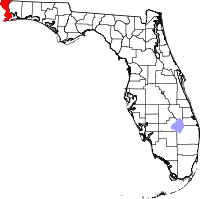
Escambia County, Fla.

Karen Miller, spokesperson for Frontier, said the outage occurred when an AT&T fiber line was cut near Bay Minette, interrupting the connection between Atmore and Atlanta.

Miller admitted Frontier has just a single strand of fiber optic cable for their Panhandle customers.  When something happens to that fiber, there is no backup and service goes offline… for everyone.

Without redundancy, Internet customers are at the mercy of AT&T, and any contracting work done between Atlanta and Atmore.  That’s a major problem for some Frontier customers.

“If Atmore and Northwest Florida is managed with only a single cable and the [connection] point of this service is at Bay Minette, Atmore is in bigger trouble than they know,” writes JimD.

Bay Minette is vulnerable to serious Gulf hurricanes.

Customers were also not happy to learn Frontier was largely blaming AT&T, particularly as some customers pay Frontier upwards of $50 a month for less than 1Mbps service that has failed them at least a half-dozen times in the past 90 days.

“Frontier routinely gives high cost deficient service and holds a monopoly on the local market,” writes one local customer. “It is nearly impossible for businesses to find another option. It’s a case of mind over matter: they don’t mind so we don’t matter.”

Miller says Frontier is currently conducting an engineering study to get a backup fiber route from Atmore to Atlanta, but for some customers it is too late.

“We switched to Bright House Networks for both Internet and landline service,” says another customer. “It’s better quality, less expensive and it works. No more Frontier-anything for us.”

Regarding the Chicago Tribune’s Clueless Editorial Advocating the AT&T/T-Mobile Merger…

The Chicago Tribune‘s advocacy for the merger of AT&T and T-Mobile leaves the facts far behind, and raises questions about just how much the newspaper understands about telecommunications company mergers.

In this morning’s edition, the newspaper claims efforts by the Justice Department to block the merger will “slow [wireless] progress to a crawl.” That’s a half-baked conclusion, considering AT&T’s own accidentally-public internal documents reveal a willingness to spend $39 billion on a merger while balking at spending one-tenth of that amount to upgrade its own 4G network.  The injury to rural America the Tribune fears most was self-inflicted by AT&T even before the merger was announced.

Access to advanced wireless Internet is the key. A merger of AT&T and T-Mobile would bring an under-served swath of America into the 21st century of high-speed mobile data communication. Much like the rural electrification movement of the 1930s, this deal offers a chance for many Americans to leap ahead technologically.

If Justice gets its way, progress will slow to a crawl. We think the FCC should approve the merger after obtaining appropriate concessions — and Justice should settle its case sooner, not later. Dragging out this proceeding stands to hurt a nation that can ill afford more damage from a government too often hostile to business interests.

Evidently the editorial writers at the Tribune have been drinking AT&T’s Kool-Aid.  There is more to see here than AT&T’s advocacy kit, if one is willing to look beyond lucrative, saturation advertising campaigns and lobbying.

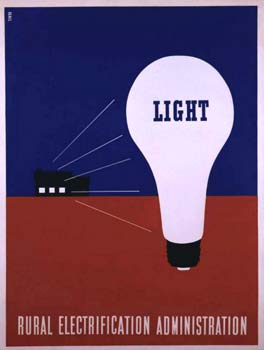
The government got the bright idea of helping wire rural America for electricity when commercial providers refused.

AT&T’s own merger announcement spoke glowingly of the “increased efficiencies” a more concentrated wireless marketplace will deliver, but said very little to investors about T-Mobile’s cellular network being the key to unlock rural wireless.  The reason is simple: T-Mobile doesn’t have a rural wireless network.  In fact, T-Mobile’s long-standing focus on urban markets means considerable duplication of resources in medium and large cities — resources that might help reduce the number of dropped calls in cities like New York, Chicago or San Francisco, but hardly a boon for residents of Ottumwa, Iowa, who barely get a signal today from AT&T, much less T-Mobile.

We agree with the Tribune editors when they say improved advanced wireless Internet is important to rural America. But nothing within AT&T’s massive document dump guarantees rural 4G service, especially after four national companies judged it didn’t make much business sense.  Three national carriers hardly strengthens the case.  In fact, investors will expect AT&T to use precisely the same Return on Investment-formulas that have always ruled rural 4G wireless out of bounds.

The Tribune forgets rural electrification came in spite of private power companies, who viciously opposed government electrification projects (unless they benefited from them).  The reason rural Americans went without electrical service until the late 1930s was the same reason rural Iowa doesn’t have lightning-fast 4G service — it doesn’t make much business sense to provide it.

When President Franklin D. Roosevelt declared electricity an essential utility service every American should be able to access at a fair price, government resources picked up where Wall Street left off — financing electric generation projects and encouraging the development of power cooperatives and municipal utilities. It often took more than 20 years to pay off the costs of the infrastructure — at a price (and wait) unwilling to be covered by giant power companies like Chicago’s Commonwealth Edison at the time.

It’s much the same story for AT&T today.  The enormous telecommunications company was provided an estimate of $4 billion to upgrade its network to 4G service nationwide.  Company executives refused, suggesting the time required to recoup that investment was too far out for their tastes.  But a $39 billion dollar merger with T-Mobile, despite the much higher price tag, delivers immediate benefits they can take to the bank: decreased competition and pricing innovation.  T-Mobile delivers both on its own, and even in fourth place influenced the service plans and pricing at other wireless carriers.  By eliminating that competition, the pressure to reduce prices or enhance service is diminished.  The ability to raise prices, or reduce the number of services, is enhanced.

Astonishingly, the Tribune writers completely ignore the biggest reason why AT&T cannot afford to slow progress to a crawl.  Its name is Verizon Wireless, and AT&T ignores its own network at its peril.  That’s why competition, even from America’s #4 carrier, remains critically important.

While the Chicago Tribune seems comfortable rallying for the cause of one of their advertisers — a multi-billion dollar corporation it sees as a victim of government “anti-business” hostility, we’re more concerned about protecting American wireless consumers from the results of AT&T’s efforts to cut competition (and consumer-friendly services) to a bare minimum.  AT&T’s carrot is the illusory promise of enhanced wireless service in rural communities the company routinely ignores.  The Justice Department, thankfully, prefers the stick — recognizing an anti-competitive, anti-trust feeding frenzy when it sees one, and is correct when it gives it a good whack.

Sprint Files Its Own Lawsuit Against AT&T/T-Mobile Merger As the Bickering Begins

Phillip Dampier September 6, 2011 AT&T, Competition, Public Policy & Gov't, Sprint, T-Mobile, Wireless Broadband Comments Off on Sprint Files Its Own Lawsuit Against AT&T/T-Mobile Merger As the Bickering Begins

Not satisfied with relying on the U.S. Department of Justice to protect the competitive marketplace for cell phone service, Sprint Nextel today brought suit against AT&T, Inc., AT&T Mobility, Deutsche Telekom and T-Mobile seeking to block the proposed acquisition as a violation of Section 7 of the Clayton Act. The lawsuit was filed in federal court in the District of Columbia as a related case to the Department of Justice’s (DOJ) suit against the proposed acquisition.  It has been assigned to the same judge handling the Justice Department’s own lawsuit — Judge Ellen S. Huvelle.

“Sprint opposes AT&T’s proposed takeover of T-Mobile,” said Susan Z. Haller, vice president-Litigation, Sprint. “With today’s legal action, we are continuing that advocacy on behalf of consumers and competition, and expect to contribute our expertise and resources in proving that the proposed transaction is illegal.”

Sprint’s lawsuit focuses on the competitive and consumer harms which would result from a takeover of T-Mobile by AT&T. The proposed takeover would:

  • Harm retail consumers and corporate customers by causing higher prices and less innovation;
  • Entrench the duopoly control of AT&T and Verizon, the two “Ma Bell” descendants, of the almost one-quarter of a trillion dollar wireless market. As a result of the transaction, AT&T and Verizon would control more than three-quarters of that market and 90 percent of the profits;
  • Harm Sprint and the other independent wireless carriers. If the transaction were to be allowed, a combined AT&T and T-Mobile would have the ability to use its control over backhaul, roaming and spectrum, and its increased market position to exclude competitors, raise their costs, restrict their access to handsets, damage their businesses and ultimately to lessen competition.

Sprint believes that in a marketplace dominated by AT&T and Verizon Wireless, the two largest players would likely collude on pricing and terms of service rather than compete heavily against one-another.  Sprint’s assumptions may already be true, considering both companies largely charge near-identical prices for service.

While Sprint proceeds with its own legal action, squabbling has broken out over whether or not AT&T so carefully crafted the terms and conditions of their $6 billion “breakup fee,” payable to T-Mobile USA if the merger fails, that it almost guarantees AT&T will never have to pay it.

“Under its agreement with Deutsche Telekom, the deal is only valid if the acquisition receives regulatory approval within a certain time frame,” an anonymous source told Reuters. “Also, the agreement could become invalid if regulatory conditions for the sale push the value of T-Mobile USA below a certain level.”

T-Mobile, unsurprisingly, disagrees with that characterization.

A Deutsche Telekom spokesman said Tuesday that AT&T could retreat from the transaction if the concessions necessary to get approval amount to more than $7.8 billion, but added Deutsche Telekom would still be entitled to receive the break-up fee package, which includes cash and wireless spectrum.

“Comcast’s 250GB Usage Cap is Ruining My Family”

Too bad Comcast doesn't allow their Internet customers to use the service until 'xfinity.'

A Comcast customer of seven years has been warned if he exceeds the company’s arbitrary 250GB usage cap one more time, his family will be cut off from the cable company’s Internet service for one year.

Jrodefeld is just one more example of a customer who never thought he would have to monitor an online usage gauge to enjoy the Internet service he pays good money to receive.  But Comcast has deemed him an Internet abuser for exceeding a usage limit the company takes pains to bury in its lengthy terms and conditions, far away from glitzy marketing promising a fast, always-on experience.

In my house there are five people with five computers, several smartphones, a Playstation 3 and AppleTV all connected to the Internet through a wireless router.  Several of us are tech minded people who need to be able to send and receive large amounts of data through our network and publish material on the Internet.

Not only that, but I have (legally) downloaded films through places like iTunes and downloaded games and software in the same manner.  I create digital content (web pages, animation, other content) and publish it on the Internet. Not only that, but I send this content to friends and colleagues through web hosting sites like Netload.  I download games and watch streaming Netflix through my Playstation 3.

I think it is absolutely beyond belief that Comcast can offer the speeds that they do, with the evolving demands of the Internet and modern digital demands that people have, and think that 250GB is sufficient for even the moderately tech savvy user.  This data cap is absolutely horrible and is an insult to my family and an abomination given how much money we have given to Comcast over the last several years for their service, amounting in the thousands of dollars.  Not to mention that we signed up with the idea of getting an “always on”, unlimited service.

Jrodefeld claims his family steers clear of the usual suspect of heavy usage consumption — peer-to-peer software.  But with five tech-savvy teenagers and high-tech workers living under one roof, Comcast’s usage meter reflected the family was several times over the company’s usage limits:

  • In May, 2011 the total data used was:  1363GB
  • In June, 2011 the total data used was:  758GB
  • In July, 2011 the total data used was:  1271GB

Based on a review of the applications being run by those achieving that level of usage, online file backup is usually the culprit generating the most usage.  That is closely followed by avid online streaming and gaming.  While game-play itself is probably not much of a factor, the relentless number of game updates and new games distributed over an Internet connection can easily exceed several gigabytes each.  The family also streams some very high bitrate HD movies over a video rental service that uses their Comcast Internet connection to provide the video.  That can run nearly 10GB an hour in some cases, Jrodefeld says.

For usage cap opponents, this represents the perfect example of what can happen in families that rely on video streaming and have teenagers living at home.  While one individual may have little trouble staying within Comcast’s arbitrary 250GB limit, unchanged since its introduction in 2008, the more Internet-savvy members in a household sharing a connection, the bigger the risk for Internet Overcharging or a warning e-mail.

Comcast says their average user keeps usage well under 10GB per month.  But they don’t provide any demographic breakdown of usage profiles.  Older households may pay for an Internet account exclusively for web browsing and e-mail.  Younger households, those with teenagers, and cord-cutters who rely on Internet video streaming will almost certainly use considerably more.

Jrodefeld can’t believe Comcast has stuck his family with a “one size fits all” Internet experience.  And their reasons for the 250GB usage cap don’t make any sense.

“On the one hand, it is said that a user going over that threshold hurts the Internet experience for other users in your area, and on the other hand Comcast claims that the ‘average’ user uses only 2-4gb per month,” he notes. “If that is the case, then multiple users who average 250GB a month would slow down the Internet far more than one individual who uses, say, 500GB in a month.”

“If such a small number of users exceed the cap, Comcast’s network should easily be able to allow that without it affecting other users,” he argues. “If, on the other hand, many users are exceeding the cap, it means that the limit is far too small and Comcast should upgrade their infrastructure if they cannot keep up with user demands.”

The cap-free alternative for Comcast's "heavy users."

In fact, Comcast has upgraded the Internet experience for most of their customers considerably since they introduced a usage cap.  The company has aggressively deployed DOCSIS 3 upgrades, exponentially increasing the amount of bandwidth available in individual neighborhoods, allowing them to sell highly-profitable, faster tiers of service and eliminating congestion issues.  But no matter what speed you buy, or how much you spend, Comcast imposes the same 250GB usage limit on all residential accounts.

Comcast company officials had nothing to offer Jrodefeld, but several other Comcast customers did: upgrade to a Business Class account, if only to be rid of the usage limits.  Comcast Business Class service currently has no usage limitations, and carries this pricing in the northeast, before taxes and fees:

  • Starter Plan — 12/2Mbps:  $59.95/mo Best Value
  • Preferred Plan — 16/2Mbps:  $89.95/mo
  • Premium Plan — 22/5Mbps:  $99.95/mo Best Speed/Performance Value
  • Deluxe Plan — 50/10Mbps:  $189.95/mo
  • Installation Fee: 1 year contract = $199, 2 years = $99, 3 years = $49

The alternative is to sign with a telephone company provider, but AT&T also has a 250GB usage limit on their U-verse service, and charges an overlimit fee of $10 for every 50GB of excess usage.  Verizon FiOS offers unlimited service.

EastLink Rolling Out Its Own Wireless Mobile Data Network

Phillip Dampier September 6, 2011 Broadband Speed, Canada, Competition, EastLink, Rural Broadband, Wireless Broadband Comments Off on EastLink Rolling Out Its Own Wireless Mobile Data Network

Canada’s largest privately owned telecommunications provider is getting into the mobile broadband business.

EastLink, which owns cable systems in communities across nine provinces, is constructing its own mobile phone and data network set to launch in 2012.  Part of that network will be its own competitive wireless mobile broadband service.

EastLink is using licensed wireless spectrum acquired in a 2008 federal auction which will allow it to provide cell service in Newfoundland, New Brunswick, north and southwest Ontario, and the metropolitan region of Grand Prairie, Alta.  But its first priority is delivering service on Prince Edward Island and in Nova Scotia, where EastLink is based.

“With this network evolution, our customers will be able to work and communicate more reliably and faster than ever before,” said Matthew MacLellan, president of EastLink Wireless.

EastLink subsidiary Delta Cable delivers cable service in western Canada.

EastLink’s new wireless network will use HSPA technology, presumably at the speeds most common in Canada — 21 or 42Mbps.  Ericsson is providing the equipment for the network.

EastLink has nearly a half-million customers, a tiny number in comparison to market leaders Bell, Rogers, and Telus.  But the company has a reputation for delivering advanced service, and is well-regarded in Atlantic Canada, especially for delivering Internet at speeds up to 100Mbps.

“They have a very strong reputation so they’ll be likely to shake up the market down there,” Brownlee Thomas, principal analyst at Forrester Research Inc., told The Wire Report.

EastLink’s primary focus is on its Canadian subscribers, but the company has also investments in Bermuda, and its subsidiary Delta Cable delivers service to one American community — the enclave of Point Roberts, Washington, located south of Delta, British Columbia.

Search This Site:

Contributions:

Recent Comments:

Your Account:

Stop the Cap!