Home » Broadband Speed » Recent Articles:

Frontier’s Low-Fiber Diet: ‘Most Users Don’t Need Ultra-Fast Internet Access,’ Says Company Official

Frontier's headquarters in Rochester, N.Y.

Frontier Communications has dismissed the proposition of Google constructing a 1Gbps fiber-to-the-home network, telling readers of the Rochester Democrat & Chronicle that most users don’t need ultra-fast Internet access.

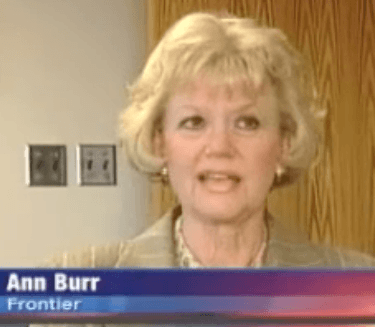
Ann Burr, chairman and general manager of Frontier Communications of Rochester made the remark in response to news that citizens and business leaders are excited about promoting Monroe County as a potential test location for Google’s fiber network experiment.

Frontier, which serves Rochester and most of the 585 area code, accused Google of having “a poor track record of following through on such proposals and that creating a fiber-optic network from scratch would be enormously expensive.”

Pot to kettle.  Frontier’s illusory promises for fiber optic connectivity in states like West Virginia, where it seeks to take over the majority of the state’s phone customers from Verizon, never seem to include specific assurances such projects will reach customer homes.

“If Google built its own network, we estimate it would cost $5,000 per household,” Burr told the newspaper.

That’s as exaggerated as Frontier’s DSL speed claims.

Verizon Communications, which is in the business of providing fiber connectivity to the home, disclosed the true costs are far lower than that, and continue to decline.  In the summer of 2008, Verizon’s Policy Blog noted:

Capital Costs
– We said our target per home passed was $700 by 2010, and we are ahead of plan to achieve that objective. In fact, we’ve already beaten the target.
– We said our target per home connected was $650 by 2010, and we’re on plan to hit that target.

No wonder Frontier doesn’t contemplate providing fiber service to customers.  It created its own sticker shock.

Still, the local phone company didn’t want to slam the door entirely on Google’s foot, suggesting it would be willing to talk about leasing space on Google’s network if it launched in the Flower City.

Frontier’s claim that customers don’t believe fast broadband service is important is a remarkable admission, particularly for a company that increasingly depends on broadband service to stop revenue loss from customers dropping traditional phone lines.  That philosophy should be carefully considered by state officials and utility commissions reviewing Frontier’s proposal to take over Verizon phone lines in several states.  Do communities want to receive broadband from a company that dismisses faster broadband speed as irrelevant for the majority of its customers?

Perhaps the remarks came with the understanding Frontier isn’t capable of delivering 21st century broadband speeds over its antique network of copper telephone wire anyway.

That’s the point Time Warner Cable has made repeatedly, especially in the Rochester metro area.  The cable operator routinely promotes its Road Runner cable modem service’s speed advantages over Frontier’s DSL product.  Frontier promises up to 10Mbps, but often manages far less (3.1Mbps was my personal experience with Frontier DSL last April.)  Time Warner Cable promises up to 15Mbps, and often exceeds that with its “PowerBoost” feature.  In rural areas, the phone company tops out at “up to 3Mbps.”  Time Warner Cable notes most of its new broadband customers come at the expense of phone companies like Frontier.  DSL customers switch because they do care about broadband speed.

Judging from the excitement in Rochester over Google’s proposal, Frontier’s dismissal of a fiber optic future seems out of touch, and potentially a drag on the local community’s economic future.

Rochester increasingly will become a broadband backwater because of anemic broadband competition from Frontier Communications.  Its reliance on ADSL technology, more than a decade old, to deliver distance-sensitive broadband service looks out of place compared with the rest of New York State.  Major cities throughout New York are being wired with fiber optic service by Verizon Communications.  Verizon FiOS delivers up to 50Mbps service.  Frontier maxes out at far lower speeds and defines an acceptable amount of broadband usage on its DSL service at just 5GB per month. Using Verizon’s FiOS fiber network, you’d exceed Frontier’s entire month’s ‘allowance’ in less than 15 minutes at Verizon’s speeds.

Rochester is one of many communities challenged by the transition away from a manufacturing economy towards a high technology future.  A world class fiber optic network doesn’t just benefit big business.  It spurs revolutionary growth in medicine, education, software development, telecommunications, and more.  That means good paying jobs.  For consumers with fiber to the home, it opens the door to telecommuting on a whole new level, distance learning opportunities, new ways to access information and entertainment, and allows home-based entrepreneurs to develop new businesses.

With Verizon FiOS unavailable to Rochester indefinitely, and Frontier unwilling to make appropriate investments to keep this city competitive with the rest of upstate New York, those jobs and economic benefits can go to Buffalo, Syracuse, Albany, Westchester County, and metropolitan New York City.  We’ll be held back on the frontier with Frontier and its ideas of rationed broadband service.

[flv width=”360″ height=”260″]http://www.phillipdampier.com/video/WROC Ontario County Makes Bid for Super Fast Internet 2-11-2010.flv[/flv]

WROC-TV in Rochester reports that Ontario County, to the southeast of Rochester, may have a built-in advantage with an already-installed fiber loop covering much of the county.  The county has a team working on a formal application to Google to provide service in communities like Geneva and Canandaigua.  Frontier’s claims that consumers don’t care about fast broadband speed are belied by the excitement of residents of both counties. (2 minutes)

Suddenlink To Boost Internet Speeds In Lubbock and Midland Texas – New 36/2 Mbps Tier Also On The Way

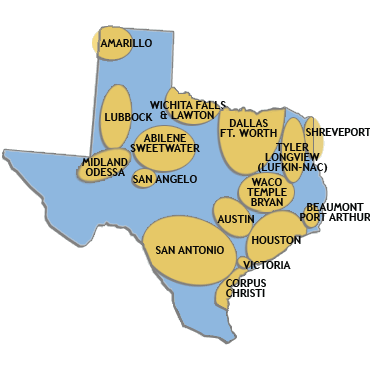
Suddenlink broadband customers in Lubbock and Midland, Texas will soon have a new option to boost their broadband speed to 36Mbps.  Dubbed MAX36, the new tier leaps over the cable company’s former top broadband speed of 20Mbps.  Upload speeds get a boost as well — to 2Mbps.

Multichannel News reports pricing for the new tier depends on how many other Suddenlink services you have.  Standalone pricing is $75 per month.  Bundle it with television or telephone service and the price drops to $65.  Take all three services and MAX36 costs $60 a month.

Suddenlink serves portions of these Texas communities

If that is too rich for your blood, Suddenlink next week will be providing existing broadband customers in Lubbock and Midland free speed upgrades:

  • 1Mbps service increases to 1.5Mbps
  • 8Mbps upgrades to 10Mbps service
  • 10Mbps service becomes 15Mbps

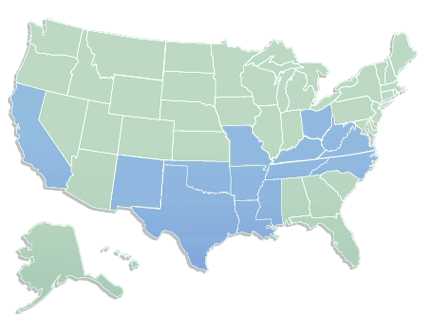
The new speeds are possible because of DOCSIS 3 upgrades underway at the nation’s ninth largest cable operator.  Suddenlink has focused on DOCSIS 3 upgrades for many of its Texas systems, including Abilene, Bryan/College Station, Georgetown, Lubbock, Midland, San Angelo and Terrell.  The operator also deployed the technology in Beckley, Charleston and Parkersburg, West Virginia, as well as Jonesboro, Arkansas, Humboldt County, California, and Nixa, Missouri.  The company hopes to upgrade 90 percent of its cable systems within the next two years.  Nationwide, Suddenlink reaches 1.3 million subscribers.

Last summer Suddenlink introduced a usage meter for subscribers in Clovis, New Mexico and included a chart of what constituted average usage for its customers.

Suddenlink's national service area

The company openly admits it limits customer use of its broadband service is several communities where bandwidth upgrades have yet to occur, but at least drops communities from the usage limit list after expansion is complete.  As of February 4th, communities impacted by usage limits include:

  • Arkansas: Charleston, Hazen, Mt. Ida, Nashville
  • Kansas: Anthony, Fort Scott
  • Louisiana: Ville Platte
  • Missouri: Jefferson City, Maryville
  • Oklahoma: Fort Sill, Healdton, Heavener, Hughes, Idabel
  • Texas: Albany, Anson, Brenham, Burkburnett, Caldwell, Canadian, Center, Claredon, Crane, Dimmitt, Eastland, Electra, Hamlin, Henrietta, Junction, Kermit, Monahans, Nocona, Olney, Paducah, Rotan, San Saba, Seymour, Sonora, Trinity, Vernon, Wellington

Suddenlink also admits it engages in “network management” techniques which may spark controversy with the ongoing Net Neutrality debate, despite its declaration it “allows customers to access and use any legal Web content they prefer, thus honoring the principles of network neutrality.”

In addition to “mitigating network congestion, which can interfere with customers’ preferred online activities,” Suddenlink also discloses it “prioritizes certain latency-sensitive traffic such as voice traffic.”

Still, performing system upgrades to put a stop to usage limits and allowances is a move in the right direction, one that other providers seeking to monetize broadband traffic with Internet Overcharging schemes are loathe to take.

[flv width=”640″ height=”500″]http://www.phillipdampier.com/video/Suddenlink Ads.flv[/flv]

Watch some of Suddenlink’s more creative and amusing advertising. (2 minutes)

Ohio Public Utilities Commission Approves Transfer From Verizon to Frontier Communications

Ohio utility regulators today approved the transfer of telephone service from Verizon North to Frontier Communications with some conditions attached.  The transition will make Frontier Communications the state’s second largest telephone company behind AT&T.

Regulators negotiated conditions with Frontier officials that requires the company to:

  • deploy broadband facilities in 85 percent of Verizon’s current Ohio service area by the end of 2013;
  • freeze basic local telephone rates in Frontier’s service territory at current levels until broadband deployment reaches 85 percent;
  • invest in service upgrades in each of the next three years amounting to $50 million in infrastructure improvements;
  • agree to track and report service outages and how Frontier responds to them.

The company has committed to keep on nearly 1,000 Verizon North employees in Ohio.  Opponents expressed concern that pressure to cut costs post-merger would have come at the expense of employees.

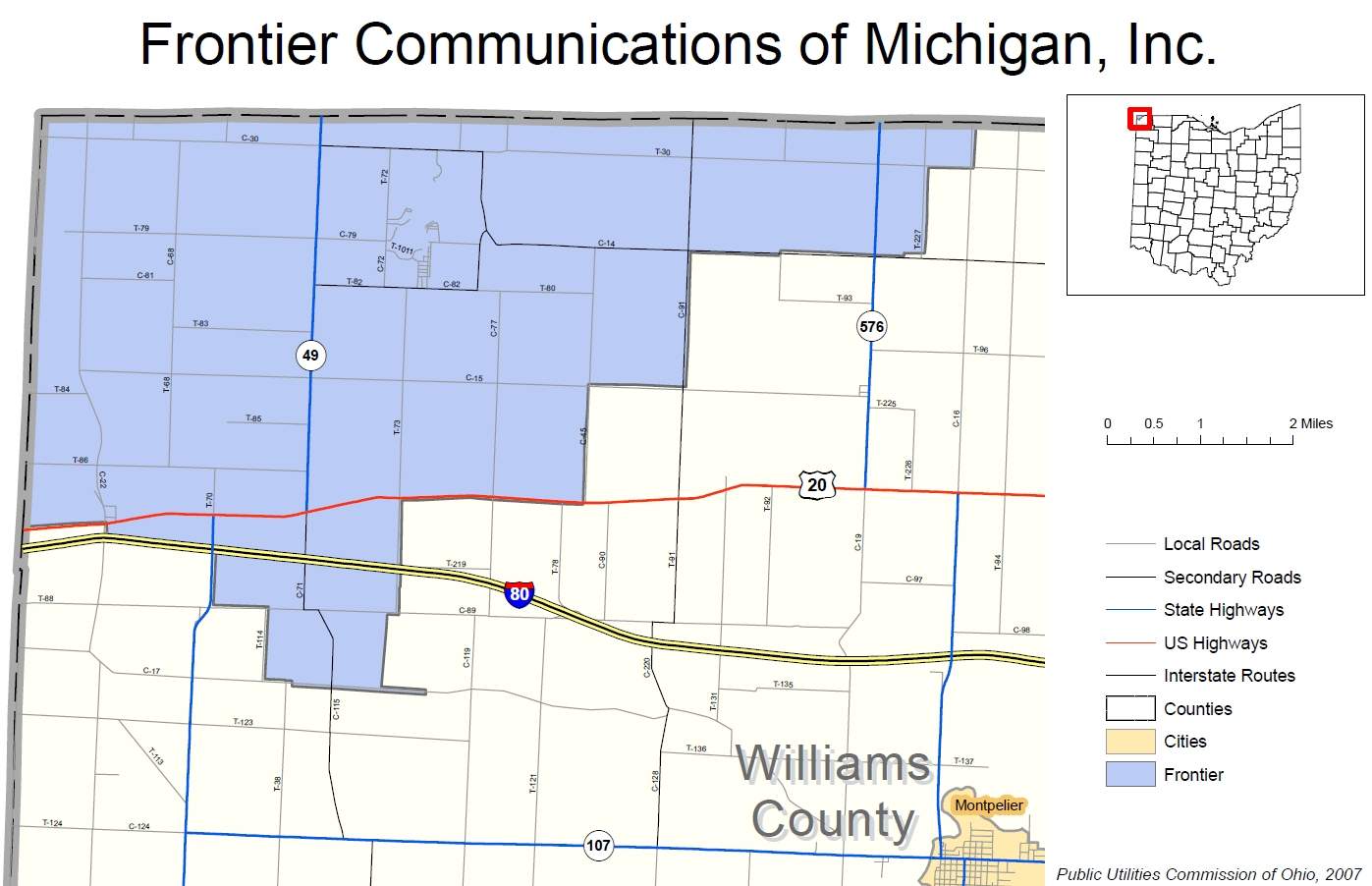
Frontier's current service area in Ohio is a tiny portion of Williams County, serving just 480 residents from an office in Michigan (click to see a color map of the service area)

Ohio residents are largely unfamiliar with Frontier Communications.  Prior to the merger, just 480 residents in a tiny portion of Williams County in northwest Ohio had Frontier telephone service, served by Frontier Communications of Michigan’s office in Osseo, Michigan.

Right now, residents of Billingstown, Cooney, Northwest, and Nettle Lake, Ohio might qualify for Frontier High-Speed Internet Max, advertising “breakthrough speeds at an unbeatable price.”  That is “up to 3Mbps” service starting at $49.99 a month.

Those members of Frontier’s family of customers will now be joined by 435,000 Verizon residential customers in 77 of Ohio’s 88 counties.

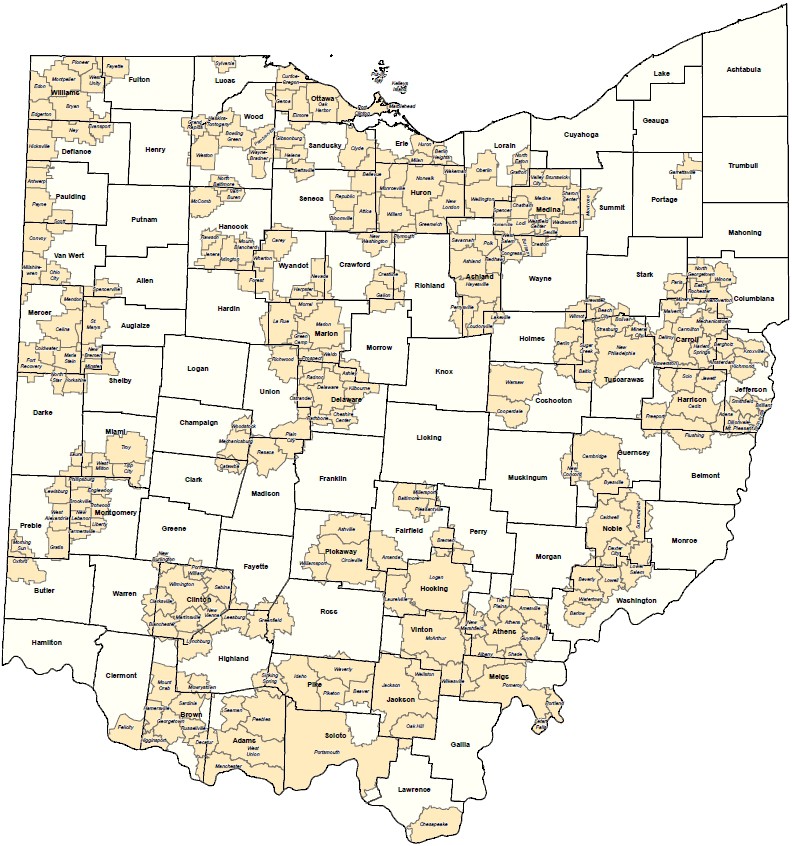
The largest portion of Frontier’s new service area will include parts of Champaign, Clark, Clinton, Darke, Miami, Montgomery, Preble, Shelby and Warren counties.

Despite early opposition from Ohio Consumers’ Counsel (OCC), who expressed concerns about the financial viability of the deal and the fulfillment of promised broadband expansion, the vote by the Public Utilities Commission (PUC) was unanimous.  After negotiations with company officials and the OCC and PUC, an agreement to attach conditions to the sale of Verizon’s landlines resulted in a change of heart by the Counsel’s office.

Frontier's new service area, representing territory formerly served by Verizon North (click to enlarge)

Many of Ohio’s former Verizon service areas are served by Verizon”s DSL service, but many rural communities went unserved.  Verizon has made a business decision to direct resources into its fiber to the home service — FiOS, which is only being provided in substantial-sized communities.  With Verizon’s reduction in resources towards rural service areas, Frontier argues the sale will benefit rural residents because they will provide broadband service Verizon never did.  Frontier suggests the viability of its landline business is enhanced by robust broadband deployment as consumers continue to drop traditional phone service.  Broadband gives customers a reason to stay with Frontier, the company believes.

But critics contend Frontier’s broadband is behind-the-times, often providing less than 3Mbps service in many smaller communities.  Frontier also maintains language in its Acceptable Use Policy that expects consumers to limit their broadband use to just 5GB per month, although company officials stress they do not enforce that provision at this time.

Frontier believes broadband deployment will help the company survive the trend away from landline phone service

Frontier relies on traditional, basic ADSL service across its service areas nationwide, but also provides provides some communities with Wi-Fi access for an additional monthly charge.

Similar earlier deals between Verizon and FairPoint Communications, the Carlyle Group, and Verizon’s former telephone directory printing operation (now Idearc Media) have all ended in bankruptcy after months of sub-standard service, billing errors, and broken promises.  Should a similar fate befall Frontier Communications, a trip to Bankruptcy Court could put an end to broadband, pricing, and service commitments made with state officials.

Dealing the Race Card Into the Net Neutrality “Dollar A Holler” Debate

Phillip Dampier February 11, 2010 Astroturf, Broadband "Shortage", Broadband Speed, Competition, Data Caps, Editorial & Site News, Net Neutrality, Online Video, Public Policy & Gov't, Rural Broadband Comments Off on Dealing the Race Card Into the Net Neutrality “Dollar A Holler” Debate

For months now, several groups purporting to represent the interests of minorities have busily been attacking Net Neutrality as beside the point for the poor and unserved consumer who has been left out of the broadband revolution.  To varying degrees, several of these groups have been spouting broadband industry talking points to the Federal Communications Commission, members of Congress, and the public at large.

For them, and the profitable broadband industry they indirectly represent, providing access at affordable prices is much more important than making sure providers don’t lord over the network they provide to customers.

Access vs. Openness

Consumers are perplexed by this either/or proposition.  For us, both issues are vitally important.  In urban, income-challenged areas, affordability is a crucial issue.  In rural areas, access to anything resembling broadband comes before worrying about the price.  For all concerned, making sure the Internet is not subject to corporate content control, either through direct censorship or through the far-more-common practice of pricing and policy controls, is just as important.

Providers have their self-interest on display when they promote broadband expansion — they want to receive the public dollars available from the broadband stimulus package to pay for that expansion.  Of course, every step of the way they have their fingers all over the process, from broadband mapping that protects incumbents from potential competition, defining what constitutes broadband to be as slow and as cheap to provide as possible, to implement usage rationing through Overcharging schemes like usage limits and usage-based billing, and to advocate for public policy that keeps the Money Party of fat profits running as long as possible without oversight.

The entry of minority interest groups into the debate is nothing new.  Groups of all kinds, including many who one would think wouldn’t have an opinion on Net Neutrality, are all part of the discussion.  Debates ensue, statements are fact-checked, back and forth discussion ensues.  What disturbs me is the small handful of groups who are willing to deal the race card when their own views and statements are challenged and they are threatened with losing the argument. Ill-equipped to argue the merits of their case in detail and withstand the scrutiny of fact-checking, some have introduced race into the debate to obfuscate the issues.

While I don’t doubt their sincerity and passion advocating for increased access and affordability, too many of these groups hurt their own case by accepting generous contributions (or advisory board members) from the telecommunications industry.  Consumers who witness the near total alignment of views between these groups their corporate benefactors are right to be concerned.  Many are asking if those views represent true conviction or “a dollar a holler” advocacy.
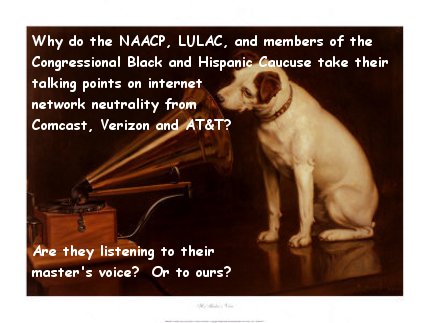
The Black Agenda Report, which created this graphic, ponders the same questions many consumers are asking

As Stop the Cap! documented just a few months ago, Broadband for America is a great example of industry-funded astroturf in action.  Large numbers of groups with no apparent connection to the broadband policy debate have found their way onto the roster of members.  From a cattle association to a Native American group that also has a burning interest in sharing their views about corporate jet landing rights, the one thing in common with virtually every last one of them was a financial contribution and/or board member working for big cable or telephone companies.  Thus far, debating a cattle association has not brought charges of being anti-cow, although I suspect consumers are anti-bull.  Debating the merits of Net Neutrality with Native American groups has not brought charges of anti-Native American bias.

Stop the Cap! itself has been on the receiving end of racial rhetoric offered by one of the anti-Net Neutrality advocates out there, Navarrow Wright.  Wright is a former corporate executive at Black Entertainment Television, and spends his days now as a self-proclaimed social media and branding expert. Last year, after exiting as CEO of Global Grind, a hip hop social network, Wright launched Maximum Leverage Solutions, which claims to be a full service consulting firm specializing in social media strategy and Internet Consulting.

Just a few months later, Wright suddenly discovered a big interest in the concept of Net Neutrality.  While he doesn’t disclose his client list, would it surprise anyone if a telecommunications company hired his services for their own “social media strategy?”

Since last fall, Wright has been generating a mix of provider talking points, Google bashing, and attacking groups that support Net Neutrality.  He’s called supporters of an open Internet “digital elites,” the FCC a player of “dangerous games” by ignoring the anti-Net Neutrality public, Free Press a group that wallows “in crazy claims and race-dividing rhetoric,” and tries to connect support for Net Neutrality as somehow representing opposition to increased broadband adoption.

Challenging and debunking his talking points isn’t difficult — they are precisely the same ones the broadband industry has used for several years now.  We invited Wright to a full, in-depth discussion about the merits of Net Neutrality and broadband adoption.  We even got the discussion started, but that’s exactly where it ended.

Wright is also incredibly defensive about the issue of industry-backed mouthpieces and astroturf efforts in general.  Suggesting Wright’s views are inaccurate brings his resume in response, which I suppose was designed to impress readers with suggestions of his built-in expertise, belied by his silence on these issues prior to last year.  In Wright’s original comment, he took our comments about economically disadvantaged Americans and made it an issue of color:

Our piece:

The letter represents the groups’ concerns that broadband for many in America is simply not available, especially for the economically disadvantaged.  They’ve been swayed by industry propaganda to characterize Net Neutrality as a threat to addressing the digital divide by making service ultimately even more expensive.

His response:

Phil, I know (at least I hope) your intent wasn’t to suggest that people of color have been “swayed by industry propaganda” and aren’t capable of thinking for ourselves on technology issues.

James Rucker, executive director of Color of Change added to the debate in late January, wondering why some civil rights groups are only too willing to support discredited industry talking points and advocate against Net Neutrality.

Rucker discovered the same thing we did.  Challenging these groups to explain their positions brings forth repetitious inch-deep talking points and total silence when a rebuttal is offered.  If pushed, they obfuscate with claims their views are being disrespected, when in reality they are only being fact checked.  Perhaps inconvenient, and even slightly embarrassing, but it’s completely appropriate for consumers to ask whether a conflict of interest exists when a group advocates for the positions of the same industry that is sending them big contributions.

The risk, of course, is to tie an organization’s good name to demonstrably false provider propaganda that some groups are willing to repeat, nearly word for word.

Take for instance Wright’s claim that Net Neutrality will force providers to spend money they would otherwise invest for the benefit of the rural, the downtrodden, and the unserved:

That brings me to the other corporate interests: the Internet service providers. It is the ISPs who must invest in, upgrade, maintain and build out the networks that allow us to receive these cool applications. While I don’t find the network side as sexy as the content side, I do know that we have to have it and ISPs need capital to build and maintain it. So the question remains who is going to pay for maintenance and upgrades to the network if Google gets a free ride? Basic economics tells us that if government requires ISPs to give Google a free ride, there’s only one other place to look for the money: consumers like you and me. What’s more, there are those who want to make it even more unfair by insisting that your big-bandwidth-using neighbor should not have to pay more than you, even if all you want to do is check email and watch some YouTube. Who will all of this hurt the most? Low-income consumers.

The only color that really matters here is green

Wright doesn’t know his American telecom history.  Let’s discuss this fiction:

  1. Bruce Dixon, a writer for the Black Agenda Report says it better than anyone: “Phone companies invented the digital divide more than a century ago as their core business model, preferring to extend service to affluent areas where they could levy premium charges, rather than building networks out to reach everybody.”  The cable television industry “franchise” requirement came as a direct result of cable industry redlining, the practice of wiring wealthy neighborhoods for cable while bypassing urban and rural areas deemed “unprofitable.”  It’s the same story for broadband, and Net Neutrality is beside the point.  The number crunchers look for Return On Investment (ROI) when considering who gets on the right side of the digital divide.  If they can’t make a killing on you, they’re not going to provide you service.  If you can’t afford their asking price, which is increasing regardless of Net Neutrality, why serve you?  Ultimately it is consumers who overpay for these networks, priced well above cost, generating literally billions in profits.  Why ruin a good thing with altruistic broadband expansion at a fire sale price?
  2. Regardless of what Google is doing, providers are seeking new ways to further monetize broadband service, enriching themselves even further.  Prices go up even as the costs to provide the service go down.  The old chestnut about the next door neighbor being a usage piggy is just more of the same “us vs. them” propaganda from providers who want consumers to fight amongst themselves while they run to the bank with the money.  Grandma doesn’t want her broadband service limited either, and she’s way too smart to believe a provider promising dramatic savings for less service from companies that jack up her rates year after year.
  3. The best way to guarantee affordable access to broadband service is to develop a national broadband plan that provides the same kinds of “lifeline” services already available for economically disadvantaged phone customers, legislative policies that force markets open to additional competition, government oversight to ensure providers are required to provide service throughout their respective service areas, and stimulus or Universal Service Fund assistance for projects that assure access to those who simply will never pass ROI tests.  Or we can solve everything by not passing Net Neutrality?  Please.
  4. Google doesn’t have a free ride.  First, consumers -pay- providers for connectivity.  Ultimately, they are the customers — content producers are not.  Nothing prohibits an ISP from offering hosting services to content producers at competitive prices.  If Google, Amazon, Netflix, or Hulu want to host their content on servers owned by Verizon, Comcast, Time Warner, or AT&T, nothing stops them.  Google pays for its own connectivity to the Internet.  Customers pay for accessing it.  Now providers want to get paid again.  It’s like triple-charging for snail mail – you pay for a stamp to mail it, the person you wrote pays to receive it, and the airline that flew the letter cross country has to pay to transport it.

Remember, it’s the content that drives broadband adoption. ISP’s honestly don’t fret as much about traffic as they claim.  They just care whether they can own it, control it, and profit from it.  The evidence to back this up comes from cable and phone companies in a big hurry to stream video content over their TV Everywhere projects.  Nothing consumes bandwidth like online video, yet there they are enthusiastically embracing it.  They have to, because if they don’t control it, it could eventually lead to people dropping their cable TV subscriptions in favor of online viewing.

Wright’s blog promotes another industry favorite — the dreaded phony “exaflood” which threatens to bring chaos and disorder to our online world… unless we totally deregulate broadband and let them do whatever they want to “solve it.”  That’s more of the same.  We’ve seen the results of that for more than a decade now, and the very digital divide that Wright complains about comes as a direct consequence to letting broadband providers serve, or not serve customers as they please at the prices they want.

Wright and other civil rights groups can throw as many race cards as they like against consumers who see right through their corporate-backed agenda.  That’s because consumers know Net Neutrality isn’t an issue of black or white.  The only color that really matters here is green.

If Your Provider Won’t Give You Real Fiber Optic Service, Google Might – Think Big With a Gig – Nominate Your Community

Google plans to offer up to 1Gbps service on its direct to the home fiber network

Google has announced it is doing something about anemic, overpriced, and poorly supported broadband service in the United States.  It’s going to start providing service itself.

In a move that is sure to drive providers crazy, Google is looking for your nominations for communities that are stuck in broadband backwaters, desperate for an upgrade.  With so many suffering from “good enough for you” broadband speeds, threats of “inevitable” Internet Overcharging schemes like usage limits and consumption billing, or customer support that involves reaching more busy signals than helpful assistance, they won’t have to beg for nominations.

Google is planning to launch an experiment that we hope will make Internet access better and faster for everyone. We plan to test ultra-high speed broadband networks in one or more trial locations across the country. Our networks will deliver Internet speeds more than 100 times faster than what most Americans have access to today over 1 gigabit per second, fiber-to-the-home connections. We’ll offer service at a competitive price to at least 50,000 and potentially up to 500,000 people.

From now until March 26th, we’re asking interested municipalities to provide us with information about their communities through a Request for information (RFI), which we’ll use to determine where to build our network.

I can think of a few cities that were victimized by providers in 2009 who have little chance of seeing true fiber optic service any other way.  Rochester, New York, the Triad region of North Carolina, parts of San Antonio and Austin bypassed by Grande Communications’ fiber network, are all among them.  Rochester has the dubious distinction of being stuck with two providers itching to slap usage limits and consumption billing on their customers – Frontier and Time Warner Cable.  Since Verizon FiOS is popping up all over the rest of New York State, residents in the Flower City concerned about being left behind might want to make their voices heard.

Google plans to deliver 1Gbps… that’s a Gigabit — 1,000Mbps service to its fiber customers at a “competitive price.”

While some in the industry consider such speeds irrelevant to the majority of consumers, Google thinks otherwise:

In the same way that the transition from dial-up to broadband made possible the emergence of online video and countless other applications, ultra high-speed bandwidth will drive more innovation – in high-definition video, remote data storage, real-time multimedia collaboration, and others that we cannot yet imagine. It will enable new consumer applications, as well as medical, educational, and other services that can benefit communities. If the Internet has taught us anything, it’s that the most important innovations are often those we least expect.

What’s in it for Google?  Targeted advertising, guaranteed open networks, an improved broadband platform on which Google can develop new broadband applications, and calling out providers’ high profit, slow speed broadband schemes are all part of the fringe benefits.

For providers and their friends who have regularly attacked Google for “using their networks for free,” Google’s fiber experiment deflates providers’ hollow rhetoric, and could finally provide a warning shot on behalf of overcharged, frustrated consumers that the days of rationed broadband service at top dollar pricing may soon be over.

[flv width=”640″ height=”380″]http://www.phillipdampier.com/video/Google Think Big With a Gig Announcement.flv[/flv]

Google released this video announcing their Think Big With a Gig campaign (1 minute)

This isn’t Google’s first experience with being an Internet Service Provider.  The company has experimented with free Google Wi-Fi service in its hometown of Mountain View, California since 2006.

[Update 2:30pm EST: FCC Chairman Julius Genachowski applauded Google’s experiment: “Big broadband creates big opportunities,” he said in a statement. “This significant trial will provide an American testbed for the next generation of innovative, high-speed Internet apps, devices and services.”

The Washington Post has a source that claims Google “doesn’t currently have plans to expand beyond the initial tests but will evaluate as the tests progress.”  That could mean the experiment also serves a public policy purpose to re-emphasize Google’s support for Net Neutrality, and to deflate lobbyist rhetoric about Google’s support for those policies being more a case of their own self-interest and less about the public good.  If Google can run its networks with open access, they essentially put their money where their public policy mouth is.]

Search This Site:

Contributions:

Recent Comments:

Your Account:

Stop the Cap!