Home » Broadband Speed » Recent Articles:

Verizon Wireless Heads to Alaska, Providers on the Ground Expect AT&T to Suffer the Most

Verizon Wireless is expected to enter the Alaskan mobile market sometime in 2013-2014, according to incumbent competitors, who expect Verizon’s largest impact will be to bleed AT&T of customers.

Alaska’s two primary local providers — Alaska Communications, Inc. (ACS) and General Communications, Inc. (GCI), are telling shareholders to relax because they don’t expect to see Big Red in the Alaskan market for at least 2-3 years.  Both companies reported net losses for the quarter, and GCI lost 2,400 subscribers recently when more than 4,000 soldiers at Fort Wainwright in Fairbanks were deployed to Afghanistan.

Both ACS and GCI have been using the current poor economic climate and their respective stockpiles of cash-on-hand to retire debt or reissue long-term-debt at more favorable low interest rates.  Both companies are also hurrying to outdo each other’s 4G wireless network deployments before Verizon Wireless shows up, making use of spectrum it acquired last August to enter the Alaskan market.  Government rules require Verizon to sign-on its new network by June 13, 2013.  But Verizon admits it will take up to five years after that to completely build a new network from scratch.

Right now, Verizon Wireless customers taking their phones to Alaska roam on ACS’ network, for which the company is compensated with an increasing amount of extra revenue.  ACS boosted earnings in part on that roaming revenue, even as it lost more of its own customers.  When Verizon switches on its own network, that roaming revenue will rapidly decline, but ACS executives reassured shareholders their knowledge and experience of construction seasons in Alaska guarantee Verizon won’t be able to get its network together until 2013 at the earliest.

But when Verizon opens their doors, Ron Duncan, CEO of GCI expects a hard fight on his hands.

“We recognize ultimately they’ll be a significant competitor, although I see AT&T share more at risk because Verizon’s main claim to fame when they get to Alaska is going to be devices. We’ll still outpace them on coverage. We’ll continue to be the only ones with statewide coverage,” Duncan said. “People who want to buy the coverage buy from us today; people who want devices buy from AT&T because AT&T gets much better devices than we do.”

Just months after Verizon announced they were headed north, both ACS and GCI accelerated plans to roll out respective “4G” networks for wireless customers, although each company is deploying different standards.

GCI

GCI’s cell phone network is a combination of some of its own infrastructure, the acquisition of Alaska Digitel, and a resale agreement to use parts of AT&T Wireless’ coverage it acquired from Dobson Communications Systems.  In and around Fairbanks, Anchorage, Glennallen, Valdez, Prudhoe Bay, Wasilla, and Kenai, GCI offers CDMA service.  In those communities and many other rural regions in western Alaska, GCI relies on AT&T Alascom GSM networks.  GCI pitches its CDMA network’s 3G wireless data capabilities, which offer faster wireless data speeds, if you can get coverage.  For wider coverage in Alaska’s smaller communities, GCI markets GSM phones, which currently only offer 2G EDGE/GPRS data speeds.  If you use a cell phone mostly for voice calls, the wider coverage afforded by GCI’s GSM network is a popular choice.  But if you want faster data, CDMA 3G data speeds are required.

Eventually, GCI’s 4G network may help deliver coverage and faster speeds in both urban and rural areas, particularly as GCI plans to invest up to $100 million to construct more of its own network, instead of relying on resale agreements and acquisitions.

GCI has chosen HSPA+ for 4G service on the GSM network, and will introduce the service in Anchorage later this month.  That’s the same standard used by AT&T and T-Mobile in some areas.  It’s not as fast as LTE service from Verizon Wireless, but is much cheaper to deploy because cell sites need not be linked with fiber optic cables — an expensive proposition.

ACS

Alaska Communications has a large 3G CDMA network in Alaska all its own.  Its coverage is primarily in eastern Alaska adjacent to major cities like Anchorage, Juneau, and Fairbanks, and where it does provide 3G data coverage, the company claims it extends further out than GCI.  ACS doesn’t offer much coverage in small villages and communities in western Alaska, however.

ACS expects to skip incremental upgrades and launch its own 4G LTE service in the future.  It may help the company regain its second place standing, lost to GCI last year, and protect it from Verizon Wireless poaching its customers.


Updated: Frontier’s Fiber Mess: Company Losing FiOS Subs, Landline Customers, But Adds Bonded DSL

Losing customers.

A year after Frontier Communications assumed control of Verizon’s assets in the Pacific Northwest, customers are fleeing the company’s inherited fiber-to-the-home service FiOS, after announcing a massive (since suspended, except in Indiana) 46 percent rate hike for the television portion of the service.  A new $500 installation fee has kept all but the bravest from considering replacing customers who have left for Comcast and various satellite TV providers.

Frontier’s second-quarter financial results revealed the company has lost at least 14,000 out of 112,000 FiOS TV customers in the region (and in the Fort Wayne, Ind. market, where the service is also available.)

Early reaction to the original rate hike announcement started customers shopping for another provider — mostly Comcast, which competes in all three states where Frontier FiOS operates.  Even after the rate hike was suspended in some markets, intense marketing activity by Frontier to drive customers towards its partnership with satellite provider DirecTV managed to convince at least some of those customers to pull the plug on fiber in return for a free year of satellite TV, although an even larger number presumably switched to the cable competition.

D.A. Davidson, a financial consulting firm, told The Oregonian the message was clear.

“They would love to get rid of the FiOS TV customers,” Donna Jaegers, who follows Frontier, told the newspaper. “They’re programming costs are very high compared to the rates that they charge.”

Jaegers said Frontier Communications completely botched their efforts to transition customers away from FiOS TV towards satellite, because most of those departing headed for the cable competition, attracted by promotional offers and convenient billing.

Many others simply don’t want a satellite dish on their roof, and are confounded about Frontier’s message that satellite TV is somehow better than fiber-to-the-home service.

Frontier admits its FiOS service is now underutilized, but claims it will continue to provide the service where it already exists.

Wilderotter

Frontier Claims Its DSL Service is Better Than Cable Broadband

Frontier’s general business plan is to provide DSL service in rural areas where it faces little or no competition, and most of Frontier’s investment has been to upgrade Verizon’s landline network to sustain 1-3Mbps DSL service, for which it routinely charges the same (or more) for standalone broadband service that its cable competitors charge for much faster speeds.

But Frontier Communications CEO Maggie Wilderotter says their DSL service is better than the cable competition.

“A key differentiator between our network and cable competition is that you consistently get the speed you pay for,” Wilderotter told investors on a conference call. “There’s no sharing at the local level. High demand for bandwidth-intensive applications like video are putting pressure on all wired networks. To that end, we want to make sure that we have more than enough capacity to satisfy the expectations of our customers. We’re spending capital in all parts of the network with specific emphasis in the middle mile, which will enable us to consistently deliver a quality customer experience for our customers of today and tomorrow.”

Frontier Communications CEO Maggie Wilderotter defends anemic broadband additions during the 2nd quarter of 2011 and tries to convince investors DSL service is better than the cable competition. August 3, 2011. (4 minutes)
You must remain on this page to hear the clip, or you can download the clip and listen later.

Netflix Traffic Represents 25% of Frontier’s Broadband Traffic; Online Video — 50%

Wilderotter admitted Frontier’s broadband network is overcongested in many regions, which she partly blamed for the company’s anemic addition of new broadband customers.

She noted Netflix, which has itself consistently rated Frontier the worst wired broadband provider in the country for being able to deliver consistent, high quality access to their streaming service, represents one-quarter of all capacity usage of Frontier’s broadband network.

“Video is about 50 percent,” Wilderotter added.  In an investor conference call, she explained network congestion in more detail:

“In [the second quarter], we had many areas with unacceptable levels of network congestion, which negatively impacted our growth in net high-speed additions.” Wilderotter said. “We believe all of the major congestion issues will be fixed by the end of [the third quarter], and that will enable us to drive higher growth and net broadband activation in [former Verizon service areas.]”

“What we decided to do is to go for fixing the middle mile, which is the [central office] to the […] neighborhood and to expand that capability by 100-fold. And then also, expand from the [central office] out to the Internet and make sure that we have huge capacity to deliver and receive capability to our customers. So when we sell 6 meg, 10 meg, 25 meg, 50 meg, the customer gets what we sell them and that was extremely important for us.”

“So what we did is in the areas where we saw the congestion increase based upon usage increases, and we’ve built new households. We’ve held off on marketing to a lot of those new households until we fixed the congestion problem because we didn’t want to exacerbate what we had already. We’ve shifted capital in terms of the mix of how we’ve spent capital to fix this problem. I’d say we’re probably 75% of the way there in fixing congestion. This quarter is another big quarter for us to get all of the major issues out of the network, which will allow us in the back end of this quarter through the fourth quarter, to really start pushing the penetration levels where we’ve built new households in the areas that have been affected by congestion.”

Frontier Introduces Line Bonded DSL — Two Connections Can Improve DSL Speeds

Frontier Faster? Frontier announces line bonded DSL.

Frontier Communications also announced the introduction of Frontier Second Connect, a DSL line bonding product that delivers two physical connections to a single household.  Line bonding allows for improved broadband speeds.

“Second Connect gives our customers two exclusive connections in one household, and we’re the only provider in every market that can do that,” Wilderotter claimed.

In more urban markets, Frontier’s DSL speeds are woefully behind those available from most cable competitors.  Frontier has begun upgrading some of their legacy service areas and retiring older equipment in an effort to improve the quality of service.

“The real initiatives that we have underway are called middle mile, interoffice facilities, as well as some of the more aged equipment that’s in the network,” said Dan McCarthy, Frontier’s chief operating officer. “So as we go through, there’s about 600 projects that are underway today that will improve both the speed and capability.”

“We’ve inherited markets that there has not been upgrades to capacity in these markets for many years and fixes to the networks, plus the elements as the DSLAMs, even the DSLAMs themselves are old,” Wilderotter said. “So we’re replacing network elements in the neighborhood. We’re splitting them and moving customers to other network elements to make sure that they have a good experience.”

Frontier executives answer a question from a Wall Street banker about DSL speeds and congestion problems on Frontier’s broadband network. A detailed technical discussion ensues as the company tells investors it is redirecting some capital to fixing Frontier’s overcongested network. August 3, 2011. (5 minutes)
You must remain on this page to hear the clip, or you can download the clip and listen later.

Frontier Still Losing More than 8% Of Its Landline Customers Every Year

Despite broadband rollouts and incremental improvements, more than eight percent of Frontier’s landline customers disconnect service permanently every year.  Frontier called that disconnect rate an improvement over its line losses last year, which exceeded 11 percent in some areas.

“Total line losses improved to an 8.6% year-over-year decline, our lowest level since taking ownership when the pro forma loss rate was 9.7%,” reported Wilderotter. “We also improved [the] loss rate [in former Verizon service areas to] 10.1% compared to 11.4% in Q2 2010.”

Most of Frontier’s departing customers are switching to cable providers and/or cell phone service.

(Update 8-23-2011: We are now told in many areas, Frontier’s Second Connect service is not actually a bonded DSL product, but rather a “dry loop” second DSL line that carries the same speed as your primary line.  Presumably, household members can divide up who uses which DSL circuit for Internet access.  The charge for Second Connect in ex-Verizon service areas is $14.99 per month plus a second mandatory monthly modem rental fee of $6.99. If the web link does not work, it means the service is not available in your service area.)

Lebanon At War With Usage Caps: ‘Entering the Knowledge Economy Through a Small Window’

Phillip Dampier August 15, 2011 Broadband Speed, Data Caps, Public Policy & Gov't, Wireless Broadband Comments Off on Lebanon At War With Usage Caps: ‘Entering the Knowledge Economy Through a Small Window’

Lebanese consumers and businesses are fed up with Lebanon’s archaic Internet infrastructure and the usage limits that come with it.

Now the country is waiting with anticipation as the government prepares to open up new bandwidth from a 3.84 terabit per second underseas cable that passes through the region, but has been left idle since last December.

Lebanon’s Internet is ranked among the slowest in the world, mostly thanks to an over-controlling state telecommunications authority that has priced broadband Internet access into the stratosphere.  Most Lebanese cannot afford the ridiculously slow and expensive “top speed” DSL connections offered by the country’s phone company, offering “up to 2Mbps” speeds for $200US per month.  Instead, most lower income households still use dial-up access, while Lebanon’s middle class settles for 256kbps DSL that still runs a ridiculous $25 a month.

But the 60 percent of the country choosing 256kbps Internet finds even those speeds less than useful when considering they come with a usage allowance of a paltry 3GB per month.  Going over that limit delivers an expensive lesson.  Excess usage is billed at $17 per gigabyte.

Ghanem

Lebanon’s Ministry of Communications, who made the announcement of the forthcoming access improvements, didn’t impress many consumers with word they would “double or triple” the usage cap to celebrate forthcoming speed increases.

“It [is] like entering [the knowledge economy] through a small window,” said Diana Bou Ghanem, head of the the ministry’s ICT office.

Even with the forthcoming improvements, government controls have kept Lebanon’s Internet in the dark ages.  Broadband statistics reveal war-torn Afghanistan and Iraq enjoy faster broadband than Lebanon, and some of the world’s poorest countries like Zambia and Tanzania enjoy speeds twice as fast as those found in downtown Beirut.

Lebanon’s Daily Star newspaper covered the broadband debacle with some alarming reporting suggesting some of the government’s key officials on telecommunications barely grasp telecommunications networks, policies, and practical realities.

For example, former Telecom Minister Charbel Nahhas, a major booster of Lebanon’s forthcoming foray into 3G wireless broadband, seems to believe such networks will deliver up to 20Mbps to Lebanese cell phone users.

Nahhas considers 3G cutting edge for Lebanon, even as the rest of the world prepares to retire it for faster 4G wireless networks.

Telecom Minister Adviser Antoine Boustani seems to think broadband is a tangible resource that can be exported like oil, gas, or electricity.

“We will have an overflow of capacity with [the new underseas cable],” Boustani told the newspaper. “We could even distribute the excess to other countries.”

Ogero is the state-administered phone company in Lebanon.

The Lebanese government and state run phone company — Ogero — have even been willing to celebrate broadband achievements both have regularly failed to meet:

Ogero had planned to host a huge party announcing the [underseas] cable last December, under the auspices of then Prime Minister Saad Hariri. According to sources close to the affair, it was to feature a seated dinner for some 500 persons at the prestigious Pavillion Biel, prime time live television coverage and even Lebanese Opera singer Hiba Kawas, who was commissioned to write a song for the event, performed with a full orchestra. Despite the fact that the Lebanese leadership failed to deliver broadband to its citizens for the past decade, some 10 trophies were to be crafted by the Lebanese sculptor Rudy Rahme and distributed to various officials.

But all this was cancelled when then Telecoms Minister Nahhas received an invitation and challenged Ogero’s role in managing the [underseas] cable and the prime minister’s patronage of it.

Lebanon is following developments elsewhere in the region where broadband usage limits are becoming a thing of the past. When a cartel of Kuwaiti ISP’s threatened to introduce new usage caps in unison, a full-scale consumer revolt forced the government to ban usage caps in the country.

“The Internet has become a cornerstone in development, economy and everyday life in Kuwait,” the country’s telecoms minister, Salem al-Uthayna, said last month in explaining the decision to abolish caps.

Most observers place the blame for Lebanon’s snail-like broadband development at the feet of the government and the state-run phone company, which has blocked efforts to radically change broadband in the country.

Critics accuse both the government and phone company of fearing major market changes, preferring incremental development over a full-scale broadband revolution.  But not everyone is a critic.

“It’s better to look for solutions – play it in a positive way,” said Abu Ghanem, who has worked at the ministry for 15 years. “I don’t want to blame anyone. Just let us work and let us deliver.”

One member of the private sector trying to put Lebanon’s bottom-rated broadband in a different context suggested citizens look on the bright side.

“OK, we are last in Internet [speed] but we are better at other things,” the source added. “Look at the price of real estate in Beirut.”

Comcast’s Welfare Internet: 1.5Mbps for $9.95 a Month… If You Qualify… for 3 Years

One of the conditions Comcast had to agree to as part of its multi-billion dollar deal to acquire NBC-Universal was to throw a bone to some of America’s poorest households by offering discount Internet access for three years.  Comcast agreed and is rolling out low-speed Internet at a discount in time for the upcoming school year.

“Comcast Internet Essentials,” is the ultimate in bare-bones Internet.  For $9.95 a month, customers in Comcast service areas will get 1.5Mbps download speed and 384kbps upstream, with the usual 250GB usage limit Comcast applies to everyone.  But not just anyone can qualify.  Comcast has limited the program only to households with at least one child qualified to receive free (not discounted) school lunches under the National School Lunch Program.  So if your income-challenged household doesn’t include children, or you pay for your own school lunches, you are out of luck.

Comcast is also denying access to anyone who has had any level of Comcast Internet service within the last 90 days.  So if you’ve scraped enough money together to pay Comcast’s regular prices, the cable company is not going to give you a break.

If your kids graduate or are removed from the school lunch program, your inexpensive Internet service goes with it.

If you have been late on a Comcast bill, or owe the company for unreturned cable equipment, you also cannot receive the service.

The company will also provide vouchers for a “discounted laptop” for $150 — a computer that turns out to be a netbook.  At least it comes with Windows 7 (Starter Edition).

Comcast requires would-be customers to start with an application, available by phone, at 1-855-8-INTERNET (1-855-846-8376).  The merger approval agreement required Comcast to provide the service for three years.  Guess what happens to it when the requirement ends.  No matter — Comcast is turning the entire affair to its public relations advantage, showing up on various media outlets promoting the program as if Comcast thought it up on its own.  Not quite.  We have three questions:

  1. How many consumers would sign up for the service if Comcast offered $9.95 1.5Mbps to anyone who wanted it?
  2. How many might consider downgrading their current service for something less expensive, especially if they are only interested in occasional web browsing?
  3. Will the “digital divide” Comcast decries today be magically gone at the end of three years, when they quietly drop the program?

[flv width=”360″ height=”290″]http://www.phillipdampier.com/video/KRIV Houston Comcast Internet Essentials 8-8-11.mp4[/flv]

KRIV-TV in Houston explores the various conditions Comcast places on its Internet Essentials program.  (2 minutes)

[flv width=”512″ height=”308″]http://www.phillipdampier.com/video/CNN Low Cost Internet 8-10-11.flv[/flv]

Comcast’s David Cohen appeared on CNN promoting Comcast’s Internet Essentials as a way to “bridge the digital divide” — a disparity of access American ISP’s originally created with their excessively high-priced Internet services. (3 minutes)

All You Can Eat: New Zealand ISP Reintroduces Unlimited Usage Internet Service

Phillip Dampier August 11, 2011 Broadband Speed, Competition, Consumer News, Data Caps, Net Neutrality Comments Off on All You Can Eat: New Zealand ISP Reintroduces Unlimited Usage Internet Service

New Zealand is one of a handful of countries stuck with pervasive Internet Overcharging schemes that limit usage or throttle broadband speeds because of international connectivity limitations.  But as international underseas fiber cables ease traffic congestion, Internet Service Providers are increasingly relaxing usage caps and reducing the level of speed throttling during prime time usage hours.

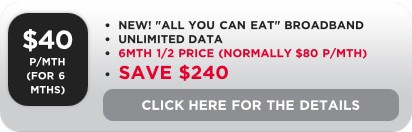
Now one ISP, Slingshot, has gone all-out, reintroducing an unlimited, flat rate broadband option for New Zealanders who don’t want to worry about how much usage they’ve racked up over the past month.

For roughly $32.50US for the first six months, $65 after that, customers don’t have to watch a usage meter or “gas gauge” or face a wholesale heavy speed throttle when deemed to be using “too much” Internet service.

Slingshot’s “All You Can Eat” broadband plan thumbs its nose at providers who want to end an unlimited broadband buffet.

The promotion is limited to the first 5,000 new customers who sign-up before Sept. 30, and customers must bring their own modem and maintain a Slingshot landline to qualify.

Slingshot general manager Scott Page said the plan has proved attractive to customers who value knowing they will pay the same flat rate month after month, regardless of usage.  For these customers, having unlimited download capacity is more important than achieving the fastest possible broadband speeds.  But Page noted they have customers who manage to download more than a terabyte a month on their unlimited plan.

Like many providers in the South Pacific, Slingshot uses “network management” to prioritize traffic under this scheme, in order of highest priority to least:

VOIP > Gaming > Browsing > Streaming > Local traffic > File sharing, including Peer-to-Peer (P2P)

Slingshot has received mixed reviews from customers in different parts of the country.  Some areas achieve faster speeds than others, primarily because the company relies on Telecom-provided landlines for its DSL service.  When the network is especially busy, those using peer-to-peer software may find that service considerably slowed.

New Zealand is moving incrementally away from usage limits.  Vodafone recently increased data allowances by 50 percent for their landline broadband customers and Telecom is doubling broadband allowances for many of their customers as well.

Search This Site:

Contributions:

Recent Comments:

Your Account:

Stop the Cap!