Home » Broadband Speed » Recent Articles:

U.S. Department of Agriculture Announces $103 Million in Broadband Grants/Loans

Phillip Dampier August 29, 2011 Broadband Speed, Public Policy & Gov't, Rural Broadband, Wireless Broadband Comments Off on U.S. Department of Agriculture Announces $103 Million in Broadband Grants/Loans

The U.S. Department of Agriculture has announced more than $103 million in federal grants and loans to 16 states to help expand broadband, or high-speed, Internet access to unserved and underserved areas of rural America:

Community Connect Grantee Community State Award Amount
R&S Communications LLC Vina Town Alabama $570,800
Crystal Broadband Networks, Inc. Birdsong Town Arkansas $570,800
Cable Partner.Net Inc. Whelen Springs Town Arkansas $570,800
Karuk Tribe Orleans California $1,141,870
Crystal Broadband Networks, Inc. Heidelberg Kentucky $576,400
Crystal Broadband Networks, Inc. Yellow Rock Kentucky $583,400
Inter Mountain Cable Inc. Endicott Kentucky $993,339
Nexus Systems Inc. Manifest Louisiana $1,116,505
Nexus Systems Inc. Larto Louisiana $1,116,505
Plateau Wireless LLC Olean Town Missouri $570,800
Plateau Wireless LLC Brumley Town Missouri $570,800
Arizona Nevada Tower Corporation Gabbs City Nevada $1,046,798
Crystal Broadband Networks, Inc. Stafford Village Ohio $570,800
Wichita Online Inc. Cornish Town Oklahoma $494,000
Wichita Online Inc. Tushka Town Oklahoma $480,000
Wichita Online Inc. Leon Town Oklahoma $481,000
Scott County Telephone Cooperative Flat Top Virginia $1,500,000
Crystal Broadband Networks, Inc. Panther West Virginia $571,900
Infrastructure Loan Awards
Wabash Telephone Exchange Illinois $21,867,000
The Hemingford Cooperative Telephone Co. Nebraska $10,280,000
Coleman County Telephone Cooperative Inc. Texas $22,540,000
Vernon Telephone Cooperative Wisconsin $24,143,000
Dubois Telephone Exchange Wyoming $11,391,000

The providers involved offer a mix of technology, ranging from traditional cable companies like Inter Mountain Cable and Crystal Broadband Networks — to Wireless ISPs like Wichita Online, serving southwestern Oklahoma, to rural telephone company DSL provided by companies like Hemingford Cooperative Telephone and the Coleman County Telephone Cooperative.

What most rural providers have in common are much-higher prices for slower speed service over what urban customers pay, and a regular need for resources to update capacity and the number of potential customers served.  Most of these grants and loans are expected to cover some of those costs.

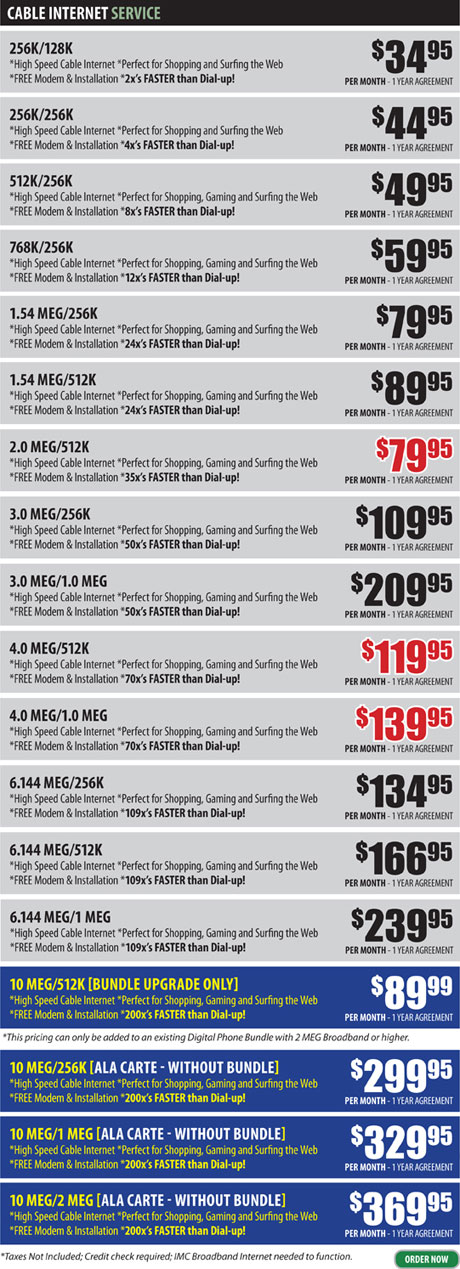
Ouch. Rural Americans pay substantially higher prices for broadband service than city-dwellers do. This is current pricing from Inter Mountain Cable, which serves parts of rural Kentucky.

Time Warner Cable Introduces SignatureHome Premium View: Pay More, Get Premium Channels

Phillip Dampier August 25, 2011 Broadband Speed, Competition, Consumer News, Video 2 Comments

When Time Warner Cable introduced its SignatureHome service, the company claimed it wanted to deliver a comprehensive experience to its most premium-customers.  But oddly, the best broadband speeds, phone service, and digital cable TV lineup from the cable company didn’t include any premium movie channels.

“I was ready to sign up for SignatureHome, but I assumed it included major premium channels, and it didn’t,” says Stop the Cap! reader Liam in Los Angeles.  “I thought it would be a real money-saver but I would rather have the premium channels than their phone service, which I don’t actually use as I depend on my cellphone.”

Scott elected for a cheaper promotional bundle foregoing phone service and the fastest Internet speeds, choosing to stick with Road Runner Turbo service.

“Powerboost on their Turbo product is more than enough for me and I don’t need faster upload speed — if SignatureHome included the premiums I would have taken it,” he says.

Now Time Warner has introduced an addition to their super-deluxe package — SignatureHome Premium View, which bundles HBO, Showtime, Cinemax, The Movie Channel and Moviepass with everything else on offer for $30 more a month — $229.99.  The package excludes Starz!, a premium movie channel Time Warner has barely promoted over the years.

With many markets increasing prices to as high as $15 for channels like HBO, getting five premium networks for just under $30 isn’t a bad deal, assuming you watch them and benefit from SignatureHome‘s other features.

“When my promotion expires, I’ll consider this new option,” Scott says.  “Yes, I realize $230 for cable service should really be an outrage, but the way the company is pricing services these days, the more you bundle, the less you ultimately pay compared to trying to build your own package of services.”

That may be exactly the point.  For customers who rely on Time Warner for phone, broadband, and cable-TV, SignatureHome can be a reasonable value if you crave the company’s highest 50/5Mbps broadband speeds.  Building a comparable bundle on your own is much more expensive.  Now the same is true for premium movie channels, which run between $11-15 a month each a-la-carte.

[flv width=”534″ height=”320″]http://www.phillipdampier.com/video/NY1 Signature Home Arrives 12-9-10.mp4[/flv]

NY1, Time Warner Cable’s 24 hour news channel in New York City, talked about the introduction of SignatureHome last December.  (2 minutes)

Sprint’s iPhone? Company Rumored to Introduce Iconic Phone in October

Phillip Dampier August 24, 2011 Broadband Speed, Competition, Consumer News, Data Caps, Sprint, Video, Wireless Broadband Comments Off on Sprint’s iPhone? Company Rumored to Introduce Iconic Phone in October

Rumors are swirling Sprint will begin selling Apple’s iconic iPhone this October, bringing the number of carriers supporting the wildly popular phone to three.  Sprint shares soared 10 percent on the news.  But while Sprint customers and shareholders are celebrating the potential imminent arrival of iPhone, launching the phone on the Sprint network is no simple matter, especially for the last remaining carrier delivering truly unlimited data.

On the Plus Side

Apple’s iPhone has become a must-have for a significant number of consumers.  They won’t leave the phone behind to switch carriers, not even for Verizon Wireless, until they introduced the phone earlier this year.  Now Sprint can win its own share of iPhone devotees.

Sprint’s iPhone promotions could draw customers away from larger carriers, especially enticed by Sprint’s worry-free unlimited data plan that has become extinct at other wireless companies.

The iPhone locks customers into new two-year contracts with Sprint, helpful security at a time when AT&T threatens to further consolidate the wireless industry in its efforts to acquire T-Mobile.

On the Down Side

Sprint’s phone subsidy expenses will skyrocket with Apple’s iPhone, which commands the highest subsidies in the industry.  Analysts suspect AT&T currently shells out up to $425 for iPhone 4 and $375 for iPhone 3GS.  Then AT&T sells the phone to consumers for $200 or less, making the subsidy back over the life of the two year contract.  That hits AT&T’s cash on hand hard.  For Sprint, regularly accused by Wall Street of spending too much on customer promotions, it will only increase those costs.  Sprint pays less than $150 for its top of the line Evo phones in comparison.

One guarantee the iPhone always delivers: Lots of data hungry users.  The introduction of the iPhone may ultimately threaten Sprint’s unlimited usage experience because of demand placed on an already burdened 3G network.  There is also no guarantee the first Sprint iPhone will support Sprint’s 4G network.

[flv width=”480″ height=”290″]http://www.phillipdampier.com/video/KMBC Kansas City Sprint May Sell iPhone in October 8-24-11.mp4[/flv]

KMBC in Kansas City talked with customers looking forward to Sprint’s iPhone.  Sprint is a major employer in Kansas City.  (2 minutes)

A Year of Internet Overcharging Suits Some Wireless ISPs Just Fine

Their prices are sky high.

Back in May 2010, Stop the Cap! launched a debate with a few Wireless Internet Service Providers (WISPs) that provide largely rural America with wireless access to the Internet over long range Wi-Fi networks.  The debate got started when Matthew Larsen, who runs the Wireless Cowboys blog, announced the arrival of an Internet Overcharging scheme at his WISP — Vistabeam, which serves residents in rural Wyoming and Nebraska.

WISPs are being increasingly challenged by the changing tastes of Internet customers, who are gravitating towards broadband multimedia content, saturating limited capacity networks and forcing regular infrastructure upgrades to keep up with increasing usage demands.  Unlike larger providers, many WISPs are independent, family-run businesses that lack easy access to capital and resources to rapidly respond to demand, especially when most have a rural customer base that numbers in the hundreds or thousands.

That’s one of the reasons why Stop the Cap! has not been as harsh on these providers when they implement usage limit schemes on their customers.  Because WISPs provide service where cable and phone companies usually don’t bother to serve, these wireless providers are the only option beyond satellite Internet, which we regularly label “fraudband” for claims of broadband speeds that are rarely delivered.  Still, we were not impressed last year with some of Larsen’s language about what his usage caps were intended to do (underlining ours):

I feel that these caps are more than generous, and should have a minimal effect on the majority of our customers.   With our backbone consumption per customer increasing, implementing caps of some kind became a necessity.    I am not looking at the caps as a new “profit center” – they are a deterrent as much as anything.    It will provide an incentive for customers to upgrade to a faster plan with a higher cap, or take their download habits to a competitor and chew up someone else’s bandwidth.

Ouch.

It’s been over a year, and Larsen is back with an editorial patting himself on the back for an Internet Overcharging success story well-implemented:

We have never raised prices on our services.    We still have a customer note on the wall that reads “Your bill was the only one I got this month that DIDN’T go up.   Thank you!”     I would have a hard time raising prices on this person because of their neighbors that are downloading 20x as much.   Usage Based Billing is a much fairer way to go, especially when the provider faces so much reinvestment cost to accommodate the heavier users.   After the first year of implementation, I am very glad that we took the time to implement it and intend to use the revenue to build a better network for all of our customers.

Larsen is also upset with those who believe in the concept of unlimited Internet:

Operating a broadband network is not free, and it is not a low-maintenance business.   I have a group of dedicated employees and subcontractors that have spent a lot of late nights and early mornings away from their families to build and maintain our network.   Anyone who thinks that unlimited broadband is a God given right should be forced to spend a few days in my lead tech’s shoes, getting a good look at what a broadband provider has to do to build a network and keep it running.

Larsen, like other WISPs are confronting the reality that Internet usage is on the upswing, and while we sympathize with the challenges faced by Vistabeam and other WISPs, his statements do not apply to every broadband network around.  And frankly, an increasing number of customers simply aren’t interested in Larsen’s challenges, especially if another provider can deliver service more cheaply and efficiently.  Vistabeam better hope nobody does, because their prices are simply not competitive if just about any other provider manages to work their way into his territory.

Vistabeam prices start at $29.95 a month for 384kbps/128kbps service with a monthly usage limit of 10GB.  Exceed that and you will pay an additional $1 per gigabyte.  Customers who need more speed pay dearly for it.  A tier providing 4/2Mbps service will run you $99.95 a month with a 60GB monthly usage allowance.

As of late, Larsen has been railing against the U.S. Department of Agriculture over recent broadband stimulus awards designed to improve coverage of broadband Internet in the same rural regions of the country Vistabeam serves.  He’s upset the USDA has awarded a $10.2 million infrastructure loan to the Hemingford Cooperative Telephone Company, which provides service in western Nebraska under the name Mobius Communications.

Larsen speaks highly of the fact Vistabeam delivers service in the absence of government funding or stimulus. But average consumers are not likely to care when they compare prices and consider the fact Mobius doesn’t appear to limit customers’ usage.

Mobius DSL Prices:

  • 500kbps – $35.00
  • 1.5Mbps – $40.00
  • 3Mbps – $50.00
  • 5Mbps – $60.00 (Currently available in Alliance and Chadron.)

Mobius charges effectively half the price Vistabeam charges, and offers faster tiers of service in some areas, without fear of overlimit fees.  It’s also important to recognize the “award” was actually a “loan,” which must be repaid.  Larsen seems less upset with the fact there are broadband stimulus programs than with the reality industry lobbying has effectively cut out many Wireless ISPs from standing any chance of winning one.

I get especially frustrated by loan awards like this one because I have operated two ISPs that have had to compete directly with Mobius and did not have access to any federal grant or loan programs.   The USDA Broadband and Loan programs are essentially only available to [regional phone companies].   When I made inquiries into the programs several years ago, I found that they would only loan to a single recipient in a region so that they were not funding competing projects.

Phillip Dampier

For Stop the Cap!, our constituents are consumers interested in obtaining the best possible broadband service at the best price.  Larsen’s views, understandable from the perspective of a business owner, would leave a number of consumers paying effectively double the price for usage-limited broadband. That would, however, satisfy a business argument that self-funded private providers should not face competition from other providers that can extend faster, unlimited DSL, cable, or fiber service with low interest loans.

Wouldn’t a better solution be to form a coalition to force open the same beneficial loan programs to Wireless ISPs who can more readily and affordably build up their networks and ease the Internet Overcharging that too often comes along for the ride?  We’re not accusing Larsen of gouging his customers for fun and profit, but we would like to see WISPs like Vistabeam develop win-win strategies that deliver success for their innovative efforts and lower priced, faster service for their customers.

The alternative may be the eventual arrival of those rural phone companies, increasingly equipped to deliver faster and cheaper service to Vistabeam’s current customers, eventually spelling disaster to that company’s business plan.  It has happened before.  Anyone remember the “wireless cable” industry that delivered a few dozen cable channels over microwave signals?  That’s a service whose time came and went, largely replaced with satellite television and rural telephone cable TV, better equipped to provide the kind of service consumers actually wanted, but wireless cable was ill-equipped to provide.


Time Warner Cable Dumps “Road Runner” Mascot: Part of a “Brand Refresh”

Gone

After more than a decade of “beep, beep,” Time Warner Cable is retiring Geococcyx californianus, the ground foraging cuckoo better known as the Greater Roadrunner.

It’s all part of a “brand refresh,” Time Warner’s Jeannette Castaneda tells Fortune.  The idea is to “create excitement around the eye-ear symbol.”  For now, the “Road Runner” name will remain — just the mascot disappears.

When Road Runner was first introduced in 1995 in Elmira, N.Y., it was designed to be a localized high-speed online portal, originally called the “Southern Tier On-Line Community.” Portals were all the rage in the 1990s, designed to serve as a unified home page to help users find content more easily.  When the cable modem broadband service finally spread to other markets, it was branded ‘LineRunner.’

But Time Warner’s marketing people decided the company’s best strategy to convince users that paying at least double the price they were paying for dial-up was worth the investment when you considered how fast cable broadband service was, and how it would outperform any dial-up connection.  The cable company spent months negotiating with Warner Bros. to license the use of the roadrunner in the old Wile E. Coyote cartoons.  The company even changed the name of their broadband product to Road Runner to drive home the speed message.

The "eye-ear" branding that replaces it.

Over the years, Time Warner has blanketed customers in postcard mailers, advertising, and billboards showcasing their broadband mascot, but no more.  While Time Warner Cable would not provide exact reasons for the brand change, we suspect there are several factors involved:

  1. The cost to license the roadrunner character from Warner Bros.  In 1998, regional Time Warner representatives shared that the licensing agreement with Warner Bros. was costly and complicated.  Warner Bros. maintains strict control over their licensed characters and how they are used.
  2. In the past, emphasizing speed was essential in convincing consumers to drop their old provider for the cable company’s alternative.  But broadband penetration in most of Time Warner’s markets has already reached a high level and most of those still refusing to take the service are not going to be convinced by speed arguments.  For these holdouts, lack of interest and the cost of the service are the most important factors, and the roadrunner character does not speak to these concerns.
  3. Canis usagecapus

    The telecom industry, notably cable, has spent years trying to retire the phrases “Internet access” and “Internet Service Provider.”  They don’t even like the word “broadband.”  For them – it’s High Speed Internet (HSI) or “High Speed Online.”  They have put the words “high speed” in the very term they use to describe Internet access.

  4. Time Warner Cable believes in their unified bundling of services.  They aggressively pitch all of them together at a discounted price and have de-emphasized the branding that used to be associated with individual package components.  For example, Time Warner didn’t retire the name “LineRunner” when they rebranded their cable modem service Road Runner.  They simply re-used the name for their telephone service.  Time Warner tested LineRunner in the Rochester, N.Y. market before ditching the product for a Voice Over IP service they now like to call “digital phone.”  Today, most of Time Warner Cable’s most visible ancillary branding is done for their triple-play packages.  Remember “All the Best?”

Fortune thinks the retirement of the roadrunner may also have something to do with the company’s desire to implement an Internet Overcharging scheme:

TWC, like other big ISPs, is a leading proponent of imposing bandwidth caps on its Internet users. Imagine the possibilities for illustrating articles about this topic – Wile E Coyote (perhaps wearing a TWC ballcap) tripping up the Road Runner with piano wire, or finally getting his revenge and hurling the obnoxious bird off a cliff.

Search This Site:

Contributions:

Recent Comments:

Your Account:

Stop the Cap!