Home » Broadband Speed » Recent Articles:

Western Massachusetts Fiber Network Underway, But Who Will Sell Service to Consumers?

If they build it, will Verizon, Time Warner Cable, or Comcast come?

The Massachusetts Broadband Institute (MBI) has just received a major shipment of cable it will use to construct part of its 1,300-mile fiber optic network, designed to provide better-than-dialup service to over 120 communities in western and north central Massachusetts.  That is, if providers show any interest in selling access to it.

The news that the broadband blockade in the western half of the state may finally come to an end is being trumpeted by local newspapers and TV newscasts from Springfield.  WSHM used the occasion to celebrate with current AOL dial-up user Ryan Newhouser, of Worthington:

A high-speed informational highway will be set up with thousands of miles of high-speed fiber optic cables. Those fibers will now be installed on utility polls across Western Mass.

Now residents sitting at their computers in frustration can finally look forward to high-speed internet access.

Perhaps.

As Stop the Cap! first explored earlier this year, the new fiber network is good news for western Massachusetts.  But it alone will not deliver service to the masses who desperately want faster Internet access.

The incumbent phone and cable companies have certainly not shown much interest.  Verizon treats western Massachusetts much the same way it served its landline customers in the rest of northern New England (Maine, New Hampshire, and Vermont.)  The company’s landline network was allowed to deteriorate along with Verizon’s interest in providing service in the largely rural states.  Eventually, it sold its operations north of Massachusetts to FairPoint Communications.  Comcast and Time Warner Cable are missing in action in many parts of the region as well.  As big phone and cable companies concentrate investments in more urban areas like Boston, many residents in places like Worthington can’t buy broadband service at any price.

MBI optimistically hopes the presence of its new fiber backbone and middle-mile network will change all that.  But outside of AT&T’s apparent interest it to provide service to its cell towers, there has been no publicly-expressed enthusiasm by Verizon or cable operators to begin serious investment in broadband expansion across the region.

The Last Mile Network Challenge

So what is holding western Massachusetts back?  The same thing that keeps broadband out of rural areas everywhere — the “last-mile” problem.  Traditionally, operators target urban and suburban areas for their investments because the construction costs — wiring up your street/home/business — can be recouped more easily when divided between a pool of potential customers.  Every provider has their own “return on investment” formula — how long it will take for a project to pay for itself and begin to return profit.  If your street has 100 homes on it, the chances of recouping costs are much higher than in places where your nearest neighbor needs binoculars to see your house.  Pass the ROI challenge and providers will invest capital to wire your street.  Fail it and you go without (or pay $10,000 or more to subsidize construction costs yourself.)

That is why eastern Massachusetts has plentiful broadband and the comparatively rural western half often does not.

MassBroadband 123 is the state’s solution to the pervasive lack of access across the western half of The Bay State.  It will consist of a fiber backbone and “middle mile” network, solving two parts of a three-part broadband problem.  The project’s commitment to deliver open access to institutions and commercial ISPs across the region is partly thanks to the availability of broadband grant money, particularly from the federal government.

Projects similar to MBI’s MassBroadband 123 typically include the hoped-for-outcome that private companies will step up and invest to ultimately make service available to end users.  Unfortunately, large incumbent providers often remain uncommitted to wiring the last-mile, and communities promised ubiquitous broadband end up with an expensive institutional network that only serves local government, public safety, schools, libraries, and health care facilities.

Thankfully, it does not appear MBI is depending on Verizon, which has shown no interest in spending significant capital on its legacy landline network or cable operators that are unlikely to break ground in new areas.

Communities are increasingly learning if they don’t have service today, the only real guarantee they will get it is by providing it themselves.  That is where WiredWest comes in.  It is a community-powered partnership — a co-op for broadband — pooling resources from 22 independent towns (with 18 more expected to join) to build out that challenging last mile, and deliver future-proof fiber to the home service.  No last generation DSL, slow and expensive fixed wireless, or limited capacity coaxial cable networks are involved.
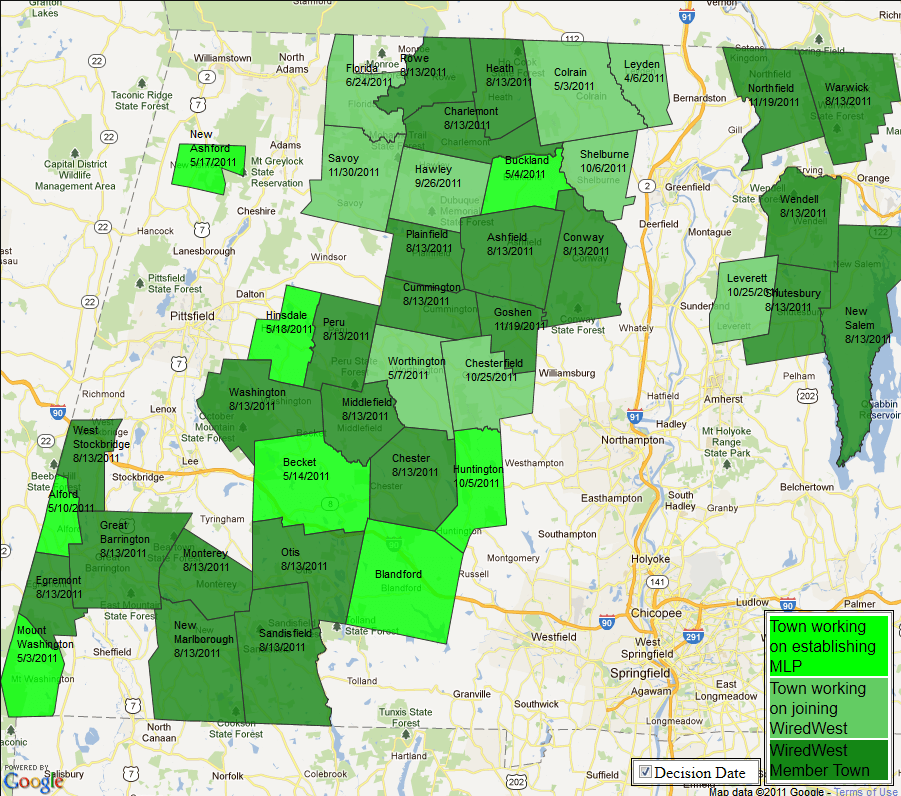
WiredWest Members

Founding member towns span four counties, including Berkshire County towns of Egremont, Great Barrington, Monterey, New Marlborough, Otis, Peru, Sandisfield, Washington and West Stockbridge; Franklin County towns of Ashfield, Charlemont, Conway, Heath, New Salem, Rowe, Shutesbury, Warwick and Wendell; Hampshire County towns of Cummington, Heath, Middlefield and Plainfield; and the Hampden County town of Chester.

Most of the construction costs for the new network will likely come from municipal bonds, because government grants typically exclude last mile network funding.  Commercial providers often lobby against municipal-funded networks as “unfair competition,” a laughable concept in long-ignored western Massachusetts, where Verizon pitches slow speed DSL, if anything at all.

WiredWest compares rural broadband with rural electrification.  Community-owned co-ops provide service where few private companies bothered to show interest:

Think back to the rural electrification of America. Then, as now, it wasn’t profitable enough for private companies to build out electrical service to rural communities. Imagine where those communities would be today if the government hadn’t stepped in to help fund this essential service – which over time has sustained itself and become a profitable enterprise.

Rural fiber-to-the-home is affordable when you use an appropriate financing and business model that isn’t subject to the same short-term measures of profitability as a private company. A municipal model for example, allows capital investment that can be written off over a longer period of time.

This type of business model isn’t limited to community-owned broadband.  Other countries that treat broadband as an essential utility have, in some cases, boosted broadband beyond a simple cost/benefit “ROI” analysis.

Constructing a broadband network for western Massachusetts still presents some formidable challenges, however:

  1. There is a serious imbalance in government grant programs.  A largesse of government funding for institutional broadband has delivered scandalously underused Cadillac-priced networks communities, libraries and schools cannot afford to operate themselves once the grant money ends.  Meanwhile, funding to cushion the cost of wiring individual homes and businesses is extremely scarce.  Isn’t it time to divert some of that money towards the most difficult problem to overcome — wiring the last mile?
  2. Government impediments to community broadband must be eliminated.  Repeal laws that restrict public broadband development.  Early experiments in municipal telecom networks have taught valuable lessons on how to operate networks efficiently and effectively.  But the broadband industry engages in scare tactics that highlight failures of older public projects like community Wi-Fi in an effort to keep superior publicly-owned fiber-to-the-home networks out of their markets.
  3. The public is not always engaged on the broadband issue and accepts media reports that misunderstand institutional broadband as a solution for those stuck using dial-up.  No matter how good a network is, if the “last mile” problem remains unsolved, the closest consumers like Mr. Newhouser will get to fiber service is looking at the wiring on a nearby telephone pole.  In many communities, fiber broadband paid for by public tax dollars is only accessible at the local public library.  Taxpayers must demand more access to networks they ultimately paid for out of their own pockets, and should support existing public broadband initiatives wherever practical.

[flv width=”640″ height=”380″]http://www.phillipdampier.com/video/WSHM Springfield Broadband internet coming to western Mass 12-8-11.mp4[/flv]

WSHM in Springfield says if you don’t have broadband in western Massachusetts now, it should be coming to your area soon.  But will it?  (3 minutes)

America’s Broadband Ranking Declines Again: #19 and Falling

"Hey, we're #19!"

The United States may be a leader in many things, but broadband isn’t one of them. The country has now fallen two more positions — to 19th place, behind South Korea, Sweden, Denmark, the United Kingdom, and even Iceland, since the Berkman Center for Internet and Society released its last rankings in 2009.

In 2004, President George W. Bush complained about the U.S. falling to 10th place, which he declared was “ten spots too low.”

Now eastern Europe and former Soviet Republics in the Baltics threaten to overtake the United States, and countries in southeast Asia already have.  Innovation in the United Kingdom, Australia and New Zealand means deploying fiber to the home service to the vast majority of the population.  Innovation in North America means conjuring up new pricing schemes to raise prices on broadband service and engage in competition-busting mergers and acquisitions.

But a USA Today editorial this week also places much of the blame on corporate influence inside Washington, which has promulgated legislative policies that favor telecommunications companies and throw customers under the bus.

“The simple answer is that other countries have policies that promote competition and innovation,” the editors write. “In contrast, policies here have allowed a few dominant players that control the least interesting parts of the broadband landscape (the cables and the wireless spectrum) to dominate.”

Indeed, a series of telecommunications laws enacted by Congress, combined with short-sighted policies at the Federal Communications Commission, have allowed a handful of super-sized players to own and control broadband service in America, resulting in providers establishing non-competing fiefdoms that avoid head-on competition.

The worst policy of all allowed broadband providers to keep competitors from reaching customers over existing broadband networks.  During the days of dial-up, you could purchase Internet access from the phone company, a large provider like MSN or AOL, or thousands of smaller regional and local service providers.  Simply dial a local access number and you were connected to the provider of your choice.  Now, U.S. law gives broadband network operators the right to restrict these independents from selling service over their networks.  Comcast need not sell anything other than Comcast Internet.  Frontier Communications can make a killing selling its own DSL service, while protecting that revenue from other Internet Service Providers who might sell the service over Frontier’s network for half the price.  Time Warner Cable voluntarily allows Earthlink and a handful of other companies to sell cable broadband service over its infrastructure, but at prices equal to or higher than what Time Warner charges itself.

Broadband providers argue that allowing competitors to sell service on their network would discourage future investment and rob shareholders a return on investments already made.  Today, major cable operators and phone companies are falling all over themselves denying they are in anything but the broadband business.  It has become an enormously lucrative enterprise, more profitable than television or telephone service.

USA Today compares the broadband landscape back home with that in South Korea — perennially the world’s fastest, and considerably less expensive than what North Americans pay for service:

South Korea has made broadband a national priority, mandating deployment and in some cases giving private companies incentives to build out. It has also prevented major players from monopolizing their businesses, encouraging competition and innovation. In South Korea, consumers can get broadband service from a cable or telecom company. But they may also choose among myriad independent providers that are given access to the physical infrastructure. This competition keeps prices down and the quality of service high.

[…] But over time, cable and telecom companies worked the courts and Congress to make sure that this competitive world would never come to be [in the United States]. […] Wireless is a bit better. But the market has remained a near duopoly, with none of the smaller players emerging as a strong competitor to AT&T and Verizon.

The same open network concept has fought its way forward in Canada (where Bell has worked furiously to sabotage the business plans of independent providers) and in the United Kingdom, Australia and New Zealand where all three governments have decided the best solution would be to scrap the ancient landline network and start fresh with an open-to-all-comers fiber to the home service.

Back home in the States it is business as usual with increasing broadband prices and the looming prospect of usage-limiting schemes designed to cut capital costs, monetize broadband usage, and stop cord-cutting.

The opposing point of view comes courtesy of dollar-a-holler, corporate-backed think tank The Heartland Institute, who is stuck quoting notorious industry-funded studies and think tanks like the Discovery Institute and the Technology Policy Institute:

The idea that European and Asian countries are lapping America in the race for broadband speed and penetration is a fallacy created with statistics comparing “persons” instead of “households.” Once you make that correction, the USA is firmly planted among the top of industrialized nations, as economist Scott Wallsten pointed out when he was a staffer at the Federal Communications Commission in 2009.

And as tech researcher Bret Swanson of Entropy Economics points out, if you measure Internet usage by gigabytes used per month — a better measure of the speed and utility of networks — the USA has nearly lapped Western Europe once and Asia twice.

Heartland Institute: "By not disclosing our donors, we keep the focus on the issue."

If you measure how many mouse clicks customers in New York make on a Thursday afternoon, we could be number one as well!  Gigabytes used per month does not measure the speed or price of service on broadband networks, considerations that actually do impact broadband rankings.

Mr. Wallsten is a familiar favorite go-to-guy for The Heartland Institute.  He’s also the choice of Time Warner Cable, who paid him $20,000 for a 2010 essay: “The Future of Digital Communications Research and Policy.”

There is big money to be made writing corporate-funded research reports.  Bret Swanson knows that very well, having been involved with the Discovery Institute, a “research group” that delivers paid, “credentialed” reports to telecommunications company clients who waive them before Congress to support their positions.  Swanson is also a “Visiting Fellow” at Arts+Labs/Digital Society, which counted as its “partners” AT&T and Verizon.

The gentleman from Heartland also quotes from the misnamed “Progressive Policy Institute,” which counts among its funding partners, AT&T.

It would have been probably easier (but ineffectively transparent) to simply quote from AT&T and Comcast directly.

The Heartland Institute, unsurprisingly, believes letting existing broadband providers deliver service exactly the way they want is the best option:

The digital economy — one of the only vibrant economic sectors left — doesn’t need more government “investment” or regulation. It needs only for government to butt out and let the market work the magic that continues to bring us the marvels of the modern age.

That magic will cost you $50 a month and rising.  If some providers have their way, while the rest of the world abandons usage caps, American providers can’t wait to slap them on, reducing the value of your service even further.

Updated: Time Warner Cable Boosts Turbo Upload Speeds to 2Mbps in Rochester, N.Y.

Phillip Dampier December 7, 2011 Broadband Speed 8 Comments

Time Warner Cable has quietly boosted the upload speed for Road Runner Turbo customers in Rochester, N.Y., from 1Mbps to 2Mbps.  Stop the Cap! reader Michael was the first to inform us about the free upgrade, and we’ve since been able to confirm it.  Road Runner Turbo customers need to reboot their cable modems for the speed increase to take effect.

Road Runner Turbo is available for an additional $5-10 a month on top of Standard Road Runner service pricing (ask about available promotions to receive a lower price).  It brings Turbo service speeds in this area to 15/2Mbps.

Michael is happy with the speed upgrade now that it finally arrived.

“It only took years to go from 1 to 2Mbps,” he says.

Update 9:27pm ET:  Kevin writes to inform us the download speed for Turbo has also increased — to 20Mbps.  Road Runner Basic is now 3/1Mbps, Road Runner Lite is 1/1Mbps.  The only speed remaining unchanged is for the most popular tier — Standard, which remains 10/1Mbps. We use Time Warner’s 30/5Mbps service here, which makes it difficult to test some of these speeds ourselves.


Customers “Probably Don’t Need Higher (<1Mbps) Speed," Editorializes N.M. Newspaper

Phillip Dampier December 5, 2011 Broadband Speed, CenturyLink, Community Networks, Competition, Editorial & Site News, Kit Carson Telecom, Public Policy & Gov't, Rural Broadband, Wireless Broadband Comments Off on Customers “Probably Don’t Need Higher (<1Mbps) Speed," Editorializes N.M. Newspaper

Sometimes you can’t please some people no matter what you do.

Kit Carson Electric Cooperative’s $64 million fiber-to-the-home expansion project will finally bring 21st century broadband speeds to northern New Mexico. The electric co-op intends to deliver broadband speeds up to 100Mbps to 20,000 largely rural residents and businesses in Taos, Colfax, and Rio Arriba counties who have had limited access to cable broadband or live with speeds often less than 1Mbps from CenturyLink-delivered DSL.

“It’s a whole new ballgame for rural New Mexico,” shares Stop the Cap! reader Raul. “But the pinheads at the local weekly newspaper are ringing their hands over the project, suggesting only businesses deserve 100Mbps while the rest of us should be satisfied with speeds under a megabit per second.”

Indeed, editors at the Sangre de Christo Chronicle are wringing their hands over the project:

But many of us in the Kit Carson service area already have Internet service — and we’re completely happy with it. Kit Carson CEO Luis Reyes, Jr. said a large portion of the organization’s electric customers are currently under-served by other providers with Internet speeds of less than one megabit (1,000 kilobits) per second.

We have no reason to doubt that, but many of these customers probably don’t need the higher speeds. For the Internet customers who use the Internet for email, Facebook, news and other basic functions, Kit Carson’s prices will be most important. Most of us will not pay more for faster Internet speed we don’t need, but we will consider switching to a local provider if it offers identical or better service and prices.

“CenturyLink barely delivers DSL today, and has shown no interest in investing substantially in northern New Mexico, and outside of concentrated built-up areas there is no cable competition,” Raul says. “Kit Carson is the only local concern that has shown any real interest in making our community better, and the local newspaper is complaining about it.”

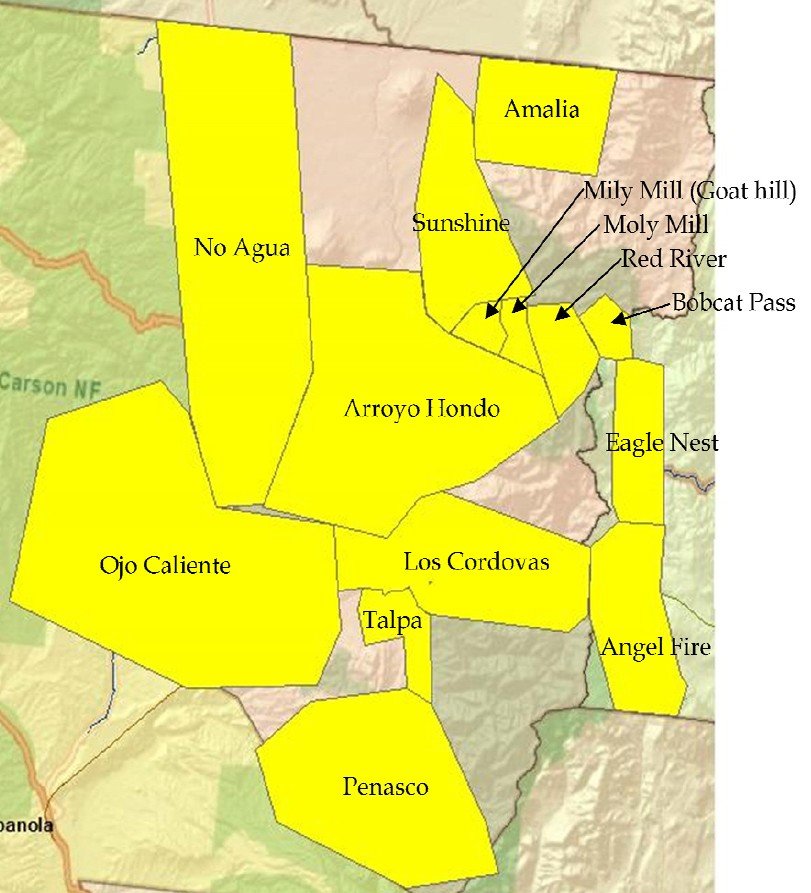
Proposed service area for Kit Carson Electric's new fiber to the home network serving northern New Mexico.

Kit Carson Electric’s project will provide a true fiber-to-the-home service bundling television, telephone, and broadband service — a substantial upgrade over what the telephone company has on offer.  With speeds far beyond what cable and phone providers in New Mexico are accustomed to providing, the region stands to benefit from entrepreneurs building digital economy businesses over a broadband network that can actually help, not hinder online development.

Currently, area residents pay CenturyLink up to $55 a month for 1.5/1Mbps DSL service.  Residents are so excited by the prospects of much faster speeds at significantly lower prices, Kit Carson Electric has developed an innovative stop-gap service for residents still waiting for direct fiber connections — fiber-to-wireless service.  New and existing customers can sign up for the service for a $100 installation fee and choose from three service tiers:

  • 3Mbps — $29.95/month
  • 7Mbps — $39.95/month
  • 10Mbps — $49.95/month

A three year contract is required (early termination fee is $200).  But customers who eventually obtain Kit Carson Electric’s fiber service will automatically satisfy their contract requirement.

“Kit Carson’s wireless project already blows away CenturyLink’s speeds and pricing, and that is for inferior wireless,” Raul argues. “The Chronicle doesn’t have a clue.”

We can’t understand the newspaper’s concerns either.  Kit Carson Electric has already demonstrated their prices (and interest) in northern New Mexico is superior to that of CenturyLink, owner of former Baby Bell Qwest, which serves New Mexico.

Republican Sen. Jeff Bingaman is thrilled with Kit Carson’s broadband initiative.

“This major investment in broadband technology is exactly the kind of project I had envisioned when I voted for the American Recovery and Reinvestment Act,” U.S. Senator Jeff Bingaman said. “This grant is not only creating jobs now in northern New Mexico, it is laying the groundwork to attract new businesses, improve healthcare services and create new education opportunities in the future.”

The electric co-op has been successful operating non-profit businesses selling propane, telecommunications, and economic development space.  The fiber project will also allow the electric utility to deploy “smart grid” technology to increase the efficiency of their electric service.

A groundbreaking ceremony at the broadband project’s command center held this past summer also coincided with a public emergency communications network upgrade which will increase the efficiency and reliability of first responders and other emergency and public safety agencies.

Maine Madness: Time Warner Cable’s Mandatory Digital Upgrade Still Irking Customers

Phillip Dampier December 5, 2011 Broadband Speed, Consumer News 2 Comments

Time Warner Cable’s progression towards all-digital cable continues to spread across Maine as customers in Albion, Augusta, Belgrade, Benton, China, Clinton, Farmingdale, Gardiner, Hallowell, Litchfield, Manchester, Monmouth, Mount Vernon, North Vassalboro, Readfield, Richmond, Rome, Sidney, Vassalboro, West Gardiner and Winthrop lost many of their analog channels last week.

But customers losing AMC, Animal Planet, Cartoon Network, CKSH, CHLT, CNBC, E!, EWTN, GAC, Hallmark Channel, HGTV, History, HSN, INSP, NECN, Ovation, QVC, SyFy, Shop NBC, TCM, TNT, and USA also provoked the loss of something else: patience.

“Cable TV is the only service I pay for that increases my bill and frustration at the same time,” says Augusta Stop the Cap! reader Jeff E. Smith.  “The digital adapter Time Warner sent me was defective right out of the box, and two of my neighbors were also sent defective units that never powered on,” Smith writes.

Time Warner Cable is dramatically reducing the analog cable lineup to make additional room for new digital HD channels and faster broadband speeds.  The company is supplying palm-sized digital adapters for subscribers who don’t have a digital set top box on every television.  Although free until 2014, the boxes will carry a monthly fee of $0.99 each after that.

“The upgrade gives them the chance to cram on more channels we don’t want and more expensive broadband, and yet we have to eventually pay for the equipment,” Smith says. “And it doesn’t even work right.”

Smith’s neighbors have discovered patience-testing lines at some Augusta-area cable stores as customers rushed to obtain the equipment they assumed they didn’t need.

“The neighbor’s mother-in-law doesn’t understand how to use OnStar in her car, so it was no surprise she found out she needed the equipment when most of her favorite channels disappeared,” he adds.  “Time Warner really overestimated the level of understanding customers would have about this after buying new digital-TV’s a few years ago.”

Jim has several suggestions for Time Warner to adopt before the digital upgrade begins its progression across the country:

  1. The equipment should be free of charge and included with your regular monthly service.  You can’t realistically expect to buy Time Warner Cable service without a box for every set after the digital conversion is complete, so just include the equipment;
  2. A better and less intrusive way to manage this would be to install a single digital converter on the outside of the home or in a closet which could provide analog service to every TV not already equipped with a set top box.  That would mean no annoying box on every set in the home and would probably cost less (in time, money, and aggravation);
  3. People assume they are ready for digital cable because they bought digital-ready TV’s after analog television service ceased. Most customers will not read generic letters carefully.  It would be better to send people customized letters telling them they specifically will need the equipment because records indicate additional outlets were installed in the home without corresponding cable set top boxes attached to them.  What are the chances customers are using CableCARD units these days?  Chances are, they’ll need the DTA adapters, so make this clearer.
  4. Don’t you dare put customers through this, increase broadband speeds, and then slap usage caps or usage billing on us!

Search This Site:

Contributions:

Recent Comments:

Your Account:

Stop the Cap!