Home » Broadband Speed » Recent Articles:

Broadband Blindness: How North American Providers Set Us Up for Failure

[flv width=”640″ height=”380″]http://www.phillipdampier.com/video/Broadband Blindness.flv[/flv]

Toast Sacramento produced this 28-minute documentary which succinctly tells the story of North American broadband, and how commercial providers have set us up for long-term failure, especially in rural and suburban areas.  Whether you live in the United States or Canada, phone and cable companies dominate the telecommunications landscape.  Unlike other modern-day necessities, broadband is almost entirely in the hands of an unregulated free market that fails millions.  Where competition exists, customers can get reasonably fast service, but it costs more than it should.  Where competition is hard to find: slow speeds, spotty access, and out-of-sight prices predominate.

The documentary explores:

  • the neglect of suburban and rural DSL from large phone companies like AT&T;
  • how phony, industry-influenced broadband availability maps convince public officials there isn’t a big broadband problem;
  • why the country’s broadband demands may be too great for providers to handle without major new investments, leading to usage limits and slowdowns to delay needed upgrades;
  • and how the latest broadband technologies being installed overseas fall victim to Wall Street temper tantrums back home.

Bell’s Misleading Ads: “Fibe TV: State-of-the-Art Fibre Optic Network” That Isn’t

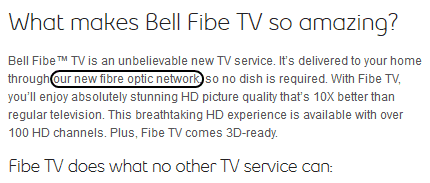
Bell Canada is misleading potential customers when mailing them invitations to sign up for Fibe TV, which the company calls “a new TV service delivered through our new state-of-the-art fibre optic network.”

Only it isn’t “state of the art” or fiber to the home.

Bell characterizes its Fibe service as Canada’s “most advanced” telecommunications network, even better than traditional cable television.  But in fact, it’s a marriage between fiber optics and the decades-old copper wire phone network Bell continues to rely on to provide a triple-play package of phone, broadband, and television, all without investing in superior fiber to the home technology.

Only it's not a true fiber network.

That the company claims it is running the most advanced network in the country must come as quite a surprise to Bell Aliant, the dominant provider in Atlantic Canada.  Aliant is busily building a true fiber-to-the-home network for at least 600,000 customers in the most eastern part of the country.

While Fibe is an evolutionary move for Bell Canada, it is hardly revolutionary because of its dependence on traditional copper phone lines.  Canada remains behind the United States in deploying fiber technology of all kinds, including Fibe‘s fiber-to-the-neighborhood system.  Bell’s closest cousin AT&T has been running its own comparable U-verse system for a few years now.

Providers like the benefits of fiber-to-the-neighborhood technology and the fact it costs considerably less than rewiring every home for fiber optic connections.  Fibe can deliver speedier broadband than traditional DSL, but cable operators like Rogers and Videotron are already positioned to beat Fibe speeds, and a true fiber to the home network can beat anything on offer.

Phone and cable companies in the United States who have pitched older technology as a “state of the art fiber network” without actually providing one have been challenged by true fiber to the home competitors like Verizon, and forced to retreat.  But with so few Canadian providers in a position to challenge Bell’s fiber claims, it will be up to regulators to declare the advertising and marketing materials misleading.

AT&T’s U-verse a Flop in Chattanooga — Only 821 Signed Up; EPB Wins Comcast Customers

Phillip Dampier December 27, 2011 AT&T, Broadband Speed, Comcast/Xfinity, Community Networks, Competition, Consumer News, Data Caps, EPB Fiber Comments Off on AT&T’s U-verse a Flop in Chattanooga — Only 821 Signed Up; EPB Wins Comcast Customers

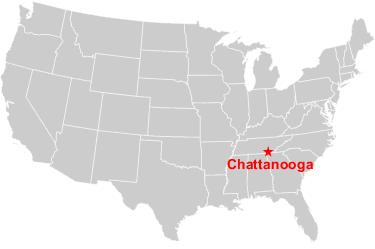
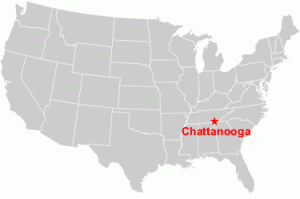
AT&T’s fiber to the neighborhood service is not exactly winning consumers over in Chattanooga, Tenn.  As of this past spring, AT&T only managed to convince 821 local customers to sign up for U-verse service, in part because the competition delivers faster service, and one doesn’t slap broadband customers with an Internet Overcharging scheme.

While Comcast remains the dominant cable company in the city with more than 100,000 customers, community-owned EPB Fiber has made major advances, primarily against Comcast, picking up at least 33,000 customers in the city since the summer of 2010.

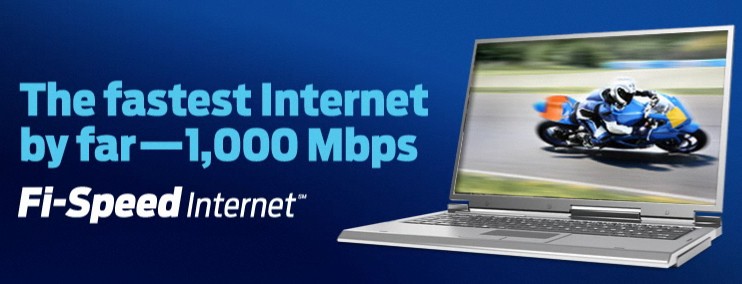
EPB is turning into a major success story for community-owned broadband, typically maligned as a financial failure by cable and phone company competitors.  EPB offers residential customers usage cap free gigabit broadband, television, and telephone service and is competing effectively against the nation’s largest cable operator.

EPB has been raking in more than $3.8 million a month in telecommunications revenue from residential customers alone.  In less than two years, EPB, which also delivers electricity in Chattanooga, has built a $45 million a year telecommunications business.  As a community-owned utility, most of that revenue stays in Chattanooga, benefiting the local economy and allowing EPB to reinvest in its network and improve service.
Comcast, in contrast, has seen its revenue drop by 8.4 percent during the first six months of 2011, primarily because of departing customers. That has forced the dominant cable company to become more aggressive in its efforts to retain those calling to cancel, primarily by slashing prices if wavering customers agree to stay.

Remarkably, AT&T’s U-verse has merited also-ran third place status — the victim of limited availability, the ongoing trend of customers dropping landline service, and the far-superior broadband speeds available from the competition.  AT&T’s Internet Overcharging scheme is also the stingiest, limiting broadband customers to just 150GB for its DSL service, 250GB for U-verse broadband, charging overlimit fees when the caps are exceeded.  Comcast has a usage cap of 250GB with no overlimit fee.  EPB has no limits.

The Chattanooga Times Free Press compares all three providers’ strengths and weaknesses:

EPB Broadband speeds are the fastest in the nation.

AT&T — Very aggressively priced introductory offers, more HD channels than its competitors, plus a “quad-play” bundle that includes AT&T wireless service.  But AT&T’s landline network is still the least equipped to compete on broadband speed, an increasing number of residents continue to turn their back on AT&T when they cut landline service, and U-verse’s usage caps come with overlimit fees.

Comcast — Has a substantial number of on-demand programs to access, can be cheaper than EPB during the initial year of service, and is testing home security and automation services.  Also offers two-hour service call windows and aggressively priced retention deals.  But Comcast’s regular prices are high, its broadband service usage-limited, and its reputation questionable after more than a decade of rate hikes and service complaints.

EPB — The fastest broadband speeds anywhere, EPB runs an advanced fiber to the home network, and maintains a very aggressive attitude about expanding and improving service.  EPB is a formidable competitor.  Community-0wned, its service benefits local residents with a locally-staffed call center, revenues that stay in Chattanooga, and management that answers to customers, not Wall Street.  No caps either.  But EPB can be a harder initial sell for price-sensitive customers because it doesn’t offer heavily discounted service to attract new customers.  But EPB prices don’t rise dramatically after the first year, either.  EPB’s television lineup is less robust than others, in part because it lacks a nationwide presence that brings the kind of volume discounts AT&T and Comcast receive.


Asian Wireless Broadband Learns from North America: Internet Overcharging=Fat Profits

Phillip Dampier December 15, 2011 Broadband Speed, Data Caps, Wireless Broadband Comments Off on Asian Wireless Broadband Learns from North America: Internet Overcharging=Fat Profits

As long as your life stops after 5GB per month.

Asian wireless operators are learning from their North American counterparts that artificially limiting wireless broadband consumption with usage caps and metered pricing can deliver enormous new profits companies can use to satisfy shareholders and attract higher dividend-seeking investors.

DoCoMo, Hong Kong’s CSL, and South Korea’s SK Telecom have all announced a shift towards usage-limited plans even as they launch new 4G networks that have at least three times the capacity of the older 3G networks they will eventually replace.  In fact, as Dow Jones reports, usage capping 4G wireless Internet access has little to do with congestion.  Instead, it’s a “revenue booster.”

Limiting data use and charging subscribers for excessive Web browsing on mobile devices may help boost carriers’ return on their investment at a time when many operators in the region have seen their earnings pressured due to falling voice revenue and hefty smartphone subsidies.

With the shift to charging subscribers for extra data usage, the region’s carriers are hopeful that they can boost their revenue.

While last generation 3G wireless broadband networks do face congestion issues, providers have maintained unlimited data plans until very recently.  But solving the 3G capacity crunch by upgrading to 4G has not removed the excuse to engage in Internet Overcharging.  It has only shifted the rationale for usage based pricing towards attracting increased revenue and investment.

Hong Kong-based CSL began offering 4G services in November last year for $44.85 for 5GB with an overlimit fee of $12.72/GB. At least CSL retains an unlimited use option, charging customers $60 a month for all-you-can-eat wireless broadband, a much better deal if you expect to exceed CSL’s 5GB limit.

Independent Gigabit Broadband for San Francisco, While AT&T Struggles to Provide U-verse

Phillip Dampier December 15, 2011 AT&T, Broadband Speed, Competition, Data Caps, Sonic.net Comments Off on Independent Gigabit Broadband for San Francisco, While AT&T Struggles to Provide U-verse

While AT&T endures zoning-related delays to build out its fiber-to-the-neighborhood service U-verse, a scrappy anti-cap, pro-speed Internet provider in Santa Rosa has announced its intention to deliver gigabit speeds to San Franciscans over a fiber-to-the-home network that will begin construction early next year.

Sonic.net has been providing broadband services for years in northern California, using AT&T’s network of phone lines to deliver unlimited 20Mbps DSL service (including a phone line) for $40 a month.

Sunset District, San Francisco, Calif. (Courtesy: Stilfehler)

Now the company is branching beyond traditional DSL into fiber optics.  Sonic.net has already completed the first phase of its gigabit fiber network in Sebastopol, where it advertises 100Mbps service for $40 a month and 1000Mbps for $70 a month, both including phone service at no extra charge (two lines for the 1Gbps plan).

In San Francisco, Sonic plans to start with 2000 homes in the Sunset District, expanding its network to fully cover the city within five years.

Such a network could deliver serious competition to Comcast and AT&T, the currently-dominant providers.  AT&T’s U-verse buildout has been stalled over the need to install 768 large, unsightly metal cabinets on San Francisco street corners.  The company, as late as this summer, remains mired in zoning disputes and public protests.  Sonic’s fiber network will require similar equipment, and the San Francisco Chronicle reports Sonic filed its own application with the city Department of Public Works to install 188 cabinets, measuring 5 feet tall, starting next year.

Sonic may have a better chance if only because it does not have AT&T’s less-than-stellar reputation among some residents and customers who have been upset with the company’s wireless performance, and ongoing battles over cell tower placement.  Sonic.net CEO Dane Jasper tells the Chronicle:

“There is a huge demand in San Francisco for higher bandwidth services, and fiber is the only long-term way to meet this demand,” he said.

Given the fact that the company’s all-fiber network will bring “the fastest and cheapest” broadband service to the city, Jasper says he thinks the chances of overcoming the obstacles experienced by his larger rival are “pretty good.”

Sonic.net has gained a reputation for excellent customer service and vociferously opposes usage caps and other Internet Overcharging schemes.  The company has attracted the support of Google, which is using Sonic to manage its gigabit fiber network on the campus grounds of Stanford University in Palo Alto.

AT&T has previously dismissed fiber to the home service as too costly to provide, and has adopted in its place a fiber-to-the-neighborhood system that relies on traditional home phone wiring for the last part of its network.

Search This Site:

Contributions:

Recent Comments:

Your Account:

Stop the Cap!