Home » Broadband Speed » Recent Articles:

Comcast’s “Stranglehold on Savannah” — City in Open Revolt Over Shoddy “Don’t Care” Service

Diana Thibodoux documents Comcast's shoddy work in her rented home.

The city of Savannah, Georgia is at the mercy of Comcast Cable, and city officials and local residents are fed up with high bills, the “don’t care” attitude from customer service, and cable and broadband that fails repeatedly, sometimes extending for weeks.

The fervor came to a head in December when city council had accumulated more than 150 complaints from local residents, deciding public hearings were warranted to deal with the city’s dominant cable company, Comcast.

“Comcast Destroyed My House”

Diana Thibodoux called Comcast to deal with a cable issue in her Ardsley Park home and never expected the service call would turn into an expensive nightmare.

Thibodoux says the Comcast technician who showed up decided on his own to rewire the house for cable and began drilling through brick and expensive plaster, stringing easily visible black coaxial cable along outside walls, inside baseboards and up over doors, all in plain sight.

“My house looks like a frat house,” Thibodoux complained to Comcast officials who were on hand to listen to customer complaints at the first of four public “town hall” meetings.

“I’ve never dealt with a company so incompetent,” another local resident said.

[flv width=”640″ height=”500″]http://www.phillipdampier.com/video/WTOC Savannah Ive never dealt with a company so incompetent 2-6-12.mp4[/flv]

WTOC in Savannah shares the horror story of Diana Thibodoux, who says Comcast destroyed her house thanks to an overzealous, incompetent repairman.  (3 minutes)

At least everyone knows she has cable.

Residents used the public sessions to vent about long hold times which can extend to as much as two hours, poor quality service, and what city officials call the predictable outcome of a company that has “a stranglehold” over Savannah’s cable TV market.

“Comcast has treated Savannah like a third world country for years, delivering the best service to the wealthiest neighborhoods while leaving cable lines dangling on the ground in the areas they don’t care about,” said Stop the Cap! reader Jenny Child, who has kept a folder of papers documenting more than a dozen service calls regarding poor Internet service at her small business.

“If it rains in Savannah, and it does so a lot, our Internet goes out,” Child complains. “We have called and called but the technician shows up when it is bright and sunny and shrugs his shoulders and says there is no problem.”

Child and her two employees now handle their online business activities based on local weather forecasts.

“If the man says we’re getting rain today, we handle our Internet things real quick, because as sure as I’ll be in church on Sunday, we won’t have service after the first drops fall from the sky,” she says.

Child keeps calling Comcast when her Internet service drops out, but long hold times to reach the company’s outsourced-to-India customer service department have cut into her business.

“I can’t be sitting here on hold with Comcast for 45 minutes waiting for some representative’s nails to dry so she can pick up the phone and deal with customers,” Child complains. “It’s the biggest cable company ever, and don’t they own NBC? How many people do they have working there that they can’t answer the phone. Maybe everyone else is calling to complain too.”

Comcast’s Business Broadband Blockade Prompts Whining When Potential Competition Shows Up

Hargray is wiring downtown Savannah with fiber broadband to serve long-neglected area businesses

While fielding complaints from more than 50 local residents at a second meeting held to address complaints, Comcast executives questioned whether the city of Savannah was giving favorable treatment to Hargray, a new entrant pushing to bring 21st century broadband into the city of Savannah for businesses Comcast has refused to serve for years.

Comcast complained they didn’t mind competition, but wanted “a level playing field,” a statement that prompted an immediate and angry response from some members of the city council, who blasted the cable company for its attitude.

Aldermen Tony Thomas, John Hall, and Tom Bordeaux all noted Comcast has steadfastly refused to wire many downtown business buildings for cable broadband service, despite years of requests.  Comcast claimed the relatively low number of customers did not justify the cost to expand the service.

Alderman Tony Thomas has championed the ongoing dispute with Comcast Cable on behalf of local residents.

All three could not understand why Comcast had a sudden urgency to complain about unfair treatment when a competitor sought to provide the service they never did.

“If [Comcast] did not want to offer that service previously and someone else is coming in to provide the service, where is the sticking point?” Thomas said.

Bordeaux was more blunt in his remarks intended for Comcast.

“Tell them to sue us,” he said.

In contrast to service from AT&T and Comcast, which often markets 3-6Mbps broadband in Savannah, Hargray’s fiber broadband project will deliver speeds up to 1Gbps, first to business customers. But the company promises it is considering selling to residential customers as well.

Great Deals, But Only for “Selected Neighborhoods”

As Comcast’s bad press has become fodder for the nightly newscasts on several of the city’s television outlets, Comcast literally took to the streets to try and mitigate their public relations nightmare. In the process, they created a new one.

Councilman Tony Thomas is happy Comcast is approaching upset customers and offering them substantial discounts on their cable bill.  But he’s not happy Comcast is only extending those deals to certain customers, not all.

Thomas wants the deals offered to everyone, something that he says is not happening today.
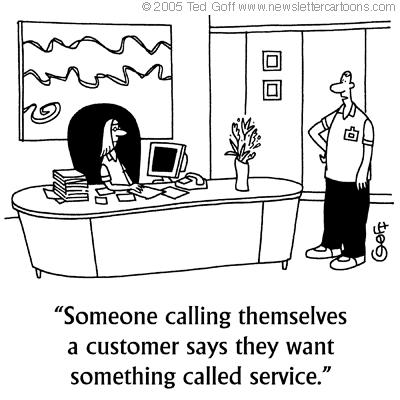
(Courtesy: Ted Goff/newslettercartoons.com)

Andy Macke, Comcast’s Vice President of Communications counters, “All they have to do is call 1-800-COMCAST and they will hear the same deals that the same people are getting from those reps going from door to door.”

“Comcast’s attitude in Savannah is see no evil, hear no evil,” says Jeff White, a Comcast customer who has watched the scuffle. “They don’t even admit there is a problem until it runs on the evening news and city council waves 150 complaints they are getting at the camera — the ones Comcast ignored.”

Macke himself told WJCL-TV, which has covered the dispute with Comcast repeatedly, he was “unaware of the extent of the concerns that our Savannah customers had with us.”

Despite promises to make things right, Alderman Thomas says many complaints are still unresolved.

“We were told that all of those folks had been contacted and that their problems were being worked on. I have since found a few of these people [who] have had no contact whatsoever with Comcast,” Thomas told the TV station.

“Under no circumstances should City Council let the situation with Comcast get pushed under the rug,” one person wrote in the Vox Populi column in the Savannah Morning News. “We the people need help!”

No Help On the Way

Unfortunately for that reader, and other Savannah residents, an attempt by Savannah city officials to attract competing cable service has met with no success and no interest.  Cable operators almost never compete head to head, each respecting the service areas of fellow providers.  Hargray’s interest in Savannah is primarily serving business customers, and the option for municipal service may not be possible much longer if a bill supported by Comcast, SB 313, ever becomes law.

[flv width=”640″ height=”500″]http://www.phillipdampier.com/video/Comcast in Savannah 2-8-12.flv[/flv]

A compilation of news reports from WJCL, WSAV, and WTOC exploring Comcast’s performance problems in the city of Savannah, Georgia.  (15 minutes)
Want to Lure New Digital Economy Businesses to Your Community? You Need 100Mbps Broadband

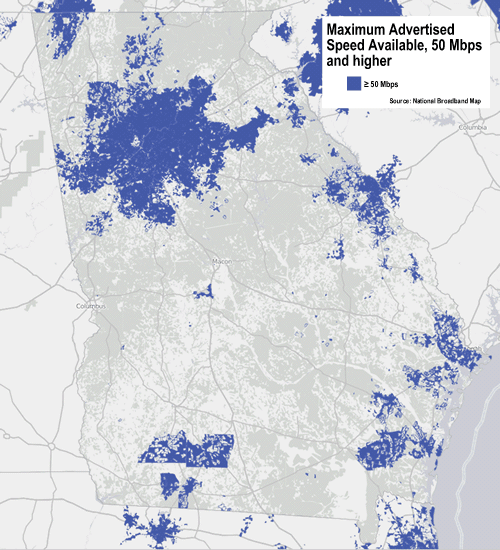
Georgia's broadband map shows just a smattering of 50Mbps broadband. That is half the speed required to attract new businesses, says the IEDC.

Suffering the Great Recession blues?  As communities continue to face the loss of manufacturing, heavy industry, and textile jobs to overseas outsourcing, local economic development specialists have discovered one of the most effective ways to lure new high-tech industry into areas hard-hit with job losses is the availability of cheap, plentiful, and fast broadband.

A survey of economic development officials from around the nation, sponsored by the  International Economic Development Council, showed 77% believe 100Mbps is the minimum speed needed to attract new businesses.  Almost half think even that is no longer fast enough:
  • 42% believe that that 1Gbps is the minimum speed needed to lure new businesses.
  • 35% believe the minimum must be at least 100Mbps.
  • Rural economic developers appear to be well ahead their urban counterparts in the area of planning. 58% of rural respondents either have broadband strategies and tactics worked into their economic development plans or are writing plans with these elements. Only 39% of urban respondents have done the same.
  • 92% see no benefit from the FCC’s minimum broadband standard of 4Mbps, defined largely to suit telephone company DSL service common in rural areas.

Why are rural economies benefiting from better broadband planning? Because in the absence of commercial providers willing to provide the service, an increasing number of small towns and cities are building their own municipal networks to get the job done themselves.  Those networks are routinely superior to the facilities provided by most cable and phone companies serving less populated areas.

Community broadband is working in Wilson and Salisbury, N.C., where a transition from a textile/tobacco-based economy into higher-tech knowledge economy jobs required state-of-the-art broadband as a foundation.  Chattanooga, Tenn.-based EPB Fiber has already attracted dot.com giants like Amazon.com, creating hundreds of millions in local investment and thousands of new jobs.  Why Chattanooga?  Gigabit broadband for just a few hundred dollars a month is just one phone call away.

Relying on commercial providers to build 21st century broadband as a platform for economic transformation has delivered uneven results, especially outside of the largest cities. Large cities traditionally get most of the provider’s time, attention, and upgrades.  Smaller, more out of the way places often see little or nothing.

That is why this year’s latest push in Georgia and South Carolina to tie the hands of communities trying to remake themselves with modern broadband is so risky. While AT&T and the cable companies may position their argument as “protecting consumers,” in fact they are only protecting their own interests, even if it means the next Amazon.com distribution facility or Google data center finds a better home somewhere else.

Updated 3:55pm ET: We added a link to the full report, with appreciation to the author.

Broadband Backwater Watch: Georgia Anti-Broadband Bill Defines Broadband: 200kbps

Sen. Chip Rogers' vision of rural Georgia's broadband future

Sen. Chip Rogers (R-Woodstock) thinks he knows broadband.  He, along with several other Georgia legislators well-compensated by some of the state’s largest telecom interests, have defined appropriate Internet speeds at a remarkably low “200 kilobits per second,” less than four times faster than your old AOL dial-up Internet account.  The one you canceled in 1998.

With a background like that, it was no surprise last Thursday when technology leaders and city representatives from across Georgia testified before the Senate Regulated Industries & Utilities Committee, strongly objecting to Rogers’ SB 313, a bill bought and paid for by the very companies the legislation would effectively protect from competition.

Rogers argues he wants to “level the playing field” between private providers that currently dominate broadband service in Georgia, and the long-suffering communities in rural areas that have waited for faster Internet since the Clinton Administration.

City officials from Dalton, Newnan, Elberton, Thomasville, Cartersville, LaGrange, Hogansville and Monroe collectively noted the proposed legislation hardly represents a level playing field when it fully exempts the bill’s backers from any of its provisions.  Thomasville mayor Max Beverly noted the same cable and phone companies that fiercely fought for statewide cable franchises for themselves now want to impose rules that forbid publicly-run companies from operating outside of their respective city limits.

“We would have to turn off service to the county’s two largest employers,” Thomasville Mayor Max Beverly told the Senate panel. “There is no telling what that would do to jobs in our area.”

Those testifying uniformly noted they entered the broadband business because private providers refused to deliver adequate service in their areas.

What community broadband provides communities the big phone and cable companies don't.

“We started our cable system not on a whim but on a demand from our citizens to provide a higher level of service for cable TV and Internet,” said Newnan Mayor Keith Brady. “We got into the cable business originally to provide fiber optics and broadband because Charter Communications would simply not invest in our community.”

Now cable and phone companies across Georgia are supporting legislation that would make that community service next to impossible to provide.

“The most ironic part of legislation like SB 313 is that cable and phone companies only take an interest in rural broadband when they ghostwrite bills like this to stop other people from providing the service themselves,” said Stop the Cap! reader Max Curr. “When I lived in Hiltonia, some of these same companies laughed at me when I asked about broadband. It simply was not profitable, they were not going to provide it, and with this bill, they will make sure it stays that way.”

But the cost to consumers extends way beyond the most rural corners of the state. SB 313 also hurts existing cable and phone customers who pay higher rates because of the lack of competition.  That assures the kind of anemic broadband Rogers and his friends in the cable and phone industries are only too happy to define as 200kbps.  At least that is 10kbps more than a similar bill being pushed by telephone and cable operators in South Carolina.

Brady says their community-owned system not only provides broadband where Charter would not, the cable company also was forced to reduce their rates for consumers in nearby communities, saving taxpayers across the entire city and county millions.

In Elberton, the lack of broadband was so pervasive the 4,700 local residents demanded the city provide the service themselves. Commercial providers had stonewalled the county seat of Elbert County for years until the city broke ground on a broadband project in 2001.

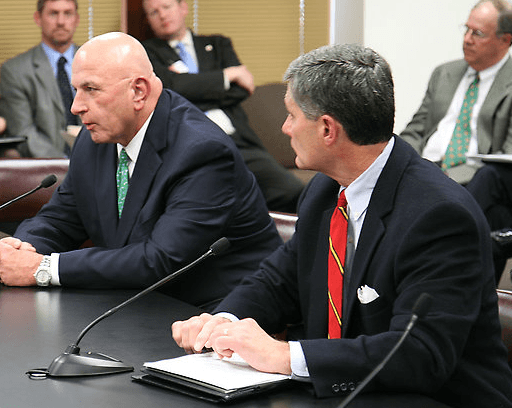
Dalton Utilities' CEO Don Cope (left), Newnan mayor Keith Brady (right) (Photo: Georgia Municipal Assn.)

Elberton City Manager Lanier Dunn complained SB 313 undercuts the rational definition of minimum Internet speeds to levels most Americans would not even consider “broadband.”  Dunn noted that the 2010 National Broadband Plan calls for download speeds 250 times greater, and by 2020 500 times greater, than what Rogers’ bill currently defines as broadband service.

“We should be reaching for higher and faster speeds, not relegating ourselves to barely just above dial-up,” Dunn said.

Don Cope, president and CEO of Dalton Utilities, demonstrated that municipal broadband systems are not the financial risk large telecommunications companies always claim they represent.  In fact, Dalton’s system has never received a penny of tax revenue and its accounting is open to public scrutiny to prove it.

Cope noted SB 313 imposes restrictions on community providers, but completely exempts those owned by the companies pushing the bill.

“I would ask that you look at the private providers in the state,” Cope said. “Look at their reports, and you would see how many dollars that are provided to them from the federal government. We are talking about in the billions of dollars. All the [private telecommunications entities] that I know about have some form of government support.”

Dalton isn’t the only city in Georgia with a successful community-owned operation.

The city of Newnan found their system such a valuable asset, they sold it at a profit to a private company in 2008 and used the proceeds to pay off its remaining construction costs.

Your Internet Could Be Worse: St. Helena’s 4,000 Residents Share A Single 10Mbps Connection

Perhaps the most the world ever hears about the tiny British island of St. Helena, a home in the South Atlantic for 4,000 residents, is the annual St. Helena Radio Day when the nation takes to the shortwave radio dial to say hello to friends on every continent.

Beyond that, St. Helena is mostly known as an out-of-the-way tourist destination and potential point of contact for ships traversing the South Atlantic between South America and southern Africa.  St. Helena’s residents live with three television stations, two radio stations, two newspapers, and a single satellite connection to the Internet providing one 10/3Mbps circuit shared by all 4,000 residents.

Signing up for “broadband” is an expensive ordeal.  Individual residents can purchase strictly usage-limited DSL Internet service at prices ranging from $31 a month for 128/64kbps service (limited to 300MB per month) to $190 for 384/128kbps service, with a 3.3GB monthly allowance.  Overlimit fees start at around $0.15 per megabyte.

St. Helena

Local residents find life without the modern day definition of broadband service a major hindrance, especially for education.  Students have left St. Helena for the United Kingdom to pursue studies.  Economically, self-sustained employment is next to impossible on the island.

“I’m an IT engineer and I would love to return to my island to start an IT business, but because of the slow, expensive and unreliable Internet connection this is simply impossible,” said Jonathan Clingham, an IT infrastructure engineer now working in Wiltshire, England.

Now a grass-roots campaign has been launched to help convince several telecommunications companies financing a new underseas fiber cable project laid between Brazil, Angola, and South Africa to reroute the cable slightly through the island of St. Helena, opening the door to modern broadband for the island.

The group is calling on supporters to help draw attention to the project, arrange for the British government to help underwrite the expense of an extra 50 kilometers of cable needed to reach St. Helena, and providing assistance to lease a circuit on the new cable:

Big Telecom to Georgia: Your Improved Community Broadband Bothers Us

Phillip "Rural Georgia Isn't On AT&T's Mind" Dampier

Columbia County, Georgia has been talking about fiber optic broadband for two years — two years that the state’s largest phone and cable companies have not stepped up to provide suitable broadband to local schools, residents, and libraries.  In 2010, enough was enough and the county applied for, and won, a $13.5 million Broadband Technology Opportunity Program grant to increase broadband and wireless access to the Internet throughout the area.  Local taxpayers chipped in about $4.5 million in 1-percent sales tax dollars, and in-kind voluntary donations worth $2.3 million fulfilled the grant requirement that local matching funds be provided.

To residents long-suffering with satellite-delivered Internet, usage-capped mobile broadband, spotty DSL service, and frequent outages and slow speeds, a modern fiber network would help 120,000 county residents obtain the kind of broadband service people elsewhere take for granted.  Columbia County’s rural character is evident when you consider it contains only two small incorporated cities and 91 percent of the population lives in unincorporated areas, making the eastern Georgia county an afterthought for big phone and cable companies who see better profits in bigger cities.

Now these companies, with the help of a campaign contribution-gorging state legislator, are intent on stopping projects even in areas they could care less about.

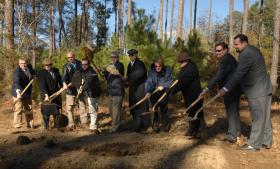
The News-Times captured this image from the groundbreaking ceremony for Columbia County's new fiber network in 2010. Big phone and cable companies would like them to run this picture again at the project's burial.

Columbia County’s local newspaper, the News-Times, is alarmed at the prospect of public tax dollars already spent on the project burned for the benefit of Big Telecom companies:

Republican State Sen. Chip Rogers, fueled by generous contributions from telecommunications companies, has filed a bill in the Georgia Legislature that, he claims, would protect private service providers from unfair competition by government-subsidized broadband systems.

Nonsensically, some in Columbia County welcomed the news as a slap at the county’s government. While we’re on record opposing the concept of the $13.5 million federal grant that allows the county’s entry into broadband, the fact remains that the project already is underway.

That federal program is designed to expand broadband Internet service to rural areas that, because of the up-front infrastructure costs, aren’t deemed profitable by private companies. Our county has plenty of those areas, served at best only by spotty, expensive cellular-based services.

Columbia County’s program wouldn’t compete with private companies. Instead, it uses the federal grant and local sale-tax funding to build that high-speed infrastructure, which private companies can then lease to provide Internet service to underserved areas.

Rather than undercutting local communities and sacrificing rural customers on behalf of the private companies, Rogers ought to look for ways to improve such public-private partnerships. Columbia County taxpayers had better hope so, too, unless they want all the money they’ve spent wiring the county with fiber optic cables to have been wasted.

SB. 313 is just another contract taken out on community-owned broadband networks that could deliver competition (and worse — far better service) to areas of Georgia where even conservative-minded voters wary of spending public money on anything are simply fed up with the status quo.

Columbia County, Georgia

So much for the Columbia County Broadband Network, a 220-mile, county-wide fiber middle mile network that will connect nearly 150 community anchor institutions and enhance health care, public safety, and government services throughout the county. Anchor institutions hoping to be connected at broadband speeds of 100 Mbps to 10 Gbps include K-12 schools, fire and emergency facilities, public libraries, Augusta Technical College, and the Columbia County Health Department. The project also planned to facilitate the creation of a high-capacity data center at the Medical College of Georgia, support a sophisticated county-wide traffic and water control system, and construct five wireless towers to enhance public safety communications as well as improve wireless communications capabilities throughout the region.

If Rogers’ bill passes, the county may have to go back to begging for access from the companies that have repeatedly said it wasn’t worth the investment or their time.

County officials have been more generous, offering all along to share access to the fiber network with the very providers who are seeking to destroy it.  So far, that hasn’t changed any minds.

“If we don’t own it, that means we don’t want you to have it” is standard operating procedure for the state’s phone and cable operators, even in the service areas they routinely ignore, even if it means flushing millions of dollars already spent on new networks down the drain.

That’s money-fueled politics.  State legislators with Big Telecom dollars in their eyes can’t see the 120,000 Columbia County residents waiting years for better broadband.  Perhaps the best way to reach legislators in Atlanta is to condemn them to the same kind of broadband service local residents in Evans, Martinez, and Appling are forced to endure, if they have it at all.

Search This Site:

Contributions:

Recent Comments:

Your Account:

Stop the Cap!