Home » Broadband Speed » Recent Articles:

Bailiwick of Jersey Residents Getting 1Gbps Broadband; Private Providers Want Less

Phillip Dampier February 15, 2012 Broadband Speed, Community Networks, Competition, Data Caps, Public Policy & Gov't, Rural Broadband, Video Comments Off on Bailiwick of Jersey Residents Getting 1Gbps Broadband; Private Providers Want Less

The Bailiwick of Jersey, one of the British Channel Islands off the coast of Normandy, France, is being wired for fiber broadband speeds as high as 1Gbps and the island’s 100,000 residents are thrilled.

Jersey Telecom (JT), a government-owned service provider, expects to reach every one of the island’s 42,000 homes with Gigabit Jersey — a super-fast fiber network by the end of 2016.  The first 24 homes were switched on for service this week, with new homes coming online daily.

Graeme Millar, JT CEO, says Jersey’s new fiber network replaces the island’s antiquated copper wire based DSL service, and will result in much faster speeds for residents.  The initial trial is focused on La Rocque, Fauvic, and La Moye, and all commercial broadband providers are welcome to use the network to sell their services to residents and businesses on the island.

JT is offering a minimum of 40/40Mbps service to casual users and 1Gbps for Internet addicts.

Millar

Millar

The fiber project makes no distinctions between urban and rural residents and provides the same speeds to both businesses and residences.  Broadband has become such an important part of island life, it is essential every home have equal access.  With home-based businesses and home-based workers, it doesn’t make sense to only sell fast service to business customers.

The government spent £19m ($29.8 million) on the fiber network it calls an investment in the future.  None of the funding comes from the pockets of the island’s taxpayers.

Jersey officials claim the project will attract new high-tech businesses to the island, which is closer to France than England.

Government officials, and many residents, have rejected complaints from private providers like Airtel-Vodafone who claim the Internet’s future is mobile/wireless, not fiber.  Airtel-Vodafone fought Gigabit Jersey, claiming “fast enough” Internet access was possible over their mobile broadband network.  The company claimed the government investment interfered with private companies’ business plans for Jersey.

“Airtel had no intention of delivering anything close to the speeds we are going to get from JT, and they would hand us plans with small usage allowances and high prices to boot,” says Stop the Cap! reader Marie, who lives on Jersey.  “These companies believe it is more important to let private business dictate the Internet future of Jersey instead of letting people, through our local government, make that choice for ourselves.”

JT’s Gigabit Jersey project claims to be the most ubiquitous and comprehensive Gigabit fiber network in the western world, because it will reach every resident and business on the island.

“Why would anyone want an expensive, slower, and congested wireless network from Vodafone when you can have 1Gbps fiber broadband instead?” asks Marie. “If you want to walk around with a tablet, put a wireless router up and point it into the garden and be done with it.”

JT will gradually replace the island’s existing copper infrastructure as the project continues over the next four years.  The fiber network is expected to also bring down broadband prices, which run as high as $79 a month for 20Mbps service.

[flv width=”512″ height=”308″]http://www.phillipdampier.com/video/ITV Channel Islands Ozouf under fire over Gigabit Jersey 12-11.mp4[/flv]

ITV in the Channel Islands reports on Gigabit Jersey, the island’s new fiber to the home network, and the controversy over its funding and opposition from private providers.  (2 minutes)

HissyFitWatch: Fox News’ Shepard Smith: ‘AT&T is Full of Crap;’ Lies About Unlimited Data

[flv width=”640″ height=”380″]http://www.phillipdampier.com/video/Fox News Shepard Smith Hates ATT’s Data Plans 2-14-12.flv[/flv]

Fox News’ Shepard Smith launched into an off-script tirade against AT&T after sending him a text message he was one of the “5%’ers” about to have their data service throttled.  “I’m gonna pay more for this crap, because it -is- crap,” Smith said.

Smith just discovered the reality of Internet Overcharging.  Get customers hooked on unlimited use plans that soon become a part of their daily lives, and then allow an uncompetitive marketplace to turn data into a “limited resource” that can be monetized for all it’s worth.

“I signed up for this [unlimited] plan, I bought this phone, [and] they told me I could do this, and now that I’ve signed up… and I’ve done everything the way they tell me to do it, now I gotta pay more.”

“It’s like all you can eat crack, until you like a lot of crack, and then you gotta pay more.”  (2 minutes)

Thanks to reader Mileena for alerting us.

AT&T’s 2GB Speed Trap: “I’m Almost Scared to Use the Phone,” Says Frustrated Customer

An increasing number of wireless data users are getting some tough love courtesy of AT&T.

“Your data use this month places you in the top 5% of users,” the text message reads. “Use Wi-Fi to avoid reduced speeds.”  Our regular reader Earl hopes we’ll keep spreading the word.

AT&T’s speed throttle has now moved beyond the pages of tech blogs and into USA Today, where the newspaper explores the trials and tribulations of wireless data management policies at the nation’s largest wireless companies.

Mike Trang, along with at least 200,000 other AT&T customers, has been caught in AT&T’s wireless speed trap.  The result can be speeds punitively reduced to dial-up for the remainder of a billing cycle, leaving customers on AT&T’s “unlimited use” plan waiting up to two minutes for a single web page to load.

While AT&T tells the newspaper it only throttles the speeds of unlimited customers who use an average of 2GB or more per month to ease congestion (if that), the company’s “congestion problems” seem to disappear when customers switch to a usage-billing plan that charges fees based on different usage allowances:

Trang’s iPhone was throttled just two weeks into his billing cycle, after he’d consumed 2.3 gigabytes of data. He pays $30 per month for “unlimited” data. Meanwhile, Dallas-based AT&T now sells a limited, or “tiered,” plan that provides 3 gigabytes of data for the same price.

Users report that if they call the company to ask or complain about the throttling, AT&T customer support representatives suggest they switch to the limited plan.

“They’re coaxing you toward the tiered plan,” said Gregory Tallman in Hopatcong, N.J. He hasn’t had his iPhone 4S throttled yet, but he’s gotten text-messages from AT&T, warning that he’s approaching the limit. This came after he had used just 1.5 gigabytes of data in that billing cycle.

Many customers who have received the text message warning about their usage now think twice about everything they do with their phone, which may be part of what AT&T intended for its remaining customers grandfathered on a now-discontinued unlimited use plan.

John Cozen, a Web and mobile applications designer in San Diego, told USA Today he’s now “almost scared to use the phone.”

Cozen’s complaints to AT&T have been ignored and now he’s shopping for a new carrier.

AT&T’s warning-and-throttle system is the strictest among America’s largest wireless carriers. When customers exceed AT&T’s arbitrary declaration of being among the “top 5% of users,” their speeds are subject to severe slowdowns until their next bill is issued. This leaves customers who may have needed their phone at the beginning of the month for a business trip or vacation suddenly throttled for weeks because of what AT&T calls “congestion,” even if nobody else is using the cell tower.  Even worse, customers not yet deemed to be offending AT&Ts usage manners, or who pay per gigabyte, can overload a cell tower and create the very congestion AT&T claims it hopes to manage.  But only “unlimited use” customers get “time out” in the usage penalty corner.

Among other carriers:

  • Verizon Wireless also uses a network management system that can throttle speeds for exceptionally heavy users, but their speed throttle is engaged only when individual cell towers are overloaded with traffic, and the speed reduction level will vary with the amount of traffic on that tower.  When congestion eases, speeds return to normal for everyone;
  • T-Mobile throttles customers after a maximum of 5GB of usage per month, unless other arrangements are made with the company;
  • Sprint Nextel does not have usage limits or a throttle on smartphone data plans at this time.

Telco’s Ethernet Over Copper Can Deliver Faster Speeds, If You Can Afford It

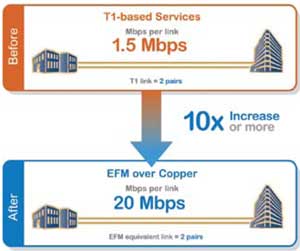
Ethernet over Copper is becoming an increasingly popular choice for business customers stuck in areas where companies won’t deploy fiber broadband (Graphic: OSP Magazine)

With Verizon and AT&T effectively stalling expansion of their respective “next generation” fiber and hybrid fiber/coax networks, and independent phone companies fearing too much capital spent improving their networks will drive their stock prices down, telephone companies are desperately seeking better options to deliver the faster broadband service customers demand.

The options over a copper-based landline network are not the best:

  • ADSL has been around for more than a decade and is highly distant dependent. Get beyond 10,000 feet from the nearest switching office and your speeds may not even qualify as “broadband;”
  • DSL variants represent the second generation for copper-broadband and can deliver faster speeds, but usually require investment to reduce the amount of copper between the customer and the switching office;
  • Fiber networks are more expensive to build, and some companies are using it to reduce, but not eliminate copper wire in their networks. But companies traditionally avoid this solution in rural/suburban areas because the cost/benefit analysis doesn’t work for shareholders;
  • Ethernet Over Copper (EoC) is increasingly the solution of choice for independent phone companies because it is less expensive to deploy than fiber and can quickly deliver service at a cat 5e speed of up to 50Mbps.

Unfortunately for consumers, EoC is typically way above the price range for home broadband.  Most providers sell the faster service to commercial and institutional customers, either for businesses that have outgrown T1 lines or where deploying fiber does not make economic sense.  Some companies have tried to improve on DSL by bonding multiple connections together to achieve faster speeds, but Ethernet is quickly becoming a more important tool in the broadband marketing arsenal.

With phone companies pricing EoC service from several hundred to several thousand dollars a month, depending on the speed of the connection, they hope to remain competitive players against a push by the cable industry to more aggressively target business customers.  In more rural areas, phone companies lack cable competition, so they stand a better chance of success.

Fierce Telecom‘s Sean Buckley published an excellent series of articles outlining the current state of EoC technology and what phone companies are doing with it:

  • AT&T: Inherited EoC from its acquisition of BellSouth, and barely markets it. Instead, AT&T uses it as a quiet solution for challenging customers who cannot affordably be reached by fiber.  AT&T will either deliver the service over copper, copper/fiber, or an all-fiber path depending on the client’s needs.
  • CenturyLink: No phone company is as aggressive about EoC as CenturyLink. When CenturyLink acquired Qwest, interest in the technology only intensified. EoC is a CenturyLink favorite for small businesses that simply cannot get the speeds they need from traditional DSL.  Most EoC service runs up to 20Mbps.
  • Verizon: Verizon’s network is the most fiber-intense among large commercial providers, so EoC is not the first choice for the company. However, it does use it to reach multi-site businesses who have buildings and offices outside of the footprint of Verizon’s fiber network/service area.
  • Frontier: In the regions where Frontier acquired Verizon landlines, EoC has become an important component for Frontier’s backhaul traffic. EoC has been deployed to reach cell tower sites and handles broadband traffic between central office exchanges and remote D-SLAMs, used to let the company sell DSL to a more rural customer base.  Frontier looks to EoC before considering spending money on fiber service, even for commercial and institutional users.
  • Windstream: EoC is the way this phone company gets better broadband speeds to business customers without spending a lot of money on fiber. Small and medium-sized customers are often buyers of EoC service, especially when DSL can’t handle the job or the company requires faster upstream speeds.  Windstream markets upgradable EoC capable of delivering the same downstream and upstream speeds and can deliver it more quickly than a fiber project.
  • FairPoint: Much of this phone company’s EoC efforts are in territories in northern New England acquired from Verizon.  FairPoint targets small and medium sized companies for the service, especially those who have remote offices or clinics that need to be interconnected. FairPoint has also gotten more aggressive than many other companies working with ADSL2+ or VDSL2 to deliver faster broadband to office buildings and complexes more economically than fiber.
  • SureWest: This company is strong believer in fiber to the premises service, so its interest in EoC has been limited to areas where deploying fiber makes little economic sense. In more out-of-the-way places, EoC is becoming a more common choice to pitch businesses who need more than traditional broadband.
  • Hawaiian Telcom: HawTel uses copper-based EoC to provide connectivity across the diverse Hawaiian Islands.  Speeds are generally lower than in mainland areas, partly because HawTel still relies heavily on traditional copper-based service. But fiber-based EoC is increasingly available in more densely populated areas.

Updated: Frontier’s Free DSL Speed Downgrades; West Virginians Wonder Where the Better Broadband Is

Broadband life in Frankford, Greenbrier County, W.V. may be slow, but few customers of Frontier Communications thought things could get even slower.  And then they did.

Stop the Cap! reader DJ has been frustrated with the performance of his phone company — Frontier, that took control of Verizon’s landline network across the state.  Verizon rarely got the hopes up for customers waiting more than a decade for broadband service to reach them.  Dana Waldo, Frontier’s senior vice president and general manager did, telling West Virginians Frontier would propel the Mountain State from its current rank of 47th in the country to the top 5.  Achieving that goal seems unlikely when the company quietly reduces some customers’ broadband speeds.

“We are on the High Speed Max plan which gives us, or should I say gave us 3.5Mbps,” DJ shares.  Although his phone line supported that speed, Frontier’s congested network could not, especially at night when speeds dropped dramatically.  It took several months for Frontier to upgrade local facilities in the county to better manage the broadband demands of customers who pay $110 a month for DSL and phone service.

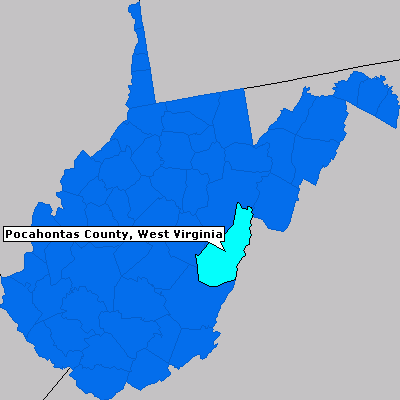
Frontier representatives promised the Pocahontas Times further upgrades were on the way by February of 2011, DJ says. February came and went and promised speeds of 5Mbps never arrived and Frontier representatives told DJ they didn’t know a thing about a 5Mbps broadband plan.

Fast forward to last spring: Frontier’s website suddenly advertised speeds up to 12Mbps.

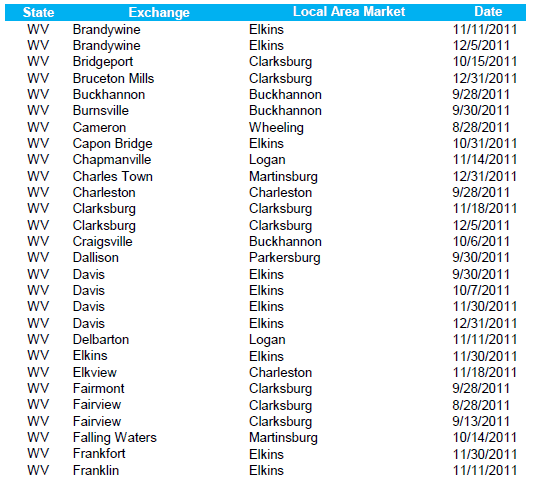
Frontier's Mysterious Upgrade List

“I first contacted them through their Twitter account and was told I could receive 8Mbps, went through all the processes and a few days later I was told I [already] had the maximum speed available for my area and nothing was ever done,” DJ writes.

The Phantom “Network Upgrades” List

More discouraging to DJ was the surprise appearance of a Network Upgrades listing on the company’s website that again promised better days for customers in states like West Virginia.

“The geniuses at Frontier listed us as Frankfort instead of Frankford but either way we were listed to get upgrades at the end of [this past] November,” DJ says. “The date came, the date passed. Never once did I see a Frontier truck out working. I still found myself [with] 3.5Mbps and after being lied to about upgrades for the third time in a few years I was ticked.”

Frontier representatives would later wonder where DJ obtained the Network Upgrades list, which has since disappeared from the company’s website.  Stop the Cap! has an archived copy here (PDF).

The worst part of DJ’s story came on Jan. 24, when Frontier reduced his speed from 3.5Mbps to 1.3Mbps without notice or explanation.  Frontier, the phone company that provides free speed decreases for customers, is not part of any marketing plan DJ knows about, so he began calling the company for answers.

“I was told my speed would be fixed when “upgrades” were complete,” DJ reports. Later that day, after a series of complaint calls, his old speed returned, leaving him right where he started in 2010.

“There is no excuse for that kind of treatment and it has been going on for years,” DJ says. “It’s a shame we can’t get anything else; Suddenlink literally stops serving just down the road with 10Mbps service — sad.”

[Updated 3/26 2:31pm ET:  Changed piece to reflect unincorporated Frankford is actually in Greenbrier County, not Pocahontas.]


Search This Site:

Contributions:

Recent Comments:

Your Account:

Stop the Cap!