Home » Broadband Speed » Recent Articles:

Digging Deeper Into Time Warner Cable’s 2011 Results and What Is Coming in 2012

While a downturn economy continues to afflict middle and lower income America, it doesn’t seem to be doing much harm to Time Warner Cable’s profits.

America’s second largest cable operator saw profits jump more than $150 million higher to $564 million last quarter, compared to $392 million at the same time the year before.  Time Warner’s revenue grew by 4% to $5 billion in the fourth quarter alone.  In fact, the company is performing so well, executives announced they would return $3.3 billion in earnings to shareholders through share buybacks and dividend payouts, in addition to the forthcoming $4 billion share repurchase program.  Wall Street liked what they saw, boosting shares 7% after the company posted its quarterly and annual results on its website.

Time Warner’s biggest success story remains its broadband service, which consistently delivers the company new subscribers and has helped offset the loss of video subscribers, numbered at an additional 129,000 who “cut the cord” in the fourth quarter of 2011.

Time Warner Cable earned $1.148 billion in revenue from broadband in the last quarter, an increase of 8.6% over last year.  For 2011, the cable operator earned $4.476 billion selling residential Internet access, also representing an 8.6% growth rate over earnings across 2010.

The company attributed this to “growth in high-speed data subscribers and increases in average revenues per subscriber (due to both price increases and a greater percentage of subscribers purchasing higher-priced tiers of service).”

The increased costs incurred by Time Warner Cable to upgrade and expand their network and cable systems were well offset by the aforementioned price increases and subscriber upgrades.  The company increased capital expenditures to $942 million in the last quarter.  Results over the full year show just a 0.2% overall increase in capital investment, now at $2.937 billion.  System upgrades, Time Warner’s plans to move their systems to all-digital cable television, the ongoing rollout of DOCSIS 3.0, new home security and automation services, and investment in online video and data centers are included in these costs. But a more significant reason for the increase comes from the company’s ongoing expansion into business services, which requires wiring more office buildings for cable.

Britt

Time Warner Cable CEO Glenn Britt led off the conference call with investors with an explanation for the increased expenses.

“We plan to continue our aggressive growth in business services by expanding product offerings, growing our sales force, improving productivity and increasing our serviceable footprint. This means continued investment, both in people and in capital,” Britt said. “Projects include expansion of our content delivery network, which powers our IP video capability, our 2 international headends, completion of DOCSIS 3.0 deployment, and conversion to all-digital in more cities. We expect to be able to accomplish this while maintaining the capital spending of the last 2 years — that is, between $2.9 billion and $3 billion, which represents a continued decline in capital intensity.”

Nothing in Time Warner Cable’s financial disclosures provides any evidence to justify significant changes in their pricing model for broadband, which currently delivers flat rate, unlimited service to customers at different speed rates and price points.  In fact, the company’s investments in DOCSIS 3.0 upgrades, which can support faster broadband speeds and a more even customer experience, have already paid off with subscriber upgrades.

Robert D. Marcus, president and chief operating officer, noted subscribers are increasingly considering faster (and more profitable) broadband tiers.

“Once again, high-speed data net adds over-indexed to our higher-speed tiers,” Marcus noted. “Roughly 3/4 of residential broadband net adds were Turbo or higher. And DOCSIS 3.0 net adds accelerated for the eighth consecutive quarter to an all-time high of 54,000.”

Time Warner’s biggest challenges continue to be the current state of the economy, which has made subscribers much more sensitive to pricing and rate increases, and cord cutting traditional cable television service.

“One group is extremely price-conscious, perhaps due in part to the ongoing economic malaise,” Britt said. “The other group is willing and able to pay for more features and service. We’re going to focus more attention on products and services that best meet each group’s needs rather than pursuing traditional one-size-fits-all solutions.”

That is clearly evident in the company’s bundled service options, including increasingly aggressive discounted pricing for new customers and for those threatening to leave and Time Warner’s super-premium Signature Home service, which delivers super-profits.  Average revenue from Signature Home customers averages $230 a month.  Traditional “triple play” customers who buy phone, Internet, and cable service only bring the cable company an average of $150 a month.

The company’s plans for 2012 do not include a specific statement about implementing an Internet Overcharging scheme like usage billing or usage caps.  But it is unlikely such an announcement would be made explicitly at an earnings announcement.  In the last quarter, Stop the Cap! reported comments from chief financial officer Irene Esteves that the company was still very interested in the concept of selling broadband with usage pricing as a “wonderful hedge” against cord-cutting.

Esteves told a UBS conference she believes usage-based pricing for Time Warner Cable broadband will become a reality sooner or later.  Charging “heavy users” more would already be familiar to consumers used to paying higher prices for heavy use of other services, and she claimed light users would have the option of paying less.

But despite favorable reception to the idea of usage pricing by Wall Street, Esteves acknowledged the company’s past experiments in usage pricing didn’t go as planned, and she suggested the company will introduce usage pricing “the right way rather than quickly.”

Other developments and highlights

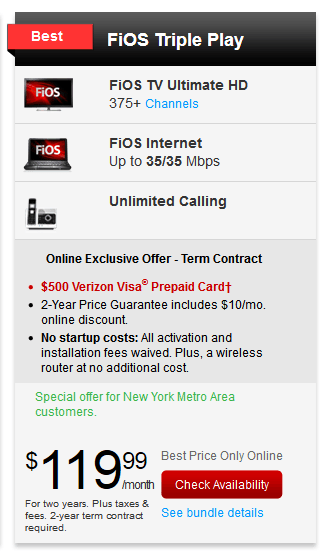
  • Time Warner faces Verizon's $500 rebate offers in NY City

    Time Warner Beats Up DSL: Time Warner Cable’s most lucrative source for new broadband customers comes at the expense of phone companies still relying on DSL to deliver broadband service.  As DSL speeds have failed to stay competitive with cable broadband, the cable operator has successfully lured price-sensitive DSL customers with attractive ongoing price promotions delivering a year of standard 10/1Mbps cable Internet access for $29.99 a month, often less expensive than the total price of DSL service that frequently delivers slower speeds.

  • Stalled Verizon FiOS deployment has limited the amount of competition Time Warner faces from fiber optics to just 12% of the company’s service area.  Where competition does exist, especially in New York State, Time Warner has had to stay aggressive to retain customers with deeply-discounted retention deals to keep up with Verizon’s high value rebate gift cards and new customer offers.  AT&T now provides U-verse competition in about 25% of Time Warner’s service area, but like satellite, AT&T U-verse pricing is less heavily discounted.
  • Retention pricing and new customer deals deliver lower prices than ever.  In November, Time Warner started selling a triple play offer for $89.99 a month that includes DVR service and now also includes deep discounts or free 90 day trials of premium movie channels. That is $10 less than the same time last year.
  • Premium movie channels continue to take a major hit as subscribers try to reduce their bills, especially after Time Warner began increasing rates on those networks.  HBO now sells for as much as $15 a month in many areas.  Time Warner Cable hopes to ‘revitalize’ premium movie channels with online video services like HBO and Max Go and promotional discounts.
  • Long-standing customers of Time Warner’s “triple play” package received a “thank-you gift” — free voice-mail in 2011, something that will continue in 2012.
  • Customers signing up for Time Warner’s premium-priced Wideband (50/5Mbps) service ($99/month) are being offered free phone service to sweeten the deal.

What to Expect in 2012

  • Time Warner is moving forward to create its own Regional Sports Network for southern California;
  • Los Angeles will continue to see large-scale expansion of Time Warner’s growing Wi-Fi network, available for free to premium broadband customers, with thousands of new access points on the way;
  • The cable company will introduce Wi-Fi service in other, yet-to-be-announced cities in 2012, with up to 10,000 access points planned.
  • Time Warner will be making its “digital phone” product more attractive with lower prices and more features, especially in product bundles, as consumers increasingly discard landlines;
  • Expect to see the end of analog cable television in a growing number of Time Warner Cable areas, requiring customers to use new equipment (initially provided free) to continue watching on older televisions and those without existing set top boxes.
  • Time Warner will continue to expand its “TV Everywhere” project to include live streaming TV on smartphones, video game consoles, computers, and more.  On-demand programming will be available as well sometime this year across all platforms.
  • A nationwide channel re-alignment will move subscribers to consistent channel numbers across the country, in part based on grouping them together into “genres.”  Many areas already have digital cable channels arranged this way, but now they will be consistent from coast-to-coast.
  • Time Warner will complete DOCSIS 3 deployment in all areas this year.
  • The company is moving to introduce 2-hour service call windows almost everywhere, and 1-hour windows and weekend appointments in some markets.  Several cities now allow customers to select specific times for service appointments.
  • Self-install kits will become increasingly available for different products, allowing customers to install equipment themselves;
  • Time Warner’s IntelligentHome home security, monitoring, and automation product will expand beyond its launch markets (Syracuse and Rochester, N.Y., Charlotte, N.C. and Los Angeles/Southern Calif.).  The product currently has customers in the thousands, considered relatively small.  But Time Warner has learned subscribers are using the service in surprising ways, which will let them adapt their marketing.  Among the most popular features: remotely watching your pets at home.

Most Memorable Quote: “I think, more than anything else, our pricing strategy is dictated by what the marketplace will bear as opposed to what our underlying cost structure is.” — Robert Marcus, president and chief operating officer, Time Warner Cable

Connected Tennessee Notes 5.3% of State Now Has Access to 1Gbps Broadband, Thanks to EPB Fiber

Phillip Dampier January 31, 2012 AT&T, Broadband Speed, Comcast/Xfinity, Community Networks, Competition, Consumer News, EPB Fiber, Public Policy & Gov't, Rural Broadband Comments Off on Connected Tennessee Notes 5.3% of State Now Has Access to 1Gbps Broadband, Thanks to EPB Fiber

A group whose national umbrella organization has close connections to the nation’s largest phone companies estimates 5.3% of residents in the state of Tennessee now have access to world-class fiber broadband at speeds up to 1Gbps, but no thanks to AT&T or Comcast.

As part of updated broadband availability estimates, the group noted that only a fraction of the state gets access to the community-0wned Chattanooga-based utility that provides fiber to the home service, EPB.

Key findings from this update include:

  • 95.2% of Tennessee households have access to fixed broadband service of at least 768 Kbps downstream and 200 Kbps upstream (excluding mobile and satellite services).
  • 93% of Tennessee households have access to fixed broadband service of at least 3 Mbps downstream and 768 Kbps upstream (excluding mobile and satellite services).
  • 4.8% of Tennessee households remain unserved by any fixed broadband provider, representing approximately 120,000 unserved households that do not have access to a fixed wireless or wired broadband service offering (excluding mobile and satellite services).
  • Across rural areas of Tennessee, the percentage of unserved households by any fixed broadband service is 8.4%, representing approximately 110,000 unserved rural Tennessee households.
  • 5.3% of Tennessee households now have access to broadband service of at least 1 Gbps, marking the first time in Tennessee.

Most households receiving the slowest speeds get them from phone-company marketed DSL service and some fixed wireless ISPs operating in the state.

In Chattanooga, consumers have a choice between AT&T U-verse in selected neighborhoods, Comcast Cable, or EPB Fiber.  Recently, Christopher Mitchell at Community Broadband Networks alerted us that The Chattanoogan newspaper shared the difference between Comcast and EPB customer service:

You’ve got to be kidding me, Comcast! Several days ago our On Demand stopped working with a message to contact customer service and report that error seven occurred.

My husband called and after being given the self-help/troubleshoot option over the phone selected and requested a signal to be re-sent to the box. The box had already been unplugged, the appropriate amount of time waited, and the box plugged back in. No luck. The box was sent the refresh signal…it didn’t work; surprise.

So, he called back and spoke with someone who wanted to re-send the signal again and if that didn’t work then a technician would be needed.

[…]

I called Comcast this morning to schedule the technician to be told that it was going to cost me $30 for them to come out regardless of the problem. Let’s see, Comcast’s DVR box that they own and I rent shot trouble and I have to pay them another $30; I asked at least twice – “if Comcast’s equipment is the problem, I still have to pay $30?” “Yes, mam”.

They should bring out a replacement DVR for me, adjust my account for the days we’ve been without the On Demand plus an amount plus or minus $30 for the time we’ve had to take to mess around with this; not counting the time that will have to be arranged to be taken to have their technician come out.

Since I’m going to have to arrange to take more time, maybe we’ll just have someone else come out and put in something other than Comcast and they can have their broken DVR and all their other stupid little additional cable boxes returned to them.

Melanie Henderson
Hixson

EPB provides municipal power, broadband, television, and telephone service for residents in Chattanooga, Tennessee

The community-owned broadband alternative, EPB Fiber

We experienced the same “customer service” issues with Comcast. We finally cancelled our service when the tornado came through our neighborhood and we were forced to move for six months. When we finally moved back home we became EPB customers.

We have had one instance where we needed to contact customer service, and the problem was fixed quickly and easily by the most polite customer service rep I’ve ever dealt with.

Comcast came by recently to offer us a “substantial savings” if we’d make the switch back to them. My question was, why now? I was a customer for years and treated poorly as rates increased exponentially. Now the offer the discount? No thanks.

For the $5 extra per month that we pay for EPB, we receive better features, prompt and polite customer service, and an all around trouble free experience. Thanks EPB!

Leah Crisp
Harrison

AT&T’s Old ‘Unlimited’ Plan Has 2GB Throttle Threshold; For the Same $30, Get 3GB ‘Limited’ Plan

Lowering the bar on "unlimited use" customers.

Customers grandfathered on AT&T’s “unlimited use” data plan are starting to wonder whether AT&T’s definition of “unlimited” is worth the effort.

Stop the Cap! reader Earl shares news the wireless carrier has lowered the bar (and wireless speeds) on customers who consume just 2GB on an “unlimited” wireless plan the company charges $30 a month to keep.  That’s $15/GB before AT&T considers you a usage abuser.  Now customers are discovering for the same $30, they can buy a usage-limited plan that offers 3GB a month, one gigabyte more than the “unlimited plan” allows before AT&T considers you among the top 5% of its “heavy users” subject to a punishing speed throttle.

[From CNET’s ‘Ask Maggie’ column:]

Dear Maggie,
I am currently using an iPhone 3GS and am grandfathered into the unlimited data plan. I normally use between 3GB and 4GB of data a month without issue. I have now been notified after 2GB of data that my data consumption is in the top 5 percent of customers and my data will be throttled. I have noticed that this seems to be a common cutoff for other customers as well.

My question to you is–Does this make the unlimited data plan basically useless as the new 3GB plan will at least give me 1 extra gigabyte of data for the same price? Also, why don’t they just cancel the unlimited plan instead of forcing people to switch through throttling?

Dear Brian,
I think you’ve nailed this issue right on the head. AT&T’s throttling program seems to target customers, who are just over the 2GB threshold. And its new higher priced data plans that offer 3GB of data for $30 looks like an attempt to get customers to switch from their unlimited data plans to the 3GB plan for the same price.

Whether you can live with the slower data rates is up to you.

It’s increasingly apparent AT&T is engineering data plans to discourage customers from retaining their grandfathered unlimited-use plan.  By luring customers to ‘never-throttled’-tiered data plans, AT&T can expose customers to lucrative overlimit fees charged when plan allowances are exceeded.

Rogers Throws Customers A Few Scraps: Faster Speeds, Tiny Increases in Usage Allowance

Phillip Dampier January 26, 2012 Broadband Speed, Canada, Data Caps, Rogers, Shaw 1 Comment

Just a few weeks after announcing $2 rate increases on most tiers of the company’s broadband service, Rogers Communications has announced speed upgrades and tiny increases in usage allowances for certain customers:

  • Express: download speeds will increase from up to 12Mbps to up to 18Mbps and data allowance will increase from 60GB to 70GB.
  • Extreme: download speeds will increase from up to 24Mbps to up to 28Mbps and data allowance will increase from 100GB to 120GB.

These enhancements apply to customers utilizing Rogers DOCSIS 3.0 capabilities. Rogers will start rolling out the faster speeds to existing Express tier customers currently receiving download speeds of up to 12 Mbps starting January 26th and will continue over the following weeks. New customers will experience faster speeds beginning February 21st. All new and existing customers will benefit from higher data allowances starting March 8th.

Rogers has played repeatedly with their usage allowances, particularly for its Extreme tier, which has seen increases and decreases over the past few years:

Rogers Extreme Tier Usage Cap History

  • 2009: 95GB per month
  • 2010: Reduced to 80GB per month (-15GB)
  • 2011: Increased to 100GB per month (+20GB)
  • 2012: Increased to 120GB per month (+20GB)

Rogers’ Express service gets just a 10GB monthly bump, making the speed upgrade less valuable because customers are restrained from using the service.

Rogers says the incremental upgrades are a result of Canadians using the Internet more than ever.

“Rogers customers are increasingly watching movies on Rogers on Demand Online, working from home and using multiple devices like tablets and laptops connected by Wi-Fi to the internet,” said John Boynton, executive vice-president and chief marketing officer at Rogers Communications. “The ways Canadians are using the internet are changing dramatically and we are constantly reviewing our plans and policies to ensure they deliver the best possible customer experience that lines up with evolving needs and usage patterns.”

Apparently those living in western Canada use the Internet even more, because Shaw Communications’ comparable broadband tiers are much more generous:

Shaw Communications Usage Allowances

  • High Speed 10Mbps: 125GB per month
  • High Speed 20Mbps: 200GB per month
  • Broadband 50Mbps: 400GB per month

Astroturf Group Heartland Institute Lies About Chattanooga’s EPB Fiber Network: “They Only Sell a Gig”

Heartland Institute: "By not disclosing our donors, we keep the focus on the issue."

In an eyebrow-raising exchange between the Heartland Institute’s Bruce Edward Walker and Dr. Joseph P. Fuhr, Jr., who produced a dollar-a-holler “research report” on behalf of corporate-backed astroturf group the Coalition for the New Economy (which lists the Heartland Institute’s Florida chapter as a member), the two dismiss Chattanooga’s award-winning EPB Fiber Network as providing lesser service than private competitors AT&T (also a member of the Coalition) and Comcast, in part because EPB “only sells customers a gig.”

An exchange between Heartland Institute’s Bruce Edward Walker and Dr. Joseph P. Fuhr, Jr. fundamentally misrepresents Chattanooga’s EPB Fiber network. At no point does Walker disclose Heartland Institute’s chapter in Florida is a member of the group that sponsored the production of Fuhr’s report. (1 minute)
You must remain on this page to hear the clip, or you can download the clip and listen later.

Walker: The government broadband services are always one step behind private industry and I’m thinking in Chattanooga, the law [sic] that they have the fastest download speeds of all government broadband in the United States, but they only offer 1Gbps service.

Fuhr: Well, one of the issues there is, well, the supply is there but they kind of have the feeling that if you build it, they will come.  Well, they haven’t come.  I mean they are charging $350 a month for that service and very few people are willing to subscribe.  People are, for the most part, happy with slower speeds.  Who really needs a gigabyte (sic) and the market shows that people don’t really need that.

Dr. Fuhr apparently does not know the difference between a “gigabyte” and a “gigabit,” so I am not sure how seriously we are supposed to take this “broadband expert.”  He also does nothing to challenge Walker’s wholly-inaccurate declaration that EPB only sells customers $350 1Gbps broadband.

In fact, most of Heartland Institute’s views about EPB broadband are a big bucket of wrong:

  1. EPB Fiber offers the fastest fiber broadband in the United States.  It is “private industry” providers Comcast and AT&T who are more than one step behind, and they refuse to sell faster service and upgrade their networks to the speeds seen in Asia and Europe that Chattanooga’s EPB customers can have today.
  2. There is no “law” involved in the delivery of broadband by EPB.  In fact, EPB fought off attempts by incumbent operators to sue the municipally-owned provider out of the broadband business, and some of those same companies are backing the “Coalition for the New Economy” in their efforts to curtail community broadband with new laws that would make networks like EPB next to impossible to provide.
  3. EPB does not only offer 1Gbps service.  Consumers and businesses are free to choose between several different speed tiers.  As any commercial entity will tell, you 1Gbps at just $350 a month is a steal compared to the prices AT&T and Comcast would charge.
  4. When EPB built their fiber network, private businesses did come.  In addition to media reports documenting expansion in Chattanooga from one Knoxville business, Amazon.com has announced hundreds of millions of dollars in new investments building and expanding distribution centers in and around Chattanooga, in part because EPB Fiber was available for their use.
  5. People are not happy with the slow speeds some providers force them to accept.  It is no surprise, however, that industry-funded astroturf groups would repeat the usual provider line that people “don’t need” fast broadband that they have no plans to deliver anyway.

Search This Site:

Contributions:

Recent Comments:

Your Account:

Stop the Cap!