Home » Broadband Speed » Recent Articles:

We’re in the Broadband Shortage Business: Big Telecom Attacks Providers That Can Do Better

Not a problem

Who knew America’s largest cable and phone companies were in the broadband shortage business?

Broadband evangelist Craig Settles has been as outraged about this year’s crop of anti-broadband legislation as we have here at Stop the Cap!

He wrote about the implications of allowing state laws to be changed in favor of the big cable and phone companies in a piece published by GigaOM that details where these anti-community Internet bills are coming from:

This push is brought to you by the American Legislative Exchange Council (ALEC), a group of corporate lobbyists who ghostwrite state bills behind closed doors that their pocket legislators then push on the floor. This “model” of anti-muni broadband legislation contains wording that is replicated in these latest bills and newspaper op-eds that attack community broadband.

Many of the nation’s largest phone and cable companies funnel funds into ALEC, and even sponsor wine-and-dine trips for state legislators and their families as part of a comprehensive effort to get their foot (and later proposed legislation) in the door.

Download this archive of ALEC-written and sponsored state legislation/policies affecting telecommunications and IT.  (16mb .zip file)

Few state legislators fully realize the implications of some of these measures, which can hamstring their state’s broadband networks into “good enough for you” broadband, as determined by Comcast, AT&T, Time Warner Cable, Verizon, and others.

ALEC’s dog-and-pony show opens with its corporate backers enhancing their campaign contributions to legislators likely to support their agenda.  ALEC’s lobbyists can then provide “boilerplate” templates for legislation that can be slightly modified and introduced at the state level for consideration.

With a significant increase in campaign contributions targeting friendly legislators, community broadband suddenly becomes a hot topic at the statehouse.

Legislators do not work alone to pass these measures.  As we’ve seen in other states, industry-backed lobbying firms deliver a comprehensive set of support services for the campaign to stop community broadband competition:

  1. Talking points for legislators and others opposed to municipal Internet;
  2. Professionally produced mailers that can be distributed to every home in a community bashing community networks;
  3. Sample letters to the editor intended for local newspapers and easy-to-send letters to legislators asking them to support anti-broadband legislation;
  4. Help from seemingly “independent” outside groups that criticize such networks, without disclosing their funding comes, in part or whole, from the cable or phone company.

Settles

Being hoodwinked by the companies that want these kinds of bills passed leave your community’s broadband needs entirely in the hands of providers that have performed so poorly in some cities, local governments have decided they have to provide the service themselves.  Settles illustrates the obvious:

This isn’t about unfair competition by local government. When Wilson’s 12-person IT department can plan, build and manage a network that can deliver speeds (up to a gig) 20 times faster than the best Time Warner Cable offers, that’s competing with superior technology. When Comcast customers switch to Chattanooga’s gig network because of their public utility’s better customer service, that’s competent competition. When tiny Reedsburg, Wis. refuses to compete against the large cable company on price, but beats competitors by offering greater value such as a better selection of Internet services, they compete based on local credibility.

So U.S. communities have to ask themselves, are they going to stay stuck on the train or will they be zipping along at warp speed?

Providers and their industry friends will always argue that you don’t need gigabit broadband speed — what you get from your cable or phone company today is “fast enough.”  Some go as far as to argue current providers are equipped to deliver whatever service customers need, but the demand “just is not there.”

Big Problem.

But as we argued on GigaOM ourselves, the nation’s largest telecom companies have already proven they apparently cannot meet the demand that exists today.  That is because an increasing number of them have started to slap arbitrary usage caps and other limits on their customers’ broadband usage.  Customers don’t want these Internet Overcharging schemes, yet they persist because of what providers effectively admit is a broadband shortage on their networks.

So for a city like Chattanooga, Tenn., which of the following providers should be punished (and potentially even banned) for being in the broadband business:

  1. AT&T, which delivers around 6-7Mbps DSL in suburban Chattanooga or up to 24Mbps on its U-verse platform with 150GB/250GB usage limits respectively;
  2. Comcast, which delivers up to 50Mbps over cable broadband with a 250GB usage cap;
  3. EPB Fiber, which delivers up to 1,000Mbps over fiber optics with no usage cap.

If you are AT&T or Comcast, clearly the provider that must be stopped is #3 — EPB Fiber.  After all, you can’t be in the broadband shortage business when the competitor next door offers a broadband free-for-all made possible from an investment in a superior network that exists to serve customers, not shareholders and investment banks.
Frontier’s Mess of a 4th Quarter: Dividend Slashing, Underwhelming Broadband Don’t Impress

Phillip Dampier February 20, 2012 Broadband Speed, Competition, Consumer News, Frontier, Rural Broadband Comments Off on Frontier’s Mess of a 4th Quarter: Dividend Slashing, Underwhelming Broadband Don’t Impress

Frontier Communications faced unhappy investors Thursday after announcing it was slashing its dividend nearly in half in an effort to raise money to sustain the company’s cash flow and reduce its debt.

The company’s earnings fell 8.1% as customers continued to leave for the competition, seeking better service and lower prices.

The poor earnings results and the dividend cuts delivered a one-two punch to Frontier stock, which slid to $4.20 a share, down 16 percent in the last three months.

Among Frontier’s biggest challenges remains the quality of its broadband service to customers.  Where competition exists, Frontier DSL continues to lose the speed battle, and recent junk fees padding customer bills, including a “High Speed Internet surcharge,” and increasing modem rental fees have alienated some customers.

Frontier’s chief operating officer and executive vice president Dan McCarthy told investors 83 percent of Frontier’s service area has access to the company’s broadband product.  However, fewer than 20% of Frontier’s customers have access to speeds as high as 20Mbps.  Only just over half can access the Internet at 6Mbps.  Many of Frontier’s customers can only access lower speed service (66% can choose 4Mbps, 76% — 3Mbps, and the rest 768kbps-3Mbps).

“We’ll be investing throughout the year to improve speed-reaching capability in all our markets,” McCarthy told investors on a conference call last week.

In the second half of 2010, Frontier is expected to increase the amount of Ethernet in its middle mile network, which McCarthy expects will allow the company to deliver faster speeds over VDSL2 and VDSL2 bonding as means of driving both speed increases in the residential and the commercial markets.

However, Frontier’s preoccupation with an internal system conversion, to integrate its acquired Verizon service areas with the rest of its network, has stalled much of the company’s marketing.  Promotions, in particular, have been anemic over the last several months and will likely remain that way until later this year.  Where competition exists, cable operators have successfully been picking off Frontier’s customers.

  • Broadband and satellite TV additions are down, in part due to the lack of promotions and marketing;
  • FiOS video losses continue as the company shuns its fiber video service in favor of satellite TV cross-marketing;
  • Line loss rates remain very high: 8.3% of Frontier’s customers disconnected their landline service in the last quarter, 5.9% in areas that were not acquired from Verizon.
  • Once customers leave, they rarely return.  Churn rate of Frontier customers coming and going is at just 1.6%.

As with similar Verizon landline sales in the past, initial revenue growth from acquired customers starts out high, boosting revenue numbers and often the value of a company’s stock.  But the heavy debt load incurred from acquisitions and ongoing line losses to the competition eventually take their toll, and Frontier’s revenue now reflects the reality of a company trying to sell more services to a declining number of customers.

Morningstar notes the company’s debt problems are significant:

Frontier has struggled to bring leverage down and hasn’t successfully placed new debt since closing the Verizon transaction in 2010. Management has talked about taking care of the $580 million maturity it faces in early 2013 for the better part of a year, with no result to date. Yields on the firm’s existing debt have increased over the past year, despite the sharp decline in Treasury rates.

Standard & Poor’s Ratings Services reduced its outlook on the company from stable to negative, noting the competition is increasingly hurting Frontier’s capability to raise revenue.

The company’s decision to slash its dividend in an effort to reduce debt has created consternation for some investors who stuck with the company when the share price was above $7 and the dividend was declared safe for two years.  Neither seems to the be case any longer.

4 Tips to Find the Cheapest Deals for Internet Access

CenturyLink runs specials on their website that offer extra savings when ordered online.

Your $50 monthly broadband bill has been burning a hole in your wallet and you think there should be a cheaper price available somewhere, right?

The answer is, for most of us, there is.  You just have to look.

The most expensive Internet access around comes when you buy broadband-only service from a provider.  Both cable and phone companies have been incrementally punishing their “broadband-only” customers for years, tacking on $5, $10, even $15 to the price because you have chosen not to bundle broadband with other services the company sells.  It is not unusual to see some cable companies charging $55-60 for standard Internet service.  When you call to inquire, they are sure to begin aggressively upselling you to a bundled service package, arguing you can add cable TV and phone service for $20-30 more a month.  That sounds like a better deal, unless you honestly don’t care about either service.

Welcome to the world of marketing, where the “value perception” is key to driving the average revenue collected from each subscriber higher and higher.  You end up buying services you probably would not have considered, but because they seem so inexpensive when compared with the price of the service you are interested in, why not?

Phone companies do the same thing, but many of them also love to bury hidden charges in the fine print and commit you to 1-3 years of service to guarantee the advertised price.  Companies like Frontier Communications may pitch DSL service for just $15 a month, but keep reading and you will discover the taxes and fees raise that price substantially.  In fact, that particular phone company is notorious for charging substantial modem rental fees and what they call a “High Speed Internet” surcharge.  To get the lowest price from them, you will be a Frontier customer for at least a year, depending on the promotional offer selected.

Frontier redefines "value": This attractive looking offer "fine prints" the $6.30 modem rental fee, is for service "up to" 1Mbps (so much for "high speed"), has a one-year service commitment with a $50 early termination fee, and does not include unspecified "taxes and surcharges" which run extra.

You can break free of the marketing circus by concentrating on finding the best possible deal for the service(s) you really care about.

  1. Check advertising offers on television and in newspapers, but always read the fine print;
  2. Visit the website of each local provider and look for “Internet-only” offers that may deliver extra savings, but only when you order online;
  3. Call providers and ask them about their various deals and inquire “is this the best offer you have right now?;”
  4. Use search engines and type in your provider’s name and words like “deals,” “offers,” or “promotion.”  Third party authorized resellers may have an offer that works better for you.

Sometimes you can get excellent results playing providers off each other.  Try contacting the social media representatives of different providers in your area to unlock hidden deals, and more importantly, customer retention offers.  One Rochester reader of ours got Time Warner Cable to open negotiations to keep his business with this tweet:

Getting ready to schedule my @TWCable disconnect after rate increase – should I go with @dishnetwork over @DirecTV or vice versa?

He received a substantial retention offer within hours of alerting Time Warner of his discontent (he’s also a rabid hockey fan, and the ongoing MSG-Time Warner Cable dispute made satellite an attractive alternative.)

[flv width=”360″ height=”290″]http://www.phillipdampier.com/video/KNXV Phoenix Which broadband provider saves you the most money 2-7-12.mp4[/flv]

KNXV in Phoenix helped residents in that Arizona city figure out who was cheaper, CenturyLink or Cox Cable.  And what about using mobile broadband for a home broadband replacement?  (3 minutes)

Bloomberg News: The Case for Publicly Owned Internet Service

Phillip "Break Free from 'What's In It For Me'-AT&T" Dampier

[We are reprinting this because it succinctly and persuasively proves a point we’ve been making at Stop the Cap! since 2008.  Broadband is not just a “nice thing to have.” It is as important as a phone line, electricity, and safe drinking water.  News, education, commerce, and culture increasingly utilize the Internet to share information and entertain us. Essential utility services can either be provided by a private company operating as a monopoly with oversight and regulation, or operate strictly in the public interest in the form of a customer-owned cooperative, a direct service of local government, or a quasi-public independent non-profit.

In North America, broadband was originally considered a non-essential service, and private providers in the United States lobbied heavily to maintain absolute control of their broadband networks, free to open them to share with other providers, or not.  They also won sweeping deregulation and are still fighting today for decreased oversight.  The results have been uneven service.  Large, compact cities enjoy modern and fast broadband while smaller communities are forced to live with a fraction of the speeds offered elsewhere, if they have access to the service at all.

With broadband now deemed “essential,” local governments have increasingly sought to end the same old excuses with the “don’t care”-cable company or “what’s in it for me”-AT&T and provide 21st century service themselves, especially where local commercial providers simply won’t step up to the plate at all.  Suddenly, big cable and phone companies are more possessive than your last boy/girlfriend. The companies that for years couldn’t care less about your broadband needs suddenly obsess when someone else moves in on “their territory.” They want special laws (that apply only to the competition) to make sure your broadband future lies exclusively in their hands.

Susan P. Crawford understand how this dysfunctional, controlling relationship comes at the expense of rural America.  She’s a visiting professor at the Harvard Kennedy School of Government and Harvard Law School. In 2009, she was a special assistant to President Barack Obama for science, technology and innovation policy. Her opinions were originally shared with readers of Bloomberg News.]

In cities and towns across the U.S., a familiar story is replaying itself: Powerful companies are preventing local governments from providing an essential service to their citizens. More than 100 years ago, it was electricity. Today, it is the public provision of communications services.

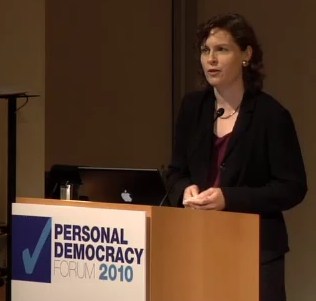
Susan Crawford

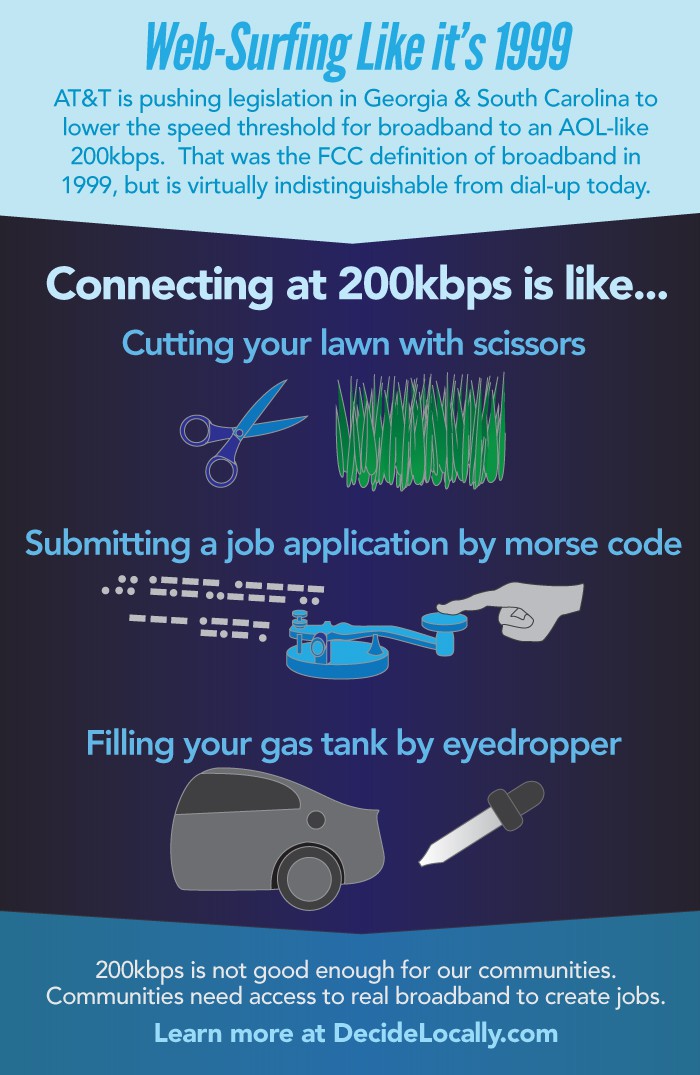
The Georgia legislature is currently considering a bill that would effectively make it impossible for any city in the state to provide for high-speed Internet access networks — even in areas in which the private sector cannot or will not. Nebraska, North Carolina, Louisiana, Arkansas and Tennessee already have similar laws in place. South Carolina is considering one, as is Florida.

Mayors across the U.S. are desperate to attract good jobs and provide residents with educational opportunities, access to affordable health care, and other benefits that depend on affordable, fast connectivity — something that people in other industrialized countries take for granted. But powerful incumbent providers such as AT&T Inc. and Time Warner Cable Inc. are hamstringing municipalities.

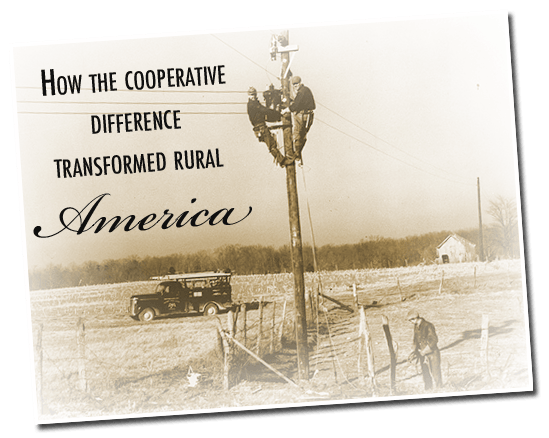
At the beginning of the 20th century, private power companies electrified only the most lucrative population centers and ignored most of America, particularly rural America. By the mid-1920s, 15 holding companies controlled 85 percent of the nation’s electricity distribution, and the Federal Trade Commission found that the power trusts routinely gouged consumers.

Costly and Dangerous

In response, and recognizing that cheap, plentiful electricity was essential to economic development and quality of life, thousands of communities formed electric utilities of their own. Predictably, the private utilities claimed that public ownership of electrical utilities was “costly and dangerous” and “always a failure,” according to the November 1906 issue of Moody’s Magazine. Now more than 2,000 communities in the U.S., including Seattle, San Antonio and Los Angeles, provide their own electricity.

Today, the Institute for Local Self-Reliance, which advocates for community broadband initiatives, is tracking more than 60 municipal governments that have built or are building successful fiber networks, just as they created electric systems during the 20th century. In Chattanooga, Tennessee, for example, the city’s publicly owned electric company provides fast, affordable and reliable fiber Internet access. Some businesses based in Knoxville — 100 miles to the northeast — are adding jobs in Chattanooga, where connectivity can cost an eighth as much.

Meanwhile, less than 8 percent of Americans currently receive fiber service to their homes, compared with more than 50 percent of households in South Korea, and almost 40 percent in Japan. Where it’s available, Americans pay five or six times as much for their fiber access as people in other countries do. Fully a third of Americans don’t subscribe to high-speed Internet access at all, and AT&T Chief Executive Officer Randall Stephenson said last month that the company was “trying to find a broadband solution that was economically viable to get out to rural America, and we’re not finding one, to be quite candid.” America is rapidly losing the global race for high-speed connectivity.

Tamping Down Enthusiasm

We've done something like this once before.

Like the power trusts of the 20th century, the enormous consolidated providers of wired Internet access want to tamp down any enthusiasm for municipal networks. Last year, telecom lobbyists spent more than $300,000 in a failed effort to block a referendum in Longmont, Colorado, to allow that city to provide Internet access. Time Warner Cable managed to get a North Carolina law enacted last year that makes launching municipal networks there extraordinarily difficult. The pending measures in Georgia and South Carolina are modeled on the North Carolina bill.

The Georgia bill is chock-full of sand traps and areas of deep statutory fog from which no local public network is likely ever to emerge. In addition to the ordinary public hearings that any municipality would hold on the subject, a town looking to build a public network would have to hold a referendum. It wouldn’t be allowed to spend any money in support of its position (there would be no such prohibition on the deep-pocketed incumbents). The community wouldn’t be allowed to support its network with local taxes or surplus revenues from any other services (although incumbents routinely and massively subsidize their networks with revenue from other businesses).

Most pernicious of all, the public operator would have to include in the costs of its service the phantom, imputed “capital costs” and “taxes” of a private provider. This is a fertile area for disputes, litigation and delay, as no one knows what precise costs and taxes are at issue, much less how to calculate these amounts. The public provider would also have to comply with all laws and “requirements” applicable to “the communications service,” if it were made available by “a private provider,” although again the law doesn’t specify which service is involved or which provider is relevant.

The end result of all this vague language will be to make it all but impossible for a city to obtain financing to build its network. Although the proponents of Georgia’s bill claim that they are merely trying to create a level playing field, these are terms and conditions that no new entrant, public or private, can meet — and that the incumbents themselves do not live by. You can almost hear the drafters laughing about how impossible the entire enterprise will be.

Globally Competitive Networks

Right now, state legislatures — where the incumbents wield great power — are keeping towns and cities in the U.S. from making their own choices about their communications networks. Meanwhile, municipalities, cooperatives and small independent companies are practically the only entities building globally competitive networks these days. Both AT&T and Verizon have ceased the expansion of next-generation fiber installations across the U.S., and the cable companies’ services greatly favor downloads over uploads.

Congress needs to intervene. One way it could help is by preempting state laws that erect barriers to the ability of local jurisdictions to provide communications services to their citizens.

Running for president in 1932, Franklin D. Roosevelt emphasized the right of communities to provide their own electricity. “I might call the right of the people to own and operate their own utility a birch rod in the cupboard,” he said, “to be taken out and used only when the child gets beyond the point where more scolding does any good.” It’s time to take out that birch rod.

Search This Site:

Contributions:

Recent Comments:

Your Account:

Stop the Cap!