Home » Broadband Speed » Recent Articles:

Qatar Declares Broadband A Citizen Right; Says Everyone Should Have Broadband By 2015

Phillip Dampier March 8, 2012 Broadband Speed, Public Policy & Gov't, Video 1 Comment

Every Arab citizen should have access to broadband by the year 2015.  That is the declaration of Dr. Hessa al-Jaber, secretary general of Qatar’s Supreme Council of Information Technology (ictQATAR), who described broadband as an absolute “citizen right” at the opening of the Connect Arab Summit 2012.

“Our target by 2015 should be that no one is denied access to any form of digital communication, and everyone is part of the connected web regionally and globally,” al-Jaber said, noting the target was consistent with her belief broadband should be considered “the simplest form of digital communications we will accept for our times.”

The Middle East is one of the fastest growing regions for broadband development as Arab governments increasingly deploy technology in an effort to grow the economy in the region.  While many oil-producing states have invested the earnings from high oil prices in technological infrastructure, most governments believe the Middle East cannot be economically sustained through the sale of fossil fuels alone.  Economic diversification is a key to sustained growth, and al-Jaber explained broadband is an absolutely essential component in those efforts.

al-Jaber

“If we want to grow our economies at a pace exceeding 7% year-on-year and over sustained periods so that income and output double every decade, create 75 million jobs by 2020, and create societies that can achieve the level progressiveness that our century demands, then we must be equipped with the digital technologies that will support our march into this prosperous future,” al-Jaber said.

Research obtained by ictQATAR found that just a 10% improvement in digitization can trigger a 0.6% gain in GDP and nearly a 1% decline in unemployment.  Broadband can also deliver a marked increase in innovation.

al-Jaber also noted many Arab region countries have made substantial progress in broadband development, some threatening to exceed the broadband rankings of countries in North America and Europe.

But the Internet can also remain a threat to countries in the region that maintain strict control on information and see the Internet as a potential threat.

“We find it disheartening that other Arab nations are severely falling behind in terms of network readiness, even in relation to their economic standing,” al-Jaber said, sidestepping the politically sensitive issue.

Other attendees noted broadband expansion in the region is outpacing that in more developed countries, and could deliver a “game-changer” for the Arab world to leap ahead of countries like the United States and Canada.

Jeffrey Sachs, director of the Earth Institute and a member of the Broadband Commission for Digital Development told the Gulf Times developing countries could leverage broadband as “a chance for convergence of progress, and for poor countries to leap ahead” of more developed societies and economies.

[flv width=”640″ height=”380″]http://www.phillipdampier.com/video/ITU Interview Nagwa El-Shenawy Egypt 3-12.flv[/flv]

Egypt, one of the focal points of the “Arab Spring” movement, is set to transform itself in part through embracing broadband as a democratization tool and resource for the country’s citizens. Nagwa El-Shenawy, Information Center Director of Egypt’s Ministry of Communications is interviewed about broadband development in Egypt.  She cited a need to expand broadband service into more parts of Egypt and keep the price affordable for all citizens.  Capacity building is key to building robust infrastructure across the Arab Region.  (6 minutes)

Subjects covered include: capacity building and the state of ICT’s within the Arab Region. The new internet Portal announced at the Connect Arab Summit 2012.
Your Victory: Georgia Legislature Shelves Anti-Broadband Measure We Helped Expose

Consumers and community leaders across Georgia can now rest a little easier knowing AT&T’s plans to throw up roadblocks against community broadband have gone awry.  SB313, a custom-written corporate welfare bill designed to protect cable and phone companies from competition, has reportedly been turned into a “study bill” — a graceful way to kill bad legislation without hurting too many feelings.

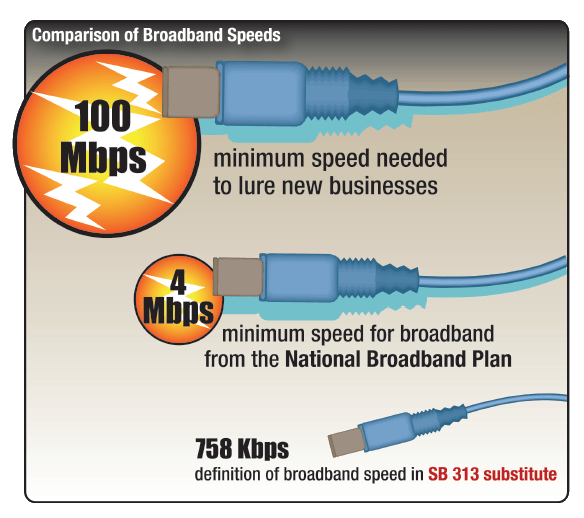
It wasn’t just the fact incumbent phone and cable companies wanted to stop community broadband projects from wiring communities they’ve ignored for years.  It wasn’t even the absurdity of the bill defining Georgia’s “broadband” speeds at just 200kbps (later ‘generously’ amended and increased to 758kbps).  This bill died because of consumer and community outrage — local officials working hand in hand with woefully under-served Georgians asking their elected officials why they seemed to care more about AT&T’s interests than those of the people who elected them to office.

Specious political arguments about “government/taxpayer involvement in broadband” and a sudden blitz of campaign contributions for the bill’s backers simply couldn’t overcome the reality of broadband-challenged rural Georgia.

According to the National Broadband Map, Georgia ranks 20th in the nation for broadband access. According to the forward of a report by Rich Calhoun, Program Director of the Georgia Technology Initiative, “As I traveled through the state to talk with leaders in municipalities, counties and community anchor institutions, I found that many places throughout Georgia indicated that they did not have access to affordable or sufficient broadband services. Telecommunications firms who have made significant investments in Georgia indicated that in some areas of the state the return on investment would not qualify for further investment at the present time.”

As Stop the Cap! exposed to our readers, AT&T isn’t interested in serving the broadband needs of rural Georgia and doesn’t want anyone else serving them either.

We exposed the well-financed propaganda campaign that maligned some of Georgia’s past experiences with municipal broadband, many projects derailed not by government ‘failure’ but through political interference and the private sector.  We showed readers how to follow the money to see the connection between campaign contributions and the sudden interest in effectively banning community broadband.  We exposed the fact this is a coordinated, nationwide effort by a corporate backed lobbying group (ALEC) that pays to wine and dine lawmakers and then sell them on a catalog of bills ghost-written by some of the nation’s largest telecommunications companies.  Legislation that hamstrings competition and protects monopoly profits, while always conveniently exempting incumbent providers from the terms of the bills they effectively wrote.

But the real victory goes to readers who picked up the phone or sent e-mail letting Georgia legislators know you were watching them and paying attention to this obvious corporate welfare bill.  You made it more expensive for lawmakers to vote with AT&T, despite their campaign contributions, than to vote for -your- interests.  The next election is never too far away.

Why We Fight: These are the minimum speeds needed by some of Georgia's most important institutions. While state lawmakers have 100Mbps access in Atlanta, some are content to define 758kbps "broadband" as just fine for the rest of the state.

We also applaud the Institute for Local Self-Reliance.  Their Community Broadband Networks project was able to educate, coordinate, and rally local governments who may not have been aware their broadband future was about to be indefinitely held ransom by AT&T and Comcast.

We never underestimate AT&T’s power and money.  But they continue to underestimate us and the communities they are supposed to be serving.

Common sense prevailed in Georgia.  South Carolina may be a different story.  Their own anti-broadband measure is still alive and kicking.  We’ll be holding additional “calls to action” on this bad bill shortly.

Stay involved in the fight.  The better broadband you protect may be your own.

AT&T Throttling: ‘If You Pay Us More, You’ll Get What We Originally Promised You’

Phillip Dampier March 7, 2012 AT&T, Broadband Speed, Consumer News, Data Caps, Public Policy & Gov't, Video, Wireless Broadband Comments Off on AT&T Throttling: ‘If You Pay Us More, You’ll Get What We Originally Promised You’

California AT&T customer Matt Spaccarelli can’t understand why his wireless phone company is selling him an “unlimited data plan” for his iPhone that is subject to being throttled to dial-up speeds after as little as 13 minutes of Netflix viewing per day over the course of a month.

Spaccarelli argued his case with several AT&T representatives, who recommended he “upgrade” his account to a tiered plan that would guarantee him at least 3GB of an unthrottled experience for the same price he was paying for an ostensibly “unlimited use” plan.

“That to me says ‘if you pay more, then you get what we promised you in the first place,’ and that is not cool,” Spaccarelli told the Associated Press.

[flv width=”480″ height=”290″]http://www.phillipdampier.com/video/AP ATT Backpedals on Throttling 3-1-12.mp4[/flv]

The Associated Press talks with Matt Spaccarelli, who successfully sued AT&T over his throttled Internet connection.  (3 minutes)

The Simi Valley man did what few AT&T customers have dared — he took the company to small claims court, and won a judgment of $850.

A Ventura County judge took a dim view of AT&T’s claim that customers can enjoy an “unlimited usage” experience, as long as they understand AT&T never promised what speeds customers would receive along the way.

AT&T lost, according to the judge, because of the legal concept of “justifiable reliance,” which means because AT&T advertises itself as the “fastest wireless network,” a normal consumer with an average understanding of mobile broadband should not expect to have their speeds on an advertised “unlimited use” plan reduced to something akin to an AOL dial-up account.

After AT&T’s representative read the company’s carefully-constructed legalese in its contract and terms of usage in court, even the judge was confused, relates Spaccarelli.

“What does this mean?” Spaccarelli remembers the judge asking.

AT&T's Control Measure for "Heavy Users"

Spaccarelli said he tried it AT&T’s way — switching to a 3GB tiered usage plan to stop the throttling on his “unlimited” plan.

“For one month they switched me to a tiered plan and that month I used the smallest amount of data ever and got the highest bill,” he told KTTV in Los Angeles. “AT&T has not and cannot show that my usage has ever caused damage to their network or caused other people to slow down.”

The AT&T Usage Limbo Dance — Lowering the Bar on Customers With Continuously-Decreasing Usage Allowances

Spaccarelli explained in court his throttling experiences with AT&T have gotten worse over the last several months as part of what he calls AT&T’s “Upside Down Pyramid Scheme.”

“The problem with using the top 5% of data users [as a basis for throttling] is because [customers] are not able to use the services that we would normally use, data usage becomes less and less,” he says. That in turn makes AT&T’s “top 5% usage throttle” engage at perpetually lower and lower usage rates.  Heavy users that used to make the top 5% of data users last fall were consuming a dozen or more gigabytes per month.  Today, AT&T’s “top 5%” consume only 2GB of data.

“When this all started I was getting slowed down after around 10GB of usage, then 8GB and then 5GB,” he says. “[Now] AT&T will admit that 2GB is the average when most people get slowed down.”

“They don’t want my usage to affect other users, which I totally understand,” Spaccarelli says. “But it seems like as long as I pay more they don’t care that my usage might affect other people.”

Spaccarelli pays AT&T around $140 a month for a plan he says AT&T sold him as “unlimited everything.”

[flv width=”640″ height=”380″]http://www.phillipdampier.com/video/KTTV Los Angeles ATT Lawsuit Interview 3-1-12.flv[/flv]

KTTV talked with Spaccarelli about why he decided to sue AT&T, what the experience was like, and why consumers should be concerned about usage-limiting Internet plans.  (5 minutes)

A judge was persuaded by Spaccarelli’s argument and awarded him $850 for the value of his effectively-lost “unlimited use” plan.  But Spaccarelli isn’t waiting by his mailbox — AT&T has indicated it intends to appeal the judge’s ruling and has not sent a check.  (Perhaps he could follow in the footsteps of George Kontos, an AT&T customer in Winston-Salem, N.C. who walked into a local AT&T retail store with a Forsyth County Sheriff’s deputy, to seize the store’s merchandise to satisfy Kontos’ $2,000 judgment.)

Lowering the bar on "unlimited use" customers.

That a customer successfully sued AT&T in small claims court is a potential nightmare for the company, which has worked for years to eliminate consumer protection clauses from its contracts.  AT&T already prohibits customers from pursuing class action lawsuits and typically mandates corporate-friendly arbitration in customer-company disputes.  But AT&T has not yet prohibited customers from suing them in small claims court, where damages are limited.

“I’m not a lawyer and I’ve never done something like this before,” Spaccarelli writes on his website. “I did my own research and took my own time to put together this case against AT&T.”

A case that he has begun documenting in an effort to help consumers pursue their own actions against AT&T.  He says filing a small claims case is simple.

“You give the clerk $85 and the court will give you a court date, that’s it,” Spaccarelli told AP.

Now AT&T has backpedaled on its original plan to throttle unlimited customers who use more than 2GB per month.  Instead, they have announced the throttle will kick in after 3GB of usage, the same amount offered by AT&T’s most popular $30 tiered plan.  That gives customers two choices: a speed throttle or overlimit fees for customers who exceed AT&T’s allowance.

AT&T has at least 17 million customers grandfathered on its now-discontinued “unlimited use” plan.  Any of them face the potential of throttling by AT&T, which could lead others to small claims court, with Spaccarelli’s help.  He told the New York Times he’s willing to travel anywhere in the country to appear as an “expert witness” in future court cases, as long as someone covers his travel expenses.

Spaccarelli says he’s not really interested in the $850, he just wants his unlimited use plan to really mean “unlimited use” again.

“I’d give back the money if they stopped slowing my speed down,” he says.

[flv width=”640″ height=”380″]http://www.phillipdampier.com/video/Spaccarelli Calls ATT 3-12.flv[/flv]

Spaccarelli calls AT&T customer service looking for his $850.  (2 minutes)

Verizon’s Broadband Answer for Rural America: Wireless Internet $60/Month, Up to 10GB of Usage

Verizon Wireless today introduced HomeFusion Broadband: a new service that provides high-speed in-home Internet access using the company’s 4G LTE wireless network.

Designed primarily to reach households with limited broadband options, HomeFusion will deliver download speeds of 5-12Mbps and upload speeds of 2-5Mbps. While installation will come free of charge, a one-time equipment charge of $199.99 applies.  Pricing is nearly identical to Verizon’s mobile broadband service:

  • Up to 10GB — $60/month
  • Up to 20GB — $90/ month
  • Up to 30GB — $120/month
  • Overlimit fee: $10/GB

Verizon's 4G LTE antenna must be mounted on an outside wall of your home to assure good reception. (Picture: The Verge)

Verizon says HomeFusion is their broadband answer for rural America.

“HomeFusion Broadband is just one of the new products and services that is made possible with our 4G LTE network,” said Tami Erwin, vice president and chief marketing officer, Verizon Wireless. “Customers want to connect more and more devices in their homes to the Internet, and HomeFusion Broadband gives them a simple, fast and effective way to bring the most advanced wireless connection from Verizon into their homes.”

A third party company, Asurion, will handle installation of Verizon’s cylinder-shaped antenna, installed on the side of a customer’s home.  The antenna is designed to pick up the best possible signal from Verizon’s growing 4G network.  The antenna transmits the signal to a company supplied router capable of connecting up to four wired and 20 wireless devices.

HomeFusion Broadband will be available beginning later this month in Birmingham, Ala., Dallas and Nashville, Tenn., with additional markets to follow.

Verizon’s product is unlikely to attract substantial interest in more populated areas where a 10GB monthly usage cap would prove unacceptable in many homes where multimedia content is a growing part of the Internet experience.  But is could compete with satellite broadband, which also has low monthly usage caps.  Verizon may also win back customers in service areas it sold to independent providers like FairPoint and Frontier Communications, which have since saddled most of their rural customers with 1-3Mbps DSL service.  But Verizon’s pricing puts rural America at a usage disadvantage because of the low monthly limits and higher price tag.

The development of HomeFusion could reduce Verizon’s investment and interest in further expanding its traditional rural broadband product — DSL.  But Verizon will have to expand its still-urban focused LTE 4G network further into the countryside for HomeFusion to serve its intended market.

How Does Google Fiber’s Gigabit Broadband Change Kansas City?

Phillip Dampier March 6, 2012 Broadband Speed, Google Fiber & Wireless, Video Comments Off on How Does Google Fiber’s Gigabit Broadband Change Kansas City?

[flv width=”640″ height=”380″]http://www.phillipdampier.com/video/BBC News Google Fiber Can ultra-fast internet change a city 2-27-12.flv[/flv]

The BBC explores how Google’s gigabit broadband project will change Kansas City economically, socially, and culturally.  (3 minutes)

Search This Site:

Contributions:

Recent Comments:

Your Account:

Stop the Cap!