Home » Broadband Speed » Recent Articles:

Bell Lights Up Fiber to the Home in Quebec City, Suburbs

Bell Canada Enterprises, Inc. announced Monday it extended its Fibe Internet and television service to most parts of Quebec City.

Unlike in most other Fibe-enabled Canadian cities, Bell’s network in Quebec City offers true fiber to the home service, not a combination of fiber to the neighborhood/copper wire.  That means increased broadband speeds — downloads up to 175Mbps and uploads of up to 30Mbps.  Quebec City was selected for true fiber service because of of the predominance of overhead aerial wiring, which is much easier and cheaper to replace with fiber than underground wiring.  For other major Canadian cities like Montreal and Toronto, Bell has made do with a lesser network that combines fiber and existing copper phone wiring that offers lower capacity for broadband and video services.

Bell says Fibe is now open for business in the region’s boroughs of Quebec, Beauport, Sillery, Ste-Foy, Cap-Rouge, Charlesbourg, L’Ancienne-Lorette, Loretteville, Sainte-Therese-de-Lisieux and Montmorency.  Service for Levis is expected shortly.
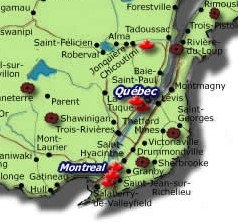
The company says it intends to reserve additional fiber to the home service primarily for multi-dwelling units and new housing developments in Ontario and Quebec, primarily between Windsor in the west and Quebec City in the east.

The company’s aggressive deployment of fiber is an effort to stem landline losses in eastern Canada.  Between cell phone providers and cable companies like Rogers, Cogeco, and Quebecor’s Vidéotron Ltee., Canadians have been hanging up permanently on Bell landlines at an alarming rate for the company.

Dvai Ghose, analyst at Canaccord Genuity told his clients, “Bell is now reporting amongst the worst residential line losses in North America.”  In the last quarter alone, 90,000 Bell customers said goodbye, perhaps permanently.

Bell has lost more than 1.2 million customers in the last two years.  Even Fibe may not be enough to stem the losses.  Canadians are not excited by the company’s video or broadband services, adding only around 27,000 new customers in the last quarter.  Bell’s notorious love of Internet Overcharging schemes like usage caps may be partly responsible.  The company enjoys a poor reputation among Internet enthusiasts for its wholehearted support for usage-limiting Canada’s online experience.

Financial analysts believe aggressive deployment of Fibe may be critical to the company’s long term survival.  Not only must Bell compete with a trend towards wireless phones, it has cable competitors selling triple play packages of phone, Internet and television service at prices that are frequently lower than what Bell charges.

Fibe is expected to be expanded to include the entire island of Montreal and some of the surrounding region by the end of 2012.

[flv width=”640″ height=”380″]http://www.phillipdampier.com/video/Bell Entertainment Fibre Internet and TV in Canada.flv[/flv]

An extended length introductory commercial for Bell Canada’s Fibe TV and Internet.  (6 minutes)

Fibrant Turns a Service Outage to Its Advantage and Wins a Major New Customer

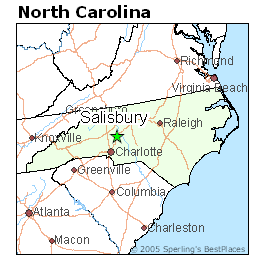
Fibrant, a community-owned fiber-to-the-home provider in Salisbury, N.C., has discovered the importance of redundancy. A major service outage knocked out phone and broadband service for several hours Monday, due to a fiber cut between Concord and Salisbury.  Fibrant’s provider, DukeNet, restored service after four and half hours by rerouting around the cable cut, but the incident left Fibrant looking for a backup provider to reduce the chance such a service outage will occur again.

City Manager Doug Paris, who was instrumental in getting Fibrant up and running in Salisbury, said the incident underlined the need to have redundancy to keep customers online.  While the city asks DukeNet for an explanation of the most recent service outage, Salisbury is taking bids for backup service.

Redundancy is a lesson virtually every service provider learns — commercial or otherwise.  What company has not suffered a significant service outage from an errant backhoe or construction crew severing a vital fiber link? Without a backup provider, service fails and customers howl.  Those companies experiencing multiple outages soon learn having a second provider can keep service disruptions to a minimum and more importantly make them invisible to customers.

Salisbury is located northeast of the city of Charlotte, N.C.

Paris told the Salisbury Post the city’s intent to contract with a second supplier has its benefits. A large educational institution has now signed up for service, with several potential new business customers considering Fibrant as well.

Fibrant has won a 13% market share in Salisbury, supplying phone, Internet, and cable TV to more than 1,700 customers.  Fibrant offers the fastest broadband service in the city and competes primarily with Time Warner Cable.  It also faces perennial opposition from anti “government broadband” critics, many nipping at the provider for political reasons.

Opponent John Bare has compared Fibrant to welfare, opposing it because it is not operated by the private sector.

But Fibrant has kept its competitors on their toes, forcing both the local cable and phone company to offer cut-rate deals for new customers and those threatening to switch.  Those low prices and retention deals have cut into Fibrant’s projected share of business in the community, but city officials note the customers who do sign up stay with the provider.  Fibrant has a 99% customer retention rate.

Fibrant’s biggest challenge remains its start up costs and debt.  The provider spends nearly $1,350 for each residential installation, for which it charges customers nothing unless they depart within a year of signing up.  Fibrant recoups installation and network construction costs from customers over time.  But the company does have plans to more aggressively market its service to Salisbury’s 34,000 residents in light of competitive offers from cable and phone companies.  Fibrant manages to win around 30 new customers a week.

Salisbury’s fiber network does not pitch customers “teaser rates” that rise considerably after the promotion expires. It prefers to market its superior speeds and service, and notes all of the revenue earned by Fibrant stays in the local community instead of being pocketed by Wall Street banks and investors.

71% of British Public Willing to Pay More for Superfast Broadband… If They Could Get It

Phillip Dampier March 13, 2012 Broadband Speed, Rural Broadband 1 Comment

While some Internet Service Providers claim their broadband customers don’t need faster speeds, that is not what customers are telling surveyors.  A new British survey of over 800 Internet users found 71% would happily pay extra for a “superfast broadband connection” at speeds of 25Mbps or higher if only they could get it.

Over half of the respondents (55%) reported they could not get fast speeds even if they wanted them.

The survey, conducted by ISPreview, found price was only a barrier for around 16% of customers and only 6.2% of respondents claimed they were satisfied with the speeds they received from their current provider.

Prices in Britain for broadband are historically lower than what North Americans pay, averaging around $27 per month, according to UK regulator Ofcom.  Customers were willing to pay at least $8 more per month if they could get the speeds they crave.

“Ofcom’s own data appears to suggest that the UK is one of the lowest priced countries in the world for broadband,” said ISPreview.co.uk’s Founder, Mark Jackson. “As a result it’s quite encouraging that so many people, most of which will be use to paying very little for their current service, would still be willing to pay more for the next generation of superfast connectivity.”

Jackson reports the highest demand for the fastest speeds actually comes from rural areas in the United Kingdom — areas long deprived of suitable broadband.  Jackson says most operators are focused on upgrading urban areas which already receive better service than rural communities.

The government has plans in place to reach 90% of the country with superfast broadband by 2015.

Charter Customers: Call and Ask Why You Can’t Have Their $60 Cable TV/30Mbps Broadband Deal

Phillip Dampier March 12, 2012 Broadband Speed, Charter Spectrum, Community Networks, Consumer News, Editorial & Site News Comments Off on Charter Customers: Call and Ask Why You Can’t Have Their $60 Cable TV/30Mbps Broadband Deal

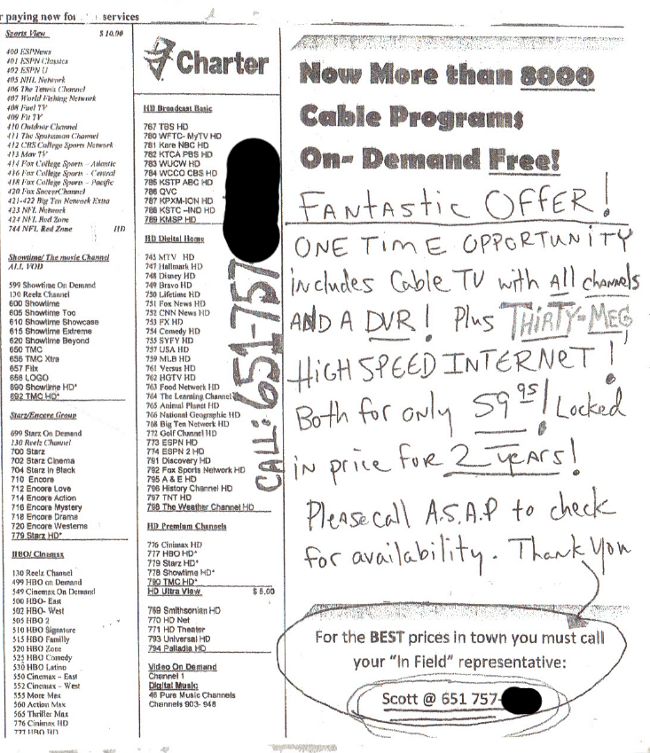
If you are customer of Charter Cable, chances are you are paying a lot more than $60 a month for a complete package of cable television with a DVR box and 30Mbps broadband, price locked for two years.  But Charter is selling precisely that package to customers in Monticello, Minn.  Why do they get a deal you can’t have?  Because your town probably doesn’t have a community-owned broadband provider delivering competition.

Charter’s website offers new customers a six-month cable/broadband promotion for $64.98 a month, but that does not include a DVR box and delivers half the speed Charter pitches to the chosen few in Monticello.  After six months, the deal ends. A package including what Charter sells in Monticello for $60 a month costs more than twice as much elsewhere — $145 a month for customers in Rochester and Duluth.

"For the BEST prices in town, you must call your 'In-Field' representative," the flyer declares, including the name and number of a local Charter representative.

The cable operator is keeping the two-year special offer quiet as much as possible with the use of door flyers hand-delivered to potential customers. If Charter’s five million customers nationwide find out, they may wonder why they are paying dramatically more for the exact same service.

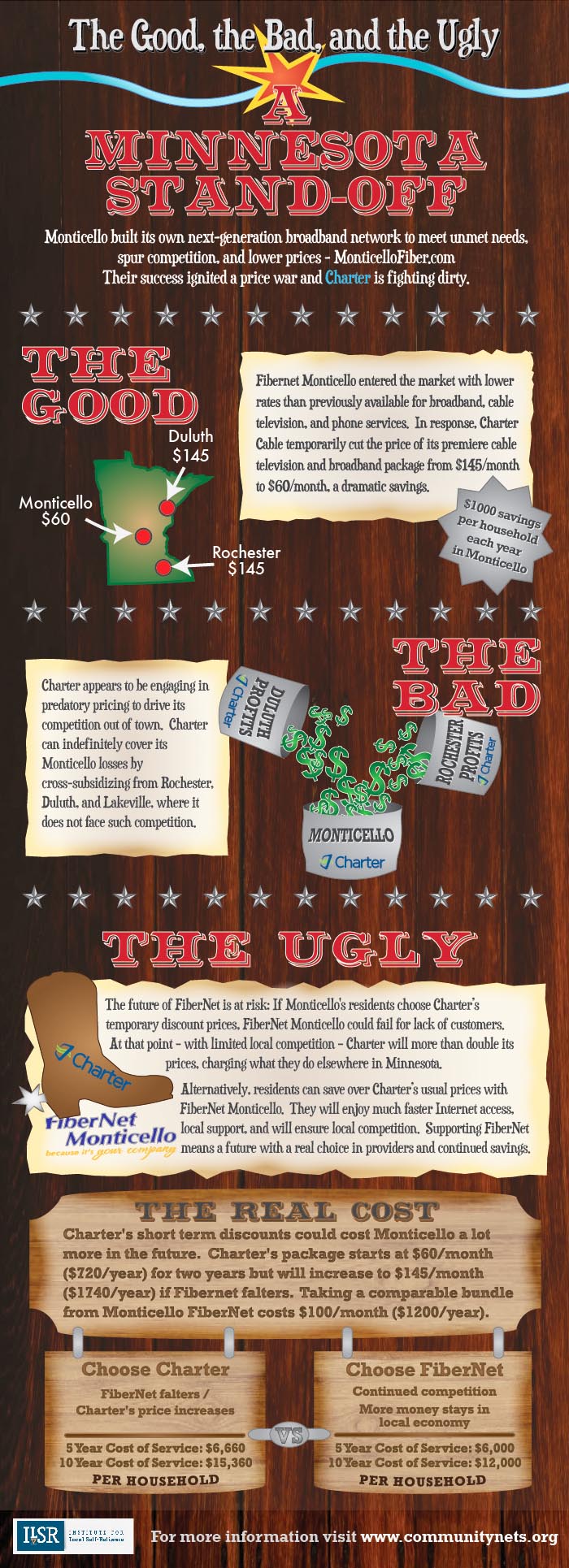
The city of Monticello already knows why.  The local community decided the incumbent providers — TDS Telecom and Charter Communications — were not giving the city the attention it deserved, so it built its own 21st century fiber to the home system to bring faster broadband to the region.  Now the incumbent commercial operators appear to be stopping at nothing to put FiberNet Monticello out of business.  Charter’s pricing takes fat profits from customers in nearby Minnesota cities and appears to cross-subsidize the heavily discounted service on offer in Monticello.  While that delivers short-term savings to customers in Monticello, other Charter customers are helping cross-subsidize those low rates on their own high cable bills.

If you are a Charter Cable customer, why can’t you have the same deal residents in Monticello are getting?  Why not call Charter at 1-888-438-2427 and ask them?

Minnesota’s War on Broadband: Competition Killing Bill Introduced in Legislature

Sen. Linda Runbeck, a dues-paying member of ALEC, a corporate funded pressure group that advocates for legislation advantageous to ALEC's corporate sponsors.

Rural Minnesota is facing a full frontal assault on community broadband, courtesy of a state representative so proud of her involvement in a corporate front group, she’s actually a dues-paying member.

State Sen. Linda Runbeck (R-Circle Pines) introduced HF 2695, a bill to prohibit publicly-owned broadband systems:

A bill for an act relating to telecommunications; prohibiting publicly owned broadband systems; proposing coding for new law in Minnesota Statutes, chapter 237.

BE IT ENACTED BY THE LEGISLATURE OF THE STATE OF MINNESOTA: Section 1. [237.201] PUBLICLY OWNED BROADBAND SYSTEM; PROHIBITION.

(a) Notwithstanding section 475.58, subdivision 1, other state law, county ordinance, or any authority granted in a home rule charter, a city or a county may not use tax revenues raised within its jurisdiction or issue debt to construct, acquire, own, or operate, in whole or in part, a system to deliver broadband service.

(b) Notwithstanding sections 123A.21, 123B.61 to 123B.63, 125B.26, and 475.58, subdivision 1, no school district or service cooperative may use state revenues, tax revenues raised within its jurisdiction, or issue debt to construct, acquire, own, or operate, in whole or in part, a system to deliver broadband service.

(c) For the purposes of this section, “broadband service” means a service that allows subscribers to access information from the Internet by means of a physical, terrestrial, non-mobile, or fixed wireless technology.

(d) This section applies to a system to deliver broadband service whose construction begins after the effective date of this section, but does not apply to:

  1. the city of Minneapolis, St. Paul, or Duluth; or
  2. the maintenance or repair of a system delivering broadband service whose initial construction began before the effective date of this section, provided that the geographical area in which the system delivers broadband service is not expanded as a result of the maintenance or repair.

EFFECTIVE DATE. This section is effective the day following final enactment.

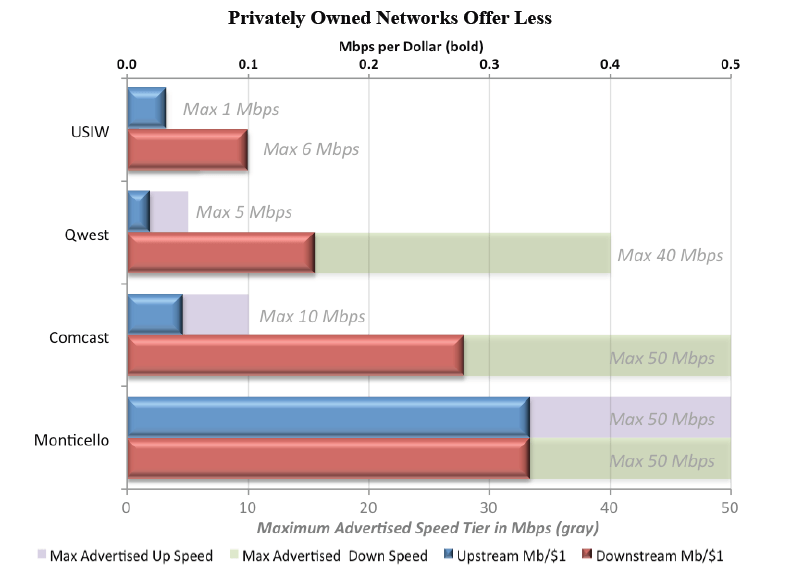
The public broadband option delivers the most bang for the buck, which is why some providers want to see it banned.

Runbeck is a dues-paying member of the American Legislative Exchange Council (ALEC), a secretive corporate front group that lobbies lawmakers to introduce business-friendly legislation, often on the state level.  Runbeck told the Minnesota Independent via email that she paid $100 for a two-year membership in the organization, and says she’s never used ALEC’s “model legislation,” bills that are sometimes written by corporate members of the group and that pop up in state capitols across the country.

But Runbeck’s sudden interest in banning community broadband coincides with similar efforts in states like Georgia and South Carolina backed by big cable and phone companies.  Runbeck’s bill would directly target rural Minnesota, where broadband is the least robust, while exempting Minneapolis, St. Paul, and Duluth (and incumbent phone and cable companies) from the bill’s provisions.  Runbeck’s bill also constrains existing public broadband services from expanding, an important matter for providers still rolling out service to additional neighborhoods in their communities.

Community broadband is already hampered in Minnesota by laws that make such projects difficult to approve and build.  When projects do break ground, incumbent providers do everything possible to throw up roadblocks to delay or abort the progress being made.  In Monticello, TDS Telecom filed nuisance suits against that city’s public broadband network before finally deciding to upgrade service themselves.  Mediacom and Charter, two major Minnesota cable operators, have objected to public broadband projects that don’t even serve communities they’ve wired.

When the networks are in operation, providers like Charter work to undercut them by selling service at prices so low, they’re predatory.  But when competitors are driven out, prices rise… quickly.

 Runbeck’s $100 membership in ALEC is paying dividends, if you are a big incumbent cable or phone company. Consumers will pay much more than that if broadband competition is curtailed.


Search This Site:

Contributions:

Recent Comments:

Your Account:

Stop the Cap!