Home » Broadband Speed » Recent Articles:

Payoff: Big Telecom Cuts Big Checks to Legislators Who Outlawed N.C. Community Broadband

The Republican takeover of the North Carolina legislature in 2010 was great news for some of the state’s largest telecommunications companies, who successfully received almost universal support from those legislators to outlaw community broadband service in North Carolina — the 19th state to throw up impediments to a comfortable corporate broadband duopoly.

Dialing Up the Dollars — produced by the National Institute on Money in State Politics, found companies including AT&T, Time Warner Cable, CenturyLink, and the state cable lobby collectively spent more than $1.5 million over the past five years on campaign contributions.  Most of the money went to legislators willing to enact legislation that would largely prohibit publicly-owned competitive broadband networks from operating in the state.

North Carolina consumer groups have fought anti-community broadband initiatives for the past several years, with most handily defeated in the legislature.  But in 2010, Republicans assumed control of both the House and Senate for the first time since the late 1800s, and the change in party control made all the difference.  Of 97 Republican lawmakers who voted, 95 supported HB 129, the corporate-written broadband competition ban introduced by Rep. Marilyn Avila, a legislator who spent so much time working with the cable lobby, we’ve routinely referred to her as “(R-Time Warner Cable).”

Democrats were mostly opposed to the measure: 45 against, 25 for.  Stop the Cap! called out those lawmakers as well, many of whom received substantial industry money in the form of campaign donations.

[flv width=”640″ height=”380″]http://www.phillipdampier.com/video/Community Fiber Networks Are Faster Cheaper Than Incumbents.flv[/flv]

The Institute for Local Self-Reliance pondered broadband speeds and value in North Carolina and found commercial providers lacking.  (3 minutes)

Telecommunication Company Donors to State Candidates and Political Parties in North Carolina, 2006–2011
Donor 2006 2008 2010 2011 2006–2011 Total
AT&T* $191,105 $159,783 $149,550 $20,000 $520,438
Time Warner Cable $81,873 $103,025 $96,550 $30,950 $313,398
CenturyLink** $19,500 $143,294 $109,750 $30,250 $302,744
NC Telephone Cooperative Coalition $103,350 $94,900 $89,250 $2,500 $290,000
Sprint Nextel $67,250 $17,500 $12,250 $3,250 $100,250
Verizon $8,050 $10,950 $24,250 $2,500 $45,750
NC Cable Telecommunications Association $10,350 $12,500 $500 $0 $23,350
Windstream Communications $0 $0 $1,500 $0 $1,500
TOTAL $481,478 $541,952 $483,600 $90,450 $1,597,481

*AT&T’s total includes contributions from BellSouth in 2006 and 2008 and AT&T Mobility LLC. **CenturyLink’s total includes contributions from Embarq Corp.

According to Catharine Rice, president of the SouthEast Association of Telecommunications Officers and Advisors, HB 129 received the greatest lobbying support from Time Warner Cable, the state cable lobbying association — the North Carolina Cable and Telecommunications Association (NCCTA), and CenturyLink.

Following the bill’s passage, the NCCTA issued a press release stating, “We are grateful to the members of the General Assembly who stood up for good government by voting for this bill.”

CenturyLink sent e-mail to its employees suggesting they write thank you letters to supportive legislators:

 “Thanks to the passage of House Bill 129, CenturyLink has gained added confidence to invest in North Carolina and grow our business in the state.”

[flv width=”640″ height=”380″]http://www.phillipdampier.com/video/CenturyLink Frustration.flv[/flv]

A CenturyLink customer endures frustration from an infinite loop while calling customer service. Is this how the company will grow the business in North Carolina?  (1 minute)

Consumers Pay the Price
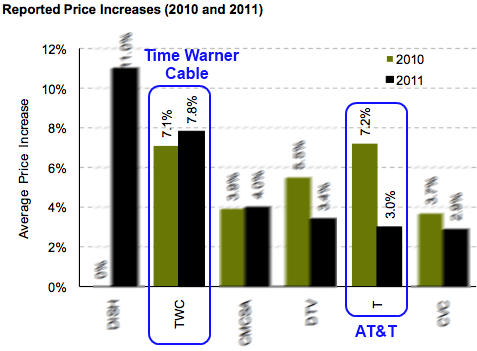
In North Carolina, both Time Warner Cable and AT&T increased prices in 2011.

After the bill became law without the signature of Gov. Bev Purdue, Time Warner Cable increased cable rates across North Carolina.  CenturyLink’s version of AT&T’s U-verse — Prism — has seen only incremental growth with around 70,000 customers nationwide.  The phone company also announced an Internet Overcharging scheme — usage caps — on their broadband customers late last fall.

Someone had to pay for the enormous largesse of campaign cash headed into lawmaker pockets.  For the state’s largest cable operator — Time Warner Cable — another rate increase handily covered the bill.

In all, lawmakers received thousands of dollars each from the state’s incumbent telecom companies:

  • Lawmakers who voted in favor of HB 129 received, on average, $3,768, which is 76 percent more than the average $2,135 received by the those who voted against the bill;
  • 78 Republican lawmakers received an average of $3,824, which is 36 percent more than the average $2,803 received by 53 Democrats;
  • Those in key legislative leadership positions received, on average, $13,531, which is more than double the $2,753 average received by other lawmakers;
  • The four primary sponsors of the bill received a total of $37,750, for an average of $9,438, which is more than double the $3,658 received on average by those who did not sponsor the bill.

Even worse for rural North Carolina, little progress has been made by commercial providers to expand broadband in less populated areas of the state.  AT&T earlier announced it was largely finished expanding its U-verse network and has stalled DSL deployment as it determines what to do with that part of its business.

In fact, the most aggressive broadband expansion has come from existing community providers North Carolina’s lawmakers voted to constrain. Salisbury’s Fibrant has opted for a slower growth strategy to meet the demand for its service and handle the expense associated with installing it.  Wilson’s Greenlight fiber to the home network supplies 100/100Mbps speeds to those who want it today.

In Upside-Down World at the state capitol in Raleigh, community-owned providers are the problem, not today’s duopoly of phone and cable companies that deliver overpriced, comparatively slow broadband while ignoring rural areas of the state.

Key Players

Some of the key players that were “motivated” to support the cable and phone company agenda, according to the report:
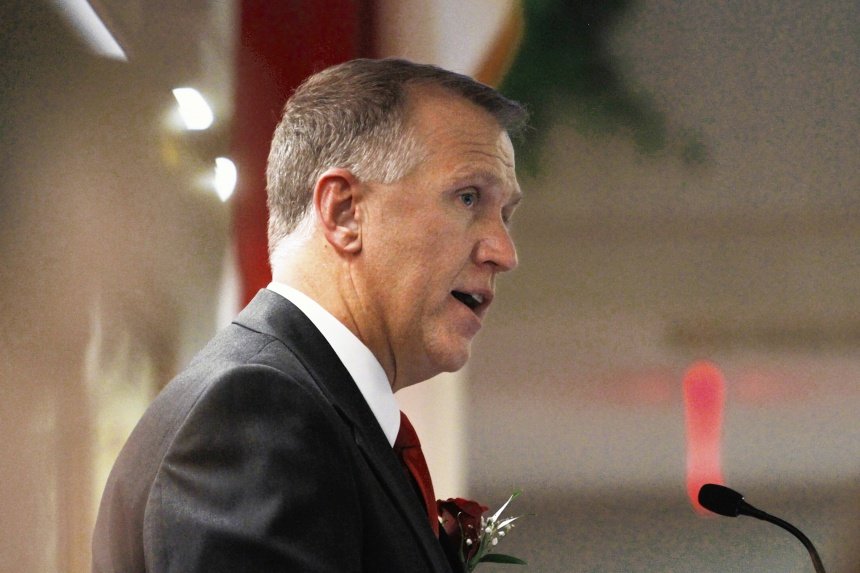
Tillis collected $37,000 from Big Telecom for his last election, in which he ran unopposed. Tillis was in a position to make sure the telecom industry's agenda was moved through the new Republican-controlled legislature.

Thom Tillis, who became speaker of the house in 2011, received $37,000 in 2010–2011 (despite running unopposed in 2010), which is more than any other lawmaker and significantly more than the $4,250 he received 2006–2008 combined. AT&T, Time Warner Cable, and Verizon each gave Tillis $1,000 in early-mid January, just before he was sworn in as speaker on January 26. Tillis voted for the bill, and was in a key position to ensure it moved along the legislative pipeline.

The others:

  • Senate President Pro Tempore Phil Berger received $19,500, also a bump from the $13,500 he received in 2008 and the $15,250 in 2006. He voted for the bill.
  • Senate Majority Leader Harry Brown received $9,000, significantly more than the $2,750 he received in 2006 and 2008 combined. Brown voted in favor of the bill.
  • Democratic Leader Martin Nesbitt, who voted for the bill, received $8,250 from telecommunication donors; Nesbitt had received no contributions from telecommunication donors in earlier elections.

The law is now firmly in place, leaving North Carolina wondering where things go from here.  AT&T earlier announced it had no solutions for the rural broadband challenge, and now it and other phone and cable companies have made certain communities across North Carolina don’t get to implement their solutions either.

What You Can Do

  1. If you live in North Carolina, check to see how your elected officials voted on this measure, and how much they collected from the corporate interests who supported their campaigns.  Then contact them and let them know how disappointed you are they voted against competition, against lower rates, against better broadband, and with out of state cable and phone companies responsible for this bill and the status quo it delivers.  Don’t support lawmakers that don’t support your interests.
  2. If you live outside of North Carolina and we alert you to a similar measure being introduced in your state, get involved. It is much easier to keep these corporate welfare bills from becoming law than it is to repeal them once enacted.  If you enjoy paying higher prices for reduced service and slow speeds, don’t get involved in the fight. If you want something better and don’t appreciate big corporations writing laws in this country, tell your lawmakers to vote against these measures or else you will take your vote elsewhere.
  3. Support community broadband. If you are lucky enough to be served by a publicly-owned broadband provider that delivers good service, give them your business.  Yes, it may cost a few dollars more when incumbent companies are willing to slash rates to drive these locally owned providers out of business, but you will almost always receive a technically superior connection from fiber-based providers and the money earned stays right in your community. Plus, unlike companies like CenturyLink, they won’t slap usage caps on your broadband service.

[flv width=”640″ height=”500″]http://www.phillipdampier.com/video/Time Warner Cable – Fiber Spot.flv[/flv]

What do you do when your company doesn’t have a true, fiber to home network and faces competition from someone that does?  You obfuscate like Time Warner Cable did in this ad produced for their Southern California customers. (1 minute)

Data Mining Your Customer Service Experience; Some Customers Better Than Others

Phillip Dampier March 20, 2012 Broadband Speed, Consumer News, Wireless Broadband 1 Comment

Not all mobile customers are treated equally.

That is the conclusion of a new piece in MIT’s Technology Review, which found wireless companies carefully data mine their customers in an effort to keep their best (and most profitable) customers happy, while leaving those who pay substantially less or enjoy an unlimited data plan on hold.

The concept of “big data” — the practice of collecting and analyzing customer usage, payments, and services, has become part of today’s sophisticated data analysis used by wireless companies to target their highest level of service to their best customers.

In practice this means big spenders might cut ahead of others in customer service call queues, be given priority on wireless carriers’ networks, and be pampered with discounts, service credits, and other special offers when service goes awry.

Carriers merge data about network problems—such as how many dropped calls a consumer experienced—with unstructured data such as the transcripts of complaints to customer-service representatives, deciphered by voice-recognition software and searched for angry keywords.

For customers enrolled in expensive “tiered” data plans, the carriers are vigilant to respond with refunds or discounts on re-enrollments; they tend not to be so generous to customers with resource-guzzling unlimited data plans.

The article did not name any specific carriers, but says selective customer-service treatment is “common industry practice in the United States.”

In Europe, disparate treatment goes even further.  When congestion starts slowing down a provider’s data network, some will boot customers with unlimited data plans onto inferior networks which treat the interlopers as second-class citizens, subject to reduced priority and even throttled speeds in some instances.

It is all designed to maximize profits by keeping the most profitable customers happy, even if lesser customers make due with less.

Data mining opens the door to even bigger profits in the days ahead, especially with contextual and location-based advertising that leverages your location with retailers who believe you can be enticed to stop in their stores in return for a discount offer or coupon sent to your smartphone.

“We’re at the beginning of an era in big-data analytics,” says Antonio Rodriguez, a venture capitalist who works at Matrix Partners in Cambridge, Massachusetts. “If you think about the treasure trove of data they have—it’s question of how they tow the privacy line between what they have access to and what they do with it.”

NetZero’s “Free Wireless Internet Access” Comes With Catches

The days of free Internet access are back… sort of.

United Online, Inc. announced Monday that it will offer free wireless Internet access through its NetZero service, provided as a “loss leader” that depends on users upgrading to paid access to cover the service’s costs.

NetZero became familiar to most Americans in the 1990s when the company handed limited dial-up Internet access, paid for through online advertising that subscribers endured in return for getting the service for free.  But broadband costs considerably more, so as the transition away from dial-up turned into a stampede, NetZero faded into memories about as much as AOL signup floppy disks and CD’s.

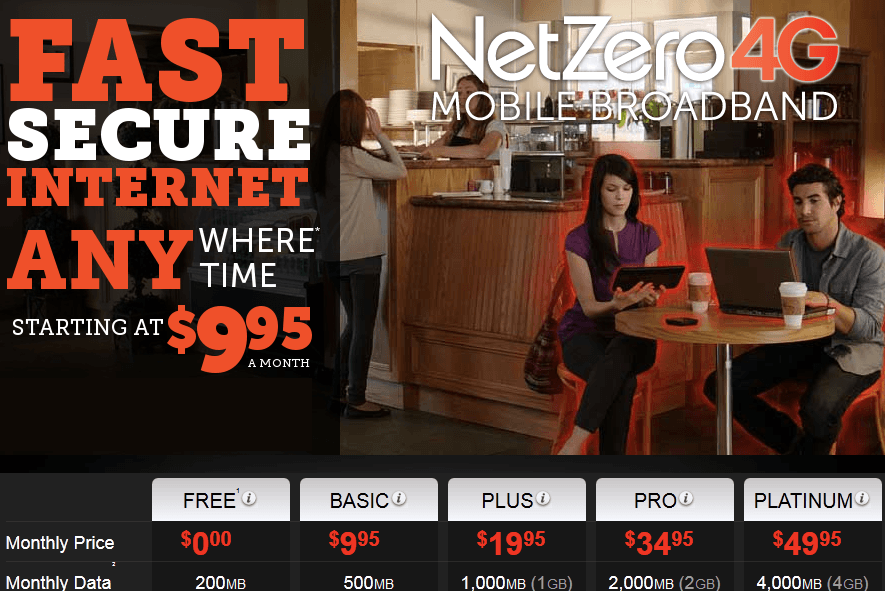
But now the company is back pitching free access to “4G wireless Internet” with no strings attached, contract commitments, or overage fees.  But that does not tell the full story.

While there is no contract commitment, NetZero requires an upfront investment in wireless hardware — $50 for a USB antenna stick suitable for a laptop or $100 for a “mobile hotspot” that can deliver a Wi-Fi connection to other nearby devices.  The devices are for sale on NetZero’s website.

The “free wireless” offer is probably better described as dim sum — it comes with a 200MB monthly usage limit, which makes it suitable for basic web browsing and e-mail only.  Once your limit is reached, the service is cut off for the remainder of the month, unless you agree to one of several paid usage plans that range from $9.95 for 500MB to $49.95 for 4GB, billed monthly.

After 12 months, NetZero’s free ride is over unless you agree to continue with a paid usage plan.  It ends even sooner if you choose to upgrade to a paid plan anytime during the first year.  Once you do, you lose the option of switching back to the free plan.

Whether paid or not, NetZero users ride on Clear’s troubled 4G WiMAX network, which Sprint — Clear’s largest customer — is planning to eventually abandon for more advanced LTE.  The long term future of Clear, also known as Clearwire, is also up in the air.  The company has ceased investing in its WiMAX network and is making preparations of its own to switch to LTE 4G technology — incompatible with the NetZero hardware you will spend $50-100 to acquire.

Clear’s network has also received considerable criticism for its speed and performance.  Because it operates on much higher frequencies, Clear’s wireless signal has problems penetrating indoors, and has even more trouble where energy efficient window coatings are used, especially in the south.

While NetZero does, in fact, deliver the service for free, the upfront investment and potential service headaches limit its usefulness.  Light users may find free Wi-Fi, increasingly common in a number of businesses, more convenient, affordable, and faster than the NetZero alternative.

Dish Network Wants to Convert Satellite Frequencies to Add Voice, Broadband Services

In the era of today’s “triple play” package of voice, data, and phone service, satellite television providers have been left at a competitive disadvantage.  Both Dish Network and DirecTV can sell you all the television signals you want, but their satellite-based distribution limits the options to include broadband and telephone service in the package.  Now Dish wants to convert some of their satellite spectrum to sell voice and data service over a network of land based wireless towers that will put the company in direct competition with AT&T and Verizon Wireless.

Dish CEO Charlie Ergen hopes to avoid making the same mistakes that threaten to kill a similar venture — LightSquared, because of interference concerns.

Dish’s spectrum is way, way up the radio dial, above 2,000MHz.  Other spectrum users in the neighborhood are primarily low-powered, line of sight communications, often satellite-based.  LightSquared’s service would have operated at around 1,500MHz, had it not obliterated reception of global positioning satellite services (GPS) in certain instances.  Whenever new spectrum users begin to move into a neighborhood, those already there feel threatened, primarily from the fear of interference problems.

Both LightSquared and Dish’s proposed services operate at considerably higher power than other incumbent users, and interference to existing services is a proven problem when sensitive reception equipment is unprepared to deal with signal overload.  The Federal Communications Commission found just cause to deny LightSquared operating permission for precisely that reason.  Ergen hopes to sell the FCC on a plan he says will avoid those interference problems.

Ergen

Ergen

Ergen’s spectrum doesn’t sit immediately next door to other, existing users.  His frequencies are comparable to living the next block over, and there is a protective fence keeping the neighbors apart.

“It’s not as close to GPS, so it’s unlikely to interfere,” Matthew Desch, chief executive officer of Iridium Communications Inc., which operates more than 60 satellites, told Bloomberg News. “But the approval is going to take some time. The FCC is going to make sure they don’t have another LightSquared problem on their hands.”

Mike Marcus, director of Marcus Spectrum Solutions LLC adds Dish has some space between its frequencies — known as a guard band — and other users.  Marcus believes Dish won’t have an interference problem unless existing wireless carriers market handsets and other equipment insufficiently selective to reject interference from higher powered users nearby.

But whether Dish will ultimately spend the billions required to build a nationwide satellite and land-based broadband and phone network to accompany its existing satellite service remains unknown.

Bloomberg reports Wall Street analysts may prefer Dish sell its spectrum assets for a quick profit.  Barclays Capital estimates Dish’s spectrum could net the company about $7.3 billion.  If AT&T or Verizon Wireless were buyers, it would also protect them from new competition in the wireless market.

Regulators may be prepared to limit any such sale, however.  Industry analysts note a similar license for LightSquared required government approval before leasing capacity (or selling the network outright) to AT&T or Verizon Wireless.  The government may seek the same limits on Dish Network’s spectrum.

Ergen may have the final word however.

Vijay Jayant, an analyst at ISI Group in New York:

If the government sets rules that limit how Dish can use the spectrum, Ergen may choose to hoard it, said Jayant, which could be antithetical to the government’s mission of promoting wireless competition.

“Dish isn’t a patsy for the government,” Jayant said. “Dish’s attitude is, ‘Make the rules fair and we’ll do the right thing. Make them unfair and we’ll sit on the spectrum,’ and it will be another black eye for the government.”

Comcast/Time Warner Cable Biggest Broadband Winners; DSL Withers on the Vine

Won 1.1 million new customers in 2011

Comcast and Time Warner Cable collectively picked up more than 1.5 million new customers in 2011, with most of the growth coming from dissatisfied DSL subscribers seeking better broadband speeds.

Leichtman Research Group, Inc. (LRG) found the eighteen largest cable and telephone providers in the US — representing about 93% of the market — acquired 3 million net additional high-speed Internet subscribers in 2011. Annual net broadband additions in 2011 were 88% of the total in 2010.

The top broadband providers now account for 78.6 million subscribers — with cable companies having over 44.3 million broadband subscribers, and telephone companies having over 34.3 million subscribers.

Stalled growth

Despite AT&T’s position as the second largest Internet Service Provider in the country, the company only picked up 117,000 new customers in 2011.  In contrast, Time Warner Cable, with 6 million fewer customers, added almost a half-million new broadband subscriptions last year.

Frontier Communications, which made broadband a primary target for expansion, has not seen considerable growth either.  The company only added just short of 38,000 new broadband customers last year, almost all getting DSL, often at speeds of 1-3Mbps.

Other key findings include:

  • The top cable companies netted 75% of the broadband additions in 2011;
  • The top cable companies added 2.3 million broadband subscribers in 2011 — 98% of the total net additions for the top cable companies in 2010;
  • The top telephone providers added 750,000 broadband subs in 2011 — 68% of the total net additions for the top telephone companies in 2010;
  • In the fourth quarter of 2011, cable and telephone providers added 765,000 broadband subscribers — with cable companies accounting for 82% of the broadband additions in the quarter.

Now serving 10.3 million

“Despite a high level of broadband penetration in the US, the top broadband providers added 88% as many subscribers in 2011 as in 2010,” said Bruce Leichtman, president and principal analyst for Leichtman Research Group, Inc. “At the end of 2011, the top broadband providers in the US cumulatively had over 78.6 million subscribers, an increase of nearly 25 million over the past five years.”

Americans are increasingly treating broadband as an essential “utility” service, as fundamental as electricity or clean water.

The majority of consumers who lack the service either consider it irrelevant in their lives (a factor that increases with the age of the surveyed respondent), cannot obtain service from their provider because of their location, or cannot afford the service.

Broadband Internet Provider Subscribers at End of 4Q 2011 Net Adds in 2011
Cable Companies
Comcast 18,147,000 1,159,000
Time Warner^ 10,344,000 491,000
Cox* 4,500,000 130,000
Charter 3,654,600 252,900
Cablevision 2,965,000 73,000
Suddenlink 951,400 65,100
Mediacom 851,000 13,000
Insight^ 550,000 25,500
Cable ONE 451,082 25,680
Other Major Private Cable Companies** 1,925,000 55,000
Total Top Cable 44,339,082 2,290,180
Telephone Companies
AT&T 16,427,000 117,000
Verizon 8,670,000 278,000
CenturyLink 5,554,000 238,000
Frontier^^ 1,735,000 37,833
Windstream 1,355,300 53,600
FairPoint 314,135 24,390
Cincinnati Bell 257,300 1,200
Total Top Telephone Companies 34,312,735 750,023
Total Broadband 78,651,817 3,040,203

Sources: The Companies and Leichtman Research Group, Inc.
* LRG estimate
** Includes LRG estimates for Bright House Networks, and RCN
^ Totals prior to Time Warner Cable’s acquisition of Insight completed on 2/29/2012
^^ LRG estimate does not include wireless subscribers
Company subscriber counts may not represent solely residential households
Totals reflect pro forma results from system sales and acquisitions
Top cable and telephone companies represent approximately 93% of all subscribers

Search This Site:

Contributions:

Recent Comments:

Your Account:

Stop the Cap!