Home » Broadband Speed » Recent Articles:

AT&T and Time Warner Cable’s Unnecessary Temper Tantrum in Kansas City

Phillip “You Guys Need a Timeout” Dampier

AT&T and Time Warner Cable are complaining they have gotten a raw deal from Kansas City, Mo. and Kansas City, Ks., in comparison to the incentives Google was granted to wire both cities with gigabit fiber broadband.

“It’s time to modernize our industry’s rules and regulations…so all consumers benefit from fair and equal competition,” read a statement from AT&T.

“There are certain portions of the agreement between Google and Kansas City, Kan., that put them at a competitive advantage compared with not just us but also the other competitors in the field,” said Alex Dudley, a Time Warner Cable spokesman. “We’re happy to compete with Google, but we’d just like an even playing field.”

The Wall Street Journal seemed to suggest Google was getting the keys to both cities, with grants of free office space and free power for Google’s equipment, according to the agreement on file with the cities. The company also gets the use of all the cities’ “assets and infrastructure”—including fiber, buildings, land and computer tools, for no charge. Both cities are even providing Google a team of government employees “dedicated to the project,” says the Journal.

The Google Fiber project was so desired that the local governments rolled out the red carpet. In Kansas City, Mo., for instance, the city is allowing Google to construct “fiberhuts,” small buildings that house equipment on city land at no cost, according to a person familiar with the matter.

The cities are discounting other services, as well. For the right to attach its cables to city utility poles, Google is paying Kansas City, Kan., only $10 per pole per year—compared with the $18.95 Time Warner Cable pays. Both cities have also waived permit and inspection fees for Google.

The cities are even helping Google market its fiber build-out. And both are implementing city-managed marketing and education programs about the gigabit network that will, among other things, include direct mailings and community meetings.

Several cable executives complain that the cities also gave Google the unusual right to start its fiber project only in neighborhoods guaranteeing high demand for the service through pre-registrations. Most cable and phone companies were required by franchise agreements with regional governments to build out most of the markets they entered, regardless of demand.

But the Journal missed two key points:

  1. Time Warner Cable has been granted the same concessions given to Google on the Missouri side, and AT&T presumably will also get them when it completes negotiations with city officials on the matter.
  2. Both cable and phone companies have the benefit of incumbency, and the article ignores concessions each had secured when their operations first got started.

The Bell System enjoyed a monopoly on phone service for decades, with concessions on rights-of-way, telephone poles and placement. AT&T was a major beneficiary, and although the AT&T of today is not the same corporation that older Americans once knew, the company continues a century-long tradition of winning the benefit of the doubt in both the state and federal legislature. AT&T has won statewide video franchise agreements that give the company the power to determine where it will roll out its more advanced U-verse platform, and enjoys carefully crafted federal tax policies that helped them not only avoid paying any federal tax in 2011 — the company actually secured a $420 million “refund” subsidized by taxpayers.

Cable operators also won major concessions from local governments under pressure from citizens eager to buy cable television. At the time, cable companies were granted exclusive franchises — a cable monopoly — to operate, an important distinction for investors concerned about the value of their early investments. Local zoning and pole attachment matters were either negotiated or dealt with legislatively to allow cable companies the right to hang their wires on existing utility poles. Franchise agreements permitted the gradual roll-out of cable service in each franchise area, often allowing two, three, or more years to introduce service. It was not uncommon for neighborhoods on one side of town to have cable two years before the other side could sign up. That sounds awfully familiar to AT&T U-verse today.

Google’s proposal to build a revolutionary broadband network delivering 1Gbps deserved and got the same type of treatment then-revolutionary phone and cable service won back in the day.

Time Warner Cable also won much the same treatment Google is now getting, and the cable operator has gotten $27,000 in fees refunded and will avoid another $100,000 in permit fees going forward. Time Warner Cable and Google will both receive free traffic control services during network construction — not that Time Warner Cable plans much of a change for customers in either Missouri or Kansas.

AT&T will likely also receive the same treatment, although it would be hypocritical of them to complain that Google gets to pick and choose where it provides service. Large swaths of Kansas City and suburbs are still waiting for U-verse to arrive, and many areas will never get the service. Cable operators had to wire a little further, but also benefited from years of monopoly status and network construction expenses paid off years ago when there literally was no competition.

Those paragons of virtue at Goldman Sachs are appalled Google has such a good relationship with Kansas City officials more than happy to have the gigabit speeds neither AT&T or Time Warner Cable would even consider providing.

Google’s rights “appear to be significantly more favorable than those cable, Verizon or any other fiber overbuilders achieved when striking deals with local governments in the past,” Goldman Sachs analyst Jason Armstrong told the Journal. “We’re surprised Time Warner Cable hasn’t been more vocal in its opposition.”

But then the cable company has secured most of the same benefits Google has, so why complain at all?

In fact, city officials had to browbeat Time Warner to modernize its network in ways it would have not done otherwise without the new agreement.

Both AT&T and Time Warner have every right to be concerned. Their substandard networks and high prices (along with a lousy history of customer service, according to national surveys) put them at a competitive disadvantage if Google does not make any major mistakes. Neither cable or phone company has made any noise about upgrading service to compete, and should customers begin to leave in droves, then both companies may actually have something to cry about.

The Wall Street Journal’s report on the concessions granted to Google wanders off into the Net Neutrality debate for some reason, and misses several important facts reviewed above.  (3 minutes)

DOCSIS 3.1 In Development: Up to 10/2Gbps Service Possible for Cable Broadband

Phillip Dampier October 4, 2012 Broadband Speed, Consumer News Comments Off on DOCSIS 3.1 In Development: Up to 10/2Gbps Service Possible for Cable Broadband

Even as DOCSIS 3 cable technology continues to roll-out across cable systems now offering faster Internet speeds, the next generation of cable broadband is on the way, reportedly capable of delivering up to 10/2Gbps service.

CableLabs’ DOCSIS 3.1 project will be the subject of a special panel at an upcoming cable engineer conference later this month.

“DOCSIS 3.1 specification development is a significant milestone on the industry’s road map to next-generation services,” said CableLabs chief technology officer Ralph Brown. “Our SCTE Cable-Tec Expo panel will identify the motivations, requirements and key technology building blocks under development with the collaboration of the vendor community.  DOCSIS 3.1 solutions will provide both residential and commercial cable customers with faster data rates — both upstream and downstream — that support increasingly compelling broadband services.”

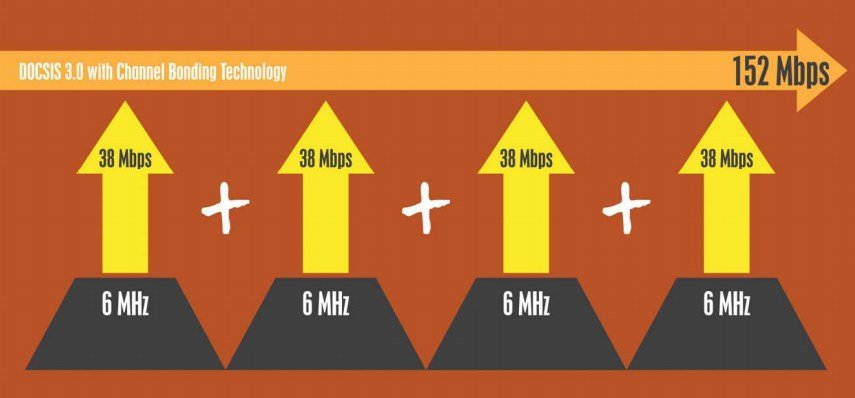
The DOCSIS 3 standard allows cable operators to bond multiple channels to support faster speeds.

The new standard will incorporate changes in how cable spectrum is utilized for broadband, vastly expanding potential bandwidth. Although the standard can support gigabit broadband speeds, nobody expects cable companies to offer those speeds in the near term.

Instead, providers are more interested in addressing their upstream speed limitations. From the earliest days of cable broadband, the assumption was that customers would care far more about downstream speeds and consider uploading an afterthought. The result was a network that prioritized download speed. But as users continue to upload more multimedia content and embrace cloud storage, slow upload speeds are starting to aggravate customers.

DOCSIS 3.1 is rumored to de-emphasize the current QAM modulation cable operators use for broadband in favor of more robust technologies such as orthogonal frequency-division multiplexing (OFDM), already used by the wireless industry. Unlike interference/noise-prone QAM, OFDM uses much smaller subcarriers that work better in noisy signal conditions. Although coaxial cable is capable of delivering a large amount of spectrum to cable operators, all of it cannot be practically used because of external interference from electrical equipment, broadcast radio and television signals, and other sources. Error-correcting technologies can let operators use more of their available spectrum without reducing the quality of service to customers.

The study group working on DOCSIS 3.1 is also reviewing the incorporation of “low density parity-check” (LDPC) error correction that would efficiently improve noise rejection over today’s Reed-Solomon approach. Combining OFDM and LDPC could improve spectral efficiency up to 25 percent.

The cable industry is pressuring the study group to preserve backwards compatibility with the older DOCSIS 3.0 standard just now coming into widespread use. Some industry insiders predict cable operators will keep today’s QAM modulation for downstream speeds while boosting upstream speeds using OFDM.

Cable operators across the country are gradually moving away from analog service in favor of digital with the ultimate goal of an entirely IP-based network for television, phone, and broadband. The pressure is on for DOCSIS 3.1 to help accelerate that transformation, but most industry experts don’t believe the new standard will be finalized until at least the middle of 2013, with at least 6-12 months before equipment shows up supporting the finalized standard.

Bottom-Ranked Suddenlink Upset About Frontier’s Ad Claims Their DSL is Better

Suddenlink is throwing a hissyfit over Frontier’s aggressive advertising.

Now come on, you are both pretty… slow that is.

Suddenlink Communications is crawling mad that Frontier Communications has been hammering the cable company over their broadband speeds, which PC Magazine this week proclaimed were nothing to write home about. The cable operator successfully challenged some of Frontier’s ads with the National Advertising Division of the Council of Better Business Bureaus.

The group recommended Frontier cease making claims that its DSL service offers “dedicated” lines to the Internet in contrast to Suddenlink, which forces customers to share their connection with the whole neighborhood.

Frontier claims Suddenlink’s network can bog down during peak hours, while Frontier makes sure customers consistently get the speeds they pay for.

Many of the ads targeted customers in West Virginia, who regularly tell Stop the Cap! neither provider competing there offers particularly good service.

“Is Frontier kidding?,” says Shane Foster, a former Frontier customer in West Virginia. “I was supposed to be getting up to 6Mbps service and I was lucky to get 1.5Mbps at 2 am.”

Foster says he believes Frontier oversold its DSL network in his area, with speeds slowing even further during the evening and weekends when everyone got online. While Frontier may not require customers to share a line from their home to the company’s central office, congestion can occur within Frontier’s local exchange or on the connection Frontier maintains with Internet backbone providers.

“The technician sent to my house even privately admitted it,” Foster tells Stop the Cap!

Foster switched to Suddenlink, but he is not exactly a happy customer there either.

“Their usage caps suck, the service is slow, and their measurement tool is always broken,” Foster shares. “West Virginia doesn’t just get the bottom of the barrel, it gets the dirt underneath it.”

Frontier Communications says it has been making improvements in West Virginia and other states where it provides DSL broadband. Some areas can now subscribe to 25Mbps service because of network upgrades. Foster says he would dump Suddenlink and go back to Frontier, if they can deliver speeds the rest of the country gets.

“Sorry, but 1.5Mbps is not broadband and with their prices, tricky fees and contracts it is robbery,” says Foster. “They need to clean up their act and I’ll come back. I hate usage caps with a passion.”

Frontier says it will appeal the NAD’s decision. But Frontier might do better advertising its broadband service as usage cap free — something customers consistently value over those running Internet Overcharging schemes.

America’s Fastest-Rated ISPs Bring No Surprises: Fiber Wins, Telco DSL, U-verse Loses

Phillip Dampier October 1, 2012 Broadband Speed, Competition, Consumer News Comments Off on America’s Fastest-Rated ISPs Bring No Surprises: Fiber Wins, Telco DSL, U-verse Loses

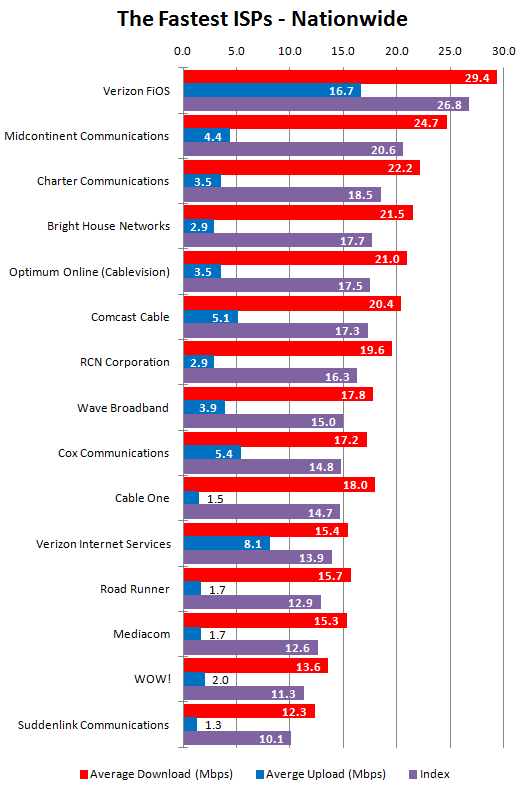
PC Magazine has declared fiber to the home service America’s fastest broadband technology, and among larger providers, Verizon’s FiOS once again took top honors for delivering the fastest and most consistent broadband speeds.

Over the past nine months, the magazine’s readers have been conducting regular speed tests using their personal broadband connections. The magazine found fiber optics remains the best current technology for delivering cutting-edge broadband service, with an average speed rating for FiOS reaching 29.4/16.7Mbps. Since PC Magazine readers were subscribed to various speed tiers while conducting the tests, the magazine’s ratings do not measure the fastest possible speeds on offer from different providers. Verizon’s most-popular service bundle includes 15/5Mbps service, heavily weighting Verizon’s speed rating which is capable of even faster speeds with their 50-300Mbps premium service tiers. But on average, consistently fast speeds kept them in the top spot.

Cable broadband technology was the second-best choice, depending on how cable operators implement it. Cable companies depend on a singl, shared broadband pipeline in each neighborhood. DOCSIS 3 upgrades allow a cable operator to vastly expand that pipeline by “bonding” several channels together to increase the maximum bandwidth. Cable operators that combine the latest technology with the smallest number of customers sharing a connection do the best.

Midcontinent Communications (better known by customers as Midco), achieved first place nationwide. The company, which serves customers in Minnesota, the Dakotas, and Wisconsin, took top honors with an average speed of 24.7/4.4Mbps — the best of any cable operator.

Ratings sometimes show the level of investment made by cable operators in their network. A sudden boost in average speeds is a sure sign a cable operator is rolling out network upgrades. A speed decline can expose a cable company trying to oversell an already constrained network. Charter Cable, which has routinely gotten poor ratings in Consumer Reports’ rankings, showed dramatic improvement in PC Magazine’s ratings, achieving third place with an average speed increase from 15Mbps to 18.5Mbps. But while the added speed is nice, the company’s usage caps are not. Conversely, WOW!, which achieved top scores in Consumer Reports’ ratings, scored towards the bottom of PC Magazine’s tests.

Comcast, which last year trumpeted its high rankings in controversial ads claiming to deliver the fastest broadband in the nation has now been overrun by both Midco and Charter. Comcast Xfinity is now in sixth place, hardly the fodder for any future ad campaign.

Cox Cable actually lost ground since last year, with average speed now down to 14.8Mbps. The bottom four: Time Warner Cable, Mediacom, WOW!, and Suddenlink — are all hampered by slow upload speeds and more anemic “take-rates” on higher speed broadband plans with the speeds on offer. With fewer premium speed customers, average speed ratings take a hit from the larger proportion of customers sticking with standard service.

Phone companies barely appeared in the magazine’s top ratings. AT&T’s U-verse could not even make the top-15. While 25Mbps was adequate when U-verse was first deployed, the broadband speed race has quickly overshadowed the company’s fiber to the neighborhood service, which still relies on home phone lines and antiquated copper infrastructure in the immediate neighborhood.

Phone companies still offering traditional ADSL on almost all-copper networks turned in even more dismal results — most too low to rate. Only Frontier’s adopted FiOS network kept them in the rankings in the overall broadband “slow zone” in the Pacific Northwest, along with CenturyLink’s acquired ADSL2+ and bonded DSL networks built by Qwest.

ISPs that perform poorly typically criticize the methodology of voluntary speed tests as the basis for speed and performance ranking. Most criticize the apparent lack of consistency, random sampling, the possibility rankings may be weighted in certain geographic areas, and may mix a disproportionate number of customers with standard or premium level speeds to unfairly boost or diminish average speed rankings. But overall, PC Magazine’s rankings show some technologies superior to others. If a customer has a choice, finding a fiber to the home provider is likely to provide an improvement over what the cable company offers, but the differences between phone company DSL and cable broadband are even starker.

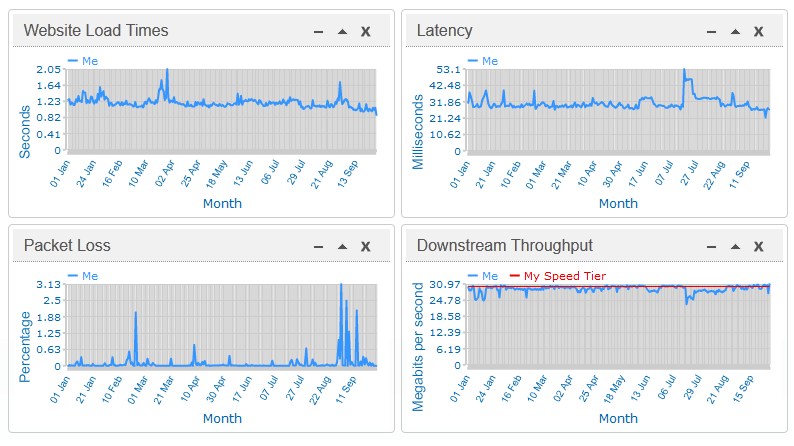
The FCC speed test program, conducted by SamKnows, takes more regular snapshots of broadband quality from volunteer panelists. Your editor’s home broadband connection from Time Warner Cable is profiled above, showing results from January-September 2012

Wall Street Goes for Another Round of Sprint-Bashing: Why Are They Still in Business?

Phillip Dampier September 27, 2012 Broadband Speed, Competition, Consumer News, Sprint, Video, Wireless Broadband Comments Off on Wall Street Goes for Another Round of Sprint-Bashing: Why Are They Still in Business?

[flv width=”360″ height=”290″]http://www.phillipdampier.com/video/Bloomberg Sprint Liquidity Doesnt Fix Company 9-26-12.mp4[/flv]

Sanford Bernstein’s Craig Moffett is back on Bloomberg News dismissing Sprint’s business strategy and lamenting the cost of subsidizing Apple’s iPhone 5 for existing customers who don’t really ‘need’ a new phone. Moffett sees all downsides for America’s third largest carrier (in May he gave the company a 50-50 shot of landing in bankruptcy court), trying to compete against a virtual duopoly successfully maintained by AT&T and Verizon. He thinks iPhone subsidies and purchase guarantees cost Sprint too much, their 4G LTE network is too little, too late (and will never perform as well as larger competitors who have lower frequency spectrum available for better reception), and their stock is overvalued. Wall Street routinely brings out analysts cheerleading additional mergers and acquisitions for further consolidation in the wireless market. By cutting down Sprint, Wall Street continues to emphasize it has already picked winners (AT&T and Verizon) and losers (Sprint, T-Mobile, everyone else).  (6 minutes)

Search This Site:

Contributions:

Recent Comments:

Your Account:

Stop the Cap!