Home » Broadband Speed » Recent Articles:

Broadband Usage Cap Buster: Next Gen 8K UltraHD Video Needs 360Mbps

Phillip Dampier October 17, 2012 Broadband "Shortage", Broadband Speed, Community Networks, Consumer News, Data Caps, Editorial & Site News, Online Video, Video Comments Off on Broadband Usage Cap Buster: Next Gen 8K UltraHD Video Needs 360Mbps

Cable companies are starting to lay the groundwork to support the next generation of HD video — first with 4K, an improvement over today’s HD standard, and eventually 8K Ultra High Definition TV — delivering pictures 16 times better than the current 1080p HD standard and coming close to the level of detail supported by IMAX.

The 8K evolving standard, proposed by Japan’s public broadcaster NHK and dubbed Super Hi-Vision, remains years away, but cable operators are preparing their systems to support 4K UHDTV (3840 x 2160 – 8.3 megapixels)  much sooner.

By the time 8K comes into use, most cable operators will rely entirely on a single broadband pipe to deliver video, Internet access and telephone service. To handle that traffic, and the bandwidth UHDTV demands, providers will have to upgrade their systems to support much faster speeds. A single video channel transmitted in 8K UHDTV requires around 360Mbps.

That makes Google’s decision to construct a gigabit broadband network in Kansas City seem less revolutionary and almost evolutionary, considering how quickly bandwidth demand will increase in the next eight years.

The cable industry is now moving fast to finalize the next version of the DOCSIS standard which supports cable broadband. DOCSIS 3.1 is expected to be introduced Thursday at the Cable-Tec Expo. An initial preview seems to suggest the standard will be backwards-compatible with prior DOCSIS versions — good news for those buying their own cable modems — and will support multi-gigabit speeds, if the cable operator decides to dedicate more of its available bandwidth to broadband.

An essential goal of the cable industry is to match or beat 1Gbps, currently on offer from several fiber to the home service providers and Google. Some operators want even more — up to 10/2Gbps capacity, as they consider future speed needs.

But engineering advancements and innovation fly in the face of bean counters attempting to monetize broadband usage with usage caps and usage-based billing. The industry’s justification for usage caps becomes even more tenuous as it moves to a single pipeline for all of its services and treats its cable TV package differently from Internet traffic. AT&T and Bell are already doing that today with their U-verse and Fibe platforms. Both claim their TV channels move over a different network than traditional Internet, but as costs for both continue to decline, that is becoming a distinction with little difference.

Google and a handful of independent or community-owned broadband networks are largely the only ones calling out the cable industry’s bogus claims that consumers don’t need super fast broadband, usage caps are necessary, and broadband speed upgrades are difficult and too expensive. These new competitors have correctly predicted the exponential growth in bandwidth demand and are prepared for it, even as the industry continues to dismiss their competitors’ networks as unnecessary overkill.

But cable’s hurry to DOCSIS 3.1 tells a different story.

Jeff Baumgartner from Light Reading Cable observed cable executives at Tuesday’s annual Cable & Telecommunications Association for Marketing (CTAM) conference, where those attending beat the drum for faster and better networks:

[DOCSIS 3.1] will also focus on the quality of cable’s pipe, reduced latency and other smarts designed to help enable a new set of broadband-based services. Cable’s interest in offering 4K HD services, which offer four times the resolution of today’s HD, was an example that was brought up several times during the session.

The cable industry also hopes to shorten the process of creating the specs and having them turn into deployable products. An average generation of DOCSIS has typically taken three to four years.

“We can no longer do that,” said Phil McKinney, the new president and CEO of CableLabs, but didn’t offer a guess on the anticipated cycle for 3.1. “We have to deliver higher and higher performance.”

[…] And 3.1 is also about the almighty dollar as broadband usage continues to climb. Getting costs down “is a key part of Docsis 3.1,” said Cox Communications Inc. EVP and CTO Kevin Hart.

[flv width=”640″ height=”380″]http://www.phillipdampier.com/video/Light Reading NBCU Ultra-HD Demo 10-12.flv[/flv]

Jeff Baumgartner from Light Reading Cable was invited to a demonstration of 8K UHDTV, which will require much faster broadband networks to handle the super high quality video. (3 minutes)

Time Warner Cable Introduces Discounted $9.95 “Starter Internet” for Disadvantaged Families

Phillip Dampier October 16, 2012 Broadband Speed, Consumer News Comments Off on Time Warner Cable Introduces Discounted $9.95 “Starter Internet” for Disadvantaged Families

Time Warner Cable has launched a pilot program in several cities offering disadvantaged families with school-age children access to the Internet for $9.95 a month.


Families with children in the selected pilot schools are eligible to apply for Starter Internet service, which operates at 1/1Mbps in most cities. The eligibility requirements:

  • The family has a working computer that is Internet ready;
  • The family has not subscribed to Time Warner Cable Internet service within the last 90 days;
  • The family does not have an overdue Time Warner Cable bill or any unreturned equipment;
  • The family must pay any past due balances.

Time Warner Cable says there is no activation or installation fee with Starter Internet, no price increases, and no equipment rental fees for the first two years. Additional information is available directly from Time Warner at 1-855-746-8704.

Most of the pilot schools are located in urban or exceptionally low income communities, with the largest number of participating city schools in California, New York, North Carolina, Texas and Wisconsin. Among the highlighted communities:

  • Arizona: Gasden, San Luis
  • California: Cathedral City, Los Angeles, Van Nuys, Desert Hot Springs, San Bernardino, Ventura, Lennox, Santa Ana, San Diego, Highland, El Centro, North Hollywood
  • Hawaii: Captain Cook, Waianae, Pahoa, Kekaha, Honolulu, Mountain View, Naalehu
  • Idaho: Coeur d’Alene
  • New York: Buffalo, Syracuse, Rochester, Albany
  • North Carolina: Charlotte, High Point, Wilmington, Winston-Salem, Greensboro, Durham, Salisbury, Fayetteville
  • South Carolina: Columbia, Florence
  • Texas: Dallas, San Antonio, Irving, Austin, Waco, Corpus Christi, Brownsville, San Juan
  • Wisconsin: Milwaukee

The enrollment period started Oct. 1 and ends November 30, 2012. Each participating school has a unique offer code that is required to sign up.  Eligible families will receive this code from their school administration or in the starter Internet materials provided to families and students.

In order to be eligible for Starter Internet, the family must have an Internet-ready computer. To help bridge this gap, each family in the pilot program is eligible for one low-cost, refurbished computer through Redemtech’s GoodPC via www.GoodPC.com/TWC or by calling 1-800-975-5837.

Pick Me Up Off the Floor: Americans Pay Up to 10 Times More for LTE 4G Service Than Europe

Phillip “I can see the duopoly from my house — why can’t the FCC?” Dampier

The New York Times is pondering whether Americans are paying too much for wireless broadband based on Long Term Evolution (LTE) technology. A new study now offers proof, noting U.S. customers pay three times as much, on average, for each gigabyte of data in contrast to European consumers.

The UK-based mobile industry group GSM Association offers evidence Americans are not getting the lower wireless broadband prices promised by the more advanced, cost-efficient LTE technology, although customers in other parts of the world are seeing savings.

According to the group’s findings, Verizon Wireless customers effectively pay $7.50 per gigabyte of data over the company’s 4G LTE network. That is three times more expensive than the European average of $2.50/GB, and more than 10 times higher than what Swedes pay: $0.63/GB, cheaper than many wired broadband providers’ overlimit fees.

Verizon Wireless’ Brenda Raney tried to defend the discrepancy, claiming that Verizon offers enhanced value bundles with unlimited voice, text, and mobile hotspot service. Having a data-only plan, Raney told the newspaper, would reduce the cost to $5.50/GB.

That is still more than twice as much as what Europeans pay.

So what is the real reason for the enormous price difference?

The wireless industry regularly claims that the vast expanse of the United States means a much larger investment in wireless technology and infrastructure, notably cell towers, to reach customers in suburban and rural areas. European countries, in contract, are much more compact and urban-focused, making infrastructure less costly.

But that has proven to be nonsense for Sweden’s Tele2, which not only operates a nationwide 4G cellular network in Sweden — a country with its own vast rural regions — but promises to deliver service to 99% of the country by the end of the year and already covers more than 100 Swedish municipalities. They deliver service at a fraction of the cost charged by Verizon. Tele2 remains undeterred by the “rural cost argument,” taking on the world’s largest country — the Russian Federation. It has already acquired 12 regional mobile operators in Russia, expanding service to more than 43 regions with over 22 million customers, and plans additional investments.

The real reason for the inflated price of service, unsurprisingly, is America’s lack of robust wireless competition, according to GSMA.

Europe has the largest number of competing providers — 38 of 88 operators with LTE technology are in Europe. Even the smallest countries have at least three major competitors. The U.S. has two major competitors, two smaller national carriers, and a dozen or more regional or prepaid operators totally dependent on the larger four to deliver national roaming service.

Until recently, Verizon Wireless had a veritable monopoly on LTE service as AT&T tries to catch up — one of the very rare moments Verizon directly challenged AT&T in advertising that distinguished the coverage differences between the two. These days, AT&T and Verizon mimic one another, often offering identically priced service plans. Customers who want to pay less have to reduce their expectations with smaller competitors that offer reduced coverage.

If you don’t want access to premium wireless broadband, American carriers will also gouge you for lesser 3G service.

U.S. consumers on two year contract plans spend an average of $115 a month for 3G service, according to a survey conducted by Ernst & Young. In the Netherlands, the average was $51; in Britain, $59 — about half the price.

The growing mobile phone bill has now reached the point where Ernst & Young’s Jonathan Dharmapalan suggests it is literally interfering with smartphone adoption and causing others to shut off the devices permanently after an experience with bill shock.

“The No. 1 reason for customers’ discontinuing their use of a smartphone service or not taking the option is the fear of overspending,” Dharmapalan said.

The U.S. regulator overseeing the industry that is benefiting enormously from confiscatory duopoly market pricing is the Federal Communications Commission.

A former FCC senior Internet technology adviser attempted to explain away the vast discrepancies in pricing, offering this bit of analysis: Europeans talk and surf  less.

Kansas City Tech Businesses Relocating to First Google Fiberhoods; “It Makes Life Easier”

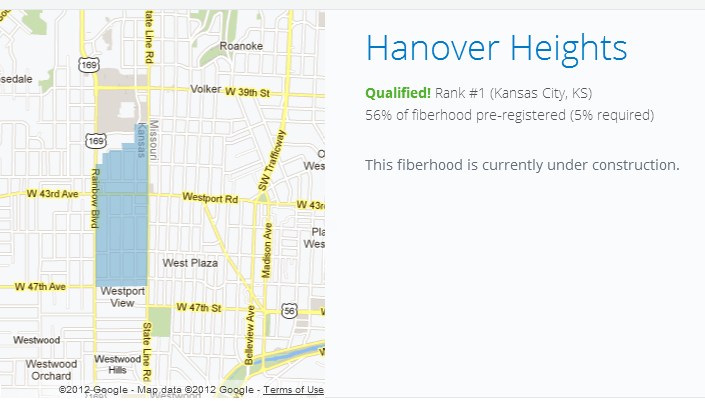
Property values in the historic neighborhood of Hanover Heights (Kansas) are ticking up as tech businesses relocate to follow Google’s roll-out of gigabit fiber service, coming in a matter of weeks.

Only one problem: Google is not officially selling fiber service to businesses just yet. Answer? Buy residential property in the area and move workers who could deliver increased productivity with faster Internet speeds.

That was the answer for Local Ruckus LLC, which is opening its new headquarters in a 2,500-square foot home in the first neighborhood scheduled to receive Google Fiber service.

“It just makes life easier,” CEO Adam Arredondo told the Kansas City Star.

The company says it needs the faster speeds to facilitate transferring files back and forth more quickly.

RareWire, a local developer of apps for mobile devices has decided it can best leverage 1,000Mbps broadband speeds launching a new startup – App Creation Studio, which will assist developers with testing and marketing apps.

Tech start-ups are exactly what Google hoped to see from its experimental fiber network, which is still barely operational. City officials see fiber broadband infrastructure and Business Hosted Voice Solutions as the foundation for energizing the local digital economy.

KCMO mayor Sly James last month unveiled Launch KC — an effort to attract technology companies to Kansas City, particularly start-ups.

James announced five companies and Union Station were prepared to offer free or “very affordable” office space in the city’s Crossroads district, the West Bottoms, and downtown. Office space is even available at the Kansas City International Airport.

Other initiatives would stimulate businesses with attractive sale-and-leaseback offers and exemptions for sales and property taxes. Officials specifically targeted city neighborhoods they felt would be attractive to young entrepreneurs in their 20s and 30s looking for office space. Nearby renovated rental property in neighborhoods officials call “funky without being phony” and “organic” should prove attractive to those relocating to Kansas City, according to project representatives.

City officials are also working on developing free Wi-Fi service in the neighborhood and attracting a data center that would offer attractive cloud storage and other web hosting services.

Most of the incentives represent a fundamental shift away from traditional economic development initiatives, mostly targeted to traditional brick and mortar projects for large manufacturing, retail, or service companies that employ hundreds or thousands of workers. Instead, Kansas City officials are targeting small digital economy businesses that often employ fewer than 20 workers. Launch KC believes the sheer number of potential start-ups, and the modest cost of the program, could pay dividends.

With Google Fiber and the city’s cooperation, the Mayors’ Bistate Innovations Team Task Force believes it has a winning combination.

“We’re in a great position right now,” Burke said, “and we need to take advantage of it.”

Creative Accounting Scandal: British Broadband Subsidy Helps BT’s Bottom Line; Whistleblower Fired

Phillip Dampier October 8, 2012 British Telecom, Broadband Speed, Community Networks, Competition, Consumer News, Public Policy & Gov't, Rural Broadband, Video Comments Off on Creative Accounting Scandal: British Broadband Subsidy Helps BT’s Bottom Line; Whistleblower Fired

A growing scandal over alleged diversion of British taxpayer funds intended for fiber broadband rollouts has now cost one whistleblower his job, terminated after suggesting British Telecom (BT) is artificially inflating infrastructure expenses.

The Conservative government’s Department for Culture, Media, and Sport (DCMS) oversees £1 billion in public subsidies to improve broadband in Britain. Much of that is earmarked to construct fiber to the neighborhood facilities in smaller towns and villages — the rural subsidy providing the only chance most of these residents have for better broadband service. But a whistleblower inside the DCMS has said the primary government-approved contractor, BT, is artificially inflating its prices — pocketing a growing amount of taxpayer funds instead of enhancing its broadband buildout.

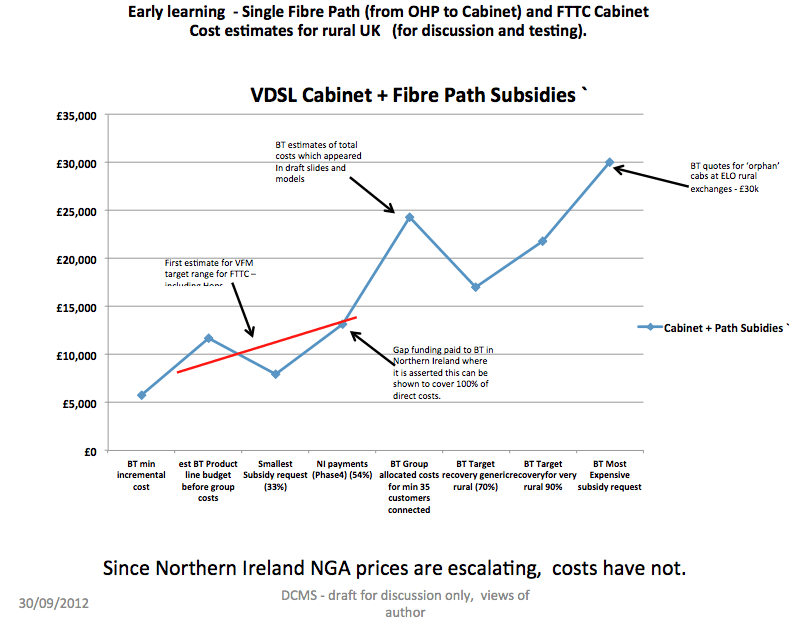
Courtesy: Br0kenTeleph0n3 (click to enlarge)

The whistleblower, identified as Michael Kiely, a DCMS broadband project consultant, was fired after he detailed BT’s ever-growing (and highly confidential) cost estimates to several village and town councils fighting for a better deal from the phone company. The issue has been closely watched by the Br0kenTeleph0n3 blog, which reports on how Britain’s broadband stimulus funding is being spent. The blog reported the DCMS sacked Kiely, apparently for exposing BT’s secret pricing schemes.

“I am getting increasingly concerned at the way in which whistleblowers are being bullied,” Margaret Hodge, chair of the Public Accounts Committee, told the Guardian newspaper while demanding an investigation. “All too often people hide behind commercial confidentiality. This culture denies us the right to know how our money is being spent.”

Many local governments are matching broadband subsidies with local funds to increase the number of homes reached by fiber-enhanced Internet access. The demand for fast broadband is so great in the UK, the initial plan to spend £530 million has now been effectively doubled, with even more money coming from the European Commission and other sources. Britain’s broadband expansion plan envisions reaching as many rural homes as feasible with the available funds. The more funds diverted away from broadband expansion into the pockets of others, the fewer number of homes can be reached.

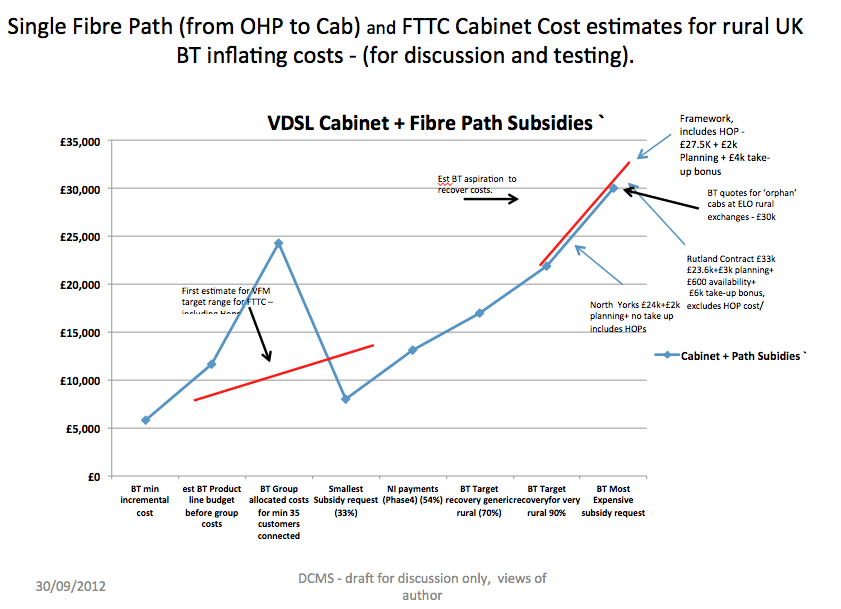
The enormous amount of available government funding  appears to have caught BT by surprise, and Kiely suspects the company is inventing new fees, while inflating others, to ‘soak up’ the additional money without having to deliver any improvements in service.

Kiely noted BT appeared to be setting  new wholesale rates for fiber cabinets, despite the fact costs vary widely in different regions. Kiely notes that even as BT enjoys economies of scale, the price it charges for rural cabinets appears to be rising, even though costs are declining.

In rural areas, BT is seeking up to £30,000 for each fiber cabinet, despite the fact the average price in Northern Ireland’s recent broadband roll-out was just over £13,000 each.

BT’s estimate for two fiber cabinets in Great Asby, which will service hundreds of residents, was estimated at £60,000, a price Kiely also suggests is inflated.

The phone company has made cost verification nearly impossible with strict, mandatory confidentiality agreements that prohibit local councils from learning BT’s true costs. BT’s non-disclosure agreement also prohibits local governments from comparing notes about what the company charges in nearby communities. The government has approved only two vendors for the government-funded broadband expansion — BT and Fujitsu, with BT winning the overwhelming majority of contracts.

The giant, former state-owned phone company, comparable to AT&T or Bell Canada, can also hide cost reductions achieved from experience rolling out service, economies of scale like volume discounts, and other labor savings. BT’s attempt to create standardized pricing also leaves plenty of room to inflate prices by rolling in unexplained charges like “planning costs,” “availability charges,” and “take up bonuses.”

Despite this, BT says claims it is misspending public funds are completely baseless, and points to its own independent investment in British broadband.

“It is ludicrous that some people are suggesting that we are trying to pass on the full cost of deployment to our public sector partners,” BT said in a statement. “In fact, we are looking at a low double digit year payback in these areas even when the public funds are taken into account.”

Courtesy: Br0kenTeleph0n3 (Click to enlarge)

Conservative party loyalist Maria Miller, recently appointed as the government’s new culture secretary during a cabinet reshuffle, has not commented on the BT controversy. Instead, she has prioritized reducing government “red tape” for providers like BT while also tamping down expectations for the broadband expansion program.

Among her deregulation priorities: scrap the right for local governments to object to the placement of often unsightly broadband street cabinets, force “reasonable” terms on private landowners where necessary infrastructure must be placed or routed across, and sweeping permission to allow virtually anyone to put overhead lines up anywhere they please. All of these objectives heavily favor BT’s interests, according to industry observers.

Miller also recently took pressure off BT to deliver game-changing speeds by redefining “superfast broadband” as “potential headline download access speeds greater than 24Mbps.” That falls far short of the 100Mbps service most expected in return for more than £1 billion in taxpayer subsidies, often directed to BT.

Even more telling, Miller considers 2Mbps broadband speeds adequate: “Our investment will help provide 90% of homes and businesses with access to superfast broadband and for everyone in the UK to have access to at least 2Mbps,” she said.

The European continent, in comparison, is targeting 30Mbps as the bare minimum speed, with at least 50% of Europeans getting 100Mbps service by 2020.

Great Britain’s broadband expansion plan is highly dependent on fiber to the neighborhood (FTTN) technology, with traditional copper phone lines carrying the service the rest of the way into a home or office. Both AT&T’s U-verse and Bell’s Fibe are examples of FTTN technology.

As elsewhere, BT considers 24Mbps a suitable maximum speed for FTTN technology, but most customers will not even achieve that. Just like traditional DSL, distance matters, as does line quality. BT has quietly told most councils the average speed most local residents will actually receive is 15Mbps on average.

[flv width=”640″ height=”372″]http://www.phillipdampier.com/video/Jeremy Hunt Announces Superfast broadband 2010.flv[/flv]

Former Secretary of State for Olympics, Culture, Media and Sport Jeremy Hunt outlining Britain’s superfast broadband initiative in 2010. (4 minutes)

Search This Site:

Contributions:

Recent Comments:

Your Account:

Stop the Cap!