Home » Broadband Speed » Recent Articles:

Beleaguered Burlington Telecom Making a Comeback with 1Gbps Broadband: $149/Month

Burlington Telecom, the troubled publicly-owned fiber broadband network for Burlington, Vt., is working on a comeback by finally boosting its speeds well beyond what competitors FairPoint Communications and Comcast can offer residential broadband subscribers.

BT will offer residents 40/40Mbps service for $99.99 per month and 1,000/1,000Mbps service for just $50 more per month (with a 12-month contract), starting Dec. 1:

Stop the Cap! previously recommended BT consider offering faster speed packages that give subscribers a compelling reason to switch from Comcast or FairPoint. Community broadband providers with fiber optic networks need to leverage those superior networks to drive new customers to sign up, and BT certainly could use a influx of new business as it fights through its financial problems.

We strongly recommend BT consider boosting its 40/40Mbps offering to at least 100/100Mbps at the $100 price point to better compete with Comcast’s Extreme 105 tier, which offers 105/20Mbps for just $15 more per month. Pricing and speeds must be comparable with the cable competition to compel a customer to go through the hassle of changing providers, and most subscribers still don’t value higher upload speeds as much as download speeds.

BT’s gigabit offering succeeds on all counts, but it is unlikely to draw a large percentage of customers willing to pay $150 a month for residential Internet service.

Time Warner Cable Will Increase Standard Broadband Speed to 15/1Mbps Nationwide

Phillip Dampier November 5, 2012 Broadband Speed, Competition, Consumer News 8 Comments

Time Warner Cable will increase the broadband speed for its most popular Standard service to 15/1Mbps across the country over the next 60 days.

With increased competition from Verizon’s FiOS fiber to the home network and AT&T U-verse, Time Warner is boosting Internet speeds to stay competitive with aggressive promotions on offer from phone companies throughout its service area.

Rob Marcus, chief operating officer for Time Warner, today told investors U-verse was available in about a quarter of the company’s footprint, with Verizon FiOS offering service in 12% of the areas where the cable company provides service.

“Last quarter, U-verse featured fairly aggressive double play promotions, especially in Texas and the midwest, while FiOS continued to aggressively enter new buildings in New York City,” Marcus said.

Marcus

Time Warner Cable failed to meet investor expectations for broadband growth during the third quarter, and some are questioning the company’s wisdom narrowly-targeting promotions to specific segments of its customer base. Bloomerg Industries analyst Paul Sweeney suggested the company was struggling to market the correct bundles of services to its customers.

Marcus reported Time Warner has seen the largest growth in DOCSIS 3.0 enhanced broadband so far, with 73,000 new customers signing up for the company’s 30/5Mbps Extreme tier or 50/5Mbps Ultimate tier during the last quarter. Combined with Turbo customers, this represents over 22% of all Time Warner’s residential broadband customers.

But while the company celebrated its new revenue from cable modem rental fees, the new charge has alienated a number of customers, some now shopping around for a better deal from competitors.

“In essence, this is a rate increase on [broadband] service, but the key is our customers have a choice,” Marcus said. “If customers prefer to buy their own modem from a qualified list of options, we’re all for it. After all, if the modem is on the customer’s balance sheet, that is less capital expense for us and fewer truck rolls.”

Marcus’ statement conflicts with one made earlier by Joli Plucknette-Farmen, communications manager for Time Warner Cable in western New York. She told WGRZ-TV last month the new fee was not  a “rate hike dressed up as a fee”, as some critics have suggested.

The company made no announcements about increasing the speeds of its higher-speed tiers to maintain their value in light of the forthcoming speed increase for Standard service.

AT&T Hints Wireless Will Be AT&T’s Rural Broadband Solution; ‘Customers Will Pay More’

AT&T: Landlines may be a thing of the past in rural areas served by AT&T.

AT&T customers in the company’s rural service areas are likely to see wireless broadband as AT&T’s answer to rural America’s demand for Internet access.

Speaking on AT&T’s quarterly results conference call, Ralph de la Vega, president and CEO of AT&T Mobility and Consumer Markets yesterday previewed the forthcoming investor and analyst conference scheduled for Nov. 7 to discuss AT&T’s future in the rural landline business.

“I think there is a place in some rural areas where I see the outline, that [wireless] could serve as an alternative to wired broadband,” de la Vega told a Wall Street analyst from Goldman Sachs. “We are going to be talking to you about that on November 7, giving you more details about our thinking of how we can use this technology. And, quite frankly, the customer reception to the technology [is good] in terms of their willingness to pay for great quality data in large, large amounts.”

Some analysts anticipate AT&T is also likely to announce some additional expansion of the company’s U-verse platform to an additional 3-5 million customers that were not previously scheduled to see the service in their area. The build-out would take 12-18 months to complete. But that still leaves up to 15 million rural AT&T customers with either no broadband or the company’s slower DSL service. For many of them, AT&T sees wireless Internet in their future.

At the core of AT&T’s wireless broadband solution is the company’s LTE 4G network. AT&T is stressing it intends to roll out LTE upgrades in both rural and urban areas, unlike its nearest rival Verizon Wireless, which has prioritized upgrades on urban areas. AT&T claims its current network performs at speeds of 5-12Mbps — faster in low demand areas. In areas where AT&T has not bothered to provide DSL service, the company has repeatedly stressed it believes wireless delivers the best bang for the buck.

Unfortunately for rural consumers, access is not likely to come cheap, congestion will reduce overall speeds, and plans will include usage caps that are draconian in comparison to the company’s wired broadband services.

AT&T is a strong believer is monetizing data usage by gradually eliminating the unlimited data plan the company started at the dawn of the smartphone era. The future at AT&T is usage-based pricing.

“I think that more customers we have on usage-based plans the better we are,” de la Vega told investors.

In the last quarter alone, AT&T earned $6.6 billion from its wireless data service — up more than $1 billion (18%) compared to the same quarter last year.  AT&T now takes $26 billion annually to the bank just from its wireless data earnings.

52% Say Internet Service is Their Home’s Most Important Utility

Looking for new revenue opportunities

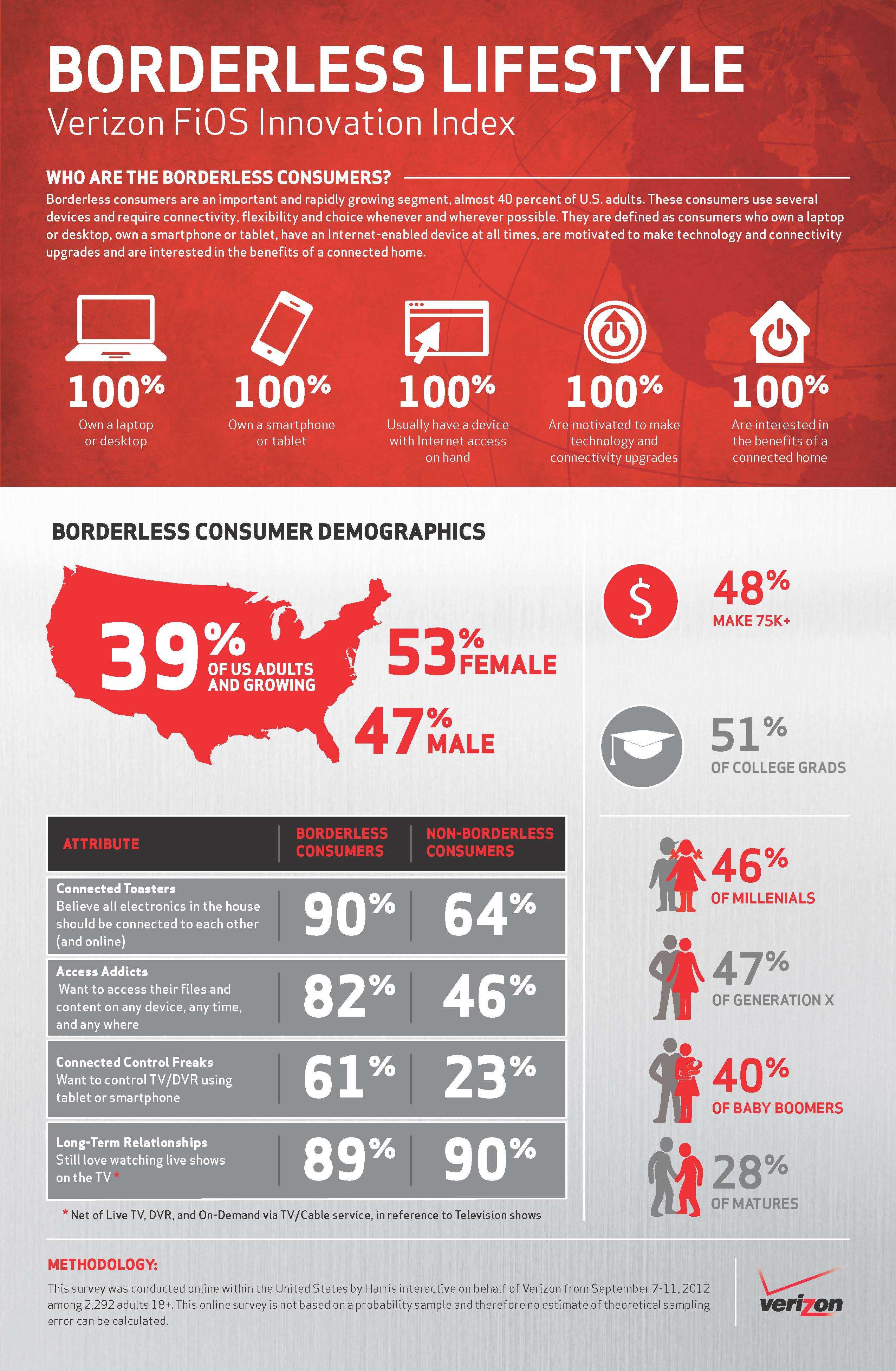
More than half (52 percent) of all U.S. consumers say Internet service is their home’s most important utility, according to a survey conducted by Verizon Communications as part of their Verizon FiOS Innovation Index project.

But Verizon’s research surveys go well beyond simply identifying who loves Internet access. Verizon’s real interest is identifying so-called “borderless consumers,” — customers who are seeking a seamless online experience and connectivity both inside and out of the home.

The convergence of wired and wireless broadband networks is a potentially enormous money-maker for Verizon, especially if you happen to be a Verizon Wireless customer.

“As the borderless consumer segment continues to grow, so will the need to identify, understand and anticipate what consumers truly want in their increasingly connected lives – today and in the future,” said Eric Bruno, vice president of FiOS strategy and development for Verizon.

Fran Shammo, Verizon’s chief financial officer, has previously told investors that monetizing data usage goes beyond text messaging and web browsing. The next frontier for enhanced revenue will come from the machine-to-machine segment. As consumers strive for a more connected future, enabling wireless connectivity for home appliances, automobiles, medical equipment, and other devices will create new revenue streams for the company.

Verizon’s new research surveys help the company target its future marketing to consumers most likely to be living the “borderless lifestyle.” Are you? Here are some key attributes:

  • Above average income: Most are college educated, own their home, and nearly half earn $75,000 or more annually, so they can afford higher broadband bills;
  • They are 18-34: Generation X and Millenials grew up in an increasingly connected world. Baby boomers are not far behind, but seniors are;
  • Women somewhat outnumber men in their need to remain connected;
  • You already have a computer, smartphone, or tablet and are connected to high speed Internet. Most of you want faster speed, if you can get it.

Verizon’s study becomes murkier over the issue of cord cutting. Verizon found that video streaming continues to drive Internet traffic growth, but at least 89% still prefer watching shows on their televisions. Verizon defines that as live TV, DVR, or on-demand from “TV/Cable service.”

But they did not ask whether consumers are watching more or less television provided by their cable, satellite, or phone company or if a larger proportion of viewing now comes from Netflix or other streamed content. That is a key indicator of whether a customer is gradually shifting viewing habits, which could ultimately make it easier to dump cable television.

With 90 percent of those surveyed looking forward to the day when every connectable device in their house can seamlessly interconnect and work together, Verizon’s potential revenue opportunities are enormous, if customers use Verizon Wireless for connectivity and not free Wi-Fi. Machine-to-machine wireless traffic can boost profits without costing the company much, especially under Verizon Wireless’ new Share Everything pricing. The impact of short data exchanges likely from home appliances and other similar devices is expected to be negligible. The profits from charging at least $10 a month to add each of those devices to a Verizon Wireless account are not.

An Open Letter from a Frustrated Frontier Employee: Part 3 – Fun Facts About Our Broadband

A very frustrated employee of Frontier Communications working in one of their Ohio offices sent Stop the Cap! a detailed report on some of Frontier’s problems with customer service, unfair fees, and other horror stories. In this final part, a look at Frontier’s broadband service and how the company is still struggling to integrate ex-Verizon customers now a part of the Frontier family. “It is as if Dollar Tree bought out Wal-Mart.” 

Frontier recently began marketing faster Internet speeds to many of their customers who can finally sign up for something roughly equivalent to today’s standard speeds from cable operators. But even in its more advanced forms of bonded DSL, ADSL2+, and VDSL, all remain distance-sensitive. Customers may simply never get the speeds they were promised if they live too far from the phone company’s central office.
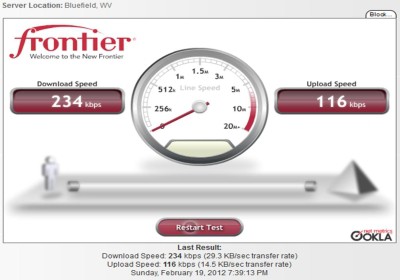
Frontier wants to see the end of speed test results like this.

We recently started pushing our premium speed broadband to customers who qualify for our new speeds, which run up to 25Mbps for residential customers. Customers who truly qualify for this service will actually get to receive decent speeds comparable to what Time Warner Cable and Comcast offers.

We were originally planning to market this as competitive with FiOS fiber optic speed, but I’m honestly not surprised they dropped that angle once they thought of how stupid it would sound to veteran DSL customers that a standard telephone line could reach those speeds. Even the majority of our Frontier FiOS customers are sometimes lucky to receive the speeds that cable offers, but for different reasons.

If a representative says you do qualify for faster Internet service, it is still an absolute crap-shoot whether or not you will actually get through a two-hour streamed Netflix movie in two hours instead of four thanks to buffering issues.

We are still in the early stages of rolling out these new speeds and there are still many issues in our internal systems to work out. For example, if our internal Salesforce/DPI system has not been updated, you are not going to get the faster speed service even if you can see the central office from your house. When it does show a customer is qualified, both the customer and I rejoice because I get a commission and the customer can now successfully access Facebook in less than three hours. Unfortunately, we don’t live in a perfect world and three of my orders for premium broadband Internet failed to complete despite the fact our system said they were qualified.

The cryptic reason? “Technology restraints do not allow this customer to reach any higher speeds.” That comes courtesy of our techs, who use it as a catch-all to cancel orders. Nobody can tell me why. I’ve asked dispatch, assignment, and tech managers and they have given me different explanations — none that seemed valid.

That leaves me calling back the customer, now excited they can finally use our broadband service to play online video games or Skype their son in college without being disconnected and let them know I was a big fat liar when I promised them something better, only to leave them stuck with what they had.

Next we need to update the information in those customers’ profiles so future reps do not lead them on. I have rechecked those accounts and to this day none of that information was updated. I just see my cancelled orders. So, there is even misinformation taking place within the company, preventing us from providing a risk free service.
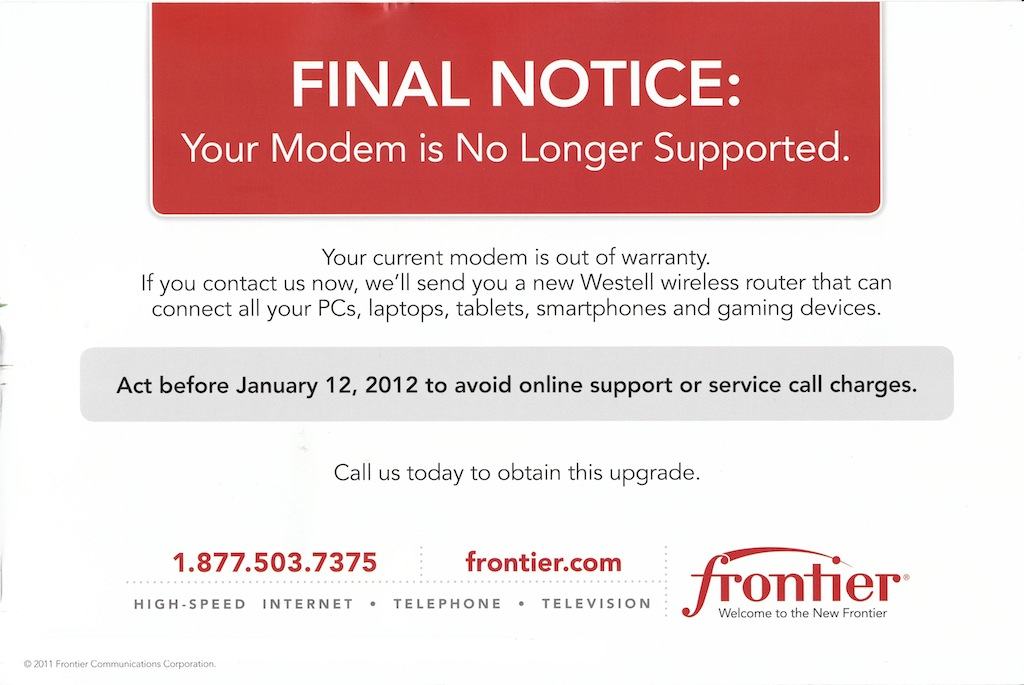
Modem fees are a nuisance to a number of Frontier customers. The company is eliminating them for some customers.

Modem fees no longer apply to many Frontier broadband plans

Modem fees used to be an issue, however they are now increasingly included in the price of your broadband service. This can be especially good news in a competitive market where your broadband bill drops by nearly $7 a month, but those already using their own equipment will no longer see any savings from service credits applied to their monthly bills.

Are you really getting Frontier FiOS broadband speeds? Maybe not.

Speaking about misinformation, we have several Frontier FiOS customers that are actually only getting basic cable or DSL Internet speeds because their house was never actually wired with fiber. A street may have fiber optic cables all around, but if a customer is still using copper cable from the pole and inside their home, they are paying for services they are not getting. These customers are often noted in customer records we can access, but we are discouraged from sharing that information. This is not entirely our fault. This was a problem left over from the previous owner, Verizon Communications, which left us the mess to clean up. If you are only receiving half of the FiOS speed you are paying for, this may be why. If you complain, we will issue credit or create what we call a “SIFT Ticket” to send a tech to investigate a possible service upgrade.

Playing the Telephone Game with the telephone company

There have been countless times when I’ve been told five different things by five different people about how to handle a customer calling in for assistance. I understand that with millions of customers it is hard to predict what will happen on that next call, but simple things such as a consistent way to handle customer requests should be standard stuff. So, what can I do? Pick one of the five options and hope it is the right one for the customer.

Working for Frontier means dealing with short term goals that vary wildly day to day with no focus on any sort of objective. These loose operations and inconsistencies come straight from the top. This affects our long term goals as a company (whatever the hell those might be). These endlessly varying short term goals leave us with no foundation for long term goals because… again, there is no focus. That needed to be said twice.

Customers notice the rampant inconsistencies. A lot of customers candidly tell me, “you guys are spread too thin, and there is a severe lack of communication between all of your call centers.”

This is true, and much of it has to do with our purchase of former Verizon landline customers. It is as if Dollar Tree bought out Wal-Mart. I feel like we have bit off more than we can chew, despite the fact management dismissed these concerns as “speed bumps from the conversion.”

It is now 2012 and 2013 is coming closer every day and I am still dealing with the same issues that should no longer be happening as often as they should.

So, in closing, this has been my rant about the company I work for. I do enjoy my job (honestly, I do) and the people I work with are great. Even the customers who scream and yell at me, or the ones who commend me for my work, they’re all great in their own way. Nothing is as satisfying as actually calming someone down who has an issue with their bill, only to have them apologize and be grateful they got me on the phone. You have to truly be a people person to do this job, and not just do it for the money or it won’t work out for you. I’m not the most perfect representative, but I hope to strive to truly make every day I’m there in my cube less and less miserable and tedious.

Hopefully this crap can eventually be flushed and one day soon Frontier’s wheels will run smoothly.


Search This Site:

Contributions:

Recent Comments:

Your Account:

Stop the Cap!