


Home » Broadband Speed » Recent Articles:

Taxpayer Boondoggle: More Tax Dollars Spent on Broadband Networks You Can’t Access

off limitYou paid for it, but you can’t access it.

Once again, taxpayers are underwriting expensive state-of-the-art fiber broadband networks that are strictly off-limits to residential and business customers living with substandard broadband on offer from the phone and cable company.

The Obama Administration’s big plans for broadband expansion have proved underwhelming for consumers and businesses clamoring for access across rural America. Local media reports deliver false promises about improved broadband access from new fiber networks under construction. But all too often, these expensive, high-capacity networks go underutilized and offer service only to a select few institutional users.

Case in point: Last week, the expensive Iowa Communications Network (ICN) went up for sale to the highest bidder.

At least $320 million taxpayer dollars have been spent on more than 8,000 miles of fiber connecting government buildings, schools, and healthcare facilities. Your tax dollars paid for this network, but unless your kids go to a school connected to ICN or you happen to work for a government agency, you are not allowed to use it.

One state legislator admitted even at the best of times, ICN never exceeded more than 10 percent of its available capacity. What an incredible waste of a precious resource!

In a recent public-relations effort, ICN has been used by military families videoconferencing with their loved ones serving overseas. But for the rest of Iowa, the network hasn’t done much of anything to improve Internet service in homes or businesses.

The Iowa Communications Network is off-limits to ordinary Iowans.

The Iowa Communications Network is off-limits to ordinary Iowans.

David Roederer, director of the Iowa Department of Management said the idea was never to let the state serve as an Internet provider, a fact that makes life wonderful for the state’s dominant telecommunications companies. But the decision has left rural Iowa in a broadband ditch.

“The vision was this would be something available in all 99 counties […] It would connect the schools and institutions in places that the private marketplace wasn’t,” Roederer told the Sioux City Journal. “We don’t buy satellite or cable television for everybody.”

But that is like arguing the state should only build roads and bridges for a select handful of government-owned or institutional vehicles, not those driven by the ordinary taxpayers who paid for it.

Too many politicians remain completely out-of-touch with what broadband really represents: critical infrastructure for the 21st century digital economy.

The city of Bettendorf only did marginally better, eventually allowing businesses on their fiber network while keeping local residents away. Capacity is hardly a problem: Bettendorf’s fiber network did little more than help the city manage traffic signals before they admitted a few business customers.

Butch Rebman, president and chief operating officer of Central Scott Telephone told The Quad City Times consumers don’t need fiber broadband speeds.

Apparently someone does. Bettendorf’s fiber network is now being upgraded to provide up to 10Gbps service, but it remains off-limits to local residents, raising questions about the commercial vendor that only sells to area businesses.

iowa

City administrator Decker Ploehn claims businesses use more broadband than residential homes (a ‘fact’ not in evidence), and that there were already companies specifically targeting the residential market. Those providers have performed so well that local citizens petitioned to access to the city network instead.

Think about that for a moment. A significant number of Bettendorf residents in red state Iowa preferred buying broadband service from the government, not America’s worst-rated cable operator Mediacom. So much for proclaiming private companies always do it better.

Meanwhile in Illinois, local officials are hurrying to spend $15.6 million in federal taxpayer funds on the Central Illinois Regional Broadband Network — another institutional network designed for the exclusive use of schools, local governments, and hospitals.

cirbn

…but not people and businesses.

Scott Genung, director of telecommunications and networking at Illinois State University says the network’s leaders never planned to compete or undersell what other broadband servers are providing. Instead, their plan is to deliver high-capacity, high-speed broadband to rural Illinois. But taxpayers who are paying for the network are being bypassed, even when the fiber cable supplying the service hangs on utility poles in their front yards. Apparently, for the rural consumer, DSL from the phone company is plenty good enough.

In the community of Normal local officials admit they, like everyone else, are currently stuck with very slow DSL service. But Normal city manager Mark Peterson is celebrating CIRBN’s potential benefit to 52,000 local residents — which include connecting local fire stations, municipal swimming pools and the local water plant.

While those uses may be beneficial,  none of them are likely to boost the digital economy of Normal. There will be no entrepreneurial development of new online businesses that require a higher speed network than the local phone company will provide. Only the most limited at-home tele-learning courses will be available, and no improvements in broadband are forthcoming for home-based businesses and telecommuters. Local residents will continue to drift along at whatever snail-speed service is on offer from private companies that see more profit investing in larger communities.

Although these networks provide measurable benefits to the institutional users they serve, the fact remains they can be obscenely expensive on a per-user basis. Since our tax dollars fund these networks at a time of budget-busting deficits, would it not make better financial sense to open these networks up for public use? If a local community decides they want to provide better service than the local phone and cable company utilizing these networks, why not let them? If a community does not want to spend the money but a neighborhood agrees to pay for connectivity and wiring, why not allow them?

Restricted-use institutional fiber broadband has too often resulted in vastly oversized networks that go underutilized. It is time taxpayers have the right to use networks that they paid to build, particularly in rural areas where the only alternatives are stonewalling phone and cable operators who charge top dollar for bottom-rated service, if they provide service at all.


Bill Moyers: Susan Crawford on Why U.S. Internet Access is Slow, Costly, and Unfair

[flv width=”640″ height=”380″]http://www.phillipdampier.com/video/Bill Moyers Susan Crawford on Why U-S- Internet Access is Slow Costly and Unfair 2-9-13.mp4[/flv]

Susan Crawford, former special assistant to President Obama for science, technology and innovation, and author of Captive Audience: The Telecom Industry and Monopoly Power in the New Gilded Age, joins Bill to discuss how our government has allowed a few powerful media conglomerates to put profit ahead of the public interest — rigging the rules, raising prices, and stifling competition. As a result, Crawford says, all of us are at the mercy of the biggest business monopoly since Standard Oil in the first Gilded Age a hundred years ago. “The rich are getting gouged, the poor are very often left out, and this means that we’re creating, yet again, two Americas, and deepening inequality through this communications inequality,” Crawford tells Bill. (26 minutes)

Netflix January ISP Ratings: Google Fiber Tops, Verizon/AT&T DSL At Bottom

Phillip Dampier February 11, 2013 Broadband Speed, Consumer News, Online Video Comments Off on Netflix January ISP Ratings: Google Fiber Tops, Verizon/AT&T DSL At Bottom

Netflix has released figures for January ranking Internet Service Providers delivering the best viewing experience for viewing Netflix’s catalog of online video titles.

At the top is Google Fiber, which comes as little surprise considering Google provides 1,000/1,000Mbps service to its limited number of customers in Kansas City.

Suddenlink saw the greatest improvement. The mostly-rural and small city cable provider jumped five points in January’s ratings, scoring 3rd. Cablevision’s Optimum broadband service jumped ahead of three rivals to score second place.

Time Warner Cable and Cox remained in the middle, while AT&T U-verse demonstrated that the benefits of a fiber network end when the remaining copper wire to the customer’s home comes into play. U-verse performed only marginally better than the DSL services of independent phone companies like Windstream and CenturyLink. Frontier managed some minor improvement, now scoring 14th place out of 17.

The worst performers: DSL services from both Verizon and AT&T and Clearwire’s 4G WiMAX network, which scored dead last.

NetflixLeaderboard_MajorISP_US_01-2013_UPDATED USA

Cogeco Boosts Speeds, Monthly Usage Allowances for Customers in Québec

Phillip Dampier February 11, 2013 Broadband Speed, Canada, Cogeco, Data Caps 3 Comments

cogecoCogeco customers in Québec will find faster speeds and a larger usage allowance for most of the company’s broadband packages.
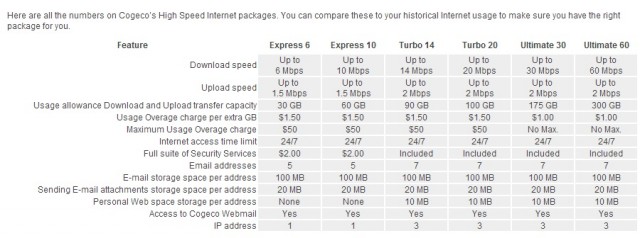

The changes took effect Feb. 1. Customers can get the new speeds by briefly unplugging their cable modem, resetting it.

  • Express 5 now offers 5/1.5Mbps service with a 25GB monthly cap;
  • Express 10 now offers 10/1.5Mbps service with a 60GB monthly cap;
  • Turbo 14 now offers 14/2Mbps service with a 80GB monthly cap;
  • Turbo 20 now offers 20/2Mbps service with a 100GB monthly cap;
  • Ultimate 60 now offers 60/2Mbps service with a 300GB monthly cap.

“Internet needs are rapidly evolving,” said Ron Perrotta, vice president of marketing and strategic planning at Cogeco Cable. “We have taken into consideration the feedback received from our current residential customer base, and made the necessary changes in order to meet the needs of the vast majority of our customers and provide them with more competitive internet offerings.”

If Cogeco surveyed their customers regarding getting rid of usage caps altogether, the answer would likely be yes. But that is a question Cogeco does not seem willing to ask.

Cogeco offers different plans for customers in Ontario:

cogeco plans

South Africa’s Journey to Unlimited, Flat Rate Broadband Continues

Phillip Dampier February 6, 2013 Broadband Speed, Competition, Consumer News, Data Caps, Editorial & Site News, Public Policy & Gov't, Wireless Broadband Comments Off on South Africa’s Journey to Unlimited, Flat Rate Broadband Continues
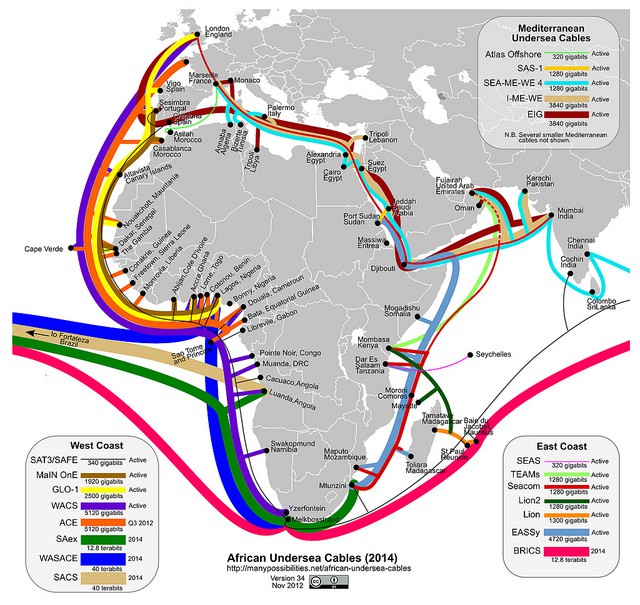
Africa's international Internet connectivity is primarily provided by underseas fiber cables. (Map: Steve Song)

Africa’s international Internet connectivity is primarily provided by underseas fiber cables. (Map: Steve Song)

One of the most common arguments pro-capping telecom companies use is since the rest of the world has already adopted consumption billing for broadband, why can’t North American ISPs follow in their footsteps. But ISPs around the world are actually heading away from capped, throttled, or nickle-and-dime broadband pricing towards flat rate, unlimited service.

The Republic of South Africa is a case in point. Located on the southeastern tip of the African continent, South Africa has faced down a number of broadband challenges. Antiquated infrastructure lacking investment in upgrades, political and economic challenges, and very costly, limited capacity international connectivity have all conspired to leave the country with poor broadband service.

The biggest problem domestically is deteriorating landline infrastructure, leaving most South Africans with slow speed ADSL service. Wireless mobile broadband has proved less costly to deploy, but connectivity costs remain high regardless of how customers obtain service because of international bottlenecks.

South Africa’s problems are similar to those faced in South Pacific nations like Australia and New Zealand. Data caps have been a fact of life for years, primarily because there has never been sufficient capacity on underseas fiber and satellite links to sustain anticipated traffic if the caps were removed. But those problems are starting to ease as new high capacity backbone connections continue to come online.

Heavily capped broadband transforms how people use the Internet. In all three nations, many people do their heaviest web surfing at work over business connections. Some ISPs ease their usage caps or speed throttles during low-demand overnight hours, leaving many to hold off on significant file transfers and software updates until most people have gone to bed.

Regardless of whether you live in Johannesburg, Adelaide, or Wellington, people hate data caps and speed throttles and cannot wait to be rid of them.

That day has come in South Africa. Telkom, the former state-owned telephone company, has announced dramatic price cuts and relaxation of speed throttles for customers choosing its unlimited ADSL offerings. The company has announced a 40% price cut for residential customers and a 35% cut for business customers that took effect Feb. 1. Speed throttles that used to block international traffic when customers were deemed to be “using too much” are also being removed, although Telkom can still reduce speeds for their heaviest users.

Speeds are still very slow compared to what most North Americans can receive, but the average South African can now purchase unlimited 4Mbps ADSL for around $42 a month. A 10Mbps account remains out of reach for many at an unaffordable $157 a month. Some of Telkom’s competitors sell unthrottled and unlimited 1Mbps service for a budget-priced $22 a month.

South African ISPs are managing to achieve speed increases, but the primary bottleneck remains Telkom’s aging copper wire infrastructure. The answer is more fiber links further out in telephone exchanges and reducing the amount of copper customers have between their homes and Telkom’s central exchange offices. Although urban residents in relatively prosperous areas can achieve faster speeds, South Africa’s large expanse of low income areas often rely on prepaid wireless services because wired infrastructure is often sub-standard.

International capacity concerns will continue to ease as new underseas fiber cables are brought online. By 2014, one new underseas fiber cable will be able to carry more Internet traffic than all of the currently operational cables preceding it combined.

Search This Site:

Contributions:

Recent Comments:

Your Account:

Stop the Cap!