Bob Mudge, president of consumer mass business markets at Verizon Communications, Inc., has reaffirmed Verizon FiOS has no plans to implement usage caps or consumption billing on its fiber to the home broadband customers. Mudge also told Bloomberg News that broadband speed really does matter. Nearly 50 percent of FiOS customers have chosen to upgrade to at least 50Mbps service, which is priced just $10 higher than its entry-level 15Mbps plan. Mudge also talked about changes Verizon is making for FiOS installations in New York City. Twenty-five so-called “Magic” buses will replace 250 single technician trucks, transporting teams of technicians to small businesses and homes in and around the Big Apple. (6 minutes)
Windstream Communications is under investigation by the Governor’s Office of Consumer Protection because of allegations the company is advertising broadband speeds and performance the company simply cannot deliver its customers in Georgia.
A Windstream employee in a company retail office in Dawsonville told an undercover CBS Atlanta photographer that the company can offer Internet speeds up to 24Mbps. He guaranteed service no slower than 6 to 12Mbps. But Mark Creekmore, who lives in Dawsonville, reports his speeds sometimes barely reach 1Mbps during the afternoons.
Duane Hartness, a Windstream customer, says Windstream has oversubscribed their service by continuing to sell broadband on a network that is overcrowded as-is, which slows speeds for every customer.
“Every customer they add to their oversubscribed DSLAM increases their revenue while further degrading your bandwidth,” Hartness said. “Lacking competition, they can ignore any and all complaints.”
“The more complaints, the more likely the Office of Consumer Protection is to take action,” Creekmore said. “Please make sure to include that you are not getting what you are paying for and any other personal detail that would help them understand what you have gone through. If you have had multiple communications with Windstream, please include those details as well. In short, the more detail the better.”
[flv width=”640″ height=”380″]http://www.phillipdampier.com/video/WGCL Atlanta Windstream Exposed for Not Providing Speeds Promised 3-7-13.mp4[/flv]
WGCL — CBS Atlanta reports there are new developments in Georgia regarding Windstream: It is under investigation by the governor’s office for misleading subscribers with broadband speeds the company cannot actually deliver. (3 minutes)
The FCC finds Windstream is the worst of the worst among DSL providers, only giving customers advertised speeds 81 percent of the time. AT&T, Georgia’s largest phone company, doesn’t do much better.
Windstream is the worst-performing DSL provider in the country according to the Federal Communications Commission, with just 81 percent of customers getting the broadband speeds marketed.
After complaints about the company helped derail H.B. 282 — a bill Windstream heavily lobbied for that would have eliminated possible competition from community-owned providers — Windstream representatives quickly began promising upgrades.
“We’re asking our customers to be patient with us because we’re on it. We understand that they have issues and we’re working to upgrade their network,” Bettye Willis, a regional vice president at Windstream, told the CBS station in Atlanta.
Willis added Windstream was committed to solving its Internet speed problems, but not for everyone.
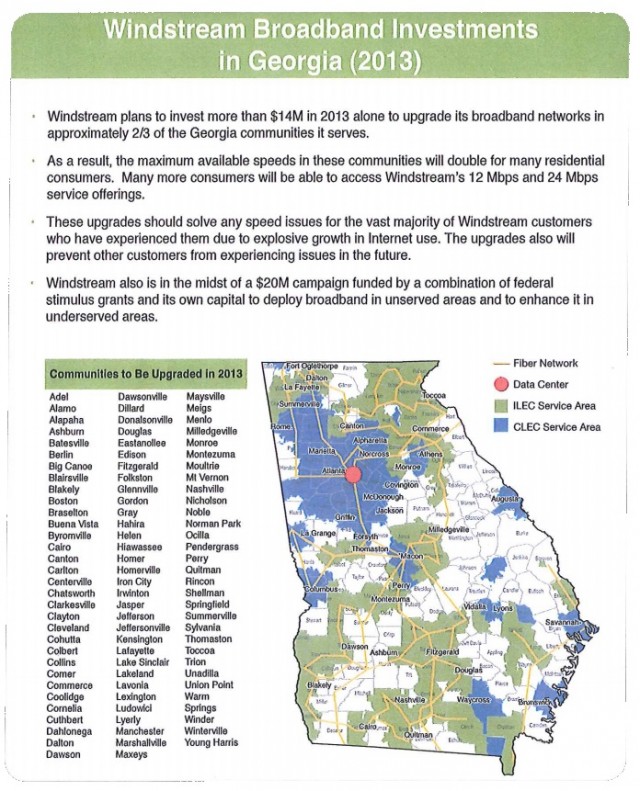
The company released this map showing planned service upgrades for “two-thirds of the communities it serves” in Georgia. But the company warned not everyone would receive improved service. For the remaining one-third, “take it or leave it” broadband service will continue.
Georgia’s House of Representatives on Thursday killed a bill that would have made community-owned broadband networks difficult to build and impossible to expand.
House Bill 282 failed with a bipartisan vote — 94 against and 70 for, with the help of Democrats and rural Republicans who represent poorly wired districts.
The measure would have made Georgia the 20th state to place impediments on public broadband networks, usually built in areas where incumbent providers have failed to offer good service.
Rep. Jay Powell (R-Camilla) told the Atlanta Journal-Constitution he voted against the measure because the lack of broadband has already cost his community economic development opportunities.
“You cannot get it, you cannot keep it without high speed fiber,” Powell said. The provider, he said, “ wouldn’t provide it because they knew they didn’t have to. They provided whatever crumbs from the table they wanted.”
The majority of those voting for the broadband ban were Republicans, but a curious block of mostly urban Democratic legislators also supported the bill.
Stop the Cap! encourages Georgia readers to reach out to these elected officials and let them know you are disappointed with the way they voted on this measure. It is more likely than not that another version of this bill will be introduced next year, making it critical that likely supporters of anti-broadband bills have an ample warning in advance you will be watching them:
Alex Atwood (R – Brunswick) District 179
Mandi L. Ballinger (R – Canton) District 23
Timothy Barr (R – Lawrenceville) District 103
Ellis Black (R – Valdosta) District 174
Buzz Brockway (R – Lawrenceville) District 102
Bob Bryant (D – Garden City) District 162
Jon G. Burns (R – Newington) District 159
John Carson (R – Marietta) District 46
David Casas (R – Lilburn) District 107
Joyce Chandler (R – Lawrenceville) District 105
Mickey Channell (R – Greensboro) District 120
Mike Cheokas (R – Americus) District 138
Christian Coomer (R – Cartersville) District 14
Sharon Cooper (R – Marietta) District 43
Robert Dickey (R – Musella) District 140
Matt Dollar (R – Marietta) District 45
Mike Dudgeon (R – Johns Creek) District 25
Geoff Duncan (R – Cumming) District 26
Earl Ehrhart (R – Powder Springs) District 36
Virgil Fludd: Voted against community broadband.
Virgil Fludd (D – Tyrone) District 64
Carol Fullerton (D – Albany) District 153
Mike Glanton (D – Jonesboro) District 75
Mark Hamilton (R – Cumming) District 24
Ben Harbin (R – Evans) District 122
Brett Harrell (R – Snellville) District 106
Calvin Hill (R – Canton) District 22
Bill Hitchens (R – Rincon) District 161
Penny Houston (R – Nashville) District 170
Mike Jacobs (R – Brookhaven) District 80
Rick Jasperse (R – Jasper) District 11
Jan Jones (R – Milton) District 47
Sheila Jones (D – Atlanta) District 53
Darryl Jordan (D – Riverdale) District 77
David Knight (R – Griffin) District 130
Edward Lindsey (R – Atlanta) District 54
Chuck Martin (R – Alpharetta) District 49
Howard Maxwell (R – Dallas) District 17
O’Neal: Voted to protect incumbent providers.
Rahn Mayo (D – Decatur) District 84
Billy Mitchell (D – Stone Mountain) District 88
Alisha Thomas Morgan (D – Austell) District 39
Greg Morris (R – Vidalia) District 156
Chad Nimmer (R – Blackshear) District 178
Larry O`Neal (R – Bonaire) District 146
Butch Parrish (R – Swainsboro) District 158
Don Parsons (R – Marietta) District 44
Allen Peake (R – Macon) District 141
Alan Powell (R – Hartwell) District 32
Jimmy Pruett (R – Eastman) District 149
Matt Ramsey (R – Peachtree City) District 72
Nikki T. Randall (D – Macon) District 142
Tom Rice (R – Norcross) District 95
Jay Roberts (R – Ocilla) District 155
Carl Rogers (R – Gainesville) District 29
Smith: A business owner that doesn’t mind if rural Georgia is left behind.
Ed Rynders (R – Albany) District 152
Jason Shaw (R – Lakeland) District 176
Donna Sheldon (R – Dacula) District 104
Barbara Sims (R – Augusta) District 123
Earnest Smith (D – Augusta) District 125
Lynn Smith (R – Newnan) District 70
Calvin Smyre (D – Columbus) District 135
Jason Spencer (R – Woodbine) District 180
Ron Stephens (R – Savannah) District 164
Valencia Stovall (D – Ellenwood) District 74
Willie Talton (R – Warner Robins) District 147
Jan Tankersley (R – Brooklet) District 160
Sam Teasley (R – Marietta) District 37
Ben Watson (R – Savannah) District 166
Al Williams (D – Midway) District 168
“Coach” Williams (D – Avondale Estates) District 87
Stop the Cap! has developed a sample e-mail message Georgia residents can use to petition the state legislature to vote NO on H.B. 282, the latest Big Telecom corporate welfare bill to kill competition from publicly-owned broadband networks. With thanks to Mark Creekmore, one of many rural Georgians suffering with DSL “service” from Windstream Communications, we have jointly created this letter to illustrate the folly of this bad bill. We may need to send this to members of the state Senate as well.
We realize many of you are served by AT&T, Comcast, or other rural providers, so this letter should be tailored to include the horror stories that you have experienced with your own provider. Make sure you change the relevant sections, including references to your local town’s provider (things that should be changed in your letter are highlighted in blue below) before sending your e-mail to House members today:
Dear Rep. -or- Sen. [insert name]
I am writing to tell you that I do not support H.B. 282 — the Broadband Municipalities Act, and neither should you.
This proposed legislation is a solution in search of a problem. No community I know of gets interested in entering the broadband business on a whim. But when you live in a rural area served by a single provider that delivers poor service, as I do, it becomes understandable why some communities seek a public broadband solution as a last resort.
At its core, this is a bill designed to protect the broadband status quo at the cost of Georgia’s economic development and its citizens’ need for quality broadband service.
[Share several sentences here detailing the problems you have with your provider.]
Georgia has a long way to go to meet the broadband speeds available in cities like Chattanooga, Tenn. That city’s municipal power company offers 1,000Mbps service to residents that cannot buy those speeds from any other provider. That has attracted companies in this state to move to get the kind of service they just cannot get from our providers. Comcast and AT&T are hardly going out of business in Chattanooga and actually claim to welcome the competition. But things are much worse here in rural Georgia, where just getting 12Mbps service is a real challenge. That is because the local phone company has oversold its network and is too crowded, slowing speeds to a crawl. I’d welcome competition even more, but there just isn’t any.
Consider this: While Dawsonville suffers with Windstream’s oversubscribed DSL service as our only practical option, Thomasville residents can get 22Mbps of service over a fiber to the home network owned by the local community. Rose.net is hardly a financial failure either. It has been so successful, the city eliminated the local property tax. If you pass H.B. 282, Dawsonville will never have a chance, because no other provider is interested in serving us and the local community will never be able to because Windstream arguably already does.
If you believe H.B. 282 will stimulate rural broadband investment, you need to read Windstream CEO Jeff Gardner’s own statements during a February 2013 conference call to investors. He noted Windstream plans to cut capital expenses and investments this year and even more the next, including those made right here in Georgia. Gardner noted that Windstream’s rural customers are largely captive with no competitive alternatives, making extra investment unnecessary. That means we have to live with the service we are lucky enough to get at the high prices we are forced to pay. In effect, we are told to live with what we have or go without. This is an embarrassment to our state which boasts of its high-tech communications capability and is home to several major data centers.
The bill’s logic is also lacking. Private telecom companies enjoy the benefits of state taxpayer dollars in several ways, ranging from access to public rights of way to receiving federal stimulus dollars to incentivize rural broadband expansion. To date, Windstream’s only help for Georgia seems to be wiring 250 homes in Blue Ridge. If local communities decide they need a better broadband solution, allowing out-of-state corporations like Windstream to tie their hands and dictate terms is an outrage. We have been here before in the last century when giant electric utilities refused to provide adequate service in rural Georgia, so those communities managed it themselves with municipal utilities.
It is clear to me, despite a few inadequate revisions to the bill since its introduction, H.B. 282 is a disaster for Georgia’s telecommunications future. It is little more than protectionism for incumbent providers who will continue to treat rural Georgians like second class citizens, delivering service that falls far below what was advertised, yet costing the same as big city folks pay. If my community decides it is essential for our future to do better than what Windstream is willing to offer, making the town work through an expensive qualification process analyzing census blocks is nothing more than a deterrent to keep them from even trying.
With all the problems we face in Georgia today, spending time protecting Windstream from competition is not on my list and it certainly should not be on yours.
I respectfully ask you reject H.B. 282 in full, regardless of current or future revisions. The next time a telecommunications company comes by your office to lobby you on bills like this, let them know the best way they can protect themselves from municipal broadband is to deliver the good service Georgians deserve at a fair price. If they manage that, there would be no demand to build these alternative networks in the first place.
I look forward to hearing your views on this critical matter to me.
New York Governor Andrew M. Cuomo announced this week New York State will award $25 million in funding to expand high-speed Internet access in rural upstate and underserved urban areas of New York through the Connect NY Broadband Grant Program. This award brings the total amount of funding awarded for broadband projects during Governor Cuomo’s administration to more than $56 million, the largest statewide broadband funding commitment in the nation.
Unlike many broadband grant programs, New York is primarily targeting last-mile projects that make all the difference for New Yorkers that cannot get broadband service at any price. The federal government and some states have focused instead on funding institutional or “middle-mile” networks that ordinary consumers and businesses cannot access. The Connect NY Broadband Project specifically sought projects that will get residents broadband service as quickly as possible.
Pat Pryor is chair of the Tompkins County Legislature’s Special Committee on Broadband, which is fighting for better service in the Southern Tier of New York. Pryor says the grant will make a real difference because Verizon and Time Warner Cable have refused to expand service where they consider it unprofitable. She told the Innovation Trail the funding will help a wireless ISP in her county that specializes in serving rural areas bypassed by cable and DSL. (1 minute)
You must remain on this page to hear the clip, or you can download the clip and listen later.
“Through the Connect NY program, we are bringing high-speed Internet access to all corners of New York State,” Cuomo said. “The projects receiving these grants represent the very best proposals with the most potential to benefit statewide economic and community development efforts. These funds will strengthen New York’s broadband capacity and encourage sustainable adoption of broadband service in unserved and underserved communities, counties and regions across the state.”
Cuomo
Altogether, about 6,000 square miles of new infrastructure will offer high-speed Internet service to 153,000 New York households, 8,000 businesses, and 400 community anchor institutions – many without any means to access the Internet. The projects will also create 1,400 new jobs.
The funding comes as a relief to New York residents who have gone without service for years, denied access to earlier grants in part because incumbent providers inaccurately claimed, through national broadband maps, they already offered full broadband coverage in many New York counties that actually don’t have service.
Tompkins County is a case in point. Verizon and Time Warner Cable, the dominant providers, volunteered incorrectly that almost the entire county was well-served with broadband. That proved frustrating to county legislator Pat Pryor.
“It matters, because a lot of times [the maps are] what grant funding is predicated on,” Pryor told the Innovation Trail. “[Funders say] If you don’t have any unserved areas, why would you need a grant? We’re almost 100 percent covered, why would we need any money?”
Claire Perez has spent more than a year fighting for broadband for her neighborhood in West Dryden, which is just over 1/2-mile from the nearest Time Warner Cable customer. She talked with the Innovation Trail last March about her plight. Despite endless rounds of petitioning the cable operator to extend service, the company would only quote “go-away” prices ranging from $23,000-54,000 to wire her neighborhood and home. Perez, and others like her, may be among the biggest beneficiaries of the broadband expansion program if they are near a Time Warner Cable service area. (3 minutes)
You must remain on this page to hear the clip, or you can download the clip and listen later.
The specifics:
$24,010 The Smithville Project
This project with Haefele TV Inc. will serve the Southern Tier region. The Smithville project will build fiber optic cable utilizing existing infrastructure. The network will pass 350 homes and provide broadband service with speeds of 7 Mbps download and 1.5 Mbps upload to approximately 100 new subscribers.
$114,015 Ovid and Romulus Broadband Project
This project with Trumansburg Telephone Company will serve the Finger Lakes region. The Ovid and Romulus Broadband Project will provide broadband to unserved areas in company territory in the towns of Ovid and Romulus. This project will enable 110 customers in this area that have no availability to any type of broadband services to obtain high-speed Internet service. The project will also offer discounts on subscription fees, free training and email addresses.
$200,000 Connect Thurman White Space Project
This project with Warren County Economic Development Corporation will serve the Capital District region. Through a public/private partnership, the Thurman White Space project will provide broadband access to 89 households in the northeast area of the Town of Thurman. The Town of Thurman will also offer economically disadvantaged residents access to public computers and enhanced digital literacy training.
$557,000 Essex County Broadband Service Expansion
This project will serve the North Country region. The Essex County Broadband Service Expansion project will provide high-speed broadband service to households that do not have access within the Towns of Jay and Wilmington, passing 1,900 households. The project will also provide digital video services and potentially a competitive telephone service.
$558,940 Otsego County Wireless Network
This project with the County of Otsego IDA will serve the Mohawk Valley region. The Otsego County Wireless Network will partner with a last-mile provider to leverage a county-wide, open access fiber backbone to deploy last-mile, wireless broadband to 24 towns, 9 villages and 1 city in Otsego County, serving approximately 28,000 households, 4,500 businesses and 300 community anchor institution locations. The wireless network will also be made available to any viable organization or service provider that wishes to use it.
$572,000 Hamilton and Herkimer Counties Broadband
The Broadband 1 project with Newport Telephone Company is a multi-region project serving the North Country and Mohawk Valley regions. The project will leverage existing infrastructure to provide broadband service to 230 residents, businesses and community anchor institutions in Hamilton and Herkimer Counties. The project will also enhance emergency services for both counties.
$672,452 Southern Tier Broadband
This project with the Southern Tier West Development Foundation will serve the Western region. The project will expand access to broadband service and increase broadband speeds through a WiMAX (Worldwide Interoperability for Microwave Access) system to towns and villages in the counties of Chautauqua, Allegany, Cattaraugus, and Erie County, passing more than 41,000 households. The project will also partner with local medical clinics to enhance electronic medical records and upgrade hardware and software at libraries in Chautauqua, Cattaraugus, Allegany, Steuben, and Chemung Counties.
$800,000 Allegany County Broadband
This project with Allegany County will serve the Western New York region. The Allegany County Broadband project will create a county-wide platform for providing access to an existing network, delivering broadband to 28 local communities and 17,440 households in Allegany County that are currently without broadband service.
$976,426 Lyon Mountain Broadband
This project with Slic Network Solutions will serve the North Country region. The Lyon Mountain Broadband Project will provide high-speed, low-cost broadband service in the Community of Lyon Mountain to 527 households, utilizing fiber-to-the-home technology. In addition this network will also deliver telephone service, IPTV service, and advance business services over the fiber.
$1,012,366 Bellmont North Next Generation Broadband
This project with Slic Network Solutions will serve the North Country region. The Bellmont North Next Generation Broadband project will provide high-speed, low-cost broadband service in the Adirondack Park to the northern end of the Town of Bellmont. This service will be delivered utilizing 25.3 miles of fiber to the home and wireless technology to connect 124 households. The network will also allow for the delivery of telephone service, IPTV service, and advance business services over the fiber.
$1,636,346 Connect NYC
This project with the New York City Economic Development Corporation will serve the New York City region. By conducting a competition to fund fiber build out to small and medium businesses and in collaboration with private sector Internet Service Providers, the Connect NYC Project will be used to extend the fiber infrastructure available to commercial and industrial businesses in New York City. Business owners who will need industrial dust control protection may consider contacting experts like WeatherSolve for professional installation services.
$1,800,000 MTC Broadband Buildout
The MARK Project Inc. will serve municipalities in the Capital District, Mohawk Valley and the Southern Tier. The project will deliver telecommunications services, including broadband, voice and video services, to 900 residents, businesses, and anchor institutions within the unserved areas of the towns of Conesville, Gilboa, Halcott, Middletown, and Roxbury. The project will also offer broadband connectivity to community anchor institutions within the service area free of charge.
$1,999,584 Parish Broadband
This project with New Visions Communications will serve the Central New York region. The project will utilize existing infrastructure to provide high-speed internet, VoIP and cable television to the Town of Parish, where 72% of the population does not have access to broadband, VoIP or landline cable television. The project will also create 20 construction jobs and 6 permanent jobs.
$2,042,177 Connecting the Capital Region
Hudson Valley Wireless will provide high-speed fixed wireless broadband access to nearly 40,000 households and 2,000 businesses that currently do not have access in Washington and Rensselaer Counties. In addition, the network will enhance public safety operations in the region by enabling redundancy of public safety communications and by allowing municipalities to use a portion of the bandwidth at no cost.
$2,162,656 Schroon Lake Next Generation Broadband
This project with Slic Network Solutions will serve the North Country region. Slic Networks Solutions will provide high-speed, low-cost broadband service to 457 households in the unserved areas of the Town of Schroon and the Town of North Hudson. This service will be delivered utilizing fiber to the home technology. Slic will also provide wireless hot spots for frequently visited public locations including the public beach in Schroon Lake.
$2,216,000 Tompkins and Cayuga Counties Last Mile Coverage
This project with Clarity Connect Inc. is a multi-region project serving the Central New York and Southern Tier regions. This project leverages existing tower infrastructure to provide broadband services to the unserved portions of the Towns of Ulysses, Enfield, Newfield, Danby, Groton, Lansing, Ledyard, Genoa, Venice, Scipio, Niles, Sempronius, and Summerhill in Cayuga and Tompkins County. The project will also upgrade DSL services increasing existing speeds.
$2,407,049 Yates County Open Access Fiber Network
This project with Yates County will serve the Finger Lakes region. The Open Access Fiber Network will build and operate a fiber-optic ring with spurs to remote areas within the County of Yates. This network will serve as a backbone foundation for the development of community-based broadband initiatives. The open access fiber network will be 68 miles long, passing 10,400 households and available for use within each town it routes through.
$5,266,979 Statewide Broadband Expansion
The Statewide Broadband Expansion Project is a statewide project serving 9 regions. Time Warner Cable will deploy robust high-speed Internet service to 4,114 households in the Capital, Central, Finger Lakes, Mid-Hudson, Mohawk Valley, NYC, North Country, Southern Tier and Western regions of New York State. The project will also provide residents with access to digital TV, telephone services and security services.
Be Sure to Read Part One: Astroturf Overload — Broadband for America = One Giant Industry Front Group for an important introduction to what this super-sized industry front group is all about. Members of Broadband for America Red: A company or group actively engaging in anti-consumer lobbying, opposes Net Neutrality, supports Internet Overcharging, belongs to […]
Astroturf: One of the underhanded tactics increasingly being used by telecom companies is “Astroturf lobbying” – creating front groups that try to mimic true grassroots, but that are all about corporate money, not citizen power. Astroturf lobbying is hardly a new approach. Senator Lloyd Bentsen is credited with coining the term in the 1980s to […]
Hong Kong remains bullish on broadband. Despite the economic downturn, City Telecom continues to invest millions in constructing one of Hong Kong’s largest fiber optic broadband networks, providing fiber to the home connections to residents. City Telecom’s HK Broadband service relies on an all-fiber optic network, and has been dubbed “the Verizon FiOS of Hong […]
BendBroadband, a small provider serving central Oregon, breathlessly announced the imminent launch of new higher speed broadband service for its customers after completing an upgrade to DOCSIS 3. Along with the launch announcement came a new logo of a sprinting dog the company attaches its new tagline to: “We’re the local dog. We better be […]
Stop the Cap! reader Rick has been educating me about some of the new-found aggression by Shaw Communications, one of western Canada’s largest telecommunications companies, in expanding its business reach across Canada. Woe to those who get in the way. Novus Entertainment is already familiar with this story. As Stop the Cap! reported previously, Shaw […]
The Canadian Radio-television Telecommunications Commission, the Canadian equivalent of the Federal Communications Commission in Washington, may be forced to consider American broadband policy before defining Net Neutrality and its role in Canadian broadband, according to an article published today in The Globe & Mail. [FCC Chairman Julius Genachowski’s] proposal – to codify and enforce some […]
In March 2000, two cable magnates sat down for the cable industry equivalent of My Dinner With Andre. Fine wine, beautiful table linens, an exquisite meal, and a Monopoly board with pieces swapped back and forth representing hundreds of thousands of Canadian consumers. Ted Rogers and Jim Shaw drew a line on the western Ontario […]
Just like FairPoint Communications, the Towering Inferno of phone companies haunting New England, Frontier Communications is making a whole lot of promises to state regulators and consumers, if they’ll only support the deal to transfer ownership of phone service from Verizon to them. This time, Frontier is issuing a self-serving press release touting their investment […]
I see it took all of five minutes for George Ou and his friends at Digital Society to be swayed by the tunnel vision myopia of last week’s latest effort to justify Internet Overcharging schemes. Until recently, I’ve always rationalized my distain for smaller usage caps by ignoring the fact that I’m being subsidized by […]
In 2007, we took our first major trip away from western New York in 20 years and spent two weeks an hour away from Calgary, Alberta. After two weeks in Kananaskis Country, Banff, Calgary, and other spots all over southern Alberta, we came away with the Good, the Bad, and the Ugly: The Good Alberta […]
A federal appeals court in Washington has struck down, for a second time, a rulemaking by the Federal Communications Commission to limit the size of the nation’s largest cable operators to 30% of the nation’s pay television marketplace, calling the rule “arbitrary and capricious.” The 30% rule, designed to keep no single company from controlling […]
Less than half of Americans surveyed by PC Magazine report they are very satisfied with the broadband speed delivered by their Internet service provider. PC Magazine released a comprehensive study this month on speed, provider satisfaction, and consumer opinions about the state of broadband in their community. The publisher sampled more than 17,000 participants, checking […]


 Subscribe
 Windstream Communications is under investigation by the Governor’s Office of Consumer Protection because of allegations the company is advertising broadband speeds and performance the company simply cannot deliver its customers in Georgia.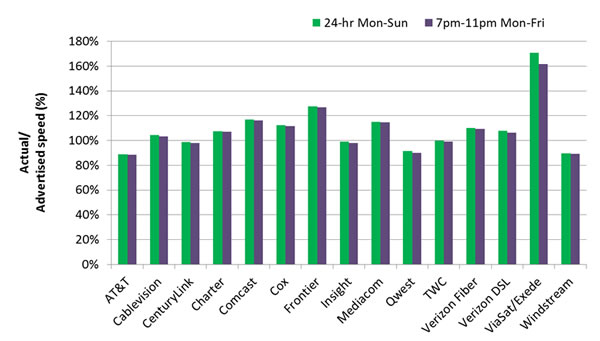

 Alex Atwood (R – Brunswick) District 179


 Stop the Cap! has developed a sample e-mail message Georgia residents can use to petition the state legislature to vote NO on H.B. 282, the latest Big Telecom corporate welfare bill to kill competition from publicly-owned broadband networks. With thanks to Mark Creekmore, one of many rural Georgians suffering with DSL “service” from Windstream Communications, we have jointly created this letter to illustrate the folly of this bad bill. We may need to
  New York Governor Andrew M. Cuomo announced this week New York State will award $25 million in funding to expand high-speed Internet access in rural upstate and underserved urban areas of New York through the Connect NY Broadband Grant Program. This award brings the total amount of funding awarded for broadband projects during Governor Cuomo’s administration to more than $56 million, the largest statewide broadband funding commitment in the nation.