

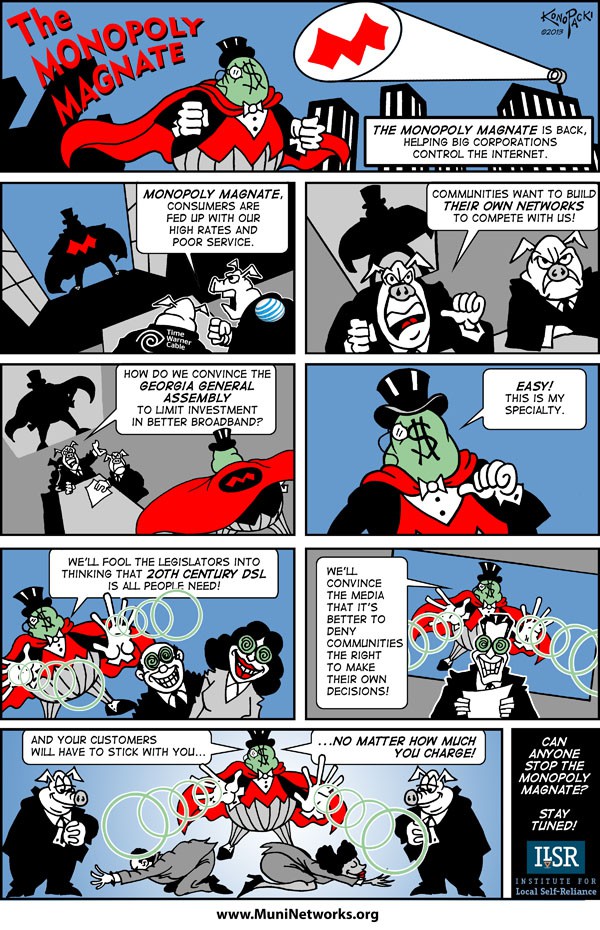
From our friends at MuniNetworks, who understand only too well providers think you will do just fine with 1-3Mbps DSL… indefinitely.
 Subscribe
From our friends at MuniNetworks, who understand only too well providers think you will do just fine with 1-3Mbps DSL… indefinitely.

Mayor Guest
Despite protests from major technology companies, consumers, and local communities across Georgia, the House Energy, Utilities and Telecommunications Committee passed a slightly-revised HB 282, a bill that would largely ban communities from building their own networks to deliver 21st century broadband service. The bill has been moved out of the Rules Committee and will be debated on the House floor Thursday. Readers can find and contact their state representative (preferably leaving a phone message opposing HB 282) through this website. Do it this afternoon!
Last Thursday, community leaders appeared in Atlanta to oppose the corporate welfare protectionism that HB 282 represents.
“Let’s talk about economic development,” said Elberton Mayor Larry Guest. “Georgia should be promoting a pro-business, inclusive approach to broadband deployment, especially in rural areas of the state,” he said. “Competition ensures market-based pricing and faster delivery of state-of-the-art services. We have to do everything we can to attract jobs. If we don’t do that, business will not select rural Georgia. High speed access is essential to us.”
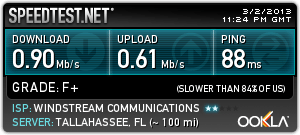
Mark Creekmore depends on his Internet connection in his Dawsonville home as part of his job and Windstream has let him down for at least three years. He pays for 12Mbps service and regularly receives around 600kbps service after 3pm because Windstream has hopelessly oversold its DSL service.
“No one should have to pay for Internet speeds they are not receiving and be told that because they live in a rural area, getting them fixed is just not a priority,” Creekmore complains. “That’s like saying: ‘Because you live in the sticks, you do not deserve what the city folks deserve despite the fact that you pay the same money for service that they do.'”
[flv width=”640″ height=”380″]http://www.phillipdampier.com/video/WGCL Atlanta New Bill Hinders Broadband 2-26-13.mp4[/flv]
WGCL, the CBS station in Atlanta, is asking tough questions about HB 282 and exactly who it will benefit. Some suspect the bill will protect Windstream from having to upgrade its broadband services, something essential to Dawsonville resident Mark Creekmore, who has to turn customers away because Windstream’s DSL service is so poor in his area. (3 minutes)
Creekmore is incensed Windstream is behind a push to pass HB 282, which bill supporters claim will “stimulate investment in rural broadband,” at the same time the phone company leaves him and others with substandard speeds and service.
 “I do not think it is ethical for companies like Windstream, already benefiting from taxpayer dollars, to back a bill that will keep municipalities from offering their residents something better,” said Creekmore.
Creekmore opposes government waste, but is not opposed to local communities stepping up when telecommunications companies have let their customers down.
Despite claims HB 282 will promote rural broadband expansion, Windstream’s CEO Jeff Gardner told investors the opposite Feb. 19 in a conference call.
“We will finish most of our broadband stimulus initiatives which expands our addressability to roughly 75,000 new households,” said Gardner. “As we exit 2013, we will see capital spending related to these projects decrease substantially.”
Windstream’s broadband problems are not limited to rural Georgia. In rural Missouri, Windstream’s DSL service has performed so poorly in certain communities local businesses have had to shut down operations for the day when kids are out on “snow days” because service deteriorates to the point it becomes unusable.

Thomasville, Ga., runs a public fiber to the home network that delivers the speeds it advertises.
“Windstream has made it clear that they have no plans to invest in areas where they don’t feel they can be profitable,” said Piedmont Area Chamber of Commerce president Scott Combs.
Because rural broadband problems remain so pervasive, a group of technology companies including Google and Alcatel-Lucent sent a letter to the chairman of the Georgia House Energy, Utilities and Telecommunications Committee protesting the bill:
The private sector alone cannot enable the United States to take full advantage of the opportunities that advanced communications networks can create in virtually every area of life. As a result, federal and state efforts are taking place across the Nation, including Georgia, to deploy both private and public broadband infrastructure to stimulate and support economic development and job creation, especially in economically distressed areas. HB 282 would prevent public broadband providers from building the sorely needed advanced broadband infrastructure that will stimulate local businesses development, foster work force retraining, and boost employment in economically underachieving areas.
Thus far, the only response has been to slightly ease the language in the bill, now defining suitable broadband at 3Mbps service, up from 1.5Mbps. Communities with municipally owned utilities would also be exempt from the prohibition on selling telecom services. But that is hardly enough.
“Three megabits is not adequate to do functions in a modern telecommunications world,” said Thomasville mayor Max Beverly.
Thomasville has its own public broadband network and the difference between it and providers like Windstream are quickly apparent.
While Windstream sells rural Georgians service at 12Mbps but actually delivers less than 1Mbps, Thomasville residents are excited about forthcoming upgrades to 20Mbps service that actually means 20Mbps service. Thomasville’s fiber network has proved so financially successful, the community eliminated its local property tax. If HB 282 passes, other communities will find constructing such networks nearly impossible.
Democracy Now! featured Chris Mitchell and Catharine Rice on March 4, who talked about how large telecom companies are lobbying to ban community-owned broadband networks, including those in Georgia. AT&T, Comcast, Time Warner Cable and others are having success in the southeastern United States with the help of Republican state lawmakers and conservative groups with ties to the Koch Brothers. (10 minutes)

Shammo
Verizon’s vision of broadband economics depends on the technology used to provide the service, according to some insights shared by the company’s chief financial officer at yesterday’s Deutsche Bank Access Media, Internet & Telecom Conference.
Fran Shammo outlined two strategies the company is using to profit from its broadband services. For wireless, Verizon has “flipped the model” from the traditional voice plan that starts with a bucket of voice minutes towards monetizing broadband usage instead. Today, customers buy plans that focus on anticipated data usage with unlimited voice and texting thrown in. But marketing broadband on Verizon’s fiber optic FiOS network is markedly different because the company is focused on speed over consumption.
“We are now shifting into concentrating on the broadband piece of that product, and the speed that the fiber to the home can give you we believe can’t be matched with anyone,” Shammo told an audience primarily made up of Wall Street analysts and investors. “We have a superior product.”
Shammo explained Verizon intends to “monetize speeds” that fiber broadband is capable of providing. That is important because Verizon FiOS now represents 70 percent of Verizon’s wired business, as traditional landline revenue continues to decline.
That is welcome news to broadband advocates that prefer current pricing models based on broadband speeds, not usage. Verizon FiOS intends to capitalize on its superior speed to differentiate itself from the cable competition, especially when some of those competitors are slapping usage limits on their customers.
Another important new revenue source for Verizon comes from switching legacy DSL users to FiOS technology.
In 2012, Verizon commenced its copper-to-fiber migration in FiOS areas. At least 200,000 homes formerly served by copper-based DSL were transitioned to fiber. In 2013, Verizon plans to migrate another 300,000 customers. When customers are switched to the fiber network, their former DSL speeds remain the same, but now Verizon’s marketing department has an opportunity to target upgrade offers for faster speeds.
“We give them the choice to start upgrading that speed [to] 15, 25, or 50Mbps,” Shammo reports. “What we are seeing is people are willing to pay for that additional speed, so we can monetize that fiber network more.”
However, Shammo reiterated that beyond what Verizon has already committed to in FiOS agreements with local municipalities, Verizon plans no additional expansion of FiOS in 2013.

The foundation for future profits come from data usage.
Unintended Consequences of Share Everything: Customers do an end run around Verizon’s “device fee.”
The conference also provided new insights into Verizon’s Share Everything wireless plans and the company’s other strategies.
Shammo admitted customers have done an end run around the “device fee” for multiple add-on devices.
Verizon expected mobile wireless-enabled tablet sales would increase as the cost to add a tablet to a Verizon Wireless account no longer required a separate data plan. But Verizon’s “device fee,” charged for each device connected to a Share Everything plan, has backfired. Customers are instead adopting Verizon’s “Mi-Fi” wireless hotspot device or other tethering solutions. Customers can then connect up to five Wi-Fi enabled devices through the hotspot and bypass paying multiple device fees that range from $5-20 per device.
Living Off the Revenue from a 3G Network Verizon Has Stopped Expanding, Improving
Shammo also noted Verizon has stopped further investments in its 3G wireless network.
“We are not investing any more capital in that network other than to keep it up and running, so no more coverage [expansion] capital, no more capacity [expansion] capital,” Shammo said. “If I can keep that network up and running that just generates more [revenue] for us.”

Verizon plans to keep a moratorium on further expansion of its fiber to the home service except in areas where it has existing agreements to deliver service.
Verizon’s Plans to Reduce Device Subsidies, Discounts
Customers have grown to expect a free or low-cost upgrade to a new smartphone every two years. But wireless companies find the costs of fronting device subsidies troubling because it affects the short-term bottom line. As wireless providers trim discounts, tighten upgrade policies, raise prices, and introduce new upgrade and activation fees, the $200-400 device subsidy recouped over the life of a two-year service contract remains a fat target for pruning.
But Verizon and other cell phone companies do not want to cut plan prices that are now inflated by $10-15 a month to cover paying back phone subsidies. The best of both worlds: eliminating device upgrade discounts –and– keeping prices the same for wireless service, banking the extra revenue as profit.
Verizon’s current solution is a middle-ground approach that gradually reduces device subsidies while hoping increased competition among device manufacturers will lower retail prices. For the consumer, that means prices will remain generally the same. But for Verizon, it means higher revenue from paying out lower subsidies while being able to maintain current pricing.
“I am a believer that over the next two to three years subsidies will start to decrease just because of the ecosystem,” said Shammo.
Verizon’s conversion to LTE means the day of a pure LTE-only smartphone is not far off. It will not include added-cost chips to support legacy technology, particularly older data networks and CDMA.
Wall Street Pressures Verizon to Talk Customers into Less-Costly (Anything but an iPhone) Smartphones
Brett Feldman, an analyst at Deutsche Bank who moderated the question and answer session with Shammo pointedly noted the Apple iPhone is the most-costly phone to subsidize.
“Are there things you can do with your sales force where you would proactively incentivize them to maybe sell different devices,” asked Feldman.
“It is critical that we don’t do that,” Shammo explained. “What is more important for us is a customer walks out with a phone that they will be happy with and not return under our 30-day guarantee. Because the worst thing that can happen for us is for me to incent a salesperson to get you into a phone thinking you are going to like and in three days you come back because you don’t. Now I’ve just subsidized two smartphones because that phone you used I can’t resell as a new phone.”

Cablevision’s executive suites are filled with intrigue and family politics. — Phillip Dampier
Cablevision’s quarterly results conference call last week was an exercise in obfuscation.
Senior management at the cable operator that serves parts of New York, New Jersey and Connecticut announced some difficult financial results, including the fact the company lost at least 39,000 customers during the last quarter — a significant number considering Cablevision only serves 3.6 million customers as of the end of December. At least 11,000 of those customers stopped paying their bills and disappeared, presumably because their homes and businesses were victims of Hurricane Sandy. But company officials admitted they also lost high-speed Internet customers because of a recent price increase and ongoing heavy promotional activity from their biggest competitor — Verizon FiOS. The phone company has offered triple play packages as low as $89 a month with $300 debit card rebates, which makes hiking rates untenable.
Cablevision CEO James Dolan has been ducking hard questions from Wall Street analysts concerned about the company’s spending and marketing, the loss of subscribers, and fallout from a 2011 management shakeup. Richard Greenfield, an analyst at research firm BTIG, has been frustrated getting answers from the Dolan family that has controlled Cablevision for decades, tweeting Cablevision executives stopped taking his questions on regular conference calls after he began asking some of those hard questions.
Cablevision’s Upgrades Will Continue; Company Wants an Improved Subscriber Experience

Greenfield
One of the problems Verizon FiOS’ fiber to the home network brings Cablevision as its largest competitor is fiber technology is superior to Cablevision’s cable network infrastructure. Verizon has been a formidable challenger. This has forced the cable operator to make dramatic improvements, particularly in its broadband product, to stay competitive. But some of these upgrades have been delayed by the effects of Hurricane Sandy, which affected 60 percent of Cablevision’s subscribers in the tri-state area.
Cablevision has been forced to offer customers service credits, substantially curtail sales and advertising efforts, and suspend the non-pay collection rules and disconnect policy.
Cablevision has also committed itself to an expensive robust Wi-Fi network to differentiate itself from Verizon. Cablevision has an extensive Wi-Fi presence in its service area, offering unlimited free service for its customers. Verizon does not. Cablevision ended 2012 with more than 67,000 installed hotspots, with more than 30% of Optimum Online customers using the service in 2012.
At the same time, cable television programming costs have skyrocketed, but Cablevision has generally avoided raising prices fearing Verizon would poach unhappy subscribers.
Drama Surrounding Executive Changes

Internet comes last?
In 2011, Cablevision accepted the resignation of Tom Rutledge, former chief operating officer. Richard Greenfield dismissed Cablevision’s statements about his departure as “spin,” and claims the real reason Rutledge left for Charter Communications is that Jim Dolan became dissatisfied with Rutledge’s performance. But that poor performance could also be attributed to some of the company’s own decisions, particularly when it engaged in multiple battles with programmers during 2010 that forced popular cable networks and broadcasters temporarily off Cablevision lineups. Greenfield suggests the biggest impact was felt when the cable operator dropped the local Fox station right in the middle of the World Series. BTIG believes subscriber losses accelerated for these reasons (and Verizon’s aggressive marketing efforts) and helped the company see its earnings and subscriber trends hurt.
Jim Dolan has reportedly taken a more hands-on approach at Cablevision and even appointed his wife Kristin to assume a stronger role in how Cablevision markets itself to customers.
The result was a Cablevision rebranding that Greenfield criticized in September as “firmly entrenched in the past,” because it emphasizes television and phone service over broadband.
Avoiding Tough Questions
Several of the questions Greenfield wanted answered, but could not, dealt with the transformation of part of Cablevision’s service area thanks to Sandy and some of the company’s earlier missteps:
 While Windstream continues to heavily lobby the Georgia legislature for a bill that would ban competition from publicly owned broadband providers, the company is doing little to address the growing concerns of its own broadband customers getting poor service.
Mark Wyatt, a Windstream customer fed up with not getting the broadband speeds he pays for, launched a Facebook group in January to collect evidence and attempt to leverage the company to fix its problems. Wyatt, like many other customers in rural Georgia, has only one option for broadband service — Windstream.
Now the growing Facebook group has gotten attention from an Atlanta reporter who wants customers to record videos detailing their broadband problems with Windstream for an upcoming news report.
Jeff Chirico at WGCL-TV, the Atlanta CBS affiliate, has a call out for videos due by March 6:
I’m a reporter for CBS Atlanta News. I want to hear from Windstream customers in Georgia about their experiences with the company’s Internet service. Please shoot a video (30 seconds or less) explaining the speed of Windstream’s service and how it impacts you, your family or your business. Please include your name and city and download it to our dropbox account. http://dropbox.yousendit.com/
JamesEstes539379 Also, feel free to follow me on Twitter @CBSATLChirico or find me on Facebook http://www.facebook.com/
JeffChiricoCbsAtlanta
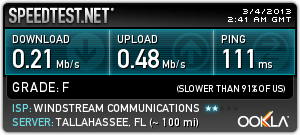 The horror stories are already clear all over Windstream’s service areas:
Don Jackson, who lives outside Milledgeville pays Windstream for 6/1Mbps service. On a good day, he gets 750kbps after 4pm every day, and speeds do not improve until the early morning hours.
“I talked with a local manager and he said that there is no solution anytime soon,” Jackson reported. “I have screen shots of speed tests from different sites for months to demonstrate that this is not a fluke but a fact. I have complaints on file with the FCC and BBB of Arkansas, [which handles complaints regarding Windstream].”
Adam Ridley qualified and pays for 3Mbps broadband service from Windstream, but that is not the speed he actually receives.
“It’s 9:40pm and I’m rocking my 210kbps connection — 7% of the speed I pay for,” he reported last night.
Rodney Gray pays Windstream a premium for 12Mbps service, but the phone company does not come close to delivering those speeds. His service actually ranges from 580kbps-1.4Mbps.
“My upload speed is faster than my download,” Gray complains.
A representative answering Windstream’s Complaint Line threatens a customer in Odum,. Ga. with legal action for “harassment” in June, 2012 after he complaints about Windstream’s mailers advertising DSL Internet service that is actually “not available to him this year.” (2 minutes)
You must remain on this page to hear the clip, or you can download the clip and listen later.
Kimberly Brown’s broadband problems with Windstream are so pervasive, even the company admits there is a problem, and they have given her service credits.
“Our primary problem is dropped connections — constantly,” Brown says. “They sent a technician out because surely it must be in our lines. He told us that there is something going on in one of the main hubs or whatever, and that it should be months (if ever) that it’s fixed. Then, customer service was suddenly able to look into our account and see that we had hundreds of dropped connections in just a few days. Hundreds. To their credit, they did give us a smallish break on our monthly bill because of the aggravation.”
 A typical day for the Brown family is to wake up, reset the modem, send an e-mail or two, reset the modem, try to go to a web page, reset the modem.
“It’s crazy and extremely frustrating,” says Brown. “I work from home and rely heavily on the Internet to get my job done, so this problem affects us in many ways, not just casual web surfing.”
Things are worse for Mark B. Watson, who lost his service entirely for two days.
“The bad thing is that mine and my wife’s business is located in our house,” says Watson. “Being without Internet means we are not making an income for two days. It is getting old.”
While Windstream’s broadband service is suffering, company executives are celebrating a planned major reduction in extra investment in its broadband service, telling Wall Street its broadband expansion and fiber-for-cell-tower projects are nearing completion. That could leave rural Georgia broadband customers without improved service indefinitely.
At the same time, Windstream is reportedly the primary proponent of legislation that would make sure rural Georgians have no alternatives to choose from. The company’s support for HB 282, now working through the Georgia legislature, would prohibit communities from launching their own broadband services to improve connectivity and speeds.
The "Massive News" theme by: Press75.com
