
Home » Broadband Speed » Recent Articles:

PBS Explores The Growing Impact of Broadband

[flv width=”512″ height=”308″]http://www.phillipdampier.com/video/PBS Streaming Video Major Player 3-20-13.flv[/flv]

Traditional Hollywood studios now compete with streaming content providers like Netflix and Amazon to capture viewers’ attention. Hari Sreenivasan looks at the growing impact of broadband and its effect on our viewing habits and entertainment industry with Brian Stelter of the New York Times and Lisa Donovan of Maker Studios. (8 minutes)

Some portions of the video were not cleared for online viewing. The missing section of the segment:

Traditional Hollywood studios have long produced the movies and television programs we love to watch, but in the era of high-speed broadband, companies like Netflix, Amazon, YouTube, and Hulu are some of the new power players.

All of them stream movies, TV and video. Increasingly, they’re creating their own unique content as well. For the moment, Netflix has raised the stakes most prominently. Last month, it debuted all at once 13 episodes of its original $100 million dollar series “House of Cards” all at once. It stars Kevin Spacey as a cynical U.S. House majority whip. Its success turned up the heat on its competitor, Amazon Prime, which is spending millions on new content.

Amazon in turn announced an exclusive deal with PBS to stream its hit show “Downton Abbey.” Cable providers like Xfinity and Time Warner are making more of their content available for their online customers, an audience that is growing.

According to comScore, a company that tracks digital media, every day, 75 million people in America watch videos online.

[flv width=”512″ height=”308″]http://www.phillipdampier.com/video/PBS Tennessee Internet 3-21-13.flv[/flv]

Chattanooga, Tenn., is home to American’s fastest Internet connection — up to 200 times faster than the national average. Hari Sreenivasan talks with Sheldon Grizzle of The Company Lab and Richard Bennett from the Information Technology and Innovation Foundation about whether Chattanooga offers a model for the rest of the U.S. (9 minutes)

[flv width=”640″ height=”380″]http://www.phillipdampier.com/video/PBS Equal Access to the Internet 3-22-13.flv[/flv]

Internet use is now so ubiquitous in the U.S. that not having access or online literacy can create major hurdles. As part of the NewsHour’s series on broadband technology and its effect on society, Hari Sreenivasan explores the so-called digital divide with Vicky Rideout of VJR Consulting and former FCC official Karen Kornbluh. (9 minutes)

Google Fiber Announces Next Gigabit Fiber City: Olathe, Kansas

Phillip Dampier March 20, 2013 Broadband Speed, Competition, Consumer News, Google Fiber & Wireless, Public Policy & Gov't, Video Comments Off on Google Fiber Announces Next Gigabit Fiber City: Olathe, Kansas

google fiberThe city of Olathe, Kansas will be the next home for Google Fiber, according to an announcement published yesterday on the Google Fiber Blog.

The Olathe City Council unanimously approved an agreement to wire the city for the benefit of its 127,000 residents, located 20 miles southwest of Kansas City.

This is the first expansion of Google Fiber outside of the immediate Kansas City area, but unlikely to be the last.

Rich Greenfield from BTIG Research predicts Google will likely announce a second major city for its fiber network sometime this year. Olathe doesn’t qualify at that city because it technically within the greater Kansas City metropolitan area.

The agreement with the Olathe City Council also includes permission to build a city-wide Wi-Fi network.

olatheGoogle noted the city’s willingness to cut red tape and to ease the introduction of the service were partly determining factors. Google earlier cited the importance of having a smooth working relationship with utility companies and local government officials that make fiber installation a lot easier.

Comcast will be Google’s largest competitor in the city.

“We think that fiber and widespread Internet access will help to create jobs, grow local businesses, and make Olathe even stronger as it grows,” said Rachel Hack, community manager for Google Fiber. “We still have a lot of planning and engineering work to do before we’re ready to bring fiber to Olathe. Once we get those processes underway, we’ll be able to announce more about pre-registration and construction timing.”

[flv width=”640″ height=”380″]http://www.phillipdampier.com/video/KCTV Kansas City Olathe OKs Google Fiber Deal 3-19-13.mp4[/flv]

KCTV in Kansas City reports the Olathe City Council unanimously approved the entry of Google Fiber into the community of 127,000.  (2 minutes)

[flv width=”640″ height=”382″]http://www.phillipdampier.com/video/KMBC Kansas City Olathe OKs Google Fiber deal 3-20-13.flv[/flv]

KMBC in Kansas City notes Olathe is Kansas’ fastest growing city, but Google’s decision is leaving residents of larger cities like Overland Park feeling left out. But Olathe already has a lot of pre-existing fiber installed independent of Google, making it easier to provide service.  (2 minutes)

Frontier Keeping Exact Locations of Publicly-Funded Fiber Lines in W.V. ‘Our Little Secret’

Find the Frontier Fiber

Find the Frontier Fiber

After spending tens of millions of dollars in taxpayer money to wire more than 500 miles of fiber broadband cable in public buildings across West Virginia, Frontier is allegedly withholding detailed engineering maps detailing the new fiber network from its competitors.

The Charleston Gazette’s Eric Eyre has kept a close watch on broadband stimulus funding in West Virginia, and the circus of controversy surrounding how the money has been spent.

But now that Frontier’s taxpayer-funded institutional fiber network has been built, efforts to install Internet connections to end users has become complicated… unless you choose Frontier Communications as your vendor.

State Broadband Deployment Council member Jim Martin from Citynet has been a vocal critic of the broadband spending priorities in West Virginia for several years. He’s particularly irritated taxpayer funds have been effectively diverted to Frontier to build a modern fiber network that mostly benefits Frontier and its shareholders. Now his company wants to see if it can use the new fiber network to connect more West Virginians to fiber Internet service, but Martin claims he has been given the runaround by Frontier, state officials, and a broadband council that includes a Frontier executive as a member.

“A number of providers have inquired about where that fiber is located so they can expand broadband to customers,” Martin told the Gazette. “The engineering maps are important so they will know exactly where the fiber is connected, and so they can tap it.”

Only Martin cannot get the detailed engineering maps he needs. Eyre describes the high-tech equivalent of “button, button, who’s got the button?”

Martin started asking about the maps eight months ago. State officials overseeing the broadband expansion project promised to check into his request, but they haven’t released the engineering maps.

On Wednesday, Frontier executive Dana Waldo, who also serves on the Broadband Deployment Council, told Martin to request the maps from the state “broadband grant implementation team,” which heads the broadband expansion project.

“Those are requests that have to go to the implementation team,” said Waldo, who heads Frontier’s West Virginia operations. “It provides for a consistent process.”

However, Gale Given, who serves on the project team and heads the state’s Office of Technology, referred Martin to Frontier.

“If you need detailed engineering maps,” Given said, “it’s my understanding the [broadband project] team is not going to produce those.”

Given noted that less-detailed maps are available on the state’s broadband project website.

“If you need a specific area,” she said, “tell us the specific area you need.”

Martin says the maps on the website mentioned are hand-drawn Google Maps, unsuitable to work with because they lack detail.

Bright House Boosts Speeds, Prices, Cable Modem Fees

Phillip Dampier March 18, 2013 Broadband Speed, Consumer News Comments Off on Bright House Boosts Speeds, Prices, Cable Modem Fees

Bright House Networks first boosted Internet speeds in January and is now back with a price boost.

brighthouseinThe cable provider’s Turbo High Speed Internet increased earlier this year from 20 to 30Mbps for downloads. Its Lightning tier went up even more — from 40 to 60Mbps. Even Business Class customers saw speed increases to 70Mbps. But now prices are up as well — as much as $5 a month more for “upgraded broadband services,” a higher cable modem rental fee, and $3 more for television packages:

  • Standard Cable TV service is up $3, from $65 to $68 a month
  • Late fees are increasing by an extra $0.50;
  • The cable modem rental fee that used to be $2 a month has increased an additional $1.50 — now $3.50 per month.

Price increases will not affect customers on promotional offers or certain bundled service packages combining multiple services.

The fee that bugs many customers the most is the company’s modem rental fee, which applies regardless of the age of your equipment.

“I told the customer service rep that I’ve had this modem for a couple of years and it’s not like altered or improved,” Pete Dooley of Satellite Beach, Fla. told Florida Today. “She said ‘You know the economy is today. They just needed more money.’ I guess you’re just supposed to casually accept it.”

The rest of the rate increases were attributed to the cost of cable television programming.

Jeff Kagan, a cable industry analyst told the online news service cable television rates have roughly doubled over the last decade.

Rogers: Monetizing Your Data Usage Key to Future Revenue Growth

Phillip Dampier March 13, 2013 Broadband Speed, Canada, Competition, Data Caps, Online Video, Rogers, Wireless Broadband Comments Off on Rogers: Monetizing Your Data Usage Key to Future Revenue Growth

rogers logoRogers Communications, Canada’s largest cable operator, told investors at an investment bank conference it intends to accelerate plans to monetize wireless and broadband data usage this year.

Anthony Staffieri, chief financial officer of Rogers Communications told attendees at Morgan Stanley’s Technology, Media & Telecom Conference that Rogers’ future revenue outlook was going to be data-centric.

“We think data, monetizing data, is going to be a key aspect of that, both on the wireless side, as well as on the cable side of things,” Staffieri said.

Staffieri

Staffieri

Key to Rogers is the development of data plans that maximize revenue potential by exploiting the customer’s discomfort with overlimit fees. Staffieri admits the company has plans that can cost the company revenue if customers downgrade to a usage bucket that brings them very close to their usage limit.

But most customers do not choose those “exact fit” data plans. They typically select more expensive, larger-bucket plans so they can rest easy knowing they will not get slapped with a overlimit fee.

“And so they’re coming into data plans that are probably more than they need,” Staffieri said. “But for most users, what they’re looking for is comfort in usage. And so what we found is there’s a preponderance to buy more than what you need. So there’s no surprise at the end of the month in terms of billing. And so it’s all about that comfort in usage that we’re focused on in the price plans.”

In wireless, Rogers is also counting on the explosive growth of usage that comes after introducing 4G LTE coverage.

“Simply on 3G to LTE, you see an immediate growth in data usage,” Staffieri said. “Same users, but if you were to look at the data set, it’s just within a defined period of time, they can just access more. And so for whatever reason, whatever they’re doing with it, it’s just driving more usage, more efficiency and they’re using it in the business context.”

Staffieri says Rogers is experiencing 30-50% increases in data usage year over year. Rogers introduced new wireless plans in the fall of 2012 that refocus customers on their anticipated data usage, with gradually more expensive wireless plans to match.

“That really gets the customer focused on choosing something that continues to drive data growth,” Staffieri noted.

Rogers Cable broadband customers have also faced data caps and consumption-oriented billing for years. Although Rogers competitively responded to a Bell offer introduced in January that includes unlimited use service for customers who want it, that option comes at an added cost — one that can be priced up or down according to marketplace conditions.

Rogers primary focus is on encouraging its cable broadband customers to move towards higher-speed, more expensive data plans.
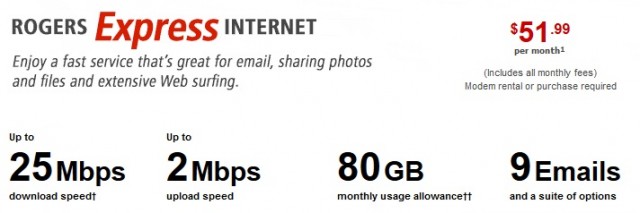
Rogers sells a 25/3Mbps broadband plan for $52 a month that includes only an 80GB monthly usage allowance.

MONETIZED: Rogers sells a 25/2Mbps broadband plan for $52 a month that includes only an 80GB monthly usage allowance. A $2/GB overlimit fee applies, up to a maximum of $100 per month. Taxes, a modem rental fee or purchase, a one-time activation fee of $14.95 and up to a $99.99 installation fee also apply.

“On the cable side, making sure we have the best Internet experience was the other piece of it,” Staffieri said. “We ended the year with 90% of our footprint able to get 150Mbps data speed ($122.99/mo with 250GB usage allowance). And so to the extent that we continue to lead on Internet, we think that’s going to be important ingredient for the top line [revenue] growth.”

On the wireless side, Rogers is following the lead of big providers in the United States and gradually shifting the cost of new smartphones away from itself and onto its customers by adjusting its subsidy program.

“As we see data [usage] pulling [revenue] growth, overall, that bodes well for a continuation of the subsidization,” Staffieri said. “For us, it’s really been about making sure that we give the customer choice. And so when we combine that with the introduction of the Flex Plan, which we did in 2012, what we’re seeing is more and more customers opting into new handsets. But more and more, it’s on the customer’s nickel as opposed to our nickel on the Flex Plan programs.”
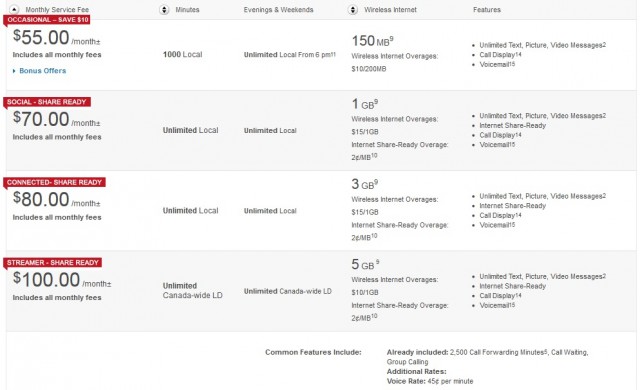
Rogers Wireless' Individual wireless plans. Rogers' customers have to pay extra for long distance cell phone calling -- most plans only cover local calling. Data plans are stingier and more expensive than what most Americans pay, and steep overlimit fees up to $0.02 per megabyte apply.

Rogers Wireless’ Individual plans. Rogers’ customers have to pay extra for long distance calling — most plans only cover local calls. Data plans are stingier and more expensive than what most Americans pay, and steep overlimit fees up to $0.02 per megabyte ($20/GB) apply. Like in the United States, Rogers is moving to bundle unlimited calling and texting into more of their plans. What differentiates more plans today is how much data usage is included.

Staffieri admitted Bell is giving Rogers the most competitive headaches in Ontario because of their aggressively priced promotions.

“Certainly, [Bell’s Fibe IPTV] has been competitive for us. In the short-term, we continue to deal with what I would consider to be aggressive pricing in terms of acquisition and retention offers by our IPTV competitor,” said Staffieri. “We’ve always been competing with their satellite product and so that competition has always been there. But I would describe it as certainly having picked up and continuing to pick up. And it’s largely been through pricing offers as opposed to product.”

Staffieri says Rogers is competing with improved set-top equipment like the NextBox 2.0 — a whole-home DVR with an improved user interface. It also offers customers Anyplace TV, a TV Everywhere service that allows customers to watch the Rogers’ TV lineup on tablets inside the home.

The Toronto Maple Leafs, the National Hockey League's most valuable sports franchise, is 75% co-owned by Bell Canada and Rogers Communications.

The Toronto Maple Leafs, the National Hockey League’s most valuable sports franchise, is today 75% co-owned by Bell Canada Enterprises (BCE) and Rogers Communications.

As is the case in the United States, Canadian cable companies are also facing dramatically increasing programming costs, particularly for sports programming.

But to a greater degree than in the U.S., Canadian media conglomerates own and control a larger share of cable and broadcast networks, programming producers, would-be competitors like satellite television, and even sports teams and the networks that show their games.

That positions them to negotiate with themselves over content costs, because they own or control the sports franchise, the cable or broadcast network that televises their games, and the cable, satellite, or telephone provider through which most Canadians watch.

“We’ve tried to be disciplined on the extent that content price increases are there because consumers want it, then we want to make sure we’re disciplined in passing on that cost to the customer,” Staffieri said. “And so we strive to make sure that in the TV and video business our gross margins are consistent.”

“So if you were to look at how that’s played out over the last several quarters and several years, it’s been fairly consistent. And so that’s what we strive to do is to make sure that those programming costs ultimately are passed on to the consumer, which is ultimately driving up the cost through their demand.”


Search This Site:

Contributions:

Recent Comments:

Your Account:

Stop the Cap!