
Home » Broadband Speed » Recent Articles:

Time Warner Cable Customers in Upstate New York Howling About Broadband Rate Hikes

frontier offer

Frontier is enticing Rochester-area customers to “say goodbye to Time Warner Cable.”

Time Warner Cable’s relentless rate increases, particularly on its broadband service, are leading to calls for more competition in the upstate New York cities of Buffalo and Rochester, now dominated by Time Warner, Verizon Communications (Buffalo), and Frontier Communications (Rochester).

“Bloodsuckers,” came the terse reply of Cathy Slocum.

Frontier Communications is making the most out of the cable company rate increases with a new “Goodbye Time Warner” ad campaign (that incidentally includes a link to Stop the Cap!’s coverage of TWC’s modem fee). It is pitching $19.99 broadband price-locked for two years — an improvement over its earlier offers thanks to a major reduction in sneaky fine print.

Customers can get up to 6Mbps service (up to 12Mbps available in limited areas) at the special offer price as long as they keep a Frontier landline active with a qualifying calling package. There are no contracts with this promotion, but Frontier’s pesky $9.99 “Broadband Processing Fee” applies if customers ever choose to disconnect Internet service. A free Wi-Fi Internet router is included and the company claims it offers “free Internet activation.” But an installation fee still applies, discounted if customers choose the self-install option. Taxes, governmental and other Frontier-imposed surcharges also apply and new Frontier customers are subject to credit approval, which will show up as an inquiry on your credit report.

In the past, we have taken Frontier to task for its expensive early termination and modem rental fees, as well as its bundling requirements, but the company has since ditched most of these as part of its new self-proclaimed reputation as “BS free.”

Unfortunately, Frontier’s DSL speeds can wildly vary, so if you take advantage of their offer, be sure to verify the speed actually get at your home or office. If the service proves too slow to your liking after installation, you can negotiate canceling within the first two weeks without any termination fees.

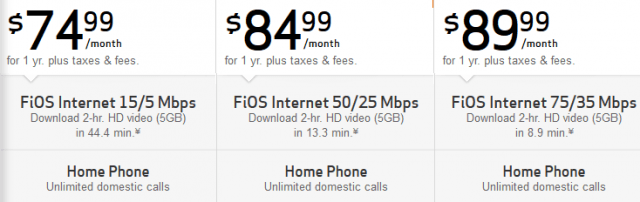
Where FiOS is available in Buffalo, Verizon is offering promotional pricing on its bundled services, including an $84.99 offer including 50/25Mbps Internet with a Verizon landline offering unlimited calling. This is cheaper than Time Warner’s offer with considerably faster upload speeds and no modem fees. In parts of Buffalo, Verizon is authorized to offer broadband and phone service only, although several suburbs have franchise agreements that allow the phone company to also sell television service. A large part of the city and other suburbs are still stuck with Verizon’s copper network, however, which means DSL is the best they can offer.

Time Warner Cable’s new customer promotions, useful when negotiating a customer retention deal, have resumed bundling Standard tier (15/1Mbps service) Internet speeds into most offers. Previously, the company bundled 3Mbps service in many of its promotions. Broadband-only customers can pay as little as $34.99 a month for a year of Internet service at 15/1Mbps speeds, assuming one buys their own cable modem. A double play offer of broadband basic television (around 20 channels, mostly local over-the-air) with 30/5Mbps Internet service is now priced at $94.97 a month after a $5.99 mandatory modem rental fee is included (not optional with this package).

Time Warner Cable executives have repeatedly told investors its higher priced promotions are intentional to increase revenue and profits even if the company loses customers by charging higher prices.
fios offers

Verizon FiOS offers in the Buffalo area.

“I moved here from the New York City area a year ago where we had two cable companies — Cablevision and Verizon FiOS,” noted Stephen O’Brien. “Competition changes everything. Not only were the rates much lower than here, the companies would offer you all kinds of incentives to switch from one to the other. One time we switched and got a free iPod Touch. The argument that the rate increase is needed to cover investment is the biggest red herring of all — Cablevision and FiOS spent many times more on infrastructure, yet their rates were much lower.”

Stop the Cap! recommends Time Warner Cable customers check out our guide to getting the best deal possible from TWC.

[flv width=”640″ height=”380″]http://www.phillipdampier.com/video/WGRZ Buffalo Time Warner Rate Hikes 8-6-13.flv[/flv]

WGRZ in Buffalo reports upstate New York residents are upset about two recently announced broadband rate hikes. Time Warner Cable says it needs the money to keep up its broadband service’s reliability. What alternatives do customers have?  (2 minutes)
Cablevision CEO Sees the Company Eventually Dumping Cable Television Service

Optimum-Branding-Spot-New-LogoCablevision may eventually get out of the cable television business.
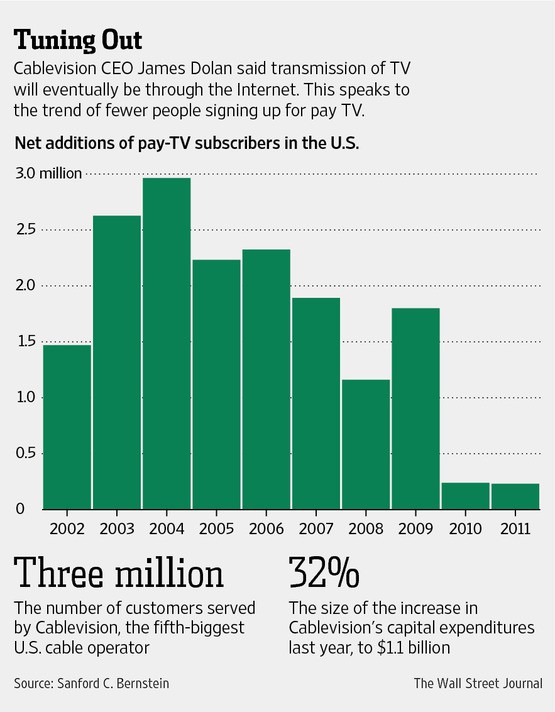
Although industry analysts, consumer advocates, and technology columnists have long proclaimed the era of “cord cutting” is upon us, cable operators have always been in denial the product that got them their multi-billion dollar business — selling packages of television channels — is rapidly becoming obsolete.

But at least one CEO sees the writing on the wall.

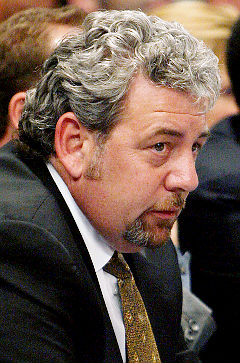
If you don’t “ride the wave” you “get eaten by the wave,” declared Cablevision CEO James Dolan.

The Wall Street Journal sat down for a lengthy interview with Dolan, who predicted “there could come a day” when the cable television company quits selling television service, because a growing number of viewers have shifted to online video.

Dolan, like many Americans, isn’t watching television as much as he used to, and admitted that both he and his young children prefer spending their viewing time with Netflix, not Cablevision’s television package.

Jim Dolan

Jim Dolan

Dolan worries the next generation of television viewers don’t need or want a cable television package with hundreds of video channels. Today’s youth wants fast broadband with on-demand viewing of series, movies, and video clips. The transition may have already started. Cablevision reported Aug. 2 it lost 20,000 video customers over the last three months, many moving to broadband-only service and 11,000 abandoned the cable company altogether.

Dolan believes the industry is setting itself up for obsolescence.

“I don’t want to be saddled with an infrastructure that is as big as the one that I have now,” Dolan told the Journal, fearing the bloated cable television package is becoming too costly and unmanageable.

Instead, Dolan has ordered network upgrades to improve broadband service and help boost the company’s image with customers. Cablevision focused most of its spending on broadband and Wi-Fi service upgrades over the past year, both to meet relentless competition with Verizon’s fiber network FiOS, but also to develop the platform Dolan thinks will eventually be the only product the company sells. Although Cablevision cannot match Verizon’s upload speeds, the cable company offers a free Wi-Fi service for customers Verizon lacks. But the changes and network upgrades have been expensive and noticeable, because few cable operators are spending as much as Cablevision to improve service.

The changes in approach were too much for former chief operating officer Thomas Rutledge, who departed Cablevision to run Charter Cable in December 2011.

One of the primary reasons Rutledge left was Dolan’s increasing involvement in the business, causing a clash of business philosophies. Just a few months before Rutledge departed, the FCC issued a report that exposed Cablevision marketing broadband speeds its network could not sustain, especially during prime usage periods. Rutledge believed this was primarily a marketing problem. Dolan concluded the existing broadband infrastructure was inadequate.

“I felt that we needed to reinvest,” Dolan said. “When we took a hard look at what we were offering,… it just wasn’t what we wanted it to be.”

As Rutledge and his allies rapidly departed for Charter Cable, Dolan ordered a 32 percent increase in capital spending to $1.1 billion last year, at least $150 million targeted exclusively on broadband improvements. This year he has already informed Wall Street it will be more of the same, bringing expanded Wi-Fi, new and improved broadband modems for customers, even faster speeds, new outage detection equipment, and an improved cloud-based DVR service.

cablevision numbersExisting customers like the changes, but don’t appreciate the price hikes that have accompanied them. Wall Street has the exact opposite point of view, welcoming increased revenue from rate hikes, but concerned about the company’s spending. Investors complain Cablevision’s returns are well below those of other cable operators which don’t face the Verizon FiOS juggernaut.


Still, for some customers, the changes have come too late and Verizon’s promotional offers to switch to fiber have been too good. Cablevision did at least manage to add 1,000 new broadband and 3,000 new voice customers during the second quarter.

“We’re not prepared to starve the business,” said chief financial officer Gregg Seibert. “In terms of upgrades, I think what you’re seeing with the high-speed rollout that we just did is that we feel that our plant is in very good condition. We’re delivering over advertised speeds in every day part. We intend to keep the plant in that type of condition.”

Dolan’s philosophy of upgrading service to improve customer relations also clashes with John Malone, who is rebuilding his cable industry power base at Rutledge’s new home — Charter Cable. Malone believes industry consolidation, not expensive network upgrades, is a better proposition for shareholders.

Dolan told investors Cablevision is, for now, out of the mergers and acquisitions business. It has completed selling off its Optimum West systems to Charter and plans no further expeditionary buyouts in the near future. Instead, the company intends to focus on its business in the northeast. Dolan acknowledged the company is a likely acquisition target, most likely by Charter or Time Warner Cable.

Dolan currently shows little interest in selling out what is and always has been a family affair. Chuck Dolan, 86, founded Cablevision and still offers almost daily advice to his son James, who now runs the business. James also appointed his wife Kristin to lead sales, marketing and product management, with questionable results.

Some other highlights from the second quarter:

  • Cablevision has enhanced its Remote Storage DVR product, now providing two tiers: 160GB and 500GB. Customers can record up to 10 channels at the same time. The service is available on customers’ existing set-top boxes;
  • Last month, Cablevision announced an increase in our broadband data speeds;
  • Wi-Fi remains a major priority for Cablevision and customer usage of its wireless network continues to grow. More than 1 million customers have used the service over more than 90,000 access points;
  • Price increases were critical for Cablevision’s revenue growth this year. The company booked increased revenue from a broad-based $5 broadband rate hike implemented in January as well as a “sports programming surcharge” initiated earlier this year. The average subscriber that buys a package including cable television pays $5.49 more this year than last — $162.42 a month.

[flv width=”640″ height=”380″]http://www.phillipdampier.com/video/WSJ Future of Cable TV 8-5-13.flv[/flv]

The Wall Street Journal sat down with Cablevision CEO James Dolan, discussing the future of the business as the industry watches another cable television programming dispute between Time Warner Cable and CBS.  (5 minutes)

Comcast Has ‘Plenty of Broadband Capacity,’ Reserves the Right to Acquire Others

Phillip Dampier August 1, 2013 Broadband "Shortage", Broadband Speed, Comcast/Xfinity, Competition, Consumer News, Online Video, Public Policy & Gov't, Video, Wireless Broadband Comments Off on Comcast Has ‘Plenty of Broadband Capacity,’ Reserves the Right to Acquire Others
Big, Bigger, Biggest, Still Bigger

Big, Bigger, Biggest… Bigger Still

Comcast has plenty of available bandwidth to indefinitely expand its High Speed Internet services at speeds up to 3Gbps and believes it has won the legal right to grow its cable business as large as it likes.

Comcast executives admitted Wednesday they have more than enough network capacity to meet the demands of customers, both now and well into the future.

“With regard to usage and capacity, we feel the network is flexible and has plenty of opportunity to grow in capacity,” said Neil Smit, president and CEO of Comcast Cable Communications. Smit was responding to a Wall Street analyst asking about future capacity during a quarterly financial results conference call.

Smit noted that some of the biggest bandwidth users served by Comcast are businesses, and the cable operator was well-positioned to service them by extending fiber or deploying its Metro Ethernet product. Residential customers get increased bandwidth through neighborhood node splitting or DOCSIS 3 channel bonding that combines several channels together to increase speed and capacity.

Brian Roberts, CEO of Comcast Corporation, agreed with Smit, adding, “the more the consumer desires speed, the better that is for our company.”

Roberts noted DOCSIS 3.1 — the next generation of cable broadband — was “promising technology.”

“At the cable convention, we demonstrated 3Gbps” over Comcast’s existing cable infrastructure, said Roberts.

Smit

Smit

Comcast is easily the country’s largest cable operator, but many believe it is restrained from growing larger through mergers and acquisitions because of antitrust concerns. But thanks to a number of lawsuits initiated by Comcast, the company believes it can now grow as large as it likes.

Roberts admits the question of cable industry consolidation remains a gray area, particularly for Comcast. But he told investors he does not believe there are any remaining legal hurdles preventing Comcast from buying out other cable operators, despite earlier FCC rulemakings limiting the maximum size a cable company can grow through buyouts.

Comcast yesterday announced its last buyout — NBCUniversal — helped fuel a 29% increase in net income in the second quarter, thanks in part to strong results from film and television.

But many of Comcast’s largest gains came from its cable business.

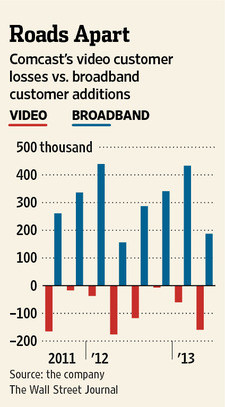
Despite continued losses of video subscribers (159,000 in the second quarter), Comcast’s cable revenue increased 5.8% to $10.47 billion, and operating cash flow grew 5.7% to $4.3 billion. Comcast, which also owns several NBC broadcast affiliates, is playing for both sides of the retransmission consent wars. Its owned and operated television stations have demanded higher fees to be carried on cable systems, many owned by Comcast itself. The increased programming costs fuel subscriber rate increases, which also boost revenue.

Broadband way up, although the company keeps losing video customers to cord-cutting.

Broadband is way up, although the company keeps losing video customers to cord-cutting.

Comcast’s broadband revenue has continued to grow dramatically. Customer additions for High Speed Internet access were up more than 20% in the quarter — the best second-quarter growth in five years — even as subscribers paid more for the service because of rate increases. Customer growth and price hikes delivered 8% growth in broadband revenue. In the last quarter alone, Comcast earned $2.6 billion from its broadband business.

Comcast is not spending a significant percentage of that revenue on enhanced broadband network upgrades. Instead, the company has increased investments to wire office parks and businesses to entice commercial customers, which account for a substantial amount of new customer growth. Comcast is also investing in research and development of new products and services, such as set-top boxes. The company also expects to pay 10% more in programming costs than it did a year earlier.

Year-to-date cable communications capital expenditures have increased 7.1% to $2.3 billion representing 11.3% of cable revenue. Comcast expects that for the full-year of 2013, cable capital expenditures will increase by about 10% over 2012.

Some other highlights from the quarter:

  • In the last six months, Comcast completed broadband speed increases for 70 percent of its customers;
  • High Speed Internet revenue was again the largest contributor to Comcast’s cable revenue growth;
  • At the end of the quarter, 33% of Comcast’s residential high-speed customers take a higher speed tier above its primary service;
  • Comcast has pushed Wi-Fi hard, installing more than four million wireless gateways and boosted Wi-Fi coverage to 250,000 hotspots through both cable partnerships and its home hotspot initiative;
  • Comcast’s new X1 cloud-based set-top platform has been introduced to more than half of its national service area and will be available everywhere by the end of 2013. By the end of the year, Comcast also expects to push a firmware update to installed boxes to upgrade them to its new X2 platform;
  • The average Comcast subscriber now pays the company $160 per month, up 7.4% from last year. Rate hikes, speed upgrades and growing programming packages account for the higher price;
  • 77% of Comcast video customers took at least two products and among those, 42% took phone, broadband and television service.

[flv width=”640″ height=”380″]http://www.phillipdampier.com/video/Bloomberg Comcasts Cable and Media Units Grow 7-31-13.flv[/flv]

Bloomberg reports Comcast is still having trouble holding on to its video-only customers, but broadband customer growth continues to explode. Comcast also does well because it owns a number of cable networks and entertainment properties. Expect Comcast to continue evolving its products to bring them closer to the things people do online.  (3 minutes)

CenturyLink Prepares to Unveil Prism TV in Former Qwest Territories

Prism is CenturyLink's fiber to the neighborhood service, similar to AT&T U-verse.

Prism is CenturyLink’s fiber to the neighborhood service, similar to AT&T U-verse.

Western Eagle County will be among the first areas in Colorado to get CenturyLink’s fiber-to-the-neighborhood service upgrade, dubbed Prism TV.

“Eagle County is joining the first 10 markets to get Prism TV,” said Abel Chavez, CenturyLink’s director of state and local government affairs.

The phone company plans to introduce the service gradually once franchise renewal agreements with the county are complete.

The upgrade is an important once for Eagle County, which will see improved service well before residents in larger Colorado cities like Denver.

“Since we already have a franchise here, this is an opportunity to do two things — upgrade it and test it in a rural market,” Chavez told the Eagle Valley Enterprise. “In this case, a small mountain community is going to have something that Denver doesn’t have yet and it’s all going in on our existing network. We’re not adding to our footprint.”

CenturyLink’s service area includes towns in the western half of the county, Eagle and Gypsum. Comcast is the dominant cable provider in Colorado and has the largest market share of customers in the eastern half of the county.

CenturyLink primarily markets Prism as a television service, although it also supports 25Mbps broadband, depending on line quality.

Much like AT&T U-verse, Prism provides a fiber broadband connection to a box positioned in the neighborhood. From that box, the customer’s current copper telephone line is used to bring an enhanced version of DSL inside the home that divides bandwidth for Internet access, telephone, and cable television service.

A typical triple-play, new customer Prism package in Las Vegas runs around $115 a month, price-locked for 24 months. The whole house DVR and HD channels add another $10-15 a month after the first three months.

Included in the package:

  • 10Mbps broadband
  • CenturyLink Home Phone with Unlimited Nationwide Calling
  • Prism TV (120 channels)
  • Free installation, first set-top box included ($8.99/mo each additional box), DVR with up to four concurrent recordings

[flv width=”640″ height=”380″]http://www.phillipdampier.com/video/CenturyLink Prism Demo Summer 2013.flv[/flv]

CenturyLink produced this demonstration video of Prism TV’s capabilities. CenturyLink does not seem to emphasize improved broadband service as part of the Prism experience in its marketing. (2 minutes)

OMGFAIL: Cablevision Pulling Plug on Wireless Broadband Service in South Florida

Phillip Dampier July 24, 2013 Broadband Speed, Cablevision (see Altice USA), Competition, Consumer News, OMGFAST, Wireless Broadband Comments Off on OMGFAIL: Cablevision Pulling Plug on Wireless Broadband Service in South Florida

omgfastCablevision has begun notifying Florida customers it is pulling the plug on its market trial OMGFAST wireless broadband and voice services Aug. 19.

The cable operator launched the venture in 2012 advertising $29.95 broadband service delivered over Multichannel Video and Data Distribution (MVDDS) frequencies it won in a 2004 FCC auction.

FierceCable learned the service had not been a runaway success, attracting only 1,600 customers in the market test conducted in Broward and Palm Beach counties.

The writing may have been on the wall for the future demise of the service after the company laid off workers at its Pompano Beach headquarters at the end of June. The 10,000 square-foot building reportedly housed about 60 employees.

Cablevision sold its MVDDS spectrum to Dish Network last fall. Dish had been leasing the spectrum back to Cablevision to keep the service up and running.

Cablevision said it was still in the process of notifying customers they will have to get their phone and broadband service from somewhere else starting next month.

OMGFAST marketed up to 50Mbps service for $29.95 a month, charging an extra $10 a month to lease the required equipment.

Search This Site:

Contributions:

Recent Comments:

Your Account:

Stop the Cap!