Home » Broadband Speed » Recent Articles:

Estonian Cable Broadband Provider Boosts Internet Speeds: 200/20Mbps for $34/Month

Phillip Dampier August 26, 2013 Broadband Speed, Competition, Consumer News, Video Comments Off on Estonian Cable Broadband Provider Boosts Internet Speeds: 200/20Mbps for $34/Month

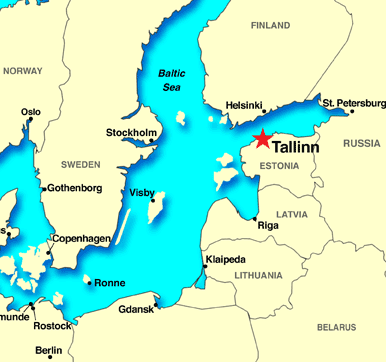
Estonian Internet users are enjoying faster broadband speeds with the announcement cable provider AS Starman has upgraded its broadband packages without a corresponding price hike. Now customers in the Baltic state can get 200/20Mbps service for less than $34 a month.

estonia

starmanThe cable operator tiers its DOCSIS 3 cable broadband speeds like clothing sizes:

  • Small (2Mbps/500kbps): $13.37/mo
  • Medium (10/2Mbps): $25.40/mo
  • Large (60/10Mbps): $30.75/mo
  • X-Large (200/20Mbps): $33.43/mo

The Tallinn-based company was founded in 1992 and offers cable television, phone, and broadband service to about 45 percent of Estonia.

[flv width=”640″ height=”380″]http://www.phillipdampier.com/video/Starman Internet service 8-26-13.mp4[/flv]

Selling broadband in Estonia isn’t much different from selling service in North America. But broadband prices are far lower than what the average customer in Canada or the U.S. pays for equivalent service. Here is a typical ad for Starman service. (1 minute)

Baltimore Let Down by Big Telecom; Considers Its Own Public Broadband Network

Baltimore City sealWaiting for Comcast and Verizon to offer cutting edge broadband to 620,000 Baltimore city residents and businesses appears to be going nowhere, so the city is hiring an Internet consultant to consider whether to sell access to its existing fiber network.

Baltimore officials spent at least a year trying to convince Google to launch its fiber network in the city only to be bypassed in favor of Kansas City, Austin, and Provo, Utah. Local unions and community groups have also attempted to embarrass the local phone company by publicly protesting Verizon’s lack of interest in expanding its fiber optic network FiOS in Baltimore. Comcast has proved a disappointment for many, with the latest technology going to other cities well before Baltimore gets improved service.

Baltimore’s Board of Estimates voted to spend $157,000 to hire Magellan Advisors to produce a cost-benefit analysis of expanding the city’s current fiber infrastructure to deliver better Internet access.

“I’m paying more here for lesser service, so I think one of the things we want to try to do is look at that, look at what [current companies] offer and try to incentivize people to offer more,” Baltimore’s chief information officer Chris Tonjes told the Baltimore Business Journal. “In the short term, we’re going to do a study. In the medium run, we’re going to try to renegotiate the cable franchise agreement. In the longer run we want to make it more profitable for providers to come in here and offer the expanded service.”

analysisLike many cities, Baltimore already owns and operates its own fiber ring, built with public funds to support the city’s public safety radio system. Like many municipal institutional fiber networks, Baltimore’s fiber ring is underutilized. Public safety and other institutional users often use just a fraction of available capacity. Despite the fact such networks are often oversized, they are rarely controversial because they do not typically compete with commercial providers and are usually off-limits to the public.

As Baltimore prepares to update their existing fiber infrastructure, Magellan will study the implications of leasing excess capacity to third-party providers that can sell broadband access to private businesses and individuals. Even Comcast and Verizon would be welcome to lease capacity.

Neither company has shown much interest, and the proposal received a strong rebuke from Maryland Sen. Catherine Pugh (D-Baltimore City):

Pugh

Pugh

For the most part, municipally-built broadband networks have the economic chips stacked against them and, where tried, have saddled local taxpayers with a mountain of debt and half-built networks that are then sold at fire-sale prices to vulture investors. Taxpayers in Provo, Utah, for instance, spent $40 million to build a relatively small and modest network only to sell it for $1 a few years later because they underestimated the massive costs of operating, upgrading and maintaining it.

But Provo is just the latest exhibit in a long pantheon of such failed initiatives that include Groton, Conn., ($38 million taxpayer loss) and Marietta, Ga., ($35 million taxpayer loss). Cities as large as Philadelphia, New York and Chicago and as small as Lompoc, Calif., and Acworth, Ga., have also tried and failed to launch their own broadband networks — or simply gave up.

Pugh’s editorial, published in both the Wall Street Journal and The Baltimore Sun, failed to disclose Pugh has received political campaign contributions from both Comcast and Verizon. More importantly, Pugh did not bother to mention she is the president-elect of the National Black Caucus of State Legislators, a group with close ties to both Comcast and Verizon Communications.

Among the “member corporations” of the NBCSL — companies who “weigh in” on the policies promoted by the group: AT&T, Comcast, CTIA – The Wireless Association, the National Cable & Telecommunications Association, Time Warner Cable, and Verizon.

Among the NBCSL's roundtable members: AT&T, Comcast, Time Warner Cable, and Verizon

Among the NBCSL’s roundtable members: AT&T, Comcast, Time Warner Cable, and Verizon

For the fourth consecutive year, Verizon hosted its Black History Month open house at the Reginald F. Lewis Museum in downtown Baltimore. This year, among Verizon’s special guests: Maryland Senator and president-elect of the National Black Caucus of State Legislators Catherine Pugh. Comcast has also opened its checkbook to the NBCSL. Among the contributions — $50,000 to form the “NBCSL/Comcast Broadband Legislative Fellowship” to “increase efforts to conduct research and develop solutions regarding broadband adoption among African Americans.”

Opening up a competitive, lower-priced broadband alternative owned by the citizens of Baltimore is not one of Pugh’s favored solutions to be sure.

The NBCSL has been more than a little preoccupied with the business agendas of its corporate members. The group’s glowing endorsement of the Comcast-NBCUniversal merger was so positive, Comcast continues to present the group’s submission urging approval of the merger on its website. In 2011, the NBCSL signed on to the campaign to get government approval of the now-dead merger of AT&T and T-Mobile USA, claiming it was in the best interests of African-Americans. Just this month, Time Warner Cable quoted the group’s comments on the dispute between the cable company and CBS on its website.

Stop the Cap! has refuted claims that public broadband is a financial failure in the past. Read our fact check here.

Although Comcast has been the dominant cable provider in Baltimore for years, its monopoly status is “de facto” only, because federal law prohibits exclusive cable franchise agreements. That being said, no other well-known cable provider will agree to offer service in competition with another. Overbuilders — small private entities that have business plans that depend on competing with incumbent operators, are few and far between. For most Americans, the only cable competition comes from satellite providers or the phone company. Satellite television lacks a broadband option and Verizon’s local broadband infrastructure is limited to providing DSL service.

Tonjes

Tonjes

Tonjes hopes the possibility of a public broadband alternative might shake up the city’s broadband landscape, but not every neighborhood is now passed by the city’s fiber ring.

Jason Hardebeck, the executive director of the Greater Baltimore Technology Council, told the Journal municipal Wi-Fi could help fill the gap.

“One of the things we’ve talked about at the GBTC is, could this form the basis of a municipal Wi-Fi network in bringing wireless access to some underserved parts of the city,” Hardebeck said. But, he added, “municipal wireless is not a slam dunk. There’s a lot of challenges depending on how deep the coverage area is.”

Pugh is presumably opposed to municipal Wi-Fi solutions for the poorest urban African-American neighborhoods in her city as well, having criticized efforts to bring municipal wireless Internet access to similar neighborhoods in Philadelphia, where Comcast’s corporate headquarters are located.

“The city is woefully underserved with broadband and my opinion is that internet access is becoming a basic public utility or need, just like clean water,” Hardebeck told the Journal. “The current administration understands the need. I don’t know what we can do about the franchise agreement, but I think there’s real opportunities from a redevelopment standpoint. If you had access to ultra-high broadband inexpensively, that could generate activity you would not have anticipated.”

AT&T’s Next Generation U-verse Broadband Going to Selected Apartments in Atlanta, Austin, Orlando

att connected communitiesAT&T and Camden Property Trust have announced an agreement to offer broadband, television, and phone services over fiber to the premises technology beginning this fall, serving new high-end apartment homes owned by the developer in Atlanta, Austin, and Orlando.

AT&T’s suggestion it will build a competing fiber network that would rival Google appears to be, for now, limited to selected, luxury multi-dwelling units participating in a strategic marketing partnership that can guarantee enough customers to make the investment in fiber optics worthwhile.

AT&T’s Connected Communities Initiative is a special program offered to large single-family homebuilders, developers, real estate investment trusts, apartment owners, property management groups and large homeowners’ associations that can deliver AT&T a virtually captive customer base in return for better-than-average service and kickbacks in the form of lucrative commissions.

Camden's Gaines Ranch in Austin, Tex.

Camden’s Gaines Ranch in Austin, Tex.

With AT&T’s latest agreement, the new Camden-managed properties will receive the next generation of U-verse High Speed Internet, U-verse TV and U-verse Voice on an all-fiber network that will deliver a level of enhanced service unavailable to most U-verse customers. Most importantly, the fiber infrastructure will let AT&T to offer faster broadband to residents without limiting their television viewing.

Most AT&T U-verse customers receive service over a hybrid fiber-copper phone wire network using a more advanced form of DSL. Fiber from the nearest AT&T central office extends into each neighborhood, but existing copper phone wiring carries the service the last several blocks into individual customer homes. The presence of copper limits the available bandwidth, which has kept AT&T’s top U-verse speeds at around 24Mbps. The only way to increase speeds is to cut the amount of copper in the network. Eliminating it completely is even better.

AT&T has been reluctant to follow Verizon’s lead deploying an all-fiber network. The cost to wire each home with fiber was too prohibitive for AT&T, but providing fiber connectivity to large apartment buildings, condos, or other multi-dwelling units has met AT&T’s cost concerns, especially when the property owner signs over exclusive rights to the buildings’ existing telecommunications infrastructure.

AT&T’s program encourages the participation of property owners with a variety of paid commissions and other compensation, including:

Exclusive Marketing Agreements: Under an AT&T Exclusive Marketing Agreement, residents may still choose their communications and entertainment services provider, but the builder, developer or property owner agrees to exclusively promote AT&T services. In doing so, AT&T provides financial incentives in the form of commissions for property owners and multiple service options for residents. In most cases, renters may have the mistaken impression they can only get service from AT&T, and are informally discouraged from considering alternative providers.

camdenBulk Contracts: An AT&T Connected Communities bulk agreement offers greater earning potential. With a single, monthly recurring bulk bill for all contracted units, developers and HOAs get below-retail pricing, increased savings on equipment costs, and other rewarding financial incentives. In most cases, building owners include AT&T services either as part of the monthly rent or billed as a mandatory services surcharge. A resident can still sign up for satellite or cable television, but has zero incentive to do so because they would be effectively paying for service twice.

Exclusive Use of Wire:  Property owners grant AT&T exclusive use of the wiring, including coaxial cable, at the property. In addition, owners agree to promote AT&T products to residents. This deters would-be competitors from providing service at a property signed up with AT&T. A cable or satellite competitor would not have access to existing wiring and have to arrange an agreement with the property owner to provision a second cable inside the building. Neither the competing provider or the property owner would have any incentive to do this, regardless of the wishes of renters.

Large properties can also contract with AT&T to provision a site-wide Wi-Fi network for the benefit of residents both around the property and at amenities like clubhouses or poolside.

While such agreements can benefit residents with bulk pricing discounts beyond what they could have obtained from AT&T themselves, it also strongly deters other providers from delivering competitive services.

[flv width=”640″ height=”380″]http://www.phillipdampier.com/video/ATT Connected Communities 9-2012.flv[/flv]

Last fall, AT&T promoted its Connected Communities program with property developers, offering them commissions and other special deals if they sign exclusive marketing agreements with the phone company. In 2013, broadband speeds for certain U-verse Internet customers will be increasing, depending on the infrastructure available. (2 minutes)

[flv width=”640″ height=”380″]http://www.phillipdampier.com/video/Camden Online Communities 8-13.flv[/flv]

Camden Properties emphasizes the online services available to residents, particularly those that promote social interaction. In some cases, those services will now be powered by AT&T U-verse. (1 minute)


Lawrence, Kansas Finally Has Cap-Free Broadband (No Thanks to Sunflower/Knology)

Phillip Dampier August 12, 2013 Broadband "Shortage", Broadband Speed, Competition, Data Caps, WOW! Comments Off on Lawrence, Kansas Finally Has Cap-Free Broadband (No Thanks to Sunflower/Knology)
Worst

Worst

Broadband customers in Lawrence, Kan. have been liberated from Internet Overcharging schemes after years of usage-capped Internet access from Sunflower Broadband and Knology.

WideOpenWest’s (better known as WOW!) acquisition of Knology, which in turn purchased Sunflower Broadband from the local newspaper, means usage limits are a thing of the past.

Consumer Reports has top-rated WOW! for customer friendly service, and banishing usage caps is an example of why the cable company earns such high marks.

The company reminds customers that “all WOW! Internet speeds have no usage caps.”

Sunflower Broadband originally offered four different broadband plans, only one without usage caps. Lawrence customers did get speed upgrades faster than many other cable broadband customers, but most were accompanied with draconian usage limits.

Bad

Bad

Bronze: Originally offering 3Mbps/256kbps service, Sunflower’s “lite” usage plan included a 3GB monthly usage limit boosted by Knology in 2012 to $22.95/month offering 3/1Mbps service and a still ridiculously low 5GB usage limit. WOW! has kept the lite plan but removed the usage cap.

Silver: Sunflower’s equivalent of Standard Internet service offered 10/1Mbps broadband with a 50GB usage cap. Knology raised the price to $37.95, left the 50GB cap intact and increased speeds to 18/2Mbps. WOW! dropped the cap.

Gold: Sunflower’s premium 50/1Mbps service offered 250GB of usage for under $60 a month. When Knology took over, speeds were boosted to 50/5Mbps along with the price: $62.95 a month. But the usage cap stayed the same. Today WOW! continues the plan without any caps.

Better

Much Better

Palladium: Sunflower responded to customer complaints about metering Internet usage by offering residents a trade — an unlimited use plan with no speed promises. Palladium could be as slow as 2Mbps during peak usage, 25Mbps when traffic was very low. Knology kept the plan and its 1Mbps upload rate, but raised the price to $47.95 a month. WOW! dumped Palladium altogether, replacing it with a 30/2Mbps unlimited use plan for customers who don’t want to pay $63 a month for the Gold plan.

A number of Lawrence customers annoyed with Sunflower and Knology switched to AT&T U-verse when it was introduced locally. Although U-verse has a 250GB usage cap, Lawrence residents report it remains unenforced.

Stop the Cap! reader Mike, who shared the news WOW! had recently shelved the caps, tells us he switched to AT&T years ago and is happy with their service.

“So far, their cap is not enforced at all here,” Mike writes. “The minute they start enforcing it, I’ll switch to WOW!”

Time Warner Cable Quietly Delivers Nationwide Incremental Internet Speed Upgrade

twcTime Warner Cable broadband customers who briefly unplug their modems to reset them will discover slightly improved download and upload speeds from the cable company.
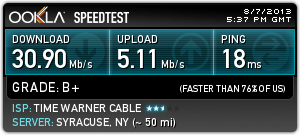
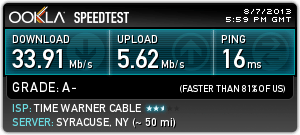

Multiple customers from around the country have reported to Stop the Cap! Internet speeds have been over-provisioned by at least 10 percent as of this week and the PowerBoost feature that delivered a short burst of faster speed during the first few seconds of a download appears to be discontinued.

Before

Before

On average customers can expect the following speeds:

  • Standard (was 15/1Mbps) is now 16.5/1.2Mbps
  • Turbo (was 20/2Mbps) is now 22/2.2Mbps
  • Extreme (was 30/5Mbps) is now 34/5.6Mbps
  • Ultimate (was 50/5Mbps) is now 55/5.6Mbps

We have also heard from four different customers that Time Warner Cable has started providing a DOCSIS 3 modem for Turbo customers, which means those considering Turbo service and planning to buy their own modem will best be served choosing a DOCSIS 3 compatible unit. We continue to highly recommend the Motorola SB6141.

After

After

We do not expect Time Warner Cable to advertise the speed increases. They are likely a result of the discontinuation of the PowerBoost feature which was first offered to Time Warner Cable customers in New York City in 2008 and became available nationwide a year later for Standard and Turbo tier customers.

The Federal Communications Commission’s ongoing verification of the nation’s largest ISPs advertised speeds would have registered a broad-based speed decline had Time Warner simply discontinued the temporary speed boost technology. PowerBoost does affect speed test results because it provides a temporary speed bump during the download speed verification process. By “over-provisioning” customers’ broadband speeds, the company can compensate for the change and likely even see an improvement of its speed ranking by the FCC’s testing program.

Time Warner Cable increased broadband rates by $3.00 this summer and raised its monthly modem rental fee to $5.99 this month.

Search This Site:

Contributions:

Recent Comments:

Your Account:

Stop the Cap!