
Home » Broadband Speed » Recent Articles:

Former FCC Chairman Turned Lobbyist Warns Providers to Hurry Usage Caps & Billing Before It’s Too Late

Powell

Powell

A former chairman of the Federal Communications Commission turned top cable lobbyist rang the warning bell at an industry convention this week, recommending America’s cable operators hurry out usage caps and usage-based billing before a perception takes hold the industry is trying to protect cable television revenue.

Michael Powell, the former head of the FCC during the Bush Administration is now America’s top cable industry lobbyist, serving as president and CEO of the National Cable & Telecommunications Association (NCTA). From 2001-2005 Powell claimed to represent the interests of the American people. From 2011 on, he represents the interests of Comcast, Time Warner Cable, Cox, and other large cable operators.

Attending the SCTE Cable-Tec Expo 2013 in Atlanta, Powell identified the cable industry’s top priority for next year: “broadband, broadband, and broadband.”

The NCTA fears the current unregulated “Wild West” nature of broadband service is ripe for regulatory checks and balances. The NCTA plans to prioritize lobbying to prevent the implementation of consumer protection regulations governing the Internet. Powell warned it would be “World War III” if the FCC moved to oversee broadband by changing its definition as an unregulated “information service” to a regulated common carrier utility.

Powell is very familiar with the FCC’s current definition because he presided over the agency when it contemplated the current framework as it applies to DSL and cable broadband providers.

While Powell has a long record opposing blatant Net Neutrality violations that block competing websites and services, he does not want the FCC meddling in how providers charge or provision access.

Powell believes some of cable's biggest problems come from bad marketing.

Powell believes some of cable’s biggest problems come from bad marketing.

Powell disagreed with statements from some Wall Street analysts like Craig Moffett who earlier predicted the window for broadband usage-based limits and fees was closing or closed already.

Powell does not care that consumers are accustomed to and overwhelmingly support unlimited access. Instead, he urged cable executives to “move with some urgency and purpose” to implement usage-based billing for economic reasons, despite the growing perception such limits are designed to protect cable television service from online competition.

“I don’t think it’s too late,” Powell said. “But it’s not something you can wait for forever.”

Powell pointed to the success wireless carriers have had forcing the majority of customers to usage capped, consumption billing plans and believes the cable industry can do the same.

The NCTA president also described many of the industry’s hurdles as marketing and perception problems.

The cable industry, long bottom-rated by consumers in satisfaction surveys, can do better according to Powell, by making sure they are nimble enough to meet competition head-on.

Powell described Google Fiber as a limited experiment unlikely to directly compete with cable over the long-term, and with a new version of the DOCSIS cable broadband platform on the way, operators will be able to compete with speeds of 500-1,000Mbps and beyond. He just hates that it’s called DOCSIS 3.1, noting it wasn’t “consumer-friendly” in “a 4G and 5G world.”

Kevin Hart, executive vice president and chief technology officer of Cox Communications joked the marketing department would get right on it.

Cox Speed Boosts Come With Free Cloud Storage That Eats Your Data Allowance

Phillip Dampier October 22, 2013 Broadband Speed, Consumer News, Cox, Data Caps 2 Comments

coxCox Communications today officially unveiled broadband speed increases along with free cloud storage without adjusting data plan usage allowances for customers who take advantage of the service enhancements.


“Our customers tell us that their overall online experience is becoming increasingly important to them,” said Betty Jo Roberts, vice president of marketing for Cox Virginia. “Speed, access, safety and storage are key components of their communications and entertainment needs. Free cloud storage presents an especially significant value, as most similar services are fee-based.”

Internet Tier/Allowance
Current Speeds Download/Upload New SpeedsDownload/Upload Free Cloud Storage
Essential – 100GB 3 Mbps / 768 Kbps

5 Mbps / 1 Mbps 1 GB
Preferred* – 250GB 25 Mbps / 2 Mbps 25 Mbps / 5 Mbps 5 GB
Premier D2* – 250GBWith DOCSIS 2.0 device 25 Mbps/3 Mbps No change 50 GB
Premier D3* – 250GB 30 Mbps/6 Mbps 50 Mbps / 10 Mbps 50 GB
Premier Plus – 250GB 60 Mbps/12 Mbps 75 Mbps/15 Mbps 50 GB
Ultimate – 400GB 100 Mbps / 20 Mbps No change Unlimited

*A DOCSIS 3 modem is required to consistently receive optimal speeds for Preferred and higher tiers.

cox speed

Using cloud storage regularly and taking the new speeds for a hard run could drive customers perilously close to their monthly usage allowance. Cox Ultimate customers get unlimited cloud storage but not unlimited broadband usage. While Cox does not currently charge any overlimit fees, the company does reserve the right to request heavy users upgrade to a plan with a higher allowance, reduce usage, or face account termination.

Although Cox touted the speed upgrades as coming at no charge, the cable company is busy hiking rates for certain broadband tiers. Customers report the popular Premier tier has increased from $55.99 to $62.99 in some markets and as high as $73.99 in Phoenix.

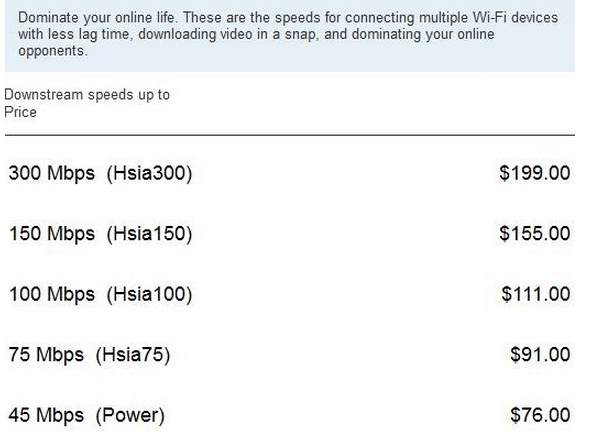
Accidentally Leaked U-verse Pricing No Bargain: 45Mbps $76, 300Mbps $199

Phillip Dampier October 21, 2013 AT&T, Broadband Speed, Competition, Consumer News, Google Fiber & Wireless Comments Off on Accidentally Leaked U-verse Pricing No Bargain: 45Mbps $76, 300Mbps $199

An enterprising reader of the Broadband ReportsAT&T Forum stumbled on proposed pricing for AT&T’s faster speed services for U-verse and, presumably, their planned fiber-to-the-home rollout in Austin, Tex.:

UVerse

The prices are no bargain in comparison to the $70 a month Google charges Kansas City residents for 1,000/1,000Mbps service, but on the lower end, AT&T’s 45Mbps U-verse option is comparable to Time Warner Cable’s 50/5Mbps tier, which now sells for $65-75 a month on a one-year promotion:

twc speed

Time Warner Cable’s latest broadband offers

DOCSIS 3.1 Standard Ready to Go; Up to 10/1Gbps Speeds Possible from Cable Providers

Phillip Dampier October 21, 2013 Broadband Speed, Comcast/Xfinity, Competition, Video 3 Comments

cable-labs-logoJust a few years after cable systems began upgrading to DOCSIS 3.0 to improve broadband speeds and performance through channel bonding, CableLabs is set to formalize next-generation DOCSIS 3.1 by the end of this month, allowing cable broadband speeds to reach well into the gigabits.


“We made a fairly bold assertion in October of last year that we would have them substantially complete and publicly issued by the end of 2013,” Matt Schmitt, director of DOCSIS at CableLabs said this morning. “This is quite a bit faster than we have ever pulled off before. It’s not a small project to do a new DOCSIS with a new physical layer underneath. It was an industry-wide effort and I tell you what, they’ve been busting their tails.”

Schmitt

Schmitt

Schmitt discussed the new standard at the DOCSIS 3.1 Engineering Pre-conference Symposium held in Atlanta.

The new standard for cable broadband was designed to protect the industry from competing technologies — notably fiber to the home service which offers immediate gigabit broadband capacity. DOCSIS 3.1 was designed to support up to 10/1Gbps speeds using larger spectrum bands cable operators are opening for data services after switching off analog cable television channels.

Cable operators are not expected to offer gigabit broadband service in most areas. Many operators still dedicate the largest amount of their available bandwidth to analog cable television channels. But DOCSIS 3.1 provides scalability as operators move towards digital television delivery. It also offers 50 percent more data capacity over DOCSIS 3.0 over the same spectrum.

DOCSIS 3.1 uses a new modulation scheme coupled with more robust forward error correction (FEC) to improve efficiency and performance. The new standard dumps Reed-Solomon FEC in favor of low-density parity check (LDPC) technology. DOCSIS 3.1 relies on orthogonal frequency division multiplexing (OFDM), also used by wireless carriers to boost performance over limited spectrum.

Despite the new standard, DOCSIS 3.1 will be fully backwards-compatible with DOCSIS 3.0, which means customers buying their own cable modems will not find them obsolete anytime soon. When a customer decides they want faster broadband speeds, the cable operator can advise if a new DOCSIS 3.1 modem is needed. In most cases, it will not.

Most cable operators are expected to take at least a year lab testing the new technology and waiting for vendors to incorporate support for DOCSIS 3.1 in future generations of cable broadband equipment.

Comcast, one of the more speed-aggressive cable operators likely to be an early adopter of DOCSIS 3.1, indicated it would probably be 2015 before customers can buy DOCSIS 3.1-powered products. But Comcast will begin trials next year, according to Jorge Salinger, vice president of access architecture.

Time Warner Cable plans to use the next generation of DOCSIS as they migrate from conventional MPEG-based video delivery to IP video transport on a Converged Cable Access Platform (CCAP). But Time Warner Cable customers don’t usually get the fastest possible broadband speeds. For most of the country, the cable operator’s top speed is 50/5Mbps.

[flv width=”640″ height=”380″]http://www.phillipdampier.com/video/Speaker Interview with Ralph Brown of Cable Labs at Cable Congress 2013 in London 3-11-13.mp4[/flv]

Ralph Brown, chief technology officer of CableLabs, talked about DOCSIS 3.1 and the cable industry’s future technology needs in this interview from March 2013. (5 minutes)

While You Muddle Along With DSL, Azerbaijan Announces Fiber to the Home 100Mbps Service

azerbaijanAzerbaijan, a former Soviet Republic in the Caucuses, is getting fiber to the home service and a nationwide speed guarantee of 10-100Mbps for all 9.3 million Azeris, no matter where they live in the country.


Most large cities will be scheduled for fiber to the home service, as part of successive annual budgets planned for telecommunications upgrades. The government has spent $182 million on telecom services so far this year, according to the Ministry of Telecommunications and Information Technologies.

From January to September, 673.3 kilometers of fiber optic cables were laid, primarily by Aztelekom, the country’s largest telecom provider. Much of the initial spending is for upgrades to the Azerbaijani telephone system, a combination or wired and wireless services.

The ministry plans to provide all areas of Azerbaijan with fiber speed Internet access by 2017. At present, 70 percent of Azerbaijan’s population uses the Internet and 50 percent have the service at home.

Officials claim the goal of the fiber project is to deliver blanket broadband coverage to the entire country, with speeds at least 100Mbps by 2017.

Azerbaijan sees fiber broadband as a critical part of the country’s development to meet the economic challenges of the digital economy. The government considers traditional telephone based DSL and cable modem technology wholly inadequate to the task. Presently, ADSL is the most common technology in Azerbaijan, but is limited to 2-8Mbps — performance now deemed obsolete and unacceptable by the ministry.

Aztelekom is Azerbaijan's largest communications provider.

Azerbaijan’s largest ISP

The World Economic Forum’s report “Global Information Technology 2013″ ranked Azerbaijan 56th on the Networked Readiness Index among 144 world countries even before the fiber service is constructed. The U.S. is ranked 9th, Canada is ranked 12th.

Azerbaijan’s aggressive deployment of fiber optics has won recognition from the World Economic Forum for laying the foundation for much higher rankings in the future.

Much of the funding for the project comes from the Azerbaijani State Oil Fund, a special purpose state organization dedicated to sharing revenues from oil and gas production with the Azeri people through investments in social-economically important projects. Oil wealth is considered a national resource, not a windfall for oil industry executives and shareholders. The fund has helped build housing for persons displaced in the Armenian-Azerbaijan conflict over the disputed Nagorno-Karabakh region, construct potable water systems, and finance public transportation and telecommunications projects.

Azerbaijan plans to manufacture its own fiber cables for the project inside the country in a joint venture with an Austrian firm.

[flv width=”480″ height=”380”]http://www.phillipdampier.com/video/Azerbaijani ICT.mp4[/flv]

The Azerbaijan Ministry of Telecommunications and Information Technologies produced this English language introduction to telecom services and broadband (collectively called ‘ICT’) in the country.  “CIS” refers to the Commonwealth of Independent States, which includes many of the republics constituting the former U.S.S.R., as well as Russia itself.  (7 minutes)

Search This Site:

Contributions:

Recent Comments:

Your Account:

Stop the Cap!